
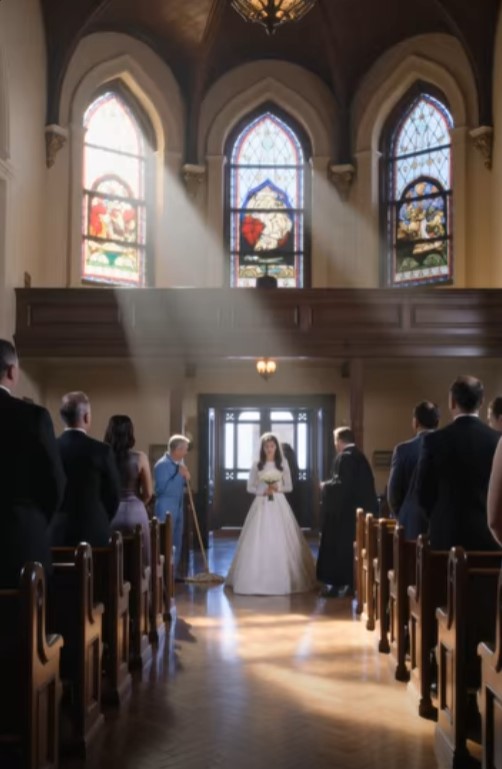
The entire church had risen to its feet.
Every pew was full. Guests leaned into the aisle with phones ready. The organ music swelled through the tall white chapel, soft and grand, the kind of sound that makes people hold their breath without realizing it.
At the front of the church, the groom stood waiting in his black suit, smiling nervously. Beside him, the priest held his Bible open. The candles flickered gently. Flowers covered the altar. Everything had been planned for months.
It was supposed to be perfect.
Then the bride appeared.
She stepped through the church doors in a long white gown, her veil falling over her shoulders like mist. Her father held her arm carefully, trying not to cry. The guests smiled as she began the slow walk toward the man she was about to marry.
But halfway down the aisle, she stopped.
At first, people thought she had stumbled.
Her father whispered something to her, but she did not answer. Her eyes were fixed on something behind the guests, near the back corner of the church.
The music continued for a few seconds longer before the organist noticed the bride was no longer moving. The sound faded awkwardly. A strange silence settled over the room.
The groom’s smile disappeared.
Everyone turned to see what she was staring at.
Near the back wall, almost hidden beside a row of stacked chairs, stood an elderly janitor holding a mop. He had been quietly cleaning a small spill near the entrance, trying not to disturb the ceremony. His gray hair was thin. His uniform was faded. His hands trembled slightly around the mop handle.
Most guests had not noticed him at all.
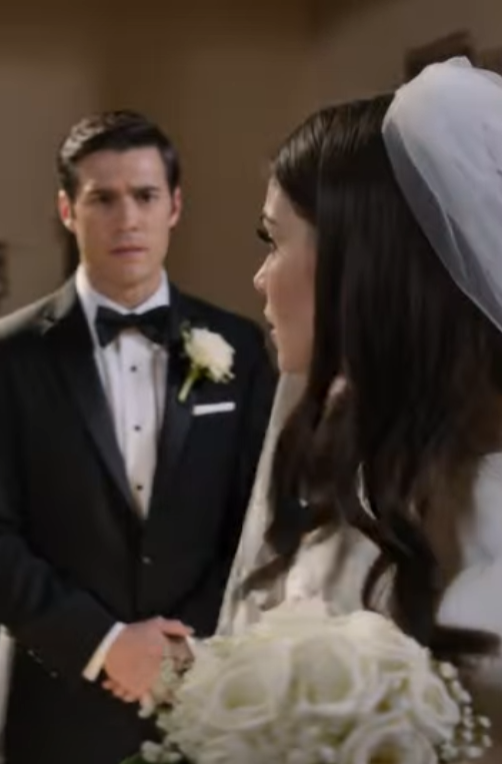
But the bride had.
Her face changed.
The nervous wedding smile vanished. In its place came something deeper, something stunned and fragile, as if she had just seen a ghost from a life she thought was gone forever.
Her father tightened his grip on her arm.
“Sweetheart?” he whispered.
But the bride gently pulled away.
The entire church watched as she turned around and began walking away from the altar.
A murmur spread through the pews.
The groom stepped forward, confused and pale.
“Emily?” he called.
She did not stop.
Her dress brushed against the aisle runner as she walked toward the back of the church, past rows of shocked guests, past whispers, past raised eyebrows and frozen smiles.
Some people thought she had changed her mind. Others thought she was having a panic attack. A few guests glanced at the groom with pity, already imagining the scandal that would follow.
But Emily was not running from her wedding.
She was walking toward the man who had once saved her life.
The old janitor lowered his eyes as she approached, embarrassed by the attention. He looked as if he wanted to step aside, to disappear, to return to being invisible.
But Emily stopped directly in front of him.
For a moment, neither of them spoke.
Then she smiled through trembling lips.
The old man looked up.
The mop slipped from his hand and clattered softly against the floor.
Emily reached out and wrapped her arms around him.

The church fell completely silent.
The janitor froze at first, as if he could not understand why a bride in a white gown was hugging him in the middle of her own wedding. Then his shoulders began to shake. His weathered hands rose slowly and rested against her back.
And then he started to cry.
Not quietly.
Not politely.
He cried like a man who had been carrying a wound for twenty years and had finally been touched in the place it hurt most.
The priest lowered his Bible.
The groom stood speechless at the altar.
Guests who had been whispering moments earlier now watched with wide eyes, unsure whether they were witnessing a breakdown or a miracle.
Emily pulled back gently, still holding the old man’s arms.
“I knew it was you,” she whispered.
The janitor stared at her, confused and broken.
“My dear,” he said softly, “I don’t understand.”
Emily reached into her bouquet.
The room seemed to hold its breath.
Between the white roses and baby’s breath, she pulled out a small faded photograph. It was worn at the edges, creased down the middle, and clearly old enough to have been handled hundreds of times.
She held it up for the janitor to see.
His face went pale.
In the photograph, a much younger man stood beside a burned-out car on the side of a dark road. His clothes were covered in soot. In his arms was a little girl wrapped in a blanket, her face hidden against his shoulder.
The old janitor reached for the picture with trembling fingers.
The second he touched it, his knees weakened.
He collapsed into the nearest pew.
Several guests gasped.
Emily knelt in front of him, still in her wedding dress, still holding the bouquet, still ignoring every stunned face around her.
The janitor stared at the photograph as tears rolled down his cheeks.
“I thought you were gone forever,” he whispered.
The words moved through the church like a wave.
Emily covered her mouth as her own tears finally spilled over.
Twenty years earlier, when she was only six years old, her family had been involved in a terrible accident on a rainy night. The car had gone off the road. Smoke filled the air. Flames spread fast. People nearby panicked, afraid to get too close.
But one man ran toward the wreck.
He had not been a firefighter. He had not been a police officer. He had not been anyone important in the eyes of the world.
He was a maintenance worker on his way home from a late shift.
He smashed the car window with a tire iron, cut his hands pulling away broken glass, and reached into the smoke until he found the little girl trapped inside. He carried her out seconds before the flames swallowed the back seat.
By the time emergency crews arrived, the man was gone.
He had vanished into the night before anyone could properly thank him.
For years, Emily’s family searched for him. They had only one photograph taken by a bystander and one name that may or may not have been correct. As Emily grew up, the memory became part of her life. She kept the photograph in a box beside her bed, then in a drawer at college, then finally tucked inside her wedding bouquet.
She had always said that if she ever found the man who saved her, she would thank him properly.
She never imagined it would happen on her wedding day.
The old janitor looked at her as if he were seeing the little girl and the bride at the same time.
“You were so small,” he said. “You weren’t breathing right. I thought I was too late.”
Emily shook her head.
“You weren’t too late,” she said. “You gave me my whole life.”
The groom slowly walked down the aisle.
For a moment, some guests worried he might be angry. After all, his bride had stopped the ceremony, left him at the altar, and embraced another man in front of everyone.
But when he reached them, his eyes were wet too.
He knelt beside Emily and looked at the janitor.
“Then I owe you as much as she does,” he said. “Because without you, I never would have met my wife.”
That was the moment the church changed.
The tension disappeared.
Guests began wiping their eyes. Emily’s father stood in the aisle with one hand over his mouth, no longer trying to hide his tears. The priest bowed his head. Even the organist, who had seen dozens of emotional weddings, sat frozen at the keys.
The old janitor tried to stand, embarrassed by all the attention.
“I shouldn’t be here,” he said. “This is your day.”
Emily held his hand firmly.
“You are exactly where you’re supposed to be.”
Then she turned toward the priest and the guests.
Her voice shook, but it carried through the church.
“This man saved my life when I was a child. I spent years wondering who he was. I carried his photograph with me today because I wanted him here in spirit. I didn’t know he would actually be standing in the back of this church.”
Nobody moved.
Emily looked back at the janitor.
“I walked down this aisle because of you,” she said. “I got to grow up because of you. I got to fall in love because of you. And I will not get married without thanking you first.”
The janitor bowed his head as if the words were too heavy for him to hold.
He had spent years believing nobody remembered what he had done. He had lived quietly, working late shifts, cleaning floors after people who rarely looked at his face. He had never called himself a hero. He had never asked for recognition.
But in that church, in front of hundreds of people, the little girl he saved stood before him as a bride.
And suddenly, the invisible man became the most important person in the room.
Emily made one more request.
She asked him to walk her the rest of the way down the aisle.
Her father stepped forward first. For one brief second, the church held its breath again. But he smiled through tears and nodded.
“I’d be honored to share that walk,” he said.
So the bride stood between the two men who had given her life in different ways.
Her father on one side.
The janitor on the other.
Together, they walked her toward the altar.
This time, nobody whispered. Nobody questioned her. Nobody wondered whether the wedding had been ruined.
They understood now.
The ceremony had not been interrupted.
It had been completed.
When Emily finally reached the groom, the old janitor tried to step away, but the groom held out his hand. The two men shook hands for a long moment.
The priest waited until everyone was still.
Then he looked at the bride, the groom, the father, and the old man wiping his eyes in the front pew.
“Some love stories,” he said quietly, “begin long before the wedding day.”
The ceremony continued.
But nobody remembered the flowers.
Nobody talked about the cake.
Nobody cared about the expensive dress, the perfect music, or the carefully planned schedule.
What people remembered was the moment a bride stopped her own wedding, turned away from the altar, and walked toward a janitor everyone else had ignored.
They remembered the faded photograph hidden in her bouquet.
They remembered the old man whispering, “I thought you were gone forever.”
Most of all, they remembered the truth that filled the church that day.
Sometimes the person who changes your life is not standing under the spotlight.
Sometimes he is standing quietly in the back, holding a mop, believing the world has forgotten him.
And sometimes, twenty years later, love stops everything just to say thank you.