
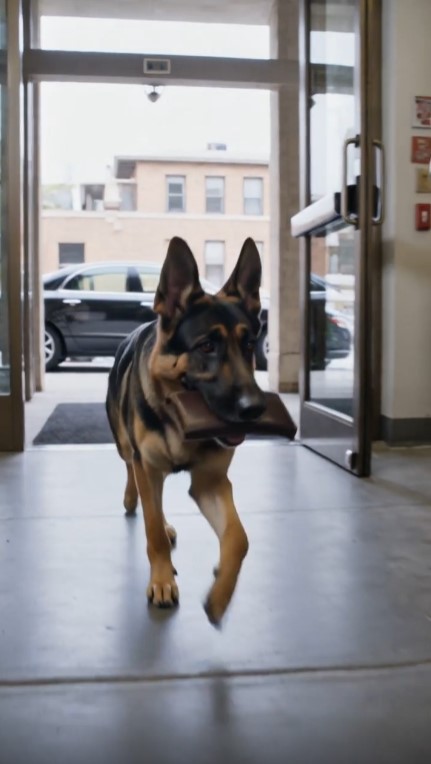
For three mornings in a row, the same German Shepherd walked into the local police station carrying a wallet in his mouth.
He would approach the front desk, gently place it on the floor, then turn around and leave.
The first morning, the officers laughed.
They assumed the dog had found someone’s lost property and somehow wandered inside with it.
The second morning, he returned with the same wallet.
This time, the officers became curious.
But on the third morning, one of them finally decided to look inside.
There was no money.
No credit cards.
No driver’s license.
Just one photograph of a little girl and an old hospital bracelet.
The German Shepherd stood near the desk watching closely.
As soon as the officer opened the wallet, the dog began whining.
Then he suddenly ran toward the station doors.
Something about his behavior felt different.
The officer followed.
The Shepherd moved quickly through town, checking behind him every few seconds as if making sure the officer was still there.
He led him for six blocks.
Then he stopped outside an abandoned-looking apartment building.
The dog scratched urgently at the entrance.
Inside, the hallway was quiet.
A half-open door stood near the end.
Behind it, the officer found an elderly man sitting on the floor.
He was conscious.
But he was weak and unable to stand.
The officer immediately called for paramedics.
Then he noticed something.
The wallet the dog had been carrying belonged to the man.
But the German Shepherd did not.
The elderly man explained that the dog was a stray.
For months, he had been feeding him every evening from his front step.
The dog would appear around the same time each day.
The old man would bring out food.
Sometimes he would sit there while the Shepherd ate.
There was no leash.
No collar.
No official adoption.
Just a quiet routine between two living beings who had become used to seeing each other.
Then the elderly man became too weak to go outside.
One evening passed.
Then another.
The dog kept returning.
But the man never appeared.
At some point, the Shepherd found a way inside through an open window.
He discovered the man on the floor.
The dog could not call for help.
He could not explain what had happened.
He did not understand emergency numbers or addresses.
So he found something that belonged to the man.
The wallet.
Then he carried it through town.
Somehow, he chose the police station.
The first time, nobody understood.
So he came back.
The second time, they still did not understand.
So he returned again.
On the third morning, someone finally followed him.
When paramedics arrived, they helped the elderly man outside.
The German Shepherd remained nearby.
The old man looked toward him.
“You figured it out, didn’t you?”
The dog sat beside him.
The officer looked down at the empty wallet.
The animal could not possibly have understood what identification was.
He did not know why humans carried wallets.
He did not know what police officers did.
But he knew one thing.
The object belonged to the man who had fed him every evening.
And that man had stopped coming outside.
So the dog carried the only clue he could find to a place filled with people.
Again.
And again.
Until somebody finally listened.
The elderly man was taken for medical care.
And the stray German Shepherd who had spent months waiting on his front step was no longer treated like just another dog wandering the neighborhood.
Because sometimes heroes do not understand the system.
They do not know the right words.
They do not know who to call.
They simply keep bringing the clue back until a human finally understands what they are trying to say.