Twelve-year-old Emma thought Walter was simply the retired runner who had become the grandfather figure she never expected to find. But when an old school trophy revealed a message from Walter’s missing brother, the family relay became the beginning of a reunion more than fifty years overdue.
Everyone laughed when the 82-year-old man stepped onto the school running track.
He wore old sneakers.
Gray sweatpants.
And race number 17.
A teacher approached him carefully.
“Sir, the family race is about to start.”
The old man smiled.
“I know.”
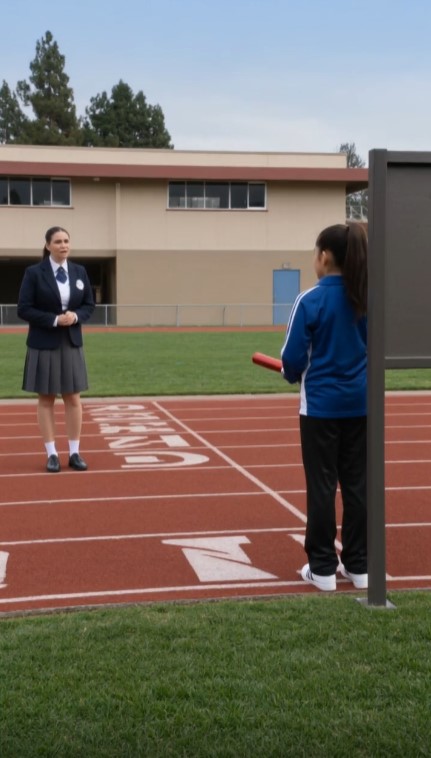
Then twelve-year-old Emma appeared beside him.
She took his hand.
“He’s running with me.”
The laughter stopped.
Emma was the only student whose parent hadn’t shown up.
Her mother was working a double shift.
Her father had not been part of her life for years.
But Emma had not come alone.
She had Walter.
Every afternoon on her walk home from school, Emma passed a retirement community.
At first, Walter was simply the elderly man who sat on the same bench outside.
They barely spoke.
Then one afternoon, Emma dropped her running shoes while digging through her backpack.
Walter noticed.
“You run?”
“A little.”
“What distance?”
Emma shrugged.
“Whatever Coach tells me.”
Walter smiled.
“That means you don’t know yet.”
The next afternoon, Emma saw him again.
This time he asked how practice went.
Then again the next day.
Slowly, she learned that Walter had once been a competitive runner.
Not famous.
Not professional.
But very good.
He had won races when he was young and continued running for decades afterward.
His knees had eventually slowed him down.
His love of the sport hadn’t.
So Walter began coaching Emma from his bench.
He taught her how to breathe.
How to pace herself.
How not to waste energy watching the runner beside her.
But the sentence Emma remembered most was:
“Don’t race the person beside you. Race the version of yourself that wants to quit.”
Emma wrote it inside her school notebook.
She repeated it during difficult practices.
And when the school announced its annual family relay, Emma went directly to Walter.
“Can family be someone you choose?”
Walter looked at her for several seconds.
Then smiled.
“I think sometimes they’re the people who choose you back.”
So now, at eighty-two years old, Walter Bennett stood on a school track wearing race number 17.
Beside a twelve-year-old girl who had asked him to be family for one afternoon.
The starting whistle blew.
Emma ran the first section.
Fast.
Controlled.
Exactly the way Walter had taught her.
She reached the exchange zone and placed the baton into his hand.
“Your turn!”
Walter started.
Slowly.
The crowd began cheering.
Some students who had laughed earlier were now standing.
Walter’s steps were short.
Careful.
But steady.
Emma jogged along the inside of the track, shouting encouragement.
“Don’t race them, Walter!”
He laughed.
“I know my own advice!”
Then, halfway around the track, Walter suddenly stopped.
Emma’s smile disappeared.
She ran toward him.
“Walter?”
He wasn’t hurt.
He wasn’t holding his chest.
He wasn’t struggling to breathe.
He was staring at the electronic scoreboard near the bleachers.
Displayed beside the modern school records was an old black-and-white photograph from the school archives.
A teenage boy in running shorts stood holding a trophy.
Beneath it were the words:
FIRST TRACK CHAMPION — 1961
WALTER BENNETT
Emma stared.
“That’s you?”
Walter smiled faintly.
“I went to school here.”
“You never told me.”
“You never asked.”
The principal had overheard them.
He turned sharply.
“Walter Bennett?”
Walter nodded.
The principal’s expression changed.
“Wait here.”
He hurried toward the school building.
Minutes later, he returned carrying an old wooden trophy.
The varnish was cracked.
The engraved plate had faded.
But Walter recognized it immediately.
He touched the front.
“That was mine.”
The principal nodded.
“It’s been in our archive storage for decades.”
Walter looked confused.
“Why?”
The principal turned the trophy over.
Taped beneath the base was an envelope.
Yellowed with age.
Across the front were the words:
DO NOT OPEN UNTIL WALTER RETURNS.
Walter’s smile disappeared.
His hands began shaking.
“Who wrote that?”
The principal handed him the envelope.
Walter knew the handwriting before he even touched it.
“James.”
Emma looked up.
“Who’s James?”
Walter swallowed.
“My brother.”
The brother who had disappeared more than fifty years earlier.
Walter had been sixteen.
James was nineteen.
They had grown up in the same small house with very little money and very big plans.
Walter wanted to run.
James wanted to become a teacher.
Then one summer, after a terrible argument with their father, James left.
He said he would be gone for a few days.
He never came home.
The family searched.
Police reports were made.
Letters were sent to relatives.
Nothing.
Years passed.
Walter eventually stopped expecting his brother to return.
Their parents died without knowing what happened to him.
Walter married.
Had children.
Lost his wife.
Grew old.
But he never stopped wondering.
Now he opened the envelope.
Inside was one small piece of paper.
Six words.
“I never left. Ask Coach Miller.”
Walter read them twice.
Emma frowned.
“Who’s Coach Miller?”
Walter slowly looked toward the bleachers.
An extremely old man sat in a wheelchair near the top row.
Someone was helping him stand.
Walter dropped the relay baton.
“Coach?”
The old man raised one hand.
His name was Arthur Miller.
He had coached Walter more than sixty years earlier.
Walter had assumed Arthur died decades ago.
Instead, the former coach had returned to town only recently to live with his daughter.
Emma helped Walter toward the bleachers.
The crowd no longer cared about the relay.
Arthur looked at Walter.
“You got old.”
Walter stared at him.
“So did you.”
Arthur smiled.
“Fair.”
Then Walter’s expression hardened.
“What did James mean?”
Arthur stopped smiling.
“Sit down.”
Walter didn’t.
“Where is my brother?”
Arthur looked around at the watching students.
Then at Emma.
“This isn’t the story I wanted to tell you in front of a crowd.”
Walter answered:
“I’ve waited fifty years. Tell me.”
Arthur nodded.
James had never planned to abandon his family.
The night he left home, he came to Arthur.
He was frightened.
Not because of the argument with his father.
Because he had learned something he wasn’t supposed to know.
Walter’s father had borrowed money from dangerous people after the family business began failing.
James discovered the debt.
Worse, he discovered those men were threatening the family.
James believed his presence was making the situation more dangerous because he had confronted them.
So Arthur helped him leave town temporarily.
Walter stared.
“Temporarily?”
“That was the plan.”
James moved to another state.
Arthur expected him home within weeks.
Then their father ordered Arthur never to tell Walter where James had gone.
“He thought he was protecting you.”
Walter’s eyes filled with anger.
“He let me think my brother abandoned me.”
Arthur nodded sadly.
“Yes.”
James wrote letters.
Their father intercepted several.
Arthur kept one.
The envelope under the trophy.
Walter looked down.
“Why didn’t you tell me after Dad died?”
Arthur’s eyes filled.
“Because by then James had made me another promise.”
Walter became still.
“What promise?”
Arthur looked toward the far end of the track.
“He wanted to come back himself.”
Emma followed his gaze.
A man was standing beneath the old scoreboard.
Much younger than Walter.
Maybe sixty.
Walter frowned.
“That’s not James.”
Arthur shook his head.
“No.”
The man started walking toward them.
“He’s James’s son.”
Walter stopped breathing.
The stranger approached slowly.
“My name is David Bennett.”
Walter stared at him.
“You’re my nephew?”
David nodded.
Walter’s voice shook.
“Where is James?”
David looked down.
“My father died three years ago.”
Walter closed his eyes.
For a moment, nobody moved.
Emma quietly took his hand.
Walter whispered:
“So I missed him.”
David shook his head.
“No. He missed you too.”
Then he removed a thick bundle of letters from his coat.
“He wrote to you for fifty years.”
Walter stared.
There were dozens.
Some unopened.
Some worn.
Different envelopes.
Different decades.
All carrying his name.
David explained.
James eventually built a life.
He became a teacher.
Married.
Had a son.
But shame grew with every passing year.
He had left to protect his family.
Then stayed away because he no longer knew how to explain why he had been gone so long.
He tried returning several times.
Once when Walter graduated.
Once after Walter’s wedding.
Once when their mother died.
Each time, he reached town.
Each time, he lost his nerve.
Walter looked at Arthur.
“You knew?”
“Some of it.”
“Why didn’t you force him to see me?”
Arthur answered quietly:
“I tried.”
Walter turned away.
He was angry.
At his father.
At James.
At Arthur.
At fifty years that could never be returned.
David didn’t ask him to forgive anyone.
Instead, he handed Walter one final letter.
“This was Dad’s last.”
Walter opened it.
The handwriting was shaky.
Walter,
I spent my whole life waiting until I had a good enough explanation.
There isn’t one.
I was afraid at nineteen.
Then ashamed at twenty-nine.
Then stubborn at thirty-nine.
By the time I became brave enough to come home, I had already made absence into a habit.
Walter stopped reading.
Emma watched him.
He wiped his eyes and continued.
If you ever return to the school track, ask Coach Miller about the trophy.
I hid the first message there because I knew that if anything could bring you back to that place, it would be running.
Walter laughed through his tears.
“Idiot.”
David smiled.
“Dad called himself that too.”
The letter continued.
I hope you kept running.
I hope somebody eventually needed what running taught you.
And if they did, I hope you gave it away.
Walter looked at Emma.
She was still holding his hand.
Suddenly the race mattered differently.
James had spent his life wondering whether Walter continued running.
Now Walter stood beside a girl he had taught to love it.
Emma whispered:
“He would’ve liked you coaching me.”
Walter nodded.
“I think he would.”
Then David reached into his pocket.
“I have something else.”
A race bib.
Old.
Folded.
Number 17.
Walter stared.
“That was James’s.”
The brothers had once entered the school relay together.
Walter ran the first leg.
James the second.
Race number 17 had belonged to James.
Walter looked down at his own bib.
Emma’s teacher had chosen the number randomly that morning.
Or at least everyone thought she had.
Arthur started laughing.
“No.”
The teacher looked confused.
“What?”
Arthur pointed toward an old box beside him.
“I asked the school to use seventeen.”
Walter stared at him.
“You planned this?”
Arthur smiled.
“I’m ninety-six. I don’t have time for subtlety.”
The crowd laughed.
Even Walter.
Arthur had learned months earlier that Walter lived at the nearby retirement home.
Then he discovered Emma had invited Walter to participate in the family relay.
He contacted the principal.
They found the old trophy.
They found David.
And together, they decided to bring the family story back to the place where it had started.
Walter looked at Emma.
“You knew?”
She shook her head.
“I thought we were just racing.”
“You tricked me into coming back to school.”
“I asked you to be my family.”
Walter smiled.
“That was apparently enough.”
The relay had technically stopped.
The other teams had finished long ago.
But the principal walked onto the track.
He picked up the baton Walter had dropped.
Then brought it back.
“You still have half a lap.”
Walter looked at him.
“You’re serious?”
Emma grinned.
“You always say finish what you start.”
Walter groaned.
“I regret teaching you things.”
David stepped forward.
“Need help?”
Walter looked at him.
Then at Emma.
Then at Arthur.
He took the baton.
“No.”
He smiled.
“But you can walk with us.”
So they did.
Walter started down the track again.
Not running now.
Walking.
Emma beside him.
David on the other side.
Every student stood.
Every parent stood.
Arthur clapped from his wheelchair.
When Walter reached the finish line, Emma lifted both arms.
“We won!”
Walter laughed.
“We finished last.”
“So?”
He looked at her.
She repeated his own words.
“Don’t race the person beside you.”
Walter smiled.
“Smart kid.”
The school later returned Walter’s old trophy to him.
He kept the letter from James underneath it.
Not hidden.
Visible.
David began visiting the retirement home.
At first, Walter didn’t know how to be an uncle to a sixty-year-old man he had just met.
David didn’t know how to explain an entire father in a few afternoons.
So they started with photographs.
James as a teacher.
James holding baby David.
James standing beside a Christmas tree.
James growing older.
Walter stared at every picture.
Sometimes he asked questions.
Sometimes he simply sat quietly.
Emma often joined them after school.
One afternoon, David brought a video.
James had recorded it shortly before he died.
Walter almost refused to watch.
Then Emma sat beside him.
He pressed play.
James appeared on the screen.
Older.
Gray-haired.
But Walter recognized his smile immediately.
“Hey, little brother.”
Walter started crying before James finished the first sentence.
“I’m sorry I took so long.”
The video wasn’t dramatic.
James talked about ordinary things.
His career.
His family.
The races he remembered.
Then he said:
“I always wondered if you still believed you could outrun me.”
Walter laughed.
“You never beat me.”
James smiled on the recording.
“I beat you twice.”
“Liar.”
Emma laughed.
Walter stared at the screen.
For a few minutes, fifty years disappeared.
Months later, the school invited Walter back.
This time not for a family relay.
For track practice.
He sat on the same bench near the field and spoke to the team.
He didn’t talk about winning.
He didn’t talk about records.
He told them:
“Sometimes you stop because you think you missed your chance. That doesn’t always mean the race is over.”
Emma stood nearby.
She knew he wasn’t talking only about running.
Walter became a regular visitor at school.
David came whenever he could.
Arthur died the following year at ninety-seven.
At his memorial, Walter placed one thing beside his photograph.
A relay baton.
Underneath, he wrote:
You kept it moving.
Emma continued running.
By high school, she became one of the fastest athletes in the district.
But her favorite race remained the one she technically lost.
The family relay.
The race where an eighty-two-year-old man stopped halfway around the track because he saw his own teenage face on a scoreboard.
The race where an old trophy revealed a letter hidden for decades.
The race where Walter learned the brother he thought had abandoned him had spent a lifetime trying to find the courage to come back.
And the race where Walter discovered he still had family waiting.
Years later, Emma kept race number 17 framed above her desk.
Beside it she wrote Walter’s advice:
“Race the version of yourself that wants to quit.”
Then underneath, she added something of her own:
“And if someone you love falls behind, turn around.”
Because sometimes winning means crossing first.
And sometimes…
it means discovering that even after fifty years, there is still someone worth waiting for at the finish line.