
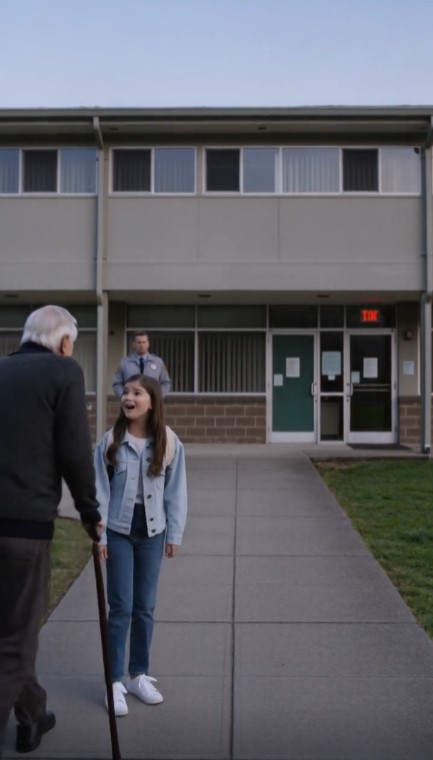
Every night at 7:00…
fourteen-year-old Grace stood outside one particular building.
She looked up at one window…
and sang.
Always the same song.
Never more than two minutes.
Then she went home.
A security guard finally asked:
“Who are you singing to?”
Grace pointed toward the third floor.
“My grandpa.”
Her grandfather had been inside for months.
Visitors were limited…
and Grace hadn’t been able to see him.
So every evening…
she sang the song he used to sing while driving her to school.
Some nights…
the curtain moved.
That was enough.
Then one evening…
Grace arrived.
The window was dark.
She sang anyway.
No movement.
The next night…
still dark.
Grace asked the security guard:
“Is he okay?”
The guard hesitated.
Then said:
“I don’t know.”
Grace kept coming.
Night after night.
Then on the seventh evening…
she started singing.
Halfway through the song…
another voice joined her.
Not from the window.
From behind her.
Grace stopped.
An elderly man stood several feet away.
Holding a cane.
Her grandfather.
Grace screamed:
“GRANDPA!”
She ran to him.
He hugged her.
But then Grace noticed something strange.
Another elderly man stood beside him.
Grace looked confused.
“Who is that?”
Her grandfather smiled.
“The reason I heard you every night.”
The second man had been in the room beside him.
Every evening he opened his own window slightly so Grace’s voice could travel down the hallway.
Then the stranger handed Grace a small envelope.
“My granddaughter used to sing too.”
Grace smiled.
“Used to?”
The man’s eyes filled.
He handed her a photograph.
Grace looked at it…
and froze.
The girl in the picture was wearing Grace’s school uniform.
Grace recognized her.
She had seen that face every day…
on a memorial photograph near the music room.
Then Grace’s grandfather whispered:
“That’s why he wanted to meet you.”
But the old man shook his head.
“No.”
He looked at Grace.
“I wanted to thank the girl who finished her song.”
Grace stared at him.
Because there was one final verse she had never been taught.
And somehow…
this stranger knew it.
The elderly man’s name was Edward.
His granddaughter had been named Hannah.
Grace knew that name.
Everyone at school did.
Hannah had been a student there years earlier.
Her photograph hung near the music room beside a small brass plaque.
Grace had walked past it hundreds of times.
She knew only the simple version.
Hannah had loved music.
She had died young.
The school held a small scholarship in her name.
That was all.
Grace looked again at the photograph.
“Hannah was your granddaughter?”
Edward nodded.
“She was.”
Grace’s grandfather, Samuel, rested a hand on her shoulder.
Then Edward said:
“She wrote the song you’ve been singing.”
Grace shook her head.
“No.”
“My grandpa taught it to me.”
Samuel’s expression changed.
Edward looked at him.
“You never told her?”
Samuel slowly sat on a nearby bench.
“No.”
Grace frowned.
“Told me what?”
Samuel looked at the ground.
“The song wasn’t mine.”
Grace stared.
All her life, Samuel had sung it.
On the way to school.
While cooking.
When Grace was nervous before a test.
It was their song.
Or so she thought.
Samuel continued.
Years earlier, before Grace was born, he had worked at her school.
Not as a teacher.
As a maintenance supervisor.
He fixed lights.
Moved chairs.
Unlocked doors before concerts.
And sometimes sat in the back of the auditorium while students rehearsed.
That was how he met Hannah.
She was sixteen.
Quiet.
Talented.
And constantly writing music in an old notebook.
Samuel had noticed her staying late one afternoon.
She was sitting alone at the piano.
Playing the same short melody over and over.
He asked:
“Stuck?”
Hannah laughed.
“Very.”
Samuel knew nothing about composition.
But he listened.
Then he said:
“It sounds unfinished.”
Hannah stared at him.
“That is deeply unhelpful.”
He laughed.
She did too.
After that, they became unlikely friends.
Not close in the way family is close.
Just familiar.
Samuel fixed the piano bench when it broke.
Hannah brought him coffee once.
He listened when she practiced.
Then one Friday, she played him a new song.
The song Grace now sang.
Hannah called it:
“Window Light.”
Grace whispered:
“That’s the name Grandpa told me.”
Samuel nodded.
Because Hannah had written it.
But there was a problem.
She never finished the final verse.
At least…
that was what Samuel believed.
Edward sat beside them.
“She did finish it.”
Samuel looked up.
“When?”
“Three weeks before she died.”
Grace went quiet.
Edward explained.
Hannah had been ill for months.
Very few students knew how serious it was.
She kept attending school whenever she could.
Music was the one thing she refused to give up.
At home, she kept working on “Window Light.”
She told Edward:
“The last verse needs to sound like somebody answering.”
He didn’t understand.
Hannah explained.
The first part was someone singing from far away.
The final part was supposed to answer:
I hear you.
I’m still here.
Then Hannah became too sick to return to school.
Samuel never saw her again.
A few months later, he learned she had died.
He was devastated.
Not because he had known her long.
Because there had been no goodbye.
Edward noticed Samuel’s reaction at the memorial concert.
That was when the two men first met.
Edward gave Samuel a copy of Hannah’s unfinished sheet music.
At least…
the version everyone thought was unfinished.
Samuel kept it.
Years later, when Grace was little, he played the melody on an old keyboard.
Grace loved it.
So he started singing it to her.
He changed a few words.
Simplified the melody.
It became part of their routine.
But he never told Grace where it came from.
Grace looked hurt.
“Why not?”
Samuel answered honestly.
“Because eventually it felt like ours.”
Grace nodded slowly.
Then looked at Edward.
“So where’s the last verse?”
Edward tapped the envelope.
“In there.”
Grace opened it.
Inside was one folded piece of sheet music.
At the top…
Hannah’s handwriting.
Final verse.
Grace’s eyes widened.
The melody looked familiar.
Not identical.
But close.
Then she noticed something else.
The final line was the exact sequence of notes Grace had started singing months earlier.
She looked at Samuel.
“You taught me this?”
He shook his head.
“No.”
Grace frowned.
That didn’t make sense.
For years, Samuel had stopped after the same verse.
Grace had always felt the ending came too soon.
So one evening, standing outside the building, she improvised.
Just four extra lines.
A little ending.
She repeated it the next night.
Then again.
Eventually, it became part of her routine.
Edward had heard it through the open window.
And he recognized it.
Almost exactly.
Not the words.
The melody.
Grace stared at the sheet.
“How?”
Edward shook his head.
“I don’t know.”
He wasn’t claiming anything magical.
There was a simpler possibility.
Grace had heard a fragment years earlier without remembering.
Maybe Samuel once hummed more than he realized.
Maybe the melody followed naturally from the earlier progression.
Maybe two people, years apart, simply made similar musical choices.
But Edward didn’t care about proving why.
The first night he heard Grace add that final phrase…
he cried.
Because for years, he had believed Hannah’s last verse had disappeared with her.
Then a fourteen-year-old girl outside a window sang something almost identical.
Grace asked:
“Is that why you opened the window every night?”
Edward nodded.
Samuel had been recovering in the room beside his.
The windows didn’t open fully.
Only a few inches.
Grace’s voice barely reached the hallway.
Edward noticed first.
He started opening his own window.
Then his door.
That helped the sound travel.
Samuel could hear.
Some evenings he was too weak to move to the window.
So Edward sat beside him and said:
“She’s here.”
Samuel would smile.
Grace looked at her grandfather.
“You heard me every night?”
“Almost.”
“What happened the week the window went dark?”
Samuel smiled.
“They moved me.”
His condition had improved enough to transfer him to another floor.
Grace didn’t know.
The security guard didn’t have access to that information.
That was why the window stayed dark.
Edward moved too a few days later.
By coincidence, both men were discharged the same week.
Samuel wanted to surprise Grace.
Edward asked to come.
But not only because of Hannah.
Edward reached into his coat.
He removed a second photograph.
Grace looked.
It showed Hannah standing in the school auditorium.
Beside her was Samuel.
Much younger.
And behind them…
Grace’s mother.
Grace froze.
“Mom?”
Samuel nodded.
Grace’s mother, Laura, had been twelve at the time.
She attended the same school.
Hannah sometimes helped younger students in the music room.
Laura admired her.
A lot.
Then Grace remembered something.
Her mother always became strangely quiet whenever Grace mentioned the memorial photograph at school.
Grace had never understood why.
Edward said:
“Your mother knew Hannah too.”
Grace whispered:
“She never told me.”
Samuel looked embarrassed.
“Your family is apparently very committed to keeping musical secrets.”
Grace almost laughed.
Then Edward explained the deeper connection.
Before Hannah became ill, she had started helping Laura with singing.
Laura had a beautiful voice but terrible confidence.
Hannah gave her one rule.
“If you’re nervous, don’t sing to the room.”
Laura asked:
“Then who do I sing to?”
Hannah pointed toward the back row.
“Pick one seat.”
That became Laura’s habit.
Every school concert, she chose one empty seat.
Sang toward it.
Pretended someone kind was sitting there.
Years later, Laura taught Grace a version of the same trick.
Before school presentations, she always said:
“Find one face.”
Grace never knew where that came from.
Edward smiled.
“Hannah.”
Grace stared at the photograph again.
“So Mom knew the song too?”
Samuel shook his head.
“Only pieces.”
Laura knew Hannah had been writing it.
But Samuel was the one who kept the melody after she died.
The strangest part came next.
Edward had one more item.
A small cassette tape.
Old.
Clear plastic.
A handwritten label:
WINDOW LIGHT — FINAL.
Samuel stared.
“You had a recording?”
Edward nodded.
“For twenty-three years.”
“Why didn’t you tell me?”
Edward looked ashamed.
“Because I couldn’t listen to it.”
After Hannah died, Edward packed many of her belongings away.
He couldn’t touch them.
Not for years.
Eventually, the boxes moved from one house to another.
The tape stayed buried.
Only after hearing Grace singing outside the building did Edward think about the song again.
His daughter searched Hannah’s old things.
They found the cassette.
Edward still hadn’t listened.
He brought it because he thought Grace should.
Grace looked at Samuel.
“Can we?”
Samuel nodded.
The security guard found them an old staff office with a cassette player.
Nobody expected it to work.
It did.
Static filled the room.
Then a young girl’s voice.
Hannah.
Laughing.
“Okay, Grandpa. This is the last one. Don’t talk.”
Edward immediately covered his mouth.
On the tape, his younger voice answered:
“I didn’t say anything.”
“You just did.”
Grace smiled.
Then piano began.
The same opening.
The same melody Samuel had sung for decades.
Grace gripped his hand.
Hannah sang.
Her voice wasn’t perfect.
A little breathy.
Young.
Real.
Then came the section Grace had always known.
And finally…
the missing verse.
Grace stopped breathing.
The melodic line rose.
Then paused.
Then descended exactly where Grace’s improvised ending did.
Not perfectly.
But close enough.
Edward cried.
Samuel cried.
Grace did too.
When the tape ended, nobody moved.
Then Grace asked:
“What were the words?”
Edward handed her the sheet.
The last verse was simple.
Not dramatic.
It was about someone standing far away…
hearing a familiar voice…
and answering so the other person would know they weren’t alone.
Grace stared at it.
“That’s what I was doing.”
Samuel smiled.
“Yes.”
She had been standing outside every night singing to a man she couldn’t visit.
Hannah had written a final verse about exactly that kind of distance decades earlier.
Again, nobody needed to call it fate.
The resemblance was enough.
Grace looked at Edward.
“You said I finished her song.”
Edward nodded.
“You gave me the ending back.”
Then the building door opened.
Grace’s mother walked inside.
Laura had come to pick them up.
She saw Edward.
Then stopped.
“Mr. Miller?”
Edward stood.
“Laura?”
Grace stared.
“You really know each other.”
Laura looked at the cassette.
Then at Samuel.
Her expression changed.
“You played it?”
Samuel nodded.
Laura sat down.
For a long time, she said nothing.
Then she asked Grace:
“Did Grandpa finally tell you?”
“Apparently everyone knew Hannah except me.”
Laura smiled sadly.
“I was twelve.”
She told Grace what Hannah had meant to her.
Hannah had been the first older student who treated Laura like her voice mattered.
After Hannah died, Laura stopped singing publicly.
Grace frowned.
“Why?”
“Because I was scared.”
“Of singing?”
“Of missing her.”
Grace understood.
That was familiar.
For months, she had sung because she missed Samuel.
Laura had stopped singing for the same reason.
Loss had pushed mother and daughter in opposite directions.
Grace kept singing.
Laura went quiet.
Edward looked at Laura.
“Hannah would hate that.”
Laura laughed through tears.
“She would.”
Then Grace handed her the sheet music.
“Sing it with me.”
Laura shook her head immediately.
“No.”
Grace smiled.
“That sounds like fear.”
Samuel laughed.
“Definitely fear.”
Laura glared at him.
Then sighed.
“Fine.”
They returned to the auditorium the following Friday.
Seat 47 wasn’t part of this story.
This one had a different place.
The music room.
Hannah’s memorial photograph hung beside the door.
Grace stood at the piano.
Laura beside her.
Samuel sat in the front row.
Edward beside him.
Grace began the song.
Samuel’s version first.
The one she had known all her life.
Then Laura joined.
Her voice shook at first.
Then steadied.
Finally, they reached the last verse.
The one Grace had never been taught.
The one Hannah had finished before she died.
Grace and Laura sang it together.
When they finished…
Edward applauded.
Samuel too.
Then one by one, students passing in the hallway stopped and listened.
The music teacher asked what they were playing.
Grace pointed toward Hannah’s photograph.
“Her song.”
The teacher stared.
Nobody at the school knew Hannah had written a complete piece.
The memorial scholarship had always described her as a talented singer.
But the song itself had disappeared from school history.
Edward agreed to donate a copy.
Not the original.
The original stayed with him.
The school arranged the piece for the spring concert.
They credited Hannah as the composer.
Grace performed it.
Laura sang the final verse with her.
Samuel sat in the audience.
Edward sat beside him.
Near the end, Grace looked toward Hannah’s memorial photograph projected quietly beside the stage.
For years, her nightly song had been a private message to her grandfather.
Now she understood it had traveled much farther than that.
From Hannah…
to Samuel.
From Samuel…
to Grace.
From Grace’s voice outside a third-floor window…
back to Edward.
And from Edward…
back into the school where the song began.
After the concert, Edward gave Grace a copy of Hannah’s old notebook.
Most pages were ordinary.
Chord ideas.
Half-written lyrics.
Homework notes.
Doodles.
Then Grace found one sentence circled near the back:
A song isn’t finished when I stop singing it.
It’s finished when nobody carries it anymore.
Grace showed Samuel.
He smiled.
“Then she was right.”
Years passed.
Grace eventually became one of the students responsible for organizing Hannah’s memorial music scholarship.
She changed one thing.
Every recipient had to perform or create something for someone who couldn’t be in the room.
A hospitalized relative.
A distant friend.
Someone they missed.
The point wasn’t technical perfection.
It was connection.
Grace called the annual performance:
Window Light.
Edward attended the first one.
So did Samuel.
When Grace introduced them, she told the audience only what mattered.
“One man kept a song alive without knowing its ending.”
“One man kept the ending safe without knowing anyone still remembered the song.”
“And somehow they met because an old window was cracked open at exactly the right time.”
Edward smiled.
Afterward, he told Grace:
“You make it sound better than it was.”
Grace laughed.
“That’s what musicians do.”
Samuel added:
“And teenagers.”
Years later, when Samuel was gone, Grace continued singing at 7:00 every June on his birthday.
Not outside a medical building.
At home.
Sometimes alone.
Sometimes with her mother.
She always included the final verse.
The one she hadn’t known existed.
Because now, whenever she sang it, Grace remembered two people.
Her grandfather…
who listened from a room she couldn’t enter.
And Hannah…
a girl Grace never met, whose unfinished story had been waiting decades for someone to hear the last line.
For months, Grace believed she was singing to one window.
She eventually learned the song had been traveling through many of them.
And all it needed…
was someone on the other side willing to open one.