
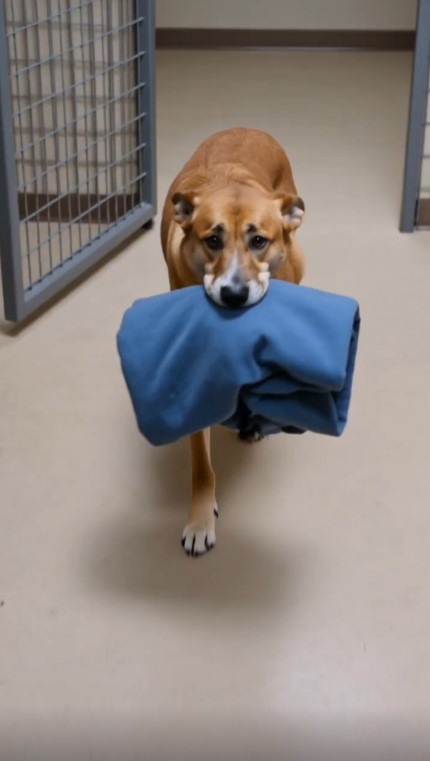
Every visitor ignored Charlie.
He was old.
Gray around the face.
And much quieter than the younger dogs.
But whenever one particular elderly man entered the shelter…
Charlie did something strange.
He grabbed his blanket…
walked across the kennel…
and dropped it at the man’s feet.
The first time, everyone laughed.
The second time, the shelter worker noticed.
By the fifth visit…
Charlie was waiting.
The elderly man’s name was Thomas.
He never asked to adopt.
He simply sat beside Charlie for twenty minutes…
then left.
One afternoon the shelter worker asked:
“Why don’t you take him home?”
Thomas smiled sadly.
“Because I promised my wife we’d choose our next dog together.”
His wife had died before they could.
The worker looked toward Charlie.
Then at the faded photograph Thomas carried in his wallet.
His wife was holding a puppy.
The worker leaned closer.
“Can I see that?”
Thomas handed it over.
She stared.
Then looked at Charlie.
Same white patch on the chest.
Same unusual mark above one eye.
She checked Charlie’s old intake file.
The dates matched.
Thomas whispered:
“No…”
Charlie wasn’t simply similar to his wife’s dog.
He was her dog.
Years earlier, after Thomas’s wife became ill, relatives had helped rehome the animal.
Thomas believed the dog had gone to a permanent family.
Somehow…
Charlie had ended up in the shelter.
Thomas opened the kennel door under staff supervision.
Charlie walked straight toward him.
But instead of jumping…
he gently placed his blanket in Thomas’s lap.
Thomas buried his face in it and cried.
Then the shelter worker found something sewn into one corner.
A tiny fabric pocket.
Inside was an old folded note.
Thomas recognized the handwriting immediately.
His wife’s.
He opened it.
Read one sentence.
Then looked at Charlie.
The worker asked:
“What does it say?”
Thomas could barely answer.
“She knew he’d find me.”
His wife’s name had been Margaret.
She had adopted Charlie as a puppy nearly thirteen years earlier.
Thomas remembered the day clearly.
He had come home from work and found Margaret sitting on the kitchen floor.
A tiny black-and-white puppy was asleep in her lap.
Thomas had stared.
“We said no more dogs.”
Margaret smiled.
“He disagreed.”
Thomas pointed at the puppy.
“We are not keeping him.”
Three hours later…
Charlie was sleeping on Thomas’s chest.
Margaret never let him forget it.
For years, Charlie was everywhere.
Walks.
Road trips.
Sunday mornings.
He slept beside Margaret’s chair while she read.
Waited outside the bathroom door.
Followed Thomas into the garage.
And every evening…
he carried the same blue blanket from room to room.
It became his comfort object.
Then Margaret became ill.
At first, they thought treatment would be simple.
It wasn’t.
Hospital stays became longer.
Thomas spent nearly every day with her.
Charlie stayed with Margaret’s sister, Ellen.
That was supposed to be temporary.
Then Margaret’s condition worsened.
One afternoon, she told Thomas:
“If I don’t come home…”
Thomas stopped her.
“Don’t.”
She smiled sadly.
“Someone has to say it.”
He refused to listen.
Charlie remained with Ellen.
Margaret died four months later.
Thomas barely remembered the weeks afterward.
Funeral arrangements.
Paperwork.
People bringing food.
People leaving flowers.
People saying words he couldn’t process.
Ellen told him she had found Charlie a good permanent home.
Thomas believed her.
At the time, he couldn’t imagine bringing the dog back into the house.
Every corner already reminded him of Margaret.
Charlie would have made the silence worse.
At least that was what Thomas told himself.
He asked only one thing.
“Is he safe?”
Ellen said yes.
Thomas never asked again.
Not because he didn’t care.
Because grief made some questions impossible.
Now, years later…
Charlie was standing in front of him.
Older.
Slower.
But alive.
Thomas stared at the note.
The first sentence read:
Tom, if Charlie ever comes back to you, please don’t send him away again.
Thomas stopped breathing.
The shelter worker sat beside him.
He unfolded the rest.
Margaret had written the note during one of her final hospital stays.
Apparently, she had asked Ellen to sew it into Charlie’s blanket.
Thomas whispered:
“She planned this?”
He kept reading.
I know you.
You’re going to tell yourself you can’t keep him because he reminds you of me.
You’re going to say the house is too quiet.
You’re going to say he deserves someone younger.
Maybe you’ll even convince yourself that letting him go is kinder.
Thomas covered his face.
“She knew exactly what I’d do.”
The worker smiled sadly.
Margaret continued.
But Charlie loves you too.
Not just me.
He waits by the door when you leave.
He sleeps on your side of the bed when you travel.
And every time you pretend not to give him food from your plate, he looks at you like you’re the easiest person in the world to fool.
Thomas laughed through tears.
Charlie lifted his head.
The note continued.
If I’m gone, don’t make him lose both of us.
That line broke him.
Thomas leaned forward.
Charlie stepped closer.
He rested his gray head against Thomas’s knee.
The shelter worker looked away.
Thomas kept reading.
And if circumstances separate you anyway…
trust him.
He always finds the person he thinks is home.
Thomas stared at Charlie.
“She knew he’d find me.”
The worker asked:
“Do you think he remembered you?”
Thomas looked toward the old dog.
“I don’t know.”
Maybe Charlie recognized him.
Maybe he recognized the blanket.
Maybe the voice.
Maybe the smell.
Maybe nothing that could be proven.
But Charlie had reacted to Thomas differently from every other visitor.
Five times.
Always the same.
Blanket.
Feet.
Waiting.
Thomas whispered:
“Maybe he remembered enough.”
The shelter worker searched Charlie’s records.
The story of the missing years slowly emerged.
After Margaret died, Ellen did rehome Charlie.
She hadn’t lied.
A retired couple named Frank and Louise adopted him.
They cared for him for seven years.
Photographs in an old veterinary file showed Charlie sleeping on their couch.
Wearing a red Christmas bow.
Running through a yard.
He had been loved.
Thomas felt immediate relief.
“So he wasn’t abandoned.”
“No.”
The worker shook her head.
“Not then.”
Frank died first.
Louise kept Charlie another two years.
Then her health declined.
She moved into assisted living.
Charlie went to her adult nephew.
That arrangement lasted only a few months.
The nephew traveled often.
Eventually, Charlie escaped through a damaged gate.
He was found wandering several miles away.
No current microchip information.
No updated contact.
No one knew where he belonged.
So he entered the shelter.
That was eight months earlier.
Thomas frowned.
“Eight months?”
“Yes.”
“And nobody chose him?”
The worker looked at Charlie.
“Older dogs are harder.”
Thomas’s face changed.
Charlie had once been a puppy Margaret carried into their home.
Then a beloved companion to another couple.
Now he had spent eight months watching younger dogs leave.
Thomas looked down at Margaret’s note.
Don’t make him lose both of us.
He folded it carefully.
Then asked:
“What do I need to sign?”
The worker smiled.
“You’re adopting him?”
Thomas looked offended.
“No.”
The worker froze.
Thomas continued:
“He was ours first.”
Then he smiled.
“I’m taking him home.”
The paperwork took nearly an hour.
Thomas called Ellen.
She was eighty-one now.
When he told her Charlie was alive, she started crying.
“I thought you knew.”
“Knew what?”
“That Louise’s family lost track of him.”
“No.”
“I found out only last year. I tried calling the old number.”
Thomas had changed phones.
Moved once.
They had drifted apart after Margaret’s death.
Ellen whispered:
“I’m sorry.”
Thomas looked at Charlie.
“Don’t be.”
Then he asked:
“Did Margaret really tell you to sew that note into his blanket?”
Ellen laughed through tears.
“She made me redo the stitches twice.”
“That sounds like her.”
“She said you would never look for a letter.”
“She was right.”
“But Charlie might bring it to you.”
Thomas stopped.
“What?”
Ellen explained.
Margaret knew Charlie’s habit.
Whenever Thomas sat on the floor after work, Charlie brought him the blue blanket.
Dropped it against his leg.
Then curled beside him.
Margaret joked that one day Charlie would deliver mail.
So she hid the note in the one object she knew Charlie carried everywhere.
Thomas looked at the blanket again.
For years…
the note had traveled with him.
From Thomas and Margaret’s home.
To Ellen’s.
To Frank and Louise.
To another house.
Then a shelter.
Still sewn into the corner.
Still waiting.
Thomas brought Charlie home that afternoon.
The house was different now.
Smaller.
Thomas had sold the old family home years earlier.
He lived in a one-story cottage.
But some things remained.
Margaret’s photographs.
Her favorite lamp.
The wooden clock she hated because it ran five minutes slow.
Thomas opened the front door.
Charlie hesitated.
He sniffed the floor.
Then stepped inside.
Thomas said:
“Not the same place, buddy.”
Charlie walked slowly through the living room.
Then stopped beneath a framed photograph of Margaret.
Thomas stared.
“Don’t do this to me.”
Charlie sat.
Thomas cried again.
The first night was difficult.
Charlie paced.
Thomas barely slept.
At 2:00 a.m., he found the dog standing beside the bedroom door.
Thomas opened it.
Charlie walked in.
Circled twice.
Then lay beside Thomas’s side of the bed.
Exactly where Margaret said he used to sleep.
Thomas sat on the edge.
“You really are Charlie.”
The dog lifted his head.
Thomas reached down.
“Okay.”
He left the bedroom door open after that.
Over the next few weeks, Charlie settled quickly.
He learned Thomas’s routine.
Breakfast at seven.
Short walk at eight.
Nap near the window.
Another walk before dinner.
Thomas learned Charlie’s new limitations.
No stairs.
Slow mornings.
Medication for arthritis.
Less appetite on hot days.
But Charlie still carried the blue blanket.
Every evening.
Room to room.
Thomas eventually washed it.
Very carefully.
He removed Margaret’s note first.
Then sewed the pocket closed again.
The note went into a frame.
Underneath it, he placed the old photograph.
Margaret holding puppy Charlie.
Next to that…
a new photograph.
Thomas sitting beside fourteen-year-old Charlie.
Same white chest patch.
Same mark above the eye.
Everything else older.
Ellen visited.
The moment Charlie saw her, he stood.
His tail started moving.
Ellen covered her mouth.
“He remembers.”
Thomas smiled.
“Maybe.”
Charlie walked toward her.
She knelt carefully.
“Hello, trouble.”
Charlie pushed his head into her hands.
Ellen cried.
Then told Thomas something else.
Margaret had written another note.
“What?”
“I kept it.”
“For thirteen years?”
“I forgot.”
“That family trait is becoming irritating.”
Ellen laughed.
She mailed it the following week.
This note was shorter.
Tom,
If Charlie ends up with you again, don’t spend the whole time being sad because I’m not there.
Take him somewhere stupid.
Buy him something expensive he doesn’t need.
Let him on the furniture.
And please stop pretending dogs can’t have bacon.
Thomas laughed so hard he had to sit down.
The following Saturday…
he drove Charlie to the lake.
Margaret loved that lake.
Charlie had been there as a puppy.
Thomas brought a folding chair.
Water.
Dog treats.
And, against every sensible dietary instinct…
one tiny piece of bacon.
Charlie ate it immediately.
Thomas looked toward the water.
“Happy?”
Charlie stared at him.
“Wrong question.”
Thomas smiled.
“Of course you’re happy.”
The lake became their weekly routine.
Sometimes Thomas talked to Charlie.
Sometimes to Margaret.
He didn’t care which.
He told stories.
Things he wished he had said.
Things that happened after she died.
He told Charlie when he was lonely.
Then laughed at himself.
“You’re a terrible conversationalist.”
Charlie rested his head on Thomas’s shoe.
For the first time in years, Thomas began leaving the house more often.
Not because grief disappeared.
Because Charlie needed walks.
Vet appointments.
Food.
The old dog gave structure to mornings that had become shapeless.
The shelter worker noticed too.
Thomas returned every month with donated blankets.
Charlie came sometimes.
One afternoon, a little boy pointed.
“That dog was here forever.”
Thomas smiled.
“Not forever.”
“Did you adopt him?”
Thomas thought.
“Something like that.”
The shelter worker later asked whether they could share Charlie’s story to encourage senior-dog adoption.
Thomas agreed under one condition.
“Don’t make it sound like he magically recognized me.”
The worker laughed.
“Why?”
“Because I don’t know what he recognized.”
He looked at Charlie.
“But I know I almost walked away five times.”
That was the part Thomas wanted people to remember.
The first visit, he saw Charlie.
Second visit, Charlie brought the blanket.
Third visit, Thomas sat longer.
Fourth visit, he almost asked about adoption.
Then stopped himself.
Fifth visit, the photograph changed everything.
Thomas had spent years waiting for a sign from Margaret.
Something dramatic.
A dream.
A letter he had never seen.
Some proof she was still somehow guiding him.
In the end…
the “sign” was a gray-faced dog carrying an old blanket.
That was enough.
Charlie lived another two and a half years.
He slowed considerably near the end.
Thomas adapted.
Shorter walks.
More blankets.
A ramp beside the porch.
On difficult mornings, Thomas carried Charlie outside.
He complained about his back.
Charlie remained unimpressed.
Then one winter evening, Charlie stopped eating.
The veterinarian came to the house.
Thomas already understood.
Ellen came too.
The shelter worker came after her shift.
Charlie lay on his blue blanket.
Thomas sat beside him.
He read Margaret’s note aloud one final time.
If I’m gone, don’t make him lose both of us.
Thomas touched Charlie’s head.
“You didn’t.”
Charlie died peacefully that evening.
At home.
With Thomas’s hand on him.
The blue blanket underneath.
For days afterward, Thomas couldn’t move it.
Eventually, he folded it.
Placed Margaret’s two notes inside.
Then put it in a wooden box with Charlie’s collar.
He kept one thing out.
The original photograph.
Margaret holding Charlie as a puppy.
Next to it remained the newer photograph of Thomas with Charlie as an old dog.
Two ends of the same life.
Months later, Thomas returned to the shelter.
He carried donated blankets.
The worker smiled.
“Good to see you.”
“You too.”
He walked past the kennels.
Puppies jumped.
Young dogs barked.
Then he reached the senior section.
An old brown dog lay quietly in the corner.
Thomas stopped.
The worker noticed.
“His name is Henry.”
“How old?”
“Thirteen.”
Thomas sighed.
“Of course.”
“You don’t have to do anything.”
“I know.”
Thomas sat beside the kennel.
Henry didn’t move.
Ten minutes passed.
Then the dog stood.
Slowly.
Walked toward the gate.
Thomas smiled.
“You’re not carrying a blanket, are you?”
The worker laughed.
“No.”
“Good.”
Thomas stayed twenty minutes.
Then left.
He returned the next week.
And the week after that.
He wasn’t trying to replace Charlie.
Nothing could.
He simply understood something now that he hadn’t before.
Old dogs did not need someone to pretend they had endless time.
They needed someone who understood that limited time could still matter.
Thomas eventually adopted Henry too.
When Ellen heard, she laughed.
“Margaret created a monster.”
Thomas smiled.
“No.”
He looked toward Henry sleeping on the rug.
“She left instructions.”
Years later, the shelter framed Charlie’s story near the senior-dog wing.
Beneath the photograph was one sentence from Margaret’s note:
TRUST HIM. HE ALWAYS FINDS THE PERSON HE THINKS IS HOME.
Visitors often stopped to read it.
Some walked on.
Others looked differently at the older dogs.
And occasionally…
someone sat down.
That was how Charlie’s story continued.
Not because anyone could prove exactly what he remembered.
But because one old dog refused to let an elderly man walk out of a shelter without noticing him.
Five visits.
The same blanket.
The same quiet invitation.
Until Thomas finally looked closely enough to realize…
the dog he thought belonged to his past had been waiting to become part of his future.