
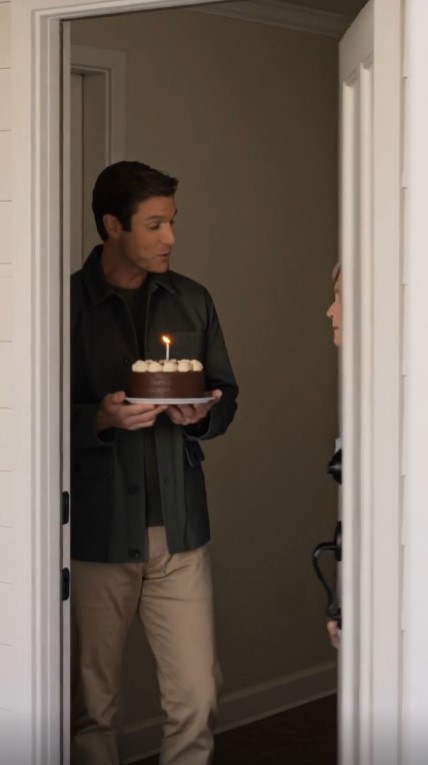
For five years, delivery driver Daniel brought the same cake to the same elderly woman.
Chocolate.
White frosting.
One candle.
Every year, Mrs. Miller opened the door alone.
Daniel finally asked:
“Whose birthday is it?”
She smiled sadly.
“My son’s.”
Daniel looked around.
Nobody else was there.
“He lives far away?”
Mrs. Miller’s smile disappeared.
“We haven’t spoken in 19 years.”
Daniel didn’t ask why.
But before leaving, he noticed one thing.
Beside the door was a box containing dozens of unopened birthday cards.
One for every year her son had been gone.
Mrs. Miller had written them all.
She simply never knew where to send them.
Daniel couldn’t forget it.
Weeks later, he returned to her house.
But there was no cake.
Instead, he asked her to come outside.
Mrs. Miller stepped onto the porch.
A middle-aged man was standing beside Daniel’s delivery van.
She froze.
The man started crying.
“Hi, Mom.”
Mrs. Miller nearly collapsed into Daniel’s arms.
Her son had finally come home.
She walked toward him…
then stopped.
“Why now?”
Her son pulled one of her old birthday cards from his jacket.
“Because someone finally found me.”
Mrs. Miller slowly turned toward Daniel.
Daniel looked almost embarrassed.
“I may have asked a few questions.”
Mrs. Miller’s son smiled through tears.
“A few?”
His name was Michael.
He was forty-six now.
His hair had begun turning gray.
But Mrs. Miller still saw the twenty-seven-year-old who had walked out of her house after the worst argument of their lives.
For several seconds, neither moved.
Then Michael whispered:
“Mom…”
Mrs. Miller crossed the distance between them.
She hugged him.
Hard.
Michael’s arms closed around her.
And nineteen years of birthdays, Christmases, illnesses, phone numbers, changed addresses, pride, and silence suddenly collapsed into one front porch.
Daniel quietly stepped backward.
This part didn’t belong to him.
But Mrs. Miller reached for his arm.
“Don’t leave.”
Daniel stopped.
She looked at Michael.
“How did he find you?”
Michael smiled.
“He started with the cake.”
Daniel laughed softly.
That was almost true.
The first clue had been the bakery.
For five years, Daniel had picked up Mrs. Miller’s birthday cake from the same small shop.
The order always said:
Chocolate cake. White frosting. One candle. For Michael.
One afternoon, after noticing the cards by Mrs. Miller’s door, Daniel asked the bakery owner whether Mrs. Miller had always ordered the same cake.
The owner, Rosa, smiled.
“Longer than you’ve been delivering here.”
“How long?”
“Maybe eighteen or nineteen years.”
Every year.
Same date.
Same name.
Daniel couldn’t stop thinking about it.
He had no intention of invading anyone’s privacy.
But during his next delivery, Mrs. Miller herself gave him the opening.
She was looking through the box of cards when Daniel arrived with groceries.
He asked gently:
“You really don’t know where he is?”
She shook her head.
“No.”
“Have you tried finding him?”
“For years.”
Then she laughed sadly.
“I’m eighty-one now. I don’t know where people find people anymore.”
Daniel hesitated.
“If you ever want help looking…”
Mrs. Miller stared at him.
“You’d do that?”
“Sure.”
That was how it began.
Not secretly.
Not by digging through private information without permission.
Mrs. Miller gave Daniel what she knew.
Michael Miller.
Born in the same town.
Worked as an auto mechanic when he left.
Had once talked about moving to Colorado.
An old friend named Thomas.
A photograph.
And nineteen birthday cards.
Daniel asked:
“Why did he leave?”
Mrs. Miller looked away.
“He thought I betrayed him.”
“Did you?”
She took a long breath.
“Yes.”
That surprised Daniel.
Most people softened their own part of a story.
Mrs. Miller didn’t.
Michael’s father, Robert, had died when Michael was twenty-three.
He left behind a small repair garage.
Michael had worked there since he was sixteen.
He believed the garage would eventually become his.
But Robert’s will divided ownership between Michael and his older sister, Emily.
Emily wanted to sell.
Michael wanted to keep it.
The siblings fought.
Then Mrs. Miller—whose first name was Margaret—sided with Emily.
Michael felt betrayed.
He had spent years working beside his father.
To him, the garage was not property.
It was his future.
Margaret saw something different.
Debt.
Old equipment.
A failing roof.
Unpaid taxes.
She believed selling it would free Michael before the business buried him financially.
Michael shouted:
“You never believed in me.”
Margaret answered:
“I’m trying to protect you.”
Michael said:
“I didn’t ask you to.”
Three days later, the garage was sold.
Michael packed.
Margaret begged him to stay.
He refused.
Before leaving he said:
“Now you have the money. I hope it was worth it.”
Margaret shouted back:
“If you walk out over a building, maybe you were looking for an excuse to leave.”
Those were the last words she said to him for nineteen years.
Daniel asked:
“Did you try contacting him?”
Margaret pointed at the cards.
The first birthday after Michael left, she mailed one to his old address.
Returned.
Then another.
Returned.
She contacted friends.
Nothing.
Eventually she heard Michael had moved west.
No address.
No number.
Later Emily searched online.
Too many Michael Millers.
Years passed.
Margaret kept writing.
She stopped mailing the cards.
Instead, she placed each one in the box.
Daniel opened none of them.
But Margaret showed him the envelopes.
Happy 28th, Michael.
Happy 29th.
Happy 30th.
All the way to forty-six.
Daniel asked:
“Why keep writing if you thought he’d never see them?”
Margaret answered:
“Because on his birthday, I still had something to say.”
That sentence stayed with him.
Daniel started with Thomas.
The old friend.
A local mechanic remembered a Thomas Reed who had worked with Michael.
Thomas had moved to Arizona.
Daniel contacted him.
Thomas remembered Michael immediately.
They had spoken occasionally for several years after Michael left.
Then lost touch.
But Thomas knew something Margaret didn’t.
Michael had changed the name he used professionally.
Not legally.
Just shortened it.
He went by Mike Robert.
Robert, his father’s first name.
That explained why Margaret’s searches had failed.
Thomas remembered the last place Michael worked.
A small fleet-maintenance company.
Daniel found it.
Michael had left eight years earlier.
But one former employee remembered him.
He was now repairing buses for a school district in another state.
Eventually Daniel reached the district.
Then Michael.
The first conversation lasted less than three minutes.
Daniel said:
“Are you Michael Miller?”
“Who wants to know?”
“My name is Daniel. I deliver cakes to your mother.”
Silence.
Then Michael hung up.
Daniel assumed that was the end.
The next day, Michael called back.
“You said cakes?”
“Yes.”
“What kind?”
Daniel smiled.
“Chocolate. White frosting. One candle.”
Michael went quiet.
“That’s what she used to make me.”
Daniel didn’t know that.
Margaret had never mentioned it.
Michael asked:
“She still does that?”
“Every year.”
Another silence.
Then:
“Is she okay?”
“She’s eighty-one.”
“That’s not what I asked.”
Daniel smiled faintly.
“No. I don’t think she is.”
Michael did not agree to come home.
Not yet.
He said he needed time.
Daniel gave him Margaret’s number.
Michael never called.
Two weeks passed.
Then Daniel mailed him one birthday card.
Not secretly.
Margaret chose it.
The most recent one.
The card Michael eventually brought back to the porch.
Inside, Margaret had written:
Michael,
I used to think the worst mistake I made was helping sell the garage.
It wasn’t.
The worst mistake was deciding my reasons mattered more than how deeply I hurt you.
I should have listened.
I should have apologized without adding “but I was trying to help.”
I miss you.
If you never come home, I will understand.
But I need you to know the door was never closed from this side.
Love, Mom.
Michael read it six times.
Then called Daniel.
“Does she mean it?”
Daniel answered:
“I’m a delivery driver, Michael. I’m not qualified to interpret your mother.”
Michael laughed for the first time.
Daniel continued:
“But she has nineteen cards in a box.”
Michael went quiet.
Then he said:
“I want to see them.”
That was why Daniel returned without a cake.
Michael had flown in that morning.
He asked Daniel not to tell Margaret.
He wasn’t sure he would have the courage to walk up to the door if he had too much time to think.
Now he stood on the porch.
Margaret still had both arms around him.
Finally, Michael pulled back.
He looked older than she had imagined.
Margaret touched his face.
“You got gray.”
Michael laughed through tears.
“You’re one to talk.”
That helped.
Then Margaret asked:
“Are you married?”
“Yes.”
Her face changed.
“You are?”
“Seventeen years.”
“Children?”
“Two.”
Margaret stepped backward.
“You have children?”
Michael nodded.
“A daughter, Sarah. She’s sixteen.”
Margaret covered her mouth.
“And a son, Noah. Twelve.”
She started crying all over again.
“I’m a grandmother?”
Michael nodded.
“You have been for sixteen years.”
That sentence hurt.
It was not meant cruelly.
But it hurt.
Margaret sat down on the porch chair.
“I missed all of that.”
“Yes.”
Michael sat beside her.
“So did I.”
He had missed Emily’s wedding.
Margaret’s seventieth birthday.
His grandmother’s funeral.
Family Christmases.
Emily’s children growing up.
There were losses on both sides.
Neither could recover them.
Margaret whispered:
“I’m sorry.”
Michael nodded.
“I know.”
“No. I need to say it correctly.”
She looked directly at him.
“I sold something you loved without listening to you.”
“I thought because I was your mother, I knew what was best.”
“I was wrong.”
Michael’s eyes filled.
Then Margaret added:
“And what I said when you left was cruel.”
“You were angry.”
“That doesn’t make it less cruel.”
Michael looked down.
“I said cruel things too.”
“You did.”
They both laughed weakly.
Not forgiveness yet.
But honesty.
Then Daniel asked:
“Should I go?”
Margaret and Michael answered simultaneously:
“No.”
They looked at each other.
For one second, they laughed like a mother and son who had spoken yesterday.
Daniel stayed for coffee.
Margaret brought out the box.
Nineteen cards.
Michael stared.
“You really wrote every year.”
“Every year.”
He picked up the first.
Happy 28th Birthday.
His hand shook.
“Can I?”
“They’re yours.”
He opened it.
The message was angry.
Margaret had not rewritten history.
I’m still furious with you. I hope you’re safe. I love you.
Michael laughed.
“That sounds like you.”
The second:
I’m less angry. Not enough to admit I was wrong yet. Maybe next year.
Michael smiled.
The third:
I was wrong. I don’t know where to send this.
He stopped smiling.
Card after card.
Some long.
Some only one sentence.
One birthday she had been ill.
I’m too tired to write much. I still remembered.
One year Emily had a baby.
You became an uncle today. I wish you knew.
One year Margaret found an old wrench from the garage.
I almost threw it away. Couldn’t.
Michael wiped his eyes.
Then he reached card number twelve.
Inside was a photograph.
Margaret standing in front of an empty lot.
Michael recognized it.
“The garage.”
She nodded.
The building had been demolished years after the sale.
But Margaret had gone there first.
On the back:
I finally understand that it was never just a building to you.
Michael cried.
“I wish you’d sent this.”
“So do I.”
Then Daniel noticed something.
The box was deeper than it looked.
Under the cards was another envelope.
Margaret seemed surprised.
She pulled it out.
It was addressed to Michael.
But the handwriting wasn’t hers.
It belonged to Robert.
Michael’s father.
The letter had been in the box for decades.
Margaret stared.
“I forgot this was here.”
Michael looked almost afraid.
His father had written it shortly before he died.
He had never seen it.
Margaret had found it among Robert’s papers after the garage dispute.
But by then Michael had already left.
She placed it with the first birthday card, intending to give it to him if he returned.
Then over years, more cards covered it.
Michael opened it.
Son,
If the garage becomes yours, don’t keep it just because it was mine.
Michael stopped.
Margaret stared at him.
He continued.
It has more debt than you know.
I should have told you sooner.
Your mother knows some of it. Emily knows less.
Michael looked at Margaret.
“You knew?”
She nodded.
“That was why I wanted to sell.”
Michael kept reading.
You’re better at fixing engines than I ever was.
You can build something of your own.
Don’t confuse loving me with inheriting my problems.
Michael put the letter down.
For nineteen years, he had believed Margaret sold the garage because she did not believe he could run it.
The truth was almost the opposite.
Robert had been hiding serious debt.
Margaret feared Michael would spend years trying to rescue a business already collapsing.
Michael whispered:
“Why didn’t you tell me this?”
“I tried.”
“When?”
“During the argument.”
“You said Dad left debts.”
“You thought I was exaggerating.”
Margaret paused.
“And then I got angry and stopped explaining.”
Michael closed his eyes.
“All these years.”
Margaret said:
“My reason for selling wasn’t wrong.”
Michael looked at her.
“No.”
“But the way I treated you was.”
He nodded.
That distinction mattered.
Margaret had not been a villain.
Michael had not been one either.
Two grieving people had faced the same problem from opposite sides.
Then pride did the rest.
Michael folded his father’s letter carefully.
“I became a mechanic anyway.”
Margaret smiled.
“I assumed you would.”
“I own a small shop now.”
Her face lit up.
“You do?”
“Four bays.”
“Is it doing well?”
“Very.”
Margaret laughed.
“Your father would be unbearable about that.”
Michael smiled.
“He’d say I got it from him.”
“He would.”
Something began healing right there.
Not through a dramatic apology.
Through ordinary conversation.
Work.
Children.
Cars.
Names.
Life.
Michael stayed three days.
On the second day, he video-called his wife, Laura.
Margaret was terrified.
“What do I say?”
Michael smiled.
“Hello usually works.”
Laura appeared.
Then Sarah.
Then Noah.
Margaret cried before anyone finished introducing themselves.
Sarah said:
“So you’re Grandma Margaret?”
Margaret nodded.
“If you’ll let me be.”
Sarah smiled.
“I’ve been asking Dad about you for years.”
Michael looked embarrassed.
Margaret raised an eyebrow.
“Oh?”
Sarah laughed.
“He has your picture.”
Michael stared at his daughter.
“You promised not to tell her that.”
Too late.
He had kept one photograph of Margaret all nineteen years.
Taken on his twenty-first birthday.
Margaret holding the chocolate cake.
White frosting.
One candle.
Exactly like the cakes Daniel delivered.
Margaret saw the photograph through the screen.
“You kept that?”
Michael nodded.
“I wasn’t as good at forgetting as I pretended.”
Neither was she.
Weeks later, Michael returned with the entire family.
Sarah hugged Margaret first.
Noah was shy.
Then Margaret asked what kind of cake he liked.
That solved everything.
By dinner, he was calling her Grandma.
Margaret showed them the birthday-card box.
Sarah read several.
Then asked:
“Can we take pictures of these?”
Margaret frowned.
“Why?”
“Because Dad should have copies.”
Michael corrected her.
“The originals are mine.”
Margaret smiled.
“They always were.”
Daniel continued delivering to Margaret.
But the next birthday was different.
He arrived with the same cake.
Chocolate.
White frosting.
One candle.
This time, when Margaret opened the door, the house was loud.
Michael was there.
Laura.
Sarah.
Noah.
Emily and her family.
Daniel stood stunned.
Margaret smiled.
“Come in.”
“I’m working.”
“You delivered the cake.”
“Yes.”
“So technically your work brought you inside.”
Michael laughed.
“Don’t argue with her.”
Daniel came in for five minutes.
Stayed almost an hour.
When the cake was placed on the table, Michael stared at the single candle.
“Why one?”
Margaret shrugged.
“You only get one wish.”
Michael smiled.
“What should I wish for?”
Margaret answered:
“Don’t waste it on something that already happened.”
Michael looked at her.
Then blew out the candle.
No one asked what he wished for.
Years passed.
The annual birthday cake tradition remained.
But the box of unopened cards stopped growing.
Margaret began mailing them.
Then texting.
Eventually video-calling.
She was terrible at it.
Half her conversations started with her forehead filling the screen.
Michael found this hilarious.
On her eighty-fifth birthday, Michael gave her a small wooden box.
Inside were nineteen envelopes.
Margaret looked confused.
“What are these?”
“My turn.”
He had written one letter for each year they had been apart.
Not pretending he wrote them during those years.
He wrote them now.
What he wished he could have said.
Year one:
I was angry. I expected you to come looking.
Year two:
I moved to Denver. I hated it for six months.
Year three:
I met Laura. You would have liked her immediately.
Year five:
I got married. I almost called.
Year six:
You became a grandmother. I wanted to tell you.
Year eleven:
Noah was born. I thought about the garage less after that.
Year fifteen:
I finally understood why you sold it. I still couldn’t call.
Year nineteen:
A delivery driver called me about a cake. I thought it was a scam.
Margaret laughed.
Then the final page:
Turns out he delivered more than cake.
Daniel received a copy of that line in the mail.
He kept it.
He never considered himself responsible for fixing the family.
He hadn’t.
He simply helped two people find each other.
They did the harder part themselves.
Apologizing.
Listening.
Returning.
Staying.
Several years later, Margaret died peacefully with both of her children nearby.
Michael was holding her hand.
After the funeral, he went to her house.
Beside the door was the old birthday-card box.
Empty now.
Almost.
Inside was one final envelope.
For Daniel.
Michael called him.
Daniel came over.
Inside the envelope was a note.
Dear Daniel,
For five years you brought a cake to an old woman and probably wondered why she kept ordering it.
Thank you for finally asking.
Sometimes people need help finding an address.
Sometimes they need help finding courage.
You helped with both.
Below it:
P.S. Michael says you still owe him a cake delivery next year. Don’t let him pick vanilla.
Daniel laughed.
Michael wiped his eyes.
The next year, on Michael’s birthday, Daniel made one final personal delivery.
Chocolate.
White frosting.
One candle.
Michael opened the door.
His family was behind him.
Daniel handed over the box.
Michael said:
“You know I live outside your delivery area.”
Daniel shrugged.
“Special route.”
They laughed.
That evening Michael placed the cake on the table.
Beside it sat the nineteen birthday cards Margaret had written.
He had kept every one.
The most precious was not the last.
It was the first.
The angry one.
I’m still furious with you. I hope you’re safe. I love you.
Because it proved something Michael had spent nineteen years forgetting.
His mother could be angry and still love him.
He could feel betrayed and still miss her.
Families were more complicated than either of them allowed themselves to believe when he walked out.
The old garage had been sold.
His father had died.
Nineteen years had passed.
None of that could be reversed.
But one thing could.
The silence.
And it ended because a delivery driver noticed an elderly woman ordering the same lonely birthday cake year after year…
saw a box filled with cards that had nowhere to go…
and decided that maybe one of them deserved to be delivered.
Daniel had spent his career bringing packages to addresses.
That time…
he found the person before he found the address.
And after nineteen birthdays spent apart…
a mother finally opened her door…
and saw her son standing on the other side.