
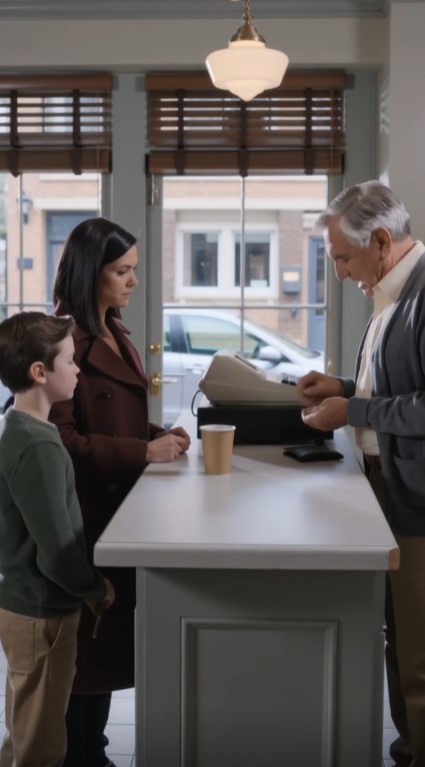
Eleven-year-old Ethan noticed the elderly man counting coins beside the coffee shop register.
He was short.
The man quietly pushed the cup away.
“I don’t have enough.”
Before anyone could say anything, Ethan placed two dollars on the counter.
“I’ll get it.”
The elderly man smiled.
“Thank you, son.”
Ethan’s mother was proud…
until she saw the man’s left hand.
There was a small crescent-shaped scar between his thumb and wrist.
Her face changed immediately.
She had seen that scar before.
In one photograph.
The only photograph her mother kept hidden in a locked drawer.
She stepped closer.
“Sir… what’s your name?”
The man answered:
“Thomas.”
She nearly dropped her phone.
Thomas was the name of the brother her mother claimed had died as a teenager.
Ethan looked confused.
The man noticed his mother staring.
Then he saw the necklace around her neck.
His coffee slipped from his hand.
“Where did you get that?”
“My mother.”
Thomas looked like he had seen a ghost.
Then he whispered:
“Your mother told you I was dead, didn’t she?”
Before she could answer…
Thomas pulled a small folded map from his wallet.
“There’s something your mother never wanted you to find.”
Ethan’s mother, Rachel, stared at him.
Her first instinct was to walk away.
Her second was to call her mother.
But Thomas unfolded the map before she could do either.
It was old.
The paper had softened along the creases.
A red circle had been drawn around a property outside town.
Rachel knew the road.
Everyone in the family did.
Her mother, Margaret, had grown up there.
The old family house had been abandoned decades earlier.
Rachel looked at Thomas.
“What’s there?”
He answered quietly.
“The reason I disappeared.”
Ethan stood close beside his mother now.
Rachel put one hand on his shoulder.
“You’re telling me my mother lied about you?”
Thomas gave a tired smile.
“She told you what she needed to believe.”
“That isn’t an answer.”
“No.”
He folded the map again.
“It’s the best one I have in a coffee shop.”
Rachel called Margaret from the parking lot.
Her mother answered on the third ring.
“Hi, sweetheart.”
Rachel didn’t waste time.
“Mom, I met Thomas.”
Silence.
Then:
“Where?”
Not who.
Where.
Rachel closed her eyes.
“So he’s alive.”
Margaret said nothing.
“Mom?”
“Come home.”
“Why did you tell me he died?”
“Come home.”
Rachel looked through the coffee shop window.
Thomas was sitting alone with Ethan.
Her son was showing him something on his phone.
Thomas was smiling.
Rachel whispered:
“He has a map.”
Margaret’s voice changed.
“Don’t go there.”
That was all Rachel needed to hear.
“There really is something.”
Margaret began crying.
“Rachel, please.”
“Then tell me.”
Another long silence.
Finally:
“Bring him.”
An hour later, Thomas stood outside Margaret’s house.
He had not been there in forty-six years.
Margaret opened the door.
For several seconds, neither moved.
Rachel watched her mother’s face.
Shock.
Anger.
Grief.
Then something else.
Relief.
Thomas whispered:
“Hi, Maggie.”
Margaret slapped him.
Not hard.
But enough to make Ethan’s eyes widen.
Then she hugged him.
Thomas started crying.
Margaret did too.
Rachel stood there stunned.
“You told me he was dead.”
Margaret pulled away.
“I know.”
“For my entire life.”
“I know.”
Thomas looked at Rachel.
“I told you. It wasn’t simple.”
Rachel snapped:
“Everybody keeps saying that when what they mean is they lied.”
No one argued.
They sat around Margaret’s kitchen table.
Ethan stayed.
Rachel considered sending him to another room.
Then decided against it.
Too many secrets had already survived because children were always told to leave the room.
Margaret began.
Thomas was her younger brother by four years.
When she was seventeen, he was thirteen.
Their father was strict.
Controlling.
Proud.
He owned a small repair shop and expected Thomas to take it over.
Thomas had other plans.
He loved drawing.
Maps.
Buildings.
He wanted to study architecture.
Their father laughed at him.
Thomas kept drawing anyway.
The scar on his hand came from a broken workshop window.
One night, after another argument, Thomas punched the glass.
Margaret wrapped his hand herself.
That was the photograph Rachel remembered.
Young Thomas sitting at the kitchen table.
Bandage on his hand.
Margaret beside him.
Rachel frowned.
“But Mom said the boy in that photograph was a cousin.”
Margaret looked down.
“I know.”
Then Thomas explained the necklace.
The small silver pendant around Rachel’s neck had belonged to their mother, Eleanor.
It was shaped like a tiny compass.
Before Eleanor died, she gave it to Margaret.
But Margaret later gave it to Thomas.
“Why?” Rachel asked.
Margaret closed her eyes.
“Because he was leaving.”
Rachel stared.
“You helped him?”
“Yes.”
That changed everything.
Thomas had not simply disappeared.
Margaret helped him go.
At seventeen, Thomas finally decided he could not stay.
Their father had become more controlling.
He destroyed Thomas’s architecture applications.
Burned drawings.
Told him he would work at the repair shop or leave with nothing.
Margaret secretly saved money.
Bought Thomas a bus ticket.
Packed food.
And gave him their mother’s compass necklace.
She told him:
“If you get lost, at least carry something that knew home.”
Thomas left.
He promised to write.
He did.
At first.
Letters came every month.
Then their father found one.
He became furious.
He accused Margaret of betrayal.
He threatened to throw her out too.
So Margaret stopped answering.
Thomas interpreted the silence as rejection.
Years passed.
Margaret whispered:
“I thought if I stopped, maybe Dad would calm down.”
Thomas said:
“I thought you wanted me gone.”
Rachel looked between them.
“And that became forty-six years?”
Thomas nodded.
“Not immediately.”
There was more.
Ten years after leaving, Thomas returned.
Secretly.
He came at night.
Margaret was already married.
Rachel had not been born yet.
Thomas stood outside the old family property but never knocked.
Instead, he buried something near the workshop.
The map marked the spot.
Rachel asked:
“What?”
Thomas looked at Margaret.
“You know.”
Margaret nodded.
“I found it.”
Thomas froze.
“When?”
“Thirty-eight years ago.”
He stared at her.
“You found it?”
Margaret started crying.
Inside the buried metal box were Thomas’s letters.
Copies of architecture drawings.
A photograph of the siblings.
And a note.
Maggie, I don’t know if you hate me or if Dad kept the letters from you. I’m leaving this here because I need one version of us to stay true.
Thomas had also included the compass necklace.
Margaret found the box two years after it was buried.
That was how she got the necklace back.
Later she gave it to Rachel.
Thomas looked devastated.
“You found everything.”
“Yes.”
“And still never contacted me.”
Margaret covered her face.
“I was ashamed.”
Rachel laughed bitterly.
“That word again.”
Margaret nodded.
She deserved that.
By then, their father was ill.
He had softened somewhat.
He admitted intercepting some of Thomas’s letters.
But Margaret never told Thomas.
She told herself she was protecting her father during his final years.
After he died, she planned to find Thomas.
Then life became busy.
Marriage.
Work.
Rachel.
Then another child.
Then divorce.
Every year made the old story harder to reopen.
Eventually, when Rachel asked about siblings, Margaret said Thomas had died young.
At first, she meant to correct it later.
She never did.
Thomas shook his head.
“You made me dead.”
Margaret whispered:
“Yes.”
Then Ethan asked the question none of the adults wanted.
“Why?”
Everyone looked at him.
He continued:
“Like, why not just tell the truth?”
Margaret laughed through tears.
“I don’t have a good answer.”
Thomas did.
“Because once people build a lie to protect themselves, they start protecting the lie too.”
Rachel stared at him.
That was exactly what had happened.
Then she asked:
“What’s still at the property?”
Thomas pulled out the map.
“Not everything was in the first box.”
Margaret looked confused.
“What do you mean?”
Thomas pointed to a second mark.
“I buried another one later.”
Margaret had never known.
They drove there the next morning.
The old property was overgrown.
The workshop roof had partially collapsed.
Professionals helped check the area before anyone approached unstable structures.
Using the old map, they located a safe section near a large oak tree.
The second box was still there.
Rusty.
Sealed.
Inside were photographs.
Dozens.
Thomas at twenty.
Thirty.
Forty.
Standing outside buildings he had helped design.
Graduation.
Marriage.
A baby girl.
Rachel stared.
“You had a family.”
Thomas nodded.
His wife, Anna, died eight years earlier.
His daughter, Emily, lived in another state.
He had two grandchildren.
Margaret looked at him.
“You had a daughter?”
“Yes.”
“You never told me.”
Thomas gave her a long look.
“I tried.”
That hurt.
Among the photographs were letters addressed to Margaret.
Never mailed.
Thomas had written one every year on her birthday.
The first:
Maggie, I hope you’re safe.
Another:
I got into architecture school. You were right. I wasn’t stupid for wanting it.
Another:
I got married today. Her name is Anna. You would like her.
Then:
You have a niece. Her name is Emily.
Margaret began sobbing.
Forty-six years of life, compressed into paper.
Then Ethan found a small envelope.
On the front:
For whoever comes after us.
Thomas smiled.
“I forgot about that.”
Inside was a note written when he was twenty-seven.
If Maggie has children someday, tell them we were not always strangers.
Rachel stopped.
Thomas continued reading.
We were kids who shared a room during storms because she pretended she wasn’t afraid and I pretended I believed her.
Margaret laughed through tears.
Then:
She taught me to ride a bike.
I ruined her favorite sweater.
She gave me her last five dollars when I left.
Whatever story survived, let this one survive too.
Rachel sat down on the grass.
For her entire life, Thomas had existed as a tragedy.
A dead teenage brother.
A sad photograph.
Nothing more.
Now he was a person.
Architect.
Husband.
Father.
Grandfather.
A man who once hated peas.
A boy who punched a window.
A brother who waited for letters.
Rachel looked at her mother.
“You didn’t just hide that he was alive.”
Margaret nodded.
“I hid who he was.”
That was harder to forgive.
But not impossible.
They spent the afternoon going through the box.
Then Thomas pulled out one last item.
A photograph of Margaret at seventeen.
She was standing beside the old bus station.
Thomas had taken it the morning he left.
On the back:
My sister saved my life and probably doesn’t know it.
Margaret read it.
Then cried harder than before.
She had spent decades believing helping Thomas leave had destroyed the family.
Thomas believed the opposite.
“If I stayed,” he said, “I would’ve become someone I hated.”
Margaret whispered:
“I thought I ruined everything.”
“You gave me a chance.”
For the first time, the story changed.
Not from villain to hero.
Not that simple.
Margaret still made terrible choices later.
Thomas still could have tried harder too.
Both had been stubborn.
Both afraid.
Both had wasted decades.
But the night Thomas left was not an abandonment.
It was one sibling helping another survive.
That mattered.
Thomas stayed in town for several weeks.
Rachel introduced him properly to the family.
Ethan immediately loved him.
Mostly because Thomas drew buildings with him.
Ethan had been obsessed with sketching houses for years.
Rachel had always assumed it came from nowhere.
Thomas looked at one of his drawings and smiled.
“Runs in the family.”
Ethan asked:
“Can you teach me?”
Thomas nodded.
“Sure.”
That became their thing.
Every Sunday, Ethan brought a sketch.
Thomas corrected perspective.
Showed him how roofs connected.
How doors changed proportions.
How to think about where people actually moved inside a building.
Then one afternoon, Ethan handed Thomas two dollars.
Thomas frowned.
“What’s this?”
“For the coffee.”
Thomas laughed.
“I thought you bought it for me.”
“I did.”
“Then why are you giving me money?”
Ethan shrugged.
“You said thank you.”
“That’s enough.”
Ethan smiled.
“So I don’t have to pay you back?”
“No.”
“Okay.”
Then Ethan asked:
“What should I do instead?”
Thomas thought about it.
“Notice somebody else.”
That became a family phrase.
Notice somebody else.
Years later, Ethan would remember the coffee shop less for the mystery than for that first moment.
An old man counting coins.
Too proud to ask.
Two dollars short.
Ethan had not known he was family.
He did not help because of blood.
He simply noticed.
Rachel thought about that often.
If Ethan had not stopped…
Thomas might have walked away.
Rachel would never have seen the scar.
Never asked his name.
Never exposed the lie.
Never opened the old box.
Never learned the truth.
Two dollars opened forty-six years of silence.
Margaret and Thomas did not become instantly close again.
There were arguments.
Painful ones.
Sometimes one would stop answering for a day.
Rachel refused to let it become longer.
“Twenty-four hours,” she told them.
“What?” Margaret asked.
“You can be mad for twenty-four hours. After that, somebody calls.”
Thomas laughed.
“Bossy.”
Rachel smiled.
“Genetic.”
They followed the rule.
Mostly.
Thomas eventually brought his daughter Emily to visit.
Margaret stared at her niece for a long time.
Emily looked like Eleanor.
Their mother.
Same eyes.
Margaret touched her face.
“You look like my mother.”
Emily smiled.
“Dad says that too.”
Then Margaret apologized.
Not for one thing.
For everything.
For never finding them.
For erasing Thomas.
For letting Rachel grow up without knowing cousins existed.
Emily listened.
Then said:
“I’m angry.”
Margaret nodded.
“You should be.”
“But I’m here.”
“Yes.”
That became enough to begin.
The family grew larger.
Holidays became chaotic.
Ethan gained cousins.
Thomas gained a place at the table.
Margaret stopped keeping the old photograph locked away.
She framed it.
Young Thomas.
The scar visible.
Beside it, she framed a newer photograph.
Thomas and Ethan sitting together drawing at the kitchen table.
Underneath she wrote:
FOUND ALIVE AFTER 46 YEARS OF SILENCE.
Thomas hated the wording.
“It sounds like I was trapped underground.”
Margaret said:
“You complain too much.”
Some things had returned quickly.
The teasing.
The old rhythm.
The ability to irritate each other.
That was how Rachel knew the relationship was real.
Years later, when Margaret died, Thomas stood beside Rachel at the funeral.
He wore the compass necklace.
Rachel had given it back to him temporarily.
“She wanted you to have it today.”
Thomas touched it.
Then whispered:
“She gave this to me the first time I left.”
Rachel nodded.
“And now?”
Thomas looked toward Margaret’s photograph.
“Now I know where home was.”
Afterward, he returned the necklace to Rachel.
“No.”
She tried to refuse.
Thomas closed her fingers around it.
“It made it back to you for a reason.”
Rachel kept it.
Then years later, when Ethan graduated from architecture school, she gave it to him.
He stared.
“This was Grandma’s?”
“And Thomas’s.”
“And yours.”
Rachel nodded.
“Now yours.”
Thomas was there.
Older.
Walking with a cane.
Still opinionated.
He inspected Ethan’s graduation project for ten minutes before saying:
“Not bad.”
Ethan laughed.
“That means he loves it.”
Rachel smiled.
Thomas looked proud.
Then Ethan pulled something from his pocket.
Two one-dollar bills.
Thomas groaned.
“Absolutely not.”
Ethan laughed.
“I kept forgetting.”
“For fifteen years?”
“Interest.”
He tucked the money into Thomas’s coat.
Thomas immediately handed it to a child buying snacks nearby.
Ethan shook his head.
“You can’t keep anything.”
Thomas smiled.
“I kept the important stuff.”
When Thomas died several years later, Ethan spoke at his memorial.
He told the coffee-shop story.
Not the whole family scandal.
Just the beginning.
An old man.
A cup of coffee.
Two missing dollars.
A scar.
A necklace.
A name.
Then he said:
“I thought I was helping a stranger buy coffee.”
He smiled.
“Turns out he was my great-uncle.”
People laughed.
“But that isn’t why the story matters.”
Ethan looked at the compass necklace hanging around his neck.
“It matters because I helped him before I knew who he was.”
Then he repeated Thomas’s advice.
“Notice somebody else.”
That was the lesson the family kept.
The old map was framed later.
Not because of the buried boxes.
Because of what it represented.
A family can live near the truth for decades and still never reach it.
Sometimes all it takes is one person stopping long enough to ask a question.
Rachel had walked into a coffee shop with her son expecting nothing more than a drink.
She walked out with an uncle.
A buried family history.
A mother’s confession.
And forty-six missing years.
All because Ethan saw an elderly man quietly pushing away a cup he could not afford…
and put two dollars on the counter.
He thought he was buying coffee.
In the end…
he bought his family the chance to finally tell the truth.