
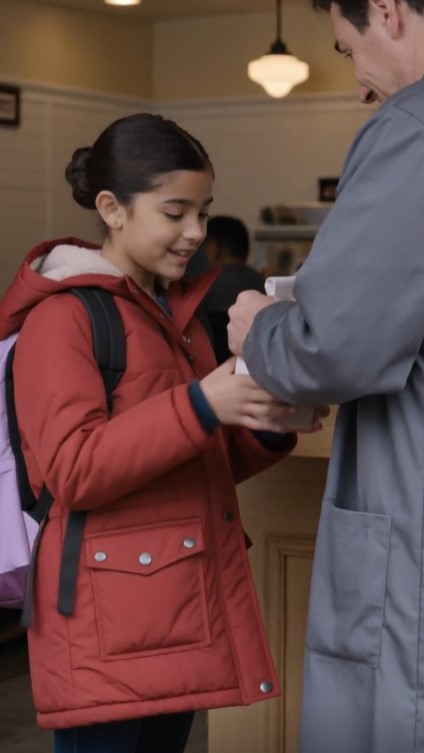
Every morning before school, 12-year-old Mia bought two breakfasts.
One for herself.
One she never ate.
The cashier assumed she had a friend waiting outside.
Then one snowy morning…
he followed her to the window.
Mia crossed the street.
She placed the second breakfast beside an elderly man clearing snow from the sidewalk.
The man smiled.
“Again?”
Mia shrugged.
“You forget to eat.”
The cashier later mentioned it to Mia’s mother.
Her mother went silent.
“What does the man look like?”
The next morning she came with Mia.
The elderly worker was there.
Mia waved.
But her mother stopped walking.
She knew him.
Years earlier, when she was a teenager with nowhere to go after school…
that same man had owned a tiny repair shop.
He let her sit inside every afternoon.
Never asked questions.
Never charged her.
She hadn’t seen him in 24 years.
But when the elderly man noticed Mia’s mother…
he didn’t look surprised.
He reached into his coat.
And removed something he’d carried for more than two decades.
It was a key.
Small.
Brass.
Worn smooth around the edges.
Mia’s mother, Rachel, stared at it.
“No.”
The elderly man smiled.
“You remember.”
Rachel took one step closer.
“That was the back-door key.”
“To the shop.”
“You kept it?”
“For you.”
Mia looked between them.
“Mom?”
Rachel didn’t answer.
Her eyes were fixed on the key.
Twenty-four years earlier, she had been seventeen.
Her father had left.
Her mother worked late shifts.
Their apartment became unbearable after school.
Too quiet some days.
Too angry on others.
Rachel never told anyone exactly why she avoided going home early.
She just walked.
For hours sometimes.
Then one winter afternoon she wandered into a tiny repair shop because it was warm.
The sign above the door read:
HENRY’S REPAIRS
Shoes.
Bags.
Zippers.
Small household items.
Anything Henry could fix with thread, glue, patience, or a screwdriver.
He found Rachel standing near the heater pretending to inspect a broken lamp.
“You need something repaired?”
She shook her head.
“No.”
“Then you need warmth.”
Rachel looked embarrassed.
Henry pointed toward a wooden chair near the back.
“Sit.”
That was it.
No questions.
No lecture.
No demand that she buy anything.
The next afternoon, Rachel came back.
Then the next.
Soon it became routine.
She did homework at the little counter.
Henry worked.
Sometimes they spoke.
Sometimes not.
When Rachel was hungry, Henry mysteriously “ordered too much” from the sandwich shop.
When she needed to print a school paper, he let her use his ancient office printer.
When her backpack zipper broke, he repaired it.
She tried to pay.
He refused.
“You’re already overpaying with terrible conversation.”
Rachel laughed.
Mia stared at him.
“You helped Mom?”
Henry shrugged.
“She mostly helped herself.”
Rachel shook her head.
“That’s not true.”
She looked at Mia.
“There were days I wouldn’t have finished schoolwork without that shop.”
Henry seemed uncomfortable.
“So dramatic.”
Rachel smiled through tears.
“You haven’t changed.”
Then she looked at the key again.
“Why did you give me one?”
Henry remembered.
One afternoon, Rachel arrived and found the shop closed.
She sat outside in the cold until he returned from a medical appointment.
He was furious.
Not at her.
At himself.
The next day, he handed her a spare key.
“If the sign says closed but you need somewhere warm, use the back door.”
Rachel had stared at it.
“You trust me?”
Henry answered:
“Shouldn’t I?”
Nobody had asked her that before.
Not like that.
Rachel kept the key until graduation.
On her final day, she gave it back.
Henry refused.
“Keep it.”
“Why?”
“In case you ever need a door again.”
Rachel carried it for years.
Then during a move in her twenties, she lost it.
Or thought she did.
Now Henry held what looked like the same key.
Rachel frowned.
“That can’t be mine.”
“It isn’t.”
He opened his hand.
A tiny paper tag was attached.
Written in faded ink:
Rachel — spare
“I made another.”
“Why?”
Henry looked at her.
“Because you said you’d come back.”
Rachel stopped.
She had forgotten.
The day before leaving for college, Rachel stood inside Henry’s shop and promised:
“When I get my life together, I’m coming back.”
Henry had laughed.
“Life doesn’t get together. It mostly piles up.”
Still, she promised.
Then college happened.
Work.
Marriage.
Mia.
Her mother’s illness.
A move.
Another move.
The repair shop disappeared from the street years later.
Rachel assumed Henry had retired somewhere far away.
She thought about him often.
But thought never became action.
Until now.
She looked at him clearing snow from a sidewalk for hourly pay.
“What happened to the shop?”
Henry leaned on the shovel.
“Landlord sold the building.”
“When?”
“Sixteen years ago.”
“And after?”
“I worked wherever I could.”
Small repair counters.
Maintenance jobs.
Part-time work.
Eventually retirement.
But retirement money was limited.
So Henry still worked mornings during winter for a local property company.
Nothing dramatic.
A few hours clearing walkways.
Changing salt bins.
Helping with small repairs.
Mia pointed at the untouched breakfast.
“And forgetting to eat.”
Henry smiled.
“Apparently.”
Rachel looked at her daughter.
“How long have you been bringing him food?”
Mia counted.
“Twenty-three days.”
“Why?”
“He gave me his gloves.”
Rachel stared.
Henry immediately objected.
“She forgot hers.”
Mia explained.
Three weeks earlier, she had crossed the street on a bitter morning without gloves.
Henry noticed her rubbing her hands.
He took off his own work gloves and gave her a spare pair from his coat pocket.
Mia returned them the next day.
Then noticed Henry had only coffee for breakfast.
So she started buying two meals.
Henry tried refusing.
Mia ignored him.
Rachel laughed through tears.
“Of course.”
The same man had found her daughter twenty-four years later.
Not through fate.
Not through some grand plan.
Just the same neighborhood.
The same habit.
Henry noticed someone cold.
Mia noticed someone hungry.
That was all.
Then Henry reached into his coat again.
“This isn’t the only thing I kept.”
He removed a folded envelope.
Rachel’s handwriting.
She recognized it immediately.
“What is that?”
“You gave it to me when you graduated.”
Rachel stared.
She had no memory of it.
Henry handed it over.
The paper was yellowed.
On the front:
For Mr. Henry
Rachel opened it.
Her seventeen-year-old self had written:
You never asked me why I stayed after school.
She stopped.
Mia moved closer.
Rachel continued silently at first.
Then aloud.
Thank you for not asking until I was ready.
Her voice cracked.
You made the shop feel like a place where I didn’t have to explain myself.
Henry looked away.
Rachel kept reading.
One day I’m going to have a home where my kids never have to look for somewhere else to feel safe.
Rachel stopped completely.
Mia took her hand.
Henry whispered:
“You did.”
Rachel looked at her daughter.
A warm coat.
Breakfast money.
A stable home.
A girl who could cross the street and help someone because she was not surviving her own childhood.
Rachel started crying.
Mia looked worried.
“Mom?”
Rachel hugged her.
“These are good tears.”
Henry smiled.
Then the final lines:
If I become a decent person, some of that will be because you gave me a chair by the heater when you didn’t have to.
I’ll come back.
Promise.
Rachel lowered the letter.
“I broke it.”
Henry shook his head.
“No.”
“I said I’d come back.”
“You did.”
“Twenty-four years late.”
Henry smiled.
“I’ve had slower repairs.”
Mia laughed.
Rachel did too.
Then she asked:
“Why didn’t you ever try to find me?”
Henry shrugged.
“I knew your married name changed.”
“No social media?”
“I can barely send pictures.”
“That tracks.”
“And anyway…”
He paused.
“You had a life.”
Rachel looked at him.
“You were part of it.”
Henry’s expression softened.
“Then I’m glad.”
The next day, Rachel returned.
Not with one breakfast.
With a folder.
Henry frowned.
“What’s that?”
“Questions.”
“That sounds dangerous.”
She sat beside him.
She wanted to know what he needed.
Not what she assumed he needed.
Housing okay?
Yes.
Medical care?
Mostly covered.
Food?
Fine.
Work?
He actually liked working a little.
What he missed was repairing things.
The property company mostly had him shoveling or doing light maintenance.
His hands were slower.
But still skilled.
Rachel thought for a moment.
Then she had an idea.
She worked at a community center.
They had been trying to start a practical-skills workshop.
Basic sewing.
Zipper repair.
Small household fixes.
Furniture touch-ups.
Things people often threw away because they didn’t know how to repair them.
Rachel asked:
“Would you teach?”
Henry laughed.
“No.”
“Why?”
“I’m old.”
“So?”
“I complain.”
“Perfect for teaching.”
“No.”
Mia interrupted.
“I’ll come.”
Henry looked at her.
“That makes it worse.”
Two weeks later, Henry taught his first Saturday workshop.
Six people came.
The next week, fourteen.
Then twenty-two.
People brought torn backpacks.
Broken jacket zippers.
Loose chair legs.
Lamps that needed simple safe repairs.
Henry refused anything requiring specialized electrical work beyond his qualifications.
“Knowing what not to fix is part of fixing things,” he told them.
Mia became his assistant.
Mostly because she talked to everyone.
Rachel watched from the back.
The small repair shop was gone.
But something about it had returned.
A workbench.
A chair.
A person who never made anyone feel foolish for not knowing how to repair something.
One afternoon, a teenage boy named Caleb stayed after the class ended.
Everyone else left.
He sat at the workbench pretending to sew a strap.
Henry noticed.
“You waiting for someone?”
Caleb hesitated.
“My dad.”
Henry nodded.
Then kept working.
Twenty minutes passed.
Then forty.
Rachel saw it happening.
Same pattern.
Different child.
Henry did not interrogate him.
He simply stayed.
Eventually Caleb admitted his father’s shift ended late and he hated waiting alone at home.
Rachel quietly worked with the community center to arrange a supervised after-school program.
Not because every teenager needed rescuing.
Because sometimes a safe chair mattered.
Henry looked at Rachel when the program began.
“You did that.”
She smiled.
“Learned from somebody.”
Years passed.
Henry stopped snow-clearing work.
The workshop gave him enough structure.
He was paid a modest stipend.
He fought about it.
Rachel won.
Mia grew older.
At sixteen, she could repair almost any backpack zipper.
She hated sewing buttons.
Henry called it a moral failure.
At eighteen, she left for college.
Before going, she handed Henry a small envelope.
He groaned.
“Not another one.”
“Open it.”
Inside was a new brass key.
Attached to it was a tag:
HENRY — SPARE
He stared.
“What does this open?”
Rachel smiled.
“My house.”
Henry looked confused.
Mia said:
“In case you ever need a door.”
For once, Henry had nothing sarcastic to say.
He just held the key.
Then hugged her.
Years later, when Henry’s health declined, Rachel helped with appointments.
Mia called from college.
The community center staff checked in.
He never became dependent on one person.
That mattered to Rachel.
She wanted him supported, not turned into a symbol.
Henry had spent his life helping quietly.
He deserved practical help with dignity.
One winter morning, he could no longer teach regularly.
The community center named the repair room after him.
Henry objected.
Naturally.
The sign went up anyway:
HENRY’S WORKBENCH
Underneath:
FIX WHAT YOU CAN. HELP WHERE YOU CAN.
Henry stared at it.
“I never said that.”
Rachel laughed.
“You say things like it constantly.”
“Still inaccurate.”
Mia came home for the dedication.
She brought two breakfasts.
One for herself.
One for Henry.
He looked at the bag.
“You’re still doing this?”
“You still forget.”
They sat together.
Exactly like that first snowy morning.
Only now Rachel sat with them.
Henry eventually died peacefully in his eighties.
Afterward, Rachel helped clear his small apartment.
There wasn’t much.
Tools.
Photographs.
Three old coats.
A drawer full of screws nobody could identify.
Then Mia found a small wooden box.
Inside were letters.
Thank-you notes.
Dozens.
From people Henry had helped over the years.
A woman whose schoolbag he repaired.
A man whose first interview shoes Henry fixed for free.
A teenager thanking him for a quiet place to wait.
Rachel found her own graduation note.
Still folded.
Beside it was the spare key.
The one Henry had made for her twenty-four years earlier.
He had kept it all along.
Mia whispered:
“Why?”
Rachel smiled through tears.
“Maybe he thought I’d come back.”
At the bottom of the box was one final note.
Henry’s handwriting.
Rachel came back.
Then Mia showed up with breakfast.
Turns out kindness has terrible timing but good memory.
Rachel laughed.
That became the line they framed in Henry’s Workbench.
Years later, Mia returned to the community center with her own daughter.
The little girl saw Henry’s photograph.
“Who’s that?”
Mia smiled.
“The man who gave Grandma somewhere safe to sit.”
“And you?”
“He gave me gloves.”
“That’s it?”
Mia laughed.
“That was enough.”
Then she told the whole story.
A teenager with nowhere comfortable to go after school.
A tiny repair shop.
A chair by the heater.
A spare key.
Twenty-four years.
A snowy sidewalk.
And a twelve-year-old girl who noticed an elderly man kept working without breakfast.
Mia had no idea Henry had once protected her mother’s dignity.
Henry had no idea the girl buying him breakfast was Rachel’s daughter.
They simply helped each other before they knew the history.
That was what Rachel loved most.
The kindness did not return because anyone planned it.
It returned because Mia had learned, without ever being told the story, to notice someone else.
And on a snowy morning twenty-four years after Rachel promised she would come back…
Henry reached into his coat…
pulled out an old brass key…
and proved that some doors stay open far longer than we realize.