
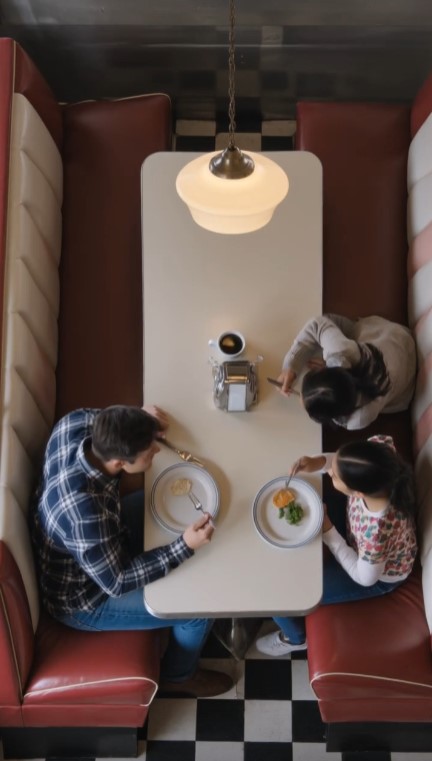
Every Friday, a father brought his two daughters to the same diner.
He ordered them dinner.
Then only coffee for himself.
The waitress assumed he wasn’t hungry.
Until she saw him quietly finishing the crusts they left behind.
The following Friday…
she placed three meals on the table.
“I only ordered two.”
She smiled.
“Tonight there are three.”
He tried to refuse.
Then an elderly customer across the diner stood up.
He had been watching.
He walked over…
looked closely at the father…
and said a name the man hadn’t heard since childhood.
“Danny?”
The father froze.
His fork slipped from his hand.
Nobody had called him Danny in almost thirty years.
Not since before he started using Daniel.
Not since before his mother died.
Not since before he was moved from one relative’s home to another.
He looked up.
The elderly man stood there trembling.
“Do I know you?”
The man pulled off his glasses.
Daniel stared harder.
Something in the face felt familiar.
The eyes.
The crooked smile.
A scar near the eyebrow.
Then one memory surfaced.
A basketball hoop nailed to a garage.
A boy much older than him.
Someone lifting him so he could reach the rim.
Daniel whispered:
“Uncle Robert?”
The elderly man’s eyes filled.
“That’s me.”
Daniel stood so quickly his daughters jumped.
The waitress, Maya, stepped back.
The girls looked between the two men.
Their father never talked about extended family.
Not because there wasn’t any.
Because he thought most of them were gone.
Robert reached for him.
Daniel hesitated for half a second.
Then hugged him.
For several moments, nobody in the diner spoke.
Finally Daniel pulled away.
“I thought you were dead.”
Robert gave a shaky laugh.
“I heard the same about you.”
That sentence changed everything.
Daniel sat back down.
Robert pulled over a chair.
Maya quietly brought another coffee.
Daniel looked at him.
“What happened?”
Robert exhaled.
“That’s a long story.”
Daniel glanced at his daughters.
“Apparently we have time.”
The girls were Lily, nine, and Sophie, seven.
They stared at Robert like he had stepped out of a family legend they had never been told.
Robert smiled at them.
“You two look like your grandmother.”
Daniel’s face changed.
“My mother?”
Robert nodded.
That alone nearly broke him.
Daniel had been ten when his mother, Anna, died.
His father had left years earlier.
After Anna’s death, Daniel went to live with an aunt.
Then another relative.
Then eventually foster care for a short period when family arrangements collapsed.
Robert had been Anna’s younger brother.
At the time, he was twenty-four.
Young.
Working construction.
Living in another state.
Daniel remembered him visiting.
Always loud.
Always joking.
Always promising:
“When I get settled, I’m taking you fishing.”
Then Anna died.
Robert disappeared.
At least, that was what Daniel believed.
Daniel asked:
“Why didn’t you come?”
Robert looked down.
“I did.”
Daniel stared.
“What?”
“I came for you.”
The diner suddenly felt too quiet.
Robert explained.
After Anna died, he drove overnight to attend the funeral.
He wanted Daniel to live with him.
But Robert was unmarried.
Working irregularly.
Living in a one-bedroom apartment.
The relatives handling Anna’s affairs told him Daniel had already been placed with their older sister, Margaret.
Robert accepted it temporarily.
He planned to return once he had stable housing.
Six months later, he did.
Margaret had moved.
No forwarding address.
No one would tell him exactly where Daniel was.
Robert kept searching.
He called relatives.
Wrote letters.
Some answered.
Most didn’t.
Then one uncle told him Daniel had been adopted by another branch of the family and wanted no contact.
Daniel stared.
“That never happened.”
“I know that now.”
Daniel shook his head.
“I waited for you.”
Robert closed his eyes.
“I know.”
“How would you know?”
“Because I found your letters.”
Daniel froze again.
“What letters?”
Robert reached into his coat.
Not letters now.
Photocopies.
Old.
Faded.
The originals were too fragile to carry.
One was written in a child’s handwriting.
Uncle Robert, Aunt Margaret says you moved away. If you come back, I still want to go fishing.
Daniel covered his mouth.
He remembered writing that.
He had forgotten.
Robert continued.
Years later, after Margaret died, her adult son cleaned out her attic.
He found a box.
Inside were letters.
Daniel’s letters to Robert.
Robert’s letters to Daniel.
None mailed.
Someone had kept them.
Daniel stared at the copies.
“Why?”
Robert shook his head.
“I don’t know for certain.”
But the pattern was obvious.
Margaret had been overwhelmed.
She had three children of her own.
Taking Daniel in became difficult.
Robert suspected she was afraid he would accuse her of failing or take Daniel away abruptly.
So instead of admitting how bad things were, she blocked communication.
Maybe she thought she was protecting everyone.
Maybe she was ashamed.
Nobody alive could answer fully.
Daniel looked furious.
“She told me you didn’t want me.”
Robert nodded.
“She told me you were happy and didn’t want contact.”
The same lie.
Different directions.
Daniel rubbed his face.
His daughters had gone quiet.
Lily finally asked:
“Dad, did you really not have anybody?”
Daniel looked at her.
He hated the question.
Not because it was wrong.
Because it was partly true.
“I had people.”
Then he looked at Robert.
“I just didn’t know all of them were looking.”
Robert’s eyes filled.
Maya, the waitress, quietly turned away.
Daniel then asked:
“How did you find me now?”
Robert smiled.
“By accident.”
He had moved back to the area six months earlier.
Retirement.
Cheaper rent.
Closer to an old friend.
Every Friday, he ate dinner at this diner.
For the last month, he had noticed Daniel and the girls.
At first, nothing.
Then he heard one of the daughters call him Dad.
Then Maya called him Daniel while refilling coffee.
Something clicked.
But Robert wasn’t sure.
Today, when Daniel laughed at something Sophie said, Robert recognized Anna’s laugh.
That was enough.
Daniel looked embarrassed.
“You were watching us?”
“Trying not to be creepy.”
“Failed.”
Robert laughed.
Then his expression shifted.
“I also noticed the coffee.”
Daniel looked down.
The untouched third meal was still there.
Robert had seen him order only food for the girls.
He saw Daniel drink coffee slowly.
Saw him eat their leftovers.
Robert knew what that meant.
He had been poor too.
Daniel immediately said:
“We’re fine.”
Maya crossed her arms.
Robert smiled.
“Of course.”
Daniel looked at both of them.
“Seriously.”
Maya pointed at the plate.
“Eat.”
Daniel sighed.
The truth was simple.
His wife, Emma, had died two years earlier after a short illness.
Daniel had gone from a two-income household to one.
Then his work hours were reduced.
Bills accumulated.
He kept the girls’ routines as normal as possible.
Friday diner night had been Emma’s tradition.
He refused to give it up.
The girls didn’t know money was tight.
So Daniel ordered what they liked.
Coffee for himself.
If they left food, he ate it.
He called it “not being hungry.”
Maya noticed.
So she decided to cover his meal herself.
The diner manager had agreed.
Daniel hated charity.
But he was too tired to fight everyone.
Robert looked at the girls.
Then at Daniel.
“You always hated accepting help.”
Daniel stared.
“You remember?”
“You were ten.”
“Still.”
Robert smiled.
“Anna was the same.”
That night, Robert paid for dinner.
Daniel protested.
Robert ignored him.
Then he asked:
“Can I see you again?”
Daniel hesitated.
Not because he didn’t want to.
Because thirty years of absence does not disappear over one plate of meatloaf.
Robert understood.
“Coffee next Friday?”
Daniel nodded.
“Coffee.”
That became the beginning.
Robert returned the next Friday.
Then the next.
At first, the girls were shy.
Then Sophie discovered Robert could draw terrible horses.
That made him fascinating.
Lily asked him questions about Anna.
Lots of them.
“What was Grandma like?”
“Did she get mad?”
“Did she sing?”
“Was Dad annoying?”
Robert laughed.
“Extremely.”
Daniel rolled his eyes.
But secretly, he listened to every story.
His mother had been dead so long that some memories had faded.
Robert restored details.
Anna hated thunderstorms but pretended she didn’t.
She once entered a pie contest and forgot sugar.
She used to dance in the kitchen when the radio played Motown.
She called Daniel “Danny Boy” when he was little.
Daniel stared at the table.
“I forgot that.”
Robert nodded.
“That’s why I’m here.”
The letters came next.
Robert brought the whole box eventually.
Not only the blocked letters between them.
There were photographs.
Anna’s recipes.
Old report cards.
A birthday card Daniel made at eight.
One photograph showed Daniel sitting on Robert’s shoulders.
Behind them was a lake.
Daniel smiled.
“The fishing trip.”
Robert laughed.
“We did go once.”
“I thought I imagined that.”
“Nope.”
Daniel showed the girls.
“That’s me.”
Sophie stared.
“You were tiny.”
“I was nine.”
“You looked five.”
“Thank you.”
The relationship grew slowly.
Robert never tried to become a parent.
Daniel was forty now.
He didn’t need one.
But he did need family.
And the girls needed stories.
Robert started helping in practical ways too.
Not money first.
Daniel would reject that.
He picked the girls up from school once a week when Daniel worked late.
Helped with homework badly.
Burned grilled cheese consistently.
Then one afternoon, Daniel’s car died.
Repair estimate: too much.
Daniel sat at the diner staring at the paperwork.
Robert said:
“I have two cars.”
“No.”
“You don’t even know what I’m offering.”
“Yes, I do.”
Robert had an old sedan.
Not pretty.
But reliable.
He wanted Daniel to use it.
Daniel refused.
Robert got angry.
“You are not ten anymore.”
Daniel looked shocked.
Robert continued.
“And I’m not twenty-four.”
“I missed every chance to help you then.”
“Don’t make me miss every chance now because it makes you uncomfortable.”
Daniel stood.
“That’s not fair.”
Robert nodded.
“You’re right.”
Then he softened.
“Sorry.”
That mattered.
No manipulation.
No emotional debt.
Robert backed off.
Two days later, Daniel called.
“I’ll borrow it.”
Robert smiled.
“Good.”
“Borrow.”
“Of course.”
Three years later, Daniel was still driving it.
Everyone stopped pretending.
Maya remained part of the story too.
The diner meal that started everything became a standing joke.
Every Friday she asked:
“Three meals?”
Daniel answered:
“Three meals.”
Eventually four.
Robert joined.
Then sometimes five when Mia, Maya’s daughter, came after school.
The table became crowded.
That was the point.
Then one Friday, Robert brought another envelope.
“This one I almost didn’t show you.”
Daniel opened it.
Anna’s handwriting.
Dated only weeks before she died.
Robert,
If anything happens to me, please keep an eye on Danny.
Daniel stopped.
Robert looked down.
He acts tougher than he is.
Lily giggled.
Daniel gave her a look.
The letter continued.
He won’t ask for help even when he needs it.
Maya laughed from across the room.
Daniel groaned.
“This is a conspiracy.”
Then the final line:
Make sure he knows family can come back after making mistakes.
Robert’s face crumpled.
He had carried guilt for decades.
Not because he abandoned Daniel.
He hadn’t.
But because he eventually stopped searching.
After years of dead ends, Robert built another life.
He married.
Raised a son.
Moved overseas for work.
He told himself Daniel was happy.
It was easier.
Now Anna’s words hit him differently.
Daniel folded the letter.
“You did come back.”
Robert nodded.
“Late.”
“Still.”
That became enough.
Years passed.
Daniel’s financial situation improved.
He found steadier work.
Paid off debts.
The girls grew.
Friday dinner remained.
Not because they needed the cheap special anymore.
Because the diner had become family ground.
When Lily turned sixteen, she got her first job.
At the diner.
Maya trained her.
Daniel complained.
“You’re encouraging this?”
Maya smiled.
“She works harder than you.”
Robert ordered pancakes every shift just to embarrass Lily.
Sophie later joined the school theater program.
Robert attended every performance.
Even the terrible ones.
Especially those.
Then Robert’s health began declining.
Nothing sudden.
Age.
Heart problems.
Mobility issues.
Daniel drove him to appointments.
One afternoon, sitting in the clinic parking lot, Robert said:
“Funny.”
“What?”
“I spent thirty years wishing I could take care of you.”
Daniel smiled.
“And now?”
“You complain about my sodium.”
“You need less salt.”
“Betrayal.”
Daniel laughed.
The old resentment had not vanished completely.
Sometimes he still thought about the childhood letters sitting unsent in Margaret’s attic.
All those birthdays.
All those years.
But anger no longer defined what remained.
Robert had not caused the separation.
He had simply been another person caught inside it.
When Robert eventually died peacefully in his eighties, Daniel was with him.
So were Lily and Sophie.
At the memorial, the girls placed the old fishing photograph beside his urn.
Daniel spoke briefly.
He told the truth.
“I lost my uncle when I was a child.”
“Then found him again because he saw me eating my daughters’ leftover crusts in a diner.”
People laughed.
Daniel continued.
“I used to think family was only the people who stayed.”
He looked at the girls.
“Now I think sometimes it’s also the people who find their way back.”
Years later, Daniel still ate at the same diner.
Maya eventually became manager.
Lily moved away for college.
Sophie attended nearby.
Friday dinners changed.
Sometimes only Daniel and Maya sat there.
Then one evening, a young father came in with a little boy.
He ordered one meal for the child.
Coffee for himself.
Daniel noticed.
He watched the father push the plate toward his son.
Then finish one cold French fry after the boy stopped eating.
Daniel called Maya over.
She already knew.
“Three meals?” she asked quietly.
Daniel smiled.
“Two.”
She brought another plate.
The young father looked confused.
“I didn’t order this.”
Maya smiled.
“Tonight there are two.”
Daniel said nothing.
He didn’t walk over.
Didn’t tell his own story.
Didn’t make the man explain himself.
Some kindness works better without an audience.
He simply paid.
On his way out, Daniel looked toward the booth where Robert first called him Danny.
For years, he believed that name belonged to a childhood that had disappeared.
Now it reminded him of something else.
A lost uncle.
A box of unopened letters.
Two daughters who gained a piece of family history.
And one waitress who noticed that a father claiming not to be hungry was surviving on crusts.
The extraordinary moment was not Robert recognizing him.
It was everything that happened because people noticed.
Maya noticed Daniel wasn’t eating.
Robert noticed a familiar face.
Daniel finally noticed that accepting help did not make him less of a father.
And decades after one family had been separated by fear, pride, and unopened letters…
they found each other again over three plates in a neighborhood diner.