
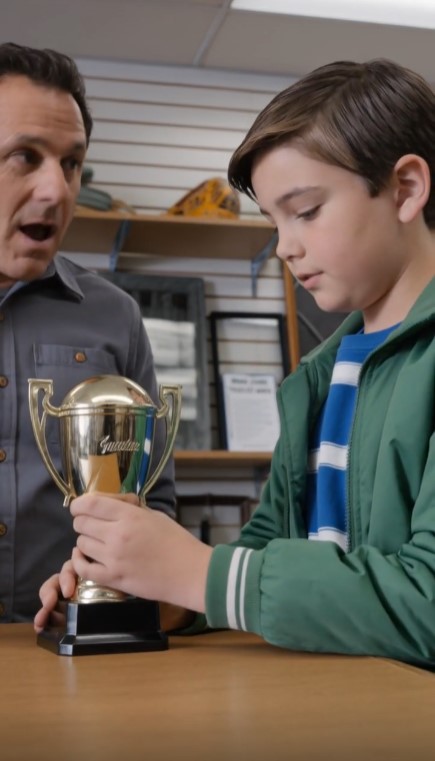
The shop owner couldn’t believe it.
A 13-year-old boy placed his soccer trophy on the counter.
“How much?”
The owner laughed at first.
Then saw the boy wasn’t joking.
“Twelve dollars.”
“Why do you need twelve dollars?”
The boy looked toward the pharmacy next door.
“My grandma’s birthday.”
He wanted to buy the perfume she used years ago.
The shop owner pushed the trophy back.
Then opened his wallet.
But before he could give the boy anything…
an elderly woman behind them said:
“Don’t.”
She walked forward.
Picked up the trophy.
And stared at the boy’s surname.
Her face changed.
“Who is your grandmother?”
The boy answered.
The woman sat down immediately.
“Margaret Carter.”
The elderly woman whispered the name back.
Then covered her mouth.
The boy, Ethan, looked confused.
“You know her?”
The woman nodded slowly.
“My name is Evelyn.”
She looked down at the trophy again.
“And your grandmother once saved my life.”
The shop owner stopped moving.
Ethan stared.
“My grandma?”
Evelyn nodded.
“Long before you were born.”
She asked if they could sit.
The owner brought over a chair.
Ethan kept one hand on his trophy.
He still didn’t understand why this stranger looked like she might cry.
Evelyn began.
Thirty-six years earlier, she and Margaret had worked together at a small clothing factory on the edge of town.
Margaret was twenty-eight.
Evelyn was twenty-four.
They were not close friends at first.
Margaret was quiet.
Evelyn talked constantly.
Margaret packed lunch every day.
Evelyn forgot hers constantly.
Eventually, they became inseparable.
Then one winter everything changed.
Evelyn’s husband left.
She had a two-year-old daughter.
Rent was overdue.
Her car had stopped running.
And the factory announced temporary layoffs.
Evelyn panicked.
She told nobody.
Not even Margaret.
She simply stopped eating lunch.
Stopped buying coffee.
Walked nearly four miles to work.
And pretended everything was fine.
Margaret noticed.
Of course she did.
One Friday, Evelyn opened her locker and found an envelope.
Inside was enough money for groceries.
No note.
She immediately knew.
She marched over to Margaret.
“You did this.”
Margaret didn’t look up from her sewing machine.
“Did what?”
“This.”
She held up the envelope.
Margaret shrugged.
“Looks like money.”
“I can’t take it.”
“Then don’t.”
“You put it in my locker.”
“Prove it.”
Evelyn almost laughed despite herself.
She tried to return it.
Margaret refused.
Then said something Evelyn never forgot.
“You can pay me back when life stops stepping on your neck.”
Ethan smiled.
“That sounds like Grandma.”
Evelyn laughed through tears.
“Yes.”
But the money wasn’t the thing Evelyn meant when she said Margaret saved her life.
A week later, Evelyn didn’t show up for work.
Margaret knew immediately something was wrong.
She went to Evelyn’s apartment after her shift.
No answer.
She knocked again.
Heard the little girl crying inside.
Margaret called for help.
Emergency responders came.
Evelyn had become seriously ill and collapsed.
Her daughter was safe.
Evelyn recovered.
Doctors later told her that if nobody had checked for much longer, the outcome could have been far worse.
She looked at Ethan.
“Your grandmother noticed I was missing.”
“That’s all?”
Evelyn smiled.
“That was enough.”
Margaret took care of Evelyn’s daughter during the hospital stay.
Brought food.
Helped with rent.
Never made a big speech.
Never wanted thanks.
Then Evelyn moved away two years later.
They promised to stay in touch.
At first they did.
Birthday cards.
Christmas calls.
Letters.
Then one year became another.
Phone numbers changed.
Margaret moved.
Evelyn moved twice.
Eventually they lost each other.
Ethan listened quietly.
Then asked:
“Why did you recognize my name?”
Evelyn pointed to the trophy.
The engraved plate read:
ETHAN CARTER
Margaret’s surname.
“I spent years looking for her.”
“You did?”
“Yes.”
“Why?”
Evelyn smiled.
“To pay her back.”
The shop owner finally spoke.
“You’ve been waiting thirty-six years to repay grocery money?”
Evelyn shook her head.
“No.”
Then she looked at Ethan.
“I wanted to tell her what happened to my daughter.”
Evelyn’s little girl, Laura, grew up.
Went to college.
Became a pharmacist.
Opened her own pharmacy.
Ethan looked toward the store next door.
The pharmacy.
Evelyn smiled.
“That’s hers.”
Ethan’s mouth fell open.
“You mean the perfume is in your daughter’s shop?”
“Yes.”
The coincidence made him laugh.
Then Evelyn asked:
“Why perfume?”
Ethan looked embarrassed.
“My grandma has an old bottle.”
“Empty?”
“Almost.”
“She keeps it in her dresser.”
He had once asked why she never threw it away.
Margaret said it was the perfume she wore when she was young.
Back when she worked at the factory.
Back when Ethan’s late grandfather first asked her out.
The brand was discontinued in many places.
But Laura’s pharmacy had recently started carrying a small vintage-inspired fragrance line.
One bottle smelled almost exactly like it.
Ethan saved money for weeks.
He was still twelve dollars short.
That was why he brought the trophy.
It was the biggest trophy he had ever won.
His team had taken the regional championship.
The shop owner looked at him.
“And you were going to sell this?”
Ethan shrugged.
“Grandma doesn’t care about soccer trophies.”
“She cares about you.”
“I know.”
“Then she’d probably care.”
Ethan looked down.
The shop owner pushed the trophy back toward him again.
“No sale.”
Ethan frowned.
“But I need twelve dollars.”
Evelyn stood.
“No, you don’t.”
Ethan immediately shook his head.
“I’m not taking money.”
Evelyn smiled.
“Definitely your grandmother.”
Then she walked next door.
Five minutes later, she returned with Laura.
Laura was in her sixties now.
Still working several days a week.
Evelyn explained everything.
Laura stared at Ethan.
“Your grandmother is Margaret Carter?”
“Yes.”
Laura looked at her mother.
“The woman who looked after me?”
Evelyn nodded.
Laura’s eyes filled.
She disappeared into the pharmacy.
Then came back with a small gift bag.
Ethan stepped away.
“I can’t take it free.”
Laura said:
“You’re not.”
“What do you mean?”
“You’re delivering something.”
Inside was the perfume.
And an envelope.
“For your grandmother.”
Ethan looked uncertain.
“What do I owe you?”
Laura smiled.
“One thing.”
“What?”
“Let us come with you.”
Ethan’s grandmother lived only ten minutes away.
When they arrived, Margaret was in the kitchen.
She heard Ethan enter.
“You’re early.”
Then Evelyn stepped inside.
Margaret looked up.
The dish towel fell from her hand.
For several seconds, neither woman moved.
Then Margaret whispered:
“No way.”
Evelyn smiled.
“Took me long enough.”
Margaret crossed the kitchen.
They hugged.
Not politely.
Not cautiously.
The kind of hug that comes after decades.
Ethan stood by the door holding the gift bag.
Laura cried openly.
Margaret pulled away and saw her.
“Laura?”
Laura nodded.
“You remember me?”
Margaret laughed.
“You bit me when you were three.”
Laura covered her face.
Ethan burst out laughing.
“I did not know that.”
Margaret pointed.
“She absolutely did.”
The room changed.
Suddenly nobody was old.
Nobody had been lost for thirty-six years.
They were back in a cramped apartment.
A factory.
A hospital waiting room.
A period of life both women thought had disappeared.
Then Ethan handed Margaret the perfume.
“Happy birthday.”
She opened it.
Sprayed a little into the air.
Then froze.
Her face softened.
“That smell.”
Ethan smiled.
“You like it?”
Margaret sat down.
“My husband loved this.”
She closed her eyes.
“For one second, I could see him again.”
Ethan’s eyes filled.
That was worth more than any trophy.
Then Laura handed Margaret the envelope.
Margaret opened it.
Inside was a photograph.
Evelyn with young Laura.
On the back:
You checked on us when nobody else did. She grew up because you noticed.
Margaret shook her head.
“Oh, stop.”
Evelyn laughed.
“You still hate being thanked?”
“Yes.”
“Too bad.”
Then Evelyn added something else.
“I’ve been trying to find you for years.”
Margaret looked surprised.
“Why?”
“I owed you.”
“No.”
“Yes.”
Margaret waved her off.
“You owed me nothing.”
Evelyn smiled.
“I knew you’d say that.”
Then Laura explained.
For years, her pharmacy had quietly kept a small emergency fund.
If an elderly customer couldn’t afford a prescription copay, or a parent came up short for basic medicine, the staff had discretion to help.
It wasn’t huge.
It didn’t solve everything.
But over the years, hundreds of people had benefited.
Laura called it:
The Margaret Fund.
Margaret stared.
“What?”
Laura laughed.
“Mom named it.”
Margaret turned to Evelyn.
“You used my name?”
“Only the first one.”
“You had no right.”
“You’ll survive.”
Margaret started crying.
Ethan had never seen her cry like that.
Not sad.
Overwhelmed.
Thirty-six years earlier, she had put grocery money into a coworker’s locker.
She never expected repayment.
Never knew the act would be remembered.
Never knew it would become a fund helping strangers decades later.
She looked at Ethan.
Then at the trophy still under his arm.
“What’s that?”
Ethan suddenly looked guilty.
“Nothing.”
Margaret narrowed her eyes.
“What did you do?”
The shop owner, who had come along because by then everyone was invested, cleared his throat.
“He tried to sell it.”
Margaret looked horrified.
“What?”
“For the perfume.”
Ethan stared at the floor.
“I was twelve dollars short.”
Margaret took the trophy.
Read the engraving.
Regional championship.
Her grandson’s name.
She sat beside him.
“Ethan.”
“I thought you’d like the perfume more.”
Margaret pulled him close.
“I do love the perfume.”
He smiled.
“But?”
“But never sell something you earned because you think love needs a price tag.”
Ethan looked at her.
“You sold things for people before.”
Margaret laughed.
“Fair point.”
Evelyn laughed too.
Then Margaret said:
“But I was an adult.”
“And I made choices with money I could replace.”
“This trophy is part of your life.”
Ethan shrugged.
“You’re part of mine.”
Margaret’s argument ended there.
She hugged him tighter.
That evening turned into dinner.
Nobody planned it.
Laura ordered food.
The shop owner stayed.
Stories filled the table.
Evelyn told Ethan about young Margaret.
How she once argued with a supervisor for twenty minutes over a broken heater.
How she could sew faster than anyone at the factory.
How she secretly hated dancing.
Margaret objected to all of it.
Most of it was true.
Laura told Margaret about the life she never got to see.
College.
Marriage.
Children.
The pharmacy.
Margaret listened like she was recovering missing chapters.
Then she said:
“I should’ve looked harder for you.”
Evelyn shook her head.
“We both should have.”
No blame.
Just regret.
They decided not to lose another year.
Every Wednesday, Evelyn visited Margaret.
Sometimes Laura came too.
Ethan started stopping by the pharmacy after soccer practice.
Laura refused to give him free things.
Mostly because he insisted.
Instead, she gave him small jobs.
Stocking greeting cards.
Breaking down boxes.
Cleaning shelves.
He earned money.
The first thing he bought was another bottle of Margaret’s perfume for later.
The second was a frame for his trophy.
Margaret displayed it in the living room.
Beside it sat the perfume bottle.
Years passed.
The Margaret Fund grew.
Not because of one viral story or wealthy donor.
Because customers heard about it quietly and contributed.
Five dollars.
Ten.
Twenty.
Laura kept it transparent and properly managed through the pharmacy’s community assistance program.
Margaret hated having her name attached.
Eventually she accepted it.
On one condition.
“No picture of me.”
Laura agreed.
Mostly.
There was one small framed photograph in the staff room.
Margaret and Evelyn laughing at the kitchen table.
No customers saw it.
When Ethan turned eighteen, he graduated high school.
Margaret sat in the front row.
So did Evelyn.
Laura too.
Afterward, Ethan handed his grandmother an envelope.
Inside was twelve dollars.
Margaret frowned.
“What is this?”
“The money I was short that day.”
She laughed.
“You’re ridiculous.”
“I know.”
“Keep it.”
“No.”
She took it eventually.
Then slipped it into the Margaret Fund the next morning.
Of course she did.
Ethan went to college.
He kept playing soccer, though he never became professional.
That didn’t matter.
The old trophy remained in Margaret’s living room.
Years later, when Margaret’s health began to decline, Ethan visited often.
The perfume bottle still sat on her dresser.
Almost empty again.
He asked:
“Want another?”
She shook her head.
“No.”
“Why?”
She smiled.
“This one lasted long enough.”
Margaret died peacefully in her eighties.
At her memorial, there were photographs of family.
Her late husband.
Ethan.
Factory friends.
And Evelyn.
Laura placed the old perfume bottle beside a small card:
She noticed when someone was missing.
Ethan placed the soccer trophy next to it.
The one he almost sold for twelve dollars.
Evelyn lived several years longer.
When she died, Laura gave Ethan one final box.
Inside was the original photograph from the factory.
Margaret and Evelyn standing beside each other.
Young.
Tired.
Laughing.
On the back, Evelyn had written:
Some debts should never be repaid. They should be passed on.
Ethan framed it.
Years later, he told his own children the story.
They loved the beginning.
A thirteen-year-old walking into a resale shop with a soccer trophy.
A shop owner asking:
“How much?”
“Twelve dollars.”
A stranger hearing his surname.
Then everything changing.
But Ethan always told them the important part came long before that.
An exhausted young mother missed work.
One woman noticed.
She knocked on the door.
Called for help.
Sat with a frightened child.
And then went back to work the next day without telling anyone she had done something extraordinary.
Margaret never thought she saved a life.
She thought she checked on a friend.
Thirty-six years later…
that friend recognized Margaret’s grandson because of one name engraved on a soccer trophy.
And what began as a boy trying to buy his grandmother a birthday gift became something much bigger.
A lost friendship returned.
A family story completed.
And a kindness Margaret had almost forgotten came all the way back to her.
Not as twelve dollars.
Not as a debt.
But as proof that the smallest things we do for people can keep moving long after we stop looking for them.