
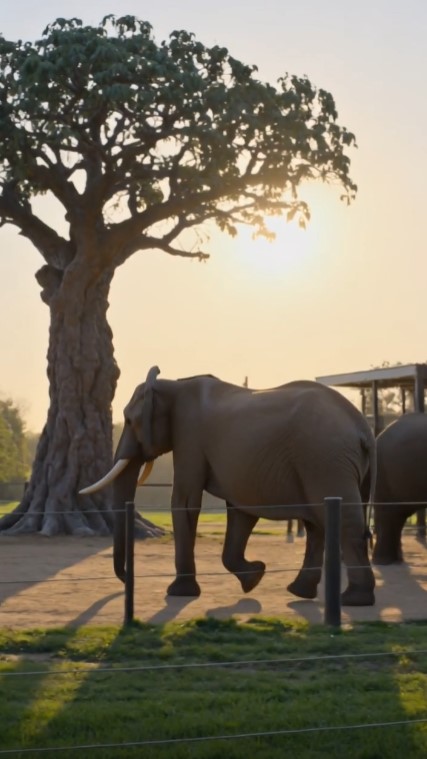
Every sunset, Mara left the herd…
walked to one old tree…
and touched the trunk with her forehead.
Then returned.
Nobody understood.
A retired ranger visited the sanctuary years later.
The moment he saw the tree…
he went silent.
Twenty-six years earlier, he had sat beneath it every afternoon while caring for a young orphaned elephant.
Her name was Mara.
He hadn’t seen her since.
He stood safely behind the barrier.
“Mara?”
The elephant turned.
Stopped.
Then slowly walked toward him.
But before reaching the barrier…
she turned around.
And called to a younger elephant.
The ranger stared.
The younger animal had the same unusual ear notch…
as Mara’s mother.
The retired ranger’s name was Joseph.
He gripped the railing.
For several seconds, he forgot how to speak.
The younger elephant stayed close to Mara.
Same gray-brown hide.
Same slow movements.
But the notch in her left ear was unmistakable.
A narrow V-shaped cut near the top.
Joseph had seen one exactly like it before.
Twenty-six years earlier.
On Mara’s mother.
He whispered:
“No.”
The sanctuary director, Rachel, looked at him.
“What?”
Joseph pointed toward the younger elephant.
“That ear.”
Rachel frowned.
“What about it?”
“Mara’s mother had the same marking.”
Rachel became quiet.
The younger elephant was named Nia.
She had arrived at the sanctuary only three years earlier.
Her records were incomplete.
The transfer documents listed her mother as a female called Amara.
Nothing more.
Joseph kept staring.
“Did you say Amara?”
Rachel nodded.
Joseph closed his eyes.
“That was Mara’s mother’s calf name.”
Rachel looked toward the herd.
“You think Nia is related to Mara?”
Joseph answered carefully.
“I think we need records before we think anything.”
He had spent too many years around wildlife to turn resemblance into proof.
Ear notches could happen for many reasons.
Names could repeat.
Old records could be wrong.
But something about the combination had shaken him.
Rachel invited Joseph into the sanctuary office.
They pulled Nia’s paperwork.
Previous facility.
Transfer dates.
Approximate age.
Maternal line.
Joseph leaned closer.
His hands started trembling.
The birthplace listed on the document was the same protected reserve where he had worked decades earlier.
He sat back.
“That’s where Mara was born.”
Rachel looked at him.
“You’re sure?”
“I lived there fifteen years.”
Joseph pointed to the record.
“And Amara was the name of Mara’s older sister.”
Rachel looked confused.
“I thought you said Mara was orphaned.”
“She was.”
Joseph explained.
Mara had not been born alone.
Her mother had two calves.
The older one, Amara, was around six years old when tragedy struck.
The mother died during a severe drought after becoming weakened and ill.
Rangers tried to keep the sisters together.
But conditions became difficult.
Amara was old enough to remain with part of the larger family group.
Mara was not.
She was still dependent.
So Joseph’s team temporarily took responsibility for her care.
That was how he met her.
Every afternoon, after feeding and monitoring, Joseph sat beneath the old tree.
Not touching Mara unnecessarily.
Not treating her like a pet.
Just nearby.
Sometimes reading.
Sometimes writing field notes.
Sometimes talking softly while she rested in the shade.
The tree became part of the routine.
Joseph said:
“Mara used to stand beside that trunk.”
Rachel looked toward the pasture.
“The same one?”
Joseph nodded.
The sanctuary property had once been connected to a much larger reserve.
Boundaries changed over time.
Fences moved.
Land management changed.
But the tree remained.
Mara had been relocated to another conservation program years later.
Joseph left the field shortly afterward.
He never expected to see her again.
Rachel asked:
“How did she end up back here?”
Joseph laughed sadly.
“Elephants travel through more paperwork than people realize.”
Mara had moved twice over the decades as facilities changed and sanctuaries consolidated herds.
Eventually, she ended up not far from where she had spent part of her youth.
Nobody on the current team had realized the tree was connected to her earlier history.
To them, it was simply an old acacia near the edge of the habitat.
Joseph looked through the window.
Mara was still near Nia.
He whispered:
“And every sunset she goes there?”
“Almost.”
“Since when?”
“Years.”
Joseph covered his mouth.
Rachel immediately added:
“We don’t know why.”
Joseph nodded.
“Good.”
He was glad she said that.
He didn’t want anyone claiming the tree represented grief or memory as if an elephant had explained it.
Animals can maintain long-term associations with places, individuals, sounds, and routines.
But people often fill uncertainty with stories.
Joseph had learned to resist that.
Still…
Mara’s routine was real.
The tree was real.
And now Nia was real.
The sanctuary began researching.
Not publicly.
Quietly.
They contacted former facilities.
Old reserve staff.
Veterinary archives.
Transfer coordinators.
Joseph provided names of people long retired.
One week later, the first important record arrived.
A reproductive history for Amara.
Joseph read it twice.
Then called Rachel.
“Amara had a calf.”
Rachel already knew what he meant.
“When?”
“Thirteen years ago.”
“Female?”
“Yes.”
“Name?”
Joseph swallowed.
“Nia.”
That still didn’t prove the current Nia was the same animal.
So they continued.
Microchip records.
Transfer numbers.
Photographs.
Veterinary identifiers.
Then came confirmation.
The younger elephant standing beside Mara was indeed Amara’s daughter.
Mara’s niece.
Not her daughter.
Not her granddaughter.
Her sister’s calf.
Joseph sat silently when Rachel told him.
“So Amara survived.”
“For many years.”
“What happened to her?”
Rachel hesitated.
“She died five years ago.”
Joseph lowered his head.
“Was it peaceful?”
“According to the records, yes. Age-related complications after a long managed life.”
Joseph nodded.
Then smiled faintly.
“And Nia ended up here.”
“Yes.”
By coincidence.
No one had intentionally reunited the family line.
Nia had been transferred because her previous facility reorganized its elephant group.
Mara happened to already live here.
The staff had observed that the two often stayed near one another.
They simply never knew why that relationship interested Joseph so deeply.
Nobody claimed Mara understood Nia was her niece.
There was no way to establish that.
But the biological relationship was confirmed.
And the social bond was observable.
Mara often moved near Nia.
Nia sometimes followed her.
They rested within the same cluster.
They communicated.
That was enough.
Joseph returned the following week.
He sat behind the protected viewing barrier.
No special treatment.
No staged interaction.
Mara was across the habitat.
Nia nearby.
Joseph whispered:
“I can’t believe you’re here.”
Mara continued feeding.
He laughed.
“Good. Ignore me.”
Twenty minutes passed.
Then Mara raised her head.
Walked toward the old tree.
Joseph watched.
She stood there.
Pressed her forehead lightly against the trunk.
Then stepped away.
Nia followed.
Joseph started crying.
Rachel stood beside him.
“What are you thinking?”
Joseph shook his head.
“Nothing scientific.”
She smiled.
“Allowed.”
He looked at the tree.
“When Mara was small, I used to sit there because it was the only place she settled.”
Rachel asked:
“Did she touch the trunk then?”
“Sometimes.”
“Like that?”
“I honestly don’t remember.”
That honesty mattered.
Memories change.
Stories become cleaner with time.
Joseph did not want to pretend certainty where there wasn’t any.
He only knew the tree had been part of Mara’s early life.
And now, decades later, she returned to it repeatedly.
That alone moved him.
Then Nia did something unexpected.
She stepped close to the trunk.
Smelled the bark.
Then stood beside Mara.
Joseph stared.
Rachel said quietly:
“Could just be following.”
“I know.”
But he smiled.
The sanctuary decided not to advertise the discovery as some miraculous reunion.
Instead, they updated Mara and Nia’s internal family records.
That mattered for welfare management.
Knowing lineage can help staff understand social histories and avoid accidental breeding issues where relevant.
It also gave context to years of observations.
Joseph offered to help organize older records.
He was retired.
Seventy-eight.
His knees were bad.
Travel was difficult.
But memory remained sharp.
He spent hours on video calls identifying old photographs.
“That’s Mara.”
“That one is Amara.”
“No, that date is wrong.”
“That ranger was Samuel, not Peter.”
The sanctuary recovered a photograph Joseph had forgotten existed.
Young Mara standing near the old tree.
Behind her, several feet away, was Joseph.
Sitting in the shade with a notebook.
Rachel emailed it to him.
Joseph stared at it for a long time.
Then printed it.
He placed it beside a newer photograph.
Mara at the same tree.
Nia beside her.
Twenty-six years between them.
Joseph’s daughter, Emily, found him looking at both.
“You okay?”
“No.”
“Bad no?”
He smiled.
“Old-man no.”
Emily sat beside him.
She had grown up hearing about Mara.
As a child, she used to complain that her father cared more about elephants than birthdays.
Joseph denied this.
Poorly.
Now she asked:
“Did Mara remember you?”
Joseph thought.
“She responded when I called her.”
“So yes?”
“Maybe.”
“That’s annoyingly careful.”
“Because it’s honest.”
Emily smiled.
Joseph explained.
Mara had heard thousands of voices.
Seen countless people.
Moved across decades and environments.
Maybe she recognized his voice.
Maybe his appearance.
Maybe some combination.
Maybe she simply responded to attention.
He would never know.
But she approached.
That was enough for him.
Months later, the sanctuary arranged another visit.
This time Emily came too.
Joseph sat behind the barrier near the old tree.
Mara was farther away.
Nia was beside her.
Joseph said nothing.
He wanted no performance.
No expectation.
Eventually Mara moved toward the tree.
Nia followed.
Joseph watched.
Then Mara stopped.
Turned.
Looked in his direction.
Joseph smiled.
“Hello.”
Mara gave a low vocalization.
Nia responded.
Emily reached for her father’s hand.
He squeezed it.
“That sound,” Joseph whispered.
“What?”
“Mara used to make something similar when she was young.”
Emily looked at him.
“Careful.”
Joseph laughed.
“You’ve learned.”
“I had a good teacher.”
The visits became annual.
Joseph could not travel often.
But each one mattered.
The sanctuary also traced more of Mara’s early history.
They learned Amara had remained with the reserve herd for years before being transferred under a conservation agreement.
That explained why the sisters separated permanently.
Not cruelty.
Not abandonment.
Different management needs.
Different age groups.
Different facilities.
A complicated history shaped by conservation practices that evolved over time.
Joseph insisted the record include context.
“Don’t turn everyone in the past into villains.”
Rachel agreed.
“Standards change.”
“Exactly.”
Mara grew older.
So did Nia.
Their relationship remained stable.
Sometimes they were together.
Sometimes apart.
Nia formed bonds with other elephants too.
Joseph liked that.
He did not want her identity reduced to “Mara’s niece.”
She had her own social life.
Her own habits.
Her own preferences.
Then one year Joseph became too ill to travel.
The sanctuary arranged a video call.
He sat at home with Emily.
Rachel carried the device to an observation area.
Mara was near the tree.
Joseph smiled.
“There she is.”
Of course Mara did not react dramatically to a screen.
She grazed.
Moved.
Ignored technology.
Joseph laughed.
“Exactly how I expected.”
Then Nia appeared.
Joseph grew quiet.
“Same ear.”
Emily smiled.
“You spotted that from hundreds of feet away.”
“I knew the family.”
That sentence mattered to him.
Not “I owned her.”
Not “she was mine.”
He had cared for her.
Observed her.
Protected her during one chapter.
Then the elephants continued without him.
That was how it should be.
Joseph died peacefully the following winter.
At his request, there was no memorial placed inside the elephant habitat.
He had written:
The sanctuary belongs to the animals. Do not turn their space into my graveyard.
Rachel respected that.
Instead, they created a small archive room for field history.
On one wall hung two photographs.
Young Mara at the tree.
Older Mara with Nia nearby.
Beneath them:
JOSEPH MILLER — RANGER, RECORD KEEPER, PATIENT OBSERVER
Emily donated his notebooks.
One contained an entry from twenty-six years earlier.
Mara settled near the acacia again today.
Sat nearby until sunset.
She seems calmer there.
Nothing poetic.
No prediction.
Just a field note.
Emily cried when she read it.
The sunset routine had been there all along.
Years later, sanctuary staff still noticed Mara visiting the tree.
Not every evening anymore.
Age changed her routine.
Sometimes Nia went near it too.
Sometimes neither did.
The tree remained.
One storm split a large branch.
Staff checked whether it posed a safety risk.
It didn’t.
So they left it.
Visitors occasionally heard the story.
But guides told it carefully.
They never said:
“Mara visits the tree because she remembers Joseph.”
They said:
“This tree was part of Mara’s early environment. Records show she often rested here as a young elephant. Decades later, she still visits it regularly.”
Then they told them about Nia.
Her confirmed relationship through Mara’s sister Amara.
The shared family history.
The surprising return of one bloodline to the same sanctuary.
That truth needed no embellishment.
Emily visited one sunset many years after Joseph’s death.
Mara was older now.
Nia stood nearby.
Emily stopped behind the barrier.
She looked at the tree.
Then at her father’s old photograph in her hand.
Mara approached the trunk.
Touched it briefly.
Then turned back toward the herd.
Emily whispered:
“Dad would’ve loved that.”
Rachel, now older too, stood beside her.
“He did.”
Emily smiled.
That was true.
Joseph had already seen enough.
He had seen Mara alive after twenty-six years.
Seen her walk toward the tree.
Seen Nia.
Recognized the ear notch.
Helped confirm the family connection.
And learned that Amara’s line had continued.
The story people remembered sounded almost impossible.
An elephant touched the same old tree every sunset.
A retired ranger returned decades later.
He called her name.
She approached.
Then turned and summoned a younger elephant carrying a familiar family marking.
But the part Joseph loved most was quieter.
Mara had continued living.
Amara had continued living.
Nia had been born.
The herd changed.
The sanctuary changed.
The tree grew.
And life moved forward without needing him.
Then, for a brief moment near the end of his own life, Joseph was allowed to see what became of a young orphaned elephant he once sat beside every afternoon.
He had cared for one chapter.
He never owned the story.
And when Mara turned away from him that day to call Nia closer…
Joseph understood that better than ever.