
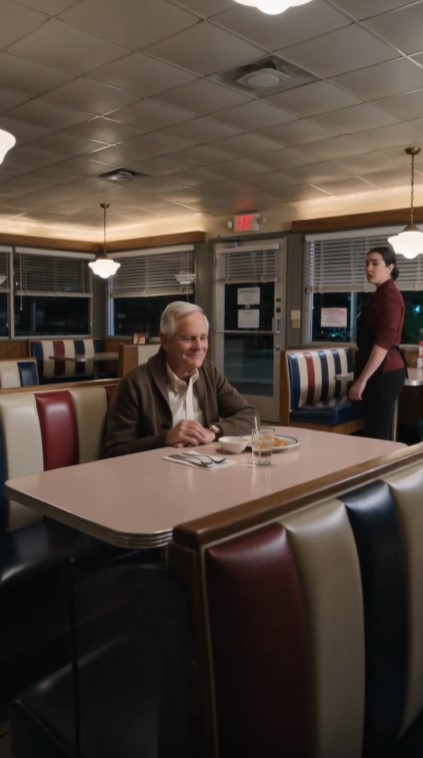
Every Friday at exactly 5 p.m.…
an elderly man entered the diner.
He ordered one children’s meal.
But no child ever came.
He sat across from the empty seat…
waited thirty minutes…
then asked for the food to go.
The waitress finally asked:
“Who are you waiting for?”
He smiled sadly.
“My daughter.”
She had been eight the last time he saw her.
Now she’d be forty-two.
He still ordered the meal she’d loved as a child.
Every Friday.
Just in case she ever remembered where to find him.
The waitress couldn’t stop thinking about it.
Then one Friday…
a woman entered the diner.
She looked around.
Saw the children’s meal.
And started crying.
The elderly man’s name was Henry.
The woman stood near the entrance, gripping her purse with both hands.
Henry had not seen her in thirty-four years.
But he knew.
Not from her face alone.
From the way she stood when she was nervous.
Weight on one foot.
Left hand wrapped around the right wrist.
His daughter had done that since she was little.
Henry slowly rose.
“Emily?”
The woman covered her mouth.
For several seconds, neither moved.
Then she whispered:
“Dad?”
The waitress, Maya, quietly stepped away.
The entire story she had heard in pieces over the last year was suddenly standing in front of her.
Henry had come to the diner every Friday because decades earlier, Friday dinner had belonged to him and Emily.
Back then, Henry and Emily’s mother, Rachel, were divorced.
The split had been ugly.
Not violent.
Not dangerous.
Just bitter.
Every disagreement became another reason not to speak.
Every missed call became proof that the other parent didn’t care.
Emily got trapped in the middle.
Henry had visitation on Fridays.
At exactly five.
And almost every Friday, he brought eight-year-old Emily to the same diner.
She ordered the children’s grilled-cheese meal.
No tomato.
Extra fries.
Chocolate milk.
Then she talked nonstop.
School.
Friends.
Cartoons.
A teacher she disliked.
A dog she wanted.
Henry listened.
Those Fridays were the best part of his week.
Then everything stopped.
Rachel decided to move out of state.
She had family there.
A better job offer.
Henry opposed it.
The arguments became worse.
Lawyers became involved.
Then a temporary custody order changed the schedule.
Henry believed it would be sorted out.
Instead, one Friday Emily didn’t come.
Then another.
Then another.
Henry drove to the house.
Empty.
Rachel had moved.
He called every number he had.
Disconnected.
Sent letters.
Returned.
Tried relatives.
Nobody answered.
Henry filed through the court.
But the process became complicated.
Rachel had left the state.
Addresses changed.
Records moved slowly.
Henry had little money for legal help.
Eventually he received one letter.
Supposedly from Rachel.
It said:
Emily is doing well. Please stop contacting us. She needs stability.
Henry stared at Emily now.
“Did you know I kept looking?”
Emily started crying.
“No.”
Henry’s face changed.
“You didn’t?”
She shook her head.
“I was told you left us.”
Henry sat down again.
Maya turned away behind the counter.
Emily moved toward the table.
The children’s meal was still sitting there.
Grilled cheese.
Extra fries.
Chocolate milk.
Exactly as it had been when she was eight.
She stared at it.
“You remembered.”
Henry laughed weakly.
“How could I forget?”
Emily touched the back of the empty chair.
Then sat.
Henry sat across from her.
Same places as before.
Neither touched the food.
Emily spoke first.
“Mom told me you stopped coming.”
Henry looked stunned.
“She said what?”
“She said after the divorce you decided you wanted a new life.”
Henry shook his head.
“No.”
“She told me you moved away.”
“I didn’t.”
“She said you stopped writing.”
“I wrote for years.”
Emily closed her eyes.
“I never got anything.”
Henry looked down.
The same silence.
Two people.
Two different stories.
Thirty-four years.
Emily continued.
For years, she believed her father had simply abandoned her.
At eight, she waited by the window on Fridays.
At nine, less often.
At ten, she stopped asking.
At twelve, she told herself she hated him.
At sixteen, Rachel finally said:
“Your father made his choice.”
Emily believed it.
Why wouldn’t she?
She was a child.
Her mother was the adult she trusted.
Henry whispered:
“I never made that choice.”
Emily’s eyes filled again.
“I know that now.”
Henry looked up.
“How?”
Emily reached into her purse.
She removed a bundle of envelopes.
Old.
Yellowed.
Some still sealed.
Henry’s handwriting.
He knew immediately.
His letters.
She placed them on the table.
Henry stared.
“Where did you get these?”
“Mom died three months ago.”
Henry lowered his head.
“I’m sorry.”
Emily nodded.
“Thank you.”
While clearing Rachel’s house, Emily found a locked metal box in the attic.
Inside were dozens of letters.
Birthday cards.
Photographs.
Court notices.
Returned envelopes.
And one stack tied with a ribbon.
Henry’s letters.
Most never opened.
Emily read the first one standing in the attic.
Then another.
Then ten.
Henry had written every Friday at first.
I’m at the diner.
I ordered your usual.
I hope school is okay.
I still have your blue sweater.
I’ll keep trying.
Then months later:
Happy ninth birthday.
Then:
I don’t know if these reach you.
Years passed.
The handwriting changed.
The messages became shorter.
But the same sentence appeared again and again.
I’ll be at the diner Friday at five.
Emily looked at him.
“You really kept going?”
Henry smiled sadly.
“Not every single Friday for thirty-four years.”
He wanted to be honest.
There were periods when work prevented it.
Illness.
Travel.
Life.
But once he retired and moved back closer to the old neighborhood, he resumed the ritual regularly.
Every Friday.
Five o’clock.
Thirty minutes.
One children’s meal.
Just in case.
Emily looked at the food.
“This is ridiculous.”
Henry nodded.
“Probably.”
“No, Dad.”
She started crying again.
“You kept ordering food for an eight-year-old who was forty-two.”
Henry laughed through tears.
“I wasn’t sure what adults eat.”
Emily laughed too.
It was the first easy sound between them.
Then Henry asked the question he had been afraid to ask.
“Why didn’t you come sooner?”
Emily looked down.
“I found the letters three months ago.”
Henry waited.
“I got angry.”
“At me?”
“At everybody.”
She had spent decades building an identity around being abandoned.
She had told her husband.
Her children.
Friends.
Therapists.
“My father left.”
Then suddenly the foundation changed.
Maybe he hadn’t.
Maybe the story she carried was incomplete.
She needed time.
She read every letter.
Then found the diner address repeated again and again.
She searched online.
The diner still existed.
She called.
Maya answered.
Emily did not give her name.
She simply asked:
“Does an older man named Henry come in on Fridays?”
Maya went quiet.
“Yes.”
“What time?”
“Exactly five.”
Emily hung up.
She sat in her car for an hour afterward.
She still didn’t come.
The next Friday, she drove past.
Saw Henry through the window.
Children’s meal on the table.
She kept driving.
The Friday after that, she made it into the parking lot.
Couldn’t get out.
Then finally…
today.
Henry listened.
No anger.
No accusation.
Just pain.
“You were outside?”
“Twice.”
He laughed.
“I wish I’d known.”
“I’m glad you didn’t.”
“Why?”
“Because I had to walk in myself.”
Henry nodded.
That mattered.
Emily needed the choice.
She had spent childhood having adults make choices for her.
Now she was forty-two.
This one belonged to her.
Maya approached quietly.
“Do you need anything?”
Emily looked at the children’s meal.
“Can I get an adult grilled cheese?”
Maya smiled.
“Extra fries?”
Emily laughed.
“Yes.”
“No tomato?”
Emily stared.
“How do you know?”
Maya pointed at Henry.
“He has been very specific for a year.”
Henry looked embarrassed.
Emily smiled.
“Keep it that way.”
They talked for almost four hours.
Not just about the past.
Henry wanted to know everything.
Did she go to college?
Yes.
Did she marry?
Yes.
His name was Daniel.
Twenty years married.
Children?
Two.
A son named Noah, sixteen.
A daughter named Lily, thirteen.
Henry’s face crumpled.
“I have grandchildren?”
Emily nodded.
“Yes.”
“Do they know about me?”
She hesitated.
“They know what I thought happened.”
Henry understood.
“So they think I abandoned you.”
“For now.”
He looked hurt.
Emily quickly added:
“I’ll tell them the truth.”
“What truth?”
She looked at the stack of letters.
“That I don’t know all of it yet.”
That answer impressed Henry.
Because there were still gaps.
Rachel was dead.
She could not explain herself.
There might have been reasons Henry didn’t know.
Fear.
Anger.
Legal advice.
A desire to protect Emily.
Control.
Resentment.
Nobody could be sure.
Emily refused to simplify her mother into a villain.
Rachel had also loved her.
Raised her.
Worked hard.
Attended every school event.
Stayed awake during illnesses.
Helped with college.
One terrible decision did not erase an entire life.
But it had consequences.
Emily said:
“I can love Mom and still be angry about this.”
Henry nodded.
“Yes.”
That became the first rule of their reunion.
No rewriting people into saints or monsters.
Just truth where they could find it.
The second rule:
No pretending thirty-four years could be fixed quickly.
Henry did not immediately become “Dad” again in the emotional sense.
Emily called him Henry sometimes.
Then Dad.
Then Henry again.
Both accepted it.
They met the next Friday.
No children’s meal this time.
Two adult meals.
The following week, Daniel came with Emily.
Henry was nervous.
So nervous he arrived forty minutes early.
Daniel shook his hand.
Then hugged him.
Henry looked shocked.
Daniel said:
“I’ve heard about you for twenty years.”
Henry laughed awkwardly.
“Probably not flattering.”
“No.”
They all laughed.
A month later, Henry met Noah and Lily.
He brought gifts.
Too many gifts.
Emily made him put half back in the car.
“You don’t have to buy your way into this.”
“I missed thirty-four birthdays.”
“You cannot financially survive catching up.”
Henry smiled.
“Fair.”
Noah asked the hardest question.
“Why didn’t you find Mom?”
Henry answered honestly.
“I tried.”
“Then you stopped.”
Henry paused.
“Yes.”
Emily looked at him.
He continued.
“I stopped looking as hard as I should have.”
No excuses.
He had believed the letter.
Believed Rachel wanted no contact.
Believed Emily eventually chose the same.
He had been hurt.
Poor.
Tired.
Then years passed.
He should have tried again later.
Technology changed.
Records became easier.
Social media appeared.
He could have searched.
He didn’t.
“I was afraid she’d hate me.”
Noah looked at him.
“So both of you were scared?”
Henry nodded.
“Basically.”
Noah shrugged.
“Adults are weird.”
Everyone laughed.
Henry liked him immediately.
Lily was quieter.
Then she asked:
“Did Mom really like the same food every Friday?”
Henry smiled.
“Every single time.”
Lily looked at Emily.
“You still order grilled cheese.”
Emily stared at her.
“Do not expose me.”
That became their running joke.
Friday dinner returned.
Not every Friday.
They had lives.
But once a month, the whole family met at the diner.
Maya sometimes reserved Henry’s old booth.
The empty chair disappeared.
Every seat became occupied.
Then one evening Henry brought something.
A small cardboard box.
Inside were keepsakes.
Emily’s eight-year-old drawings.
A school photograph.
The blue sweater from one of his letters.
Still folded.
Emily held it up.
“You kept this?”
Henry laughed.
“I didn’t know where to send it.”
Then she found a paper placemat.
Crayon scribbles.
A stick figure of Henry.
A smaller figure labeled:
ME
Across the top, in a child’s handwriting:
FRIDAY IS DAD DAY
Emily stopped breathing for a moment.
She didn’t remember drawing it.
Henry did.
“You made that the last Friday we ate here.”
Emily sat down.
For thirty-four years, that placemat had been evidence that there had once been a version of her life before the disappearance.
A child who did not yet believe her father had left.
She pressed it flat.
“I want this.”
“It’s yours.”
“No.”
Emily looked at him.
“Keep it.”
Henry smiled.
“Why?”
“Because you waited.”
That night, Emily went home and opened the box of letters again.
This time she read them differently.
Not as evidence in a case.
As a conversation she never received.
She decided to answer some of them.
Not all.
Just a few.
Henry’s letter from her ninth birthday:
I wonder if you still like strawberry cake.
Emily wrote beneath it:
No. Chocolate now. You missed a phase.
His letter from when she would have been thirteen:
I hope middle school isn’t too awful.
She answered:
It was. You were right to worry.
Then one:
If you ever find these, know I never stopped being your father just because I wasn’t allowed to act like one.
Emily cried.
Underneath she wrote:
I know now.
She gave Henry the replies at Christmas.
He read them privately.
Then called her at midnight.
“Thank you.”
That was all.
Years passed.
Henry became part of the family.
Not the center.
Part.
He attended Noah’s graduation.
Lily’s school play.
Emily’s forty-fifth birthday.
At every event he looked slightly overwhelmed, as if afraid someone might wake him and say the reunion had been temporary.
Eventually Emily noticed.
“You can relax.”
Henry smiled.
“I’m trying.”
“We’re not disappearing.”
He nodded.
“Good.”
Then his health began to decline.
He developed heart problems.
Nothing sudden.
But enough that Friday diner trips became harder.
One week, Emily went to his apartment instead.
She carried a bag.
Henry looked suspicious.
“What’s that?”
She opened it.
A children’s grilled-cheese meal.
Extra fries.
Chocolate milk.
Henry burst out laughing.
“You’re forty-eight.”
“So?”
“You’re ridiculous.”
She sat across from him.
Then placed one empty chair beside the table.
Henry looked at it.
“Who’s that for?”
Emily smiled.
“Nobody.”
“Then why?”
“To remind us we don’t need it anymore.”
Henry stared at her.
Then reached across the table and took her hand.
He died peacefully two years later.
Emily was with him.
So were Daniel, Noah, and Lily.
Afterward, Maya attended the memorial.
She brought a framed photograph.
One of the diner staff had taken it years earlier without Henry knowing.
Henry sitting at the booth.
Emily across from him.
The first night they reunited.
Between them, the tiny children’s meal.
On the back Maya had written:
THE LAST FRIDAY HE WAITED ALONE.
Emily cried.
Then laughed.
“That’s perfect.”
Years later, the diner renovated.
The old booth had to be replaced.
Maya called Emily first.
“Do you want anything from it?”
Emily thought.
“Yes.”
She asked for one thing.
The small brass table number.
17
Henry’s booth.
She kept it beside the old placemat.
When Emily became a grandmother, her granddaughter once found the stack of letters.
“Who wrote all these?”
Emily smiled.
“My dad.”
“Why didn’t you open them?”
“I never got them.”
Then she told the story.
A little girl who believed her father disappeared.
An elderly man who believed his daughter had forgotten him.
Thirty-four years.
A diner.
An empty chair.
One children’s meal every Friday.
And a waitress who finally asked:
“Who are you waiting for?”
Her granddaughter said:
“Did Grandpa Henry really think you might walk in after all those years?”
Emily smiled.
“Yes.”
“Why?”
“Because hope can be stubborn.”
The child looked at the photograph.
“Did he waste all those meals?”
Emily laughed.
“He took them home.”
“That’s good.”
Then the child pointed to the empty chair in the picture.
“That’s sad.”
Emily thought for a moment.
“It was.”
Then she pointed to herself sitting across from Henry.
“But not forever.”
That became how she remembered it.
Not thirty-four years of waiting.
One final Friday when the waiting ended.
At exactly five o’clock, Henry ordered the same meal.
Sat across from the same empty chair.
Then the diner door opened.
A forty-two-year-old woman stepped inside.
Saw the grilled cheese she had loved when she was eight.
And realized the father she thought had abandoned her…
had been saving her a seat all along.