
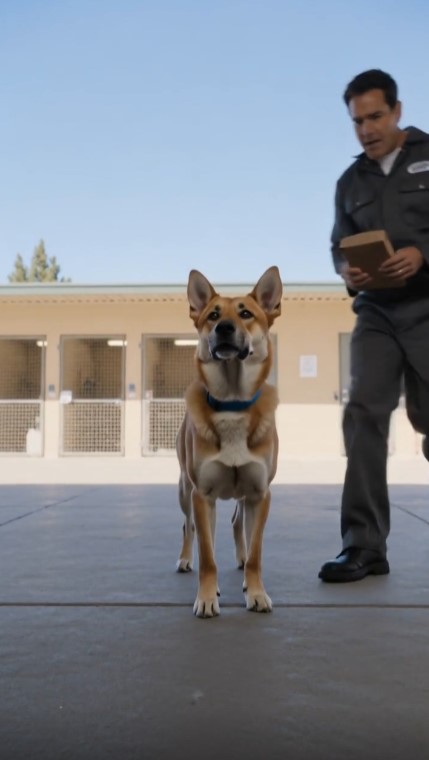
The shelter dog had rejected 43 families.
Then a delivery man walked through the door.
The dog froze.
The box slipped from the man’s hands.
“Buddy?”
Nobody at the shelter had ever called him that.
They knew him as Cooper.
But the dog was already running toward him.
Tail wagging.
Whining.
The man dropped to his knees.
“I thought you were gone.”
The shelter worker couldn’t understand.
“Is he yours?”
The man shook his head.
“My father’s.”
His father had lived alone hundreds of miles away.
After he died, nobody could find Buddy.
That was four years ago.
The worker checked Cooper’s intake history.
Different town.
Different name.
Nothing connected them.
Then Buddy suddenly left the man’s side.
He ran to his kennel.
Returned carrying the only object he’d arrived with four years earlier.
A battered leather pouch.
The delivery man had never seen it before.
But when he opened it…
there was a photograph of his father.
Beside a woman nobody in the family knew.
And on the back was an address.
The delivery man looked at the shelter worker.
Then at Buddy.
“That address is three streets from my house.”
The delivery man’s name was Michael.
He stared at the photograph again.
His father, Thomas, looked younger in it.
Maybe sixty.
Still wearing the brown work jacket Michael remembered from childhood.
Beside him stood a woman around the same age.
Short silver hair.
A green sweater.
One hand resting on Buddy’s back.
Buddy looked younger too.
Same white patch on the chest.
Same slightly bent ear.
No doubt.
Michael turned the picture over.
The address was written in his father’s handwriting.
18 Willow Lane.
Michael lived on Willow Avenue.
Only three streets away.
The shelter worker, Rachel, looked confused.
“You’ve never seen this woman?”
“Never.”
“Your father never mentioned her?”
Michael shook his head.
“My dad barely mentioned anybody.”
Thomas had become more private as he aged.
After Michael’s mother died, Thomas refused to leave the small house where they had raised their children.
Michael visited when he could.
But he lived several hours away at the time.
Work.
Kids.
Life.
Phone calls became easier than visits.
Thomas always said he was fine.
Buddy was with him.
That seemed like enough.
Then Thomas died suddenly after a heart attack.
Michael drove home immediately.
Buddy was gone.
The back gate stood open.
Neighbors said the dog had been seen wandering the road earlier.
Michael searched.
Shelters.
Animal control.
Social media.
Posters.
For weeks.
Nothing.
He assumed Buddy had been hit by a car, taken in by someone who never checked a microchip, or simply vanished too far away to trace.
Four years passed.
Then Michael changed jobs.
Moved with his wife and daughter to another town.
Started delivering medical supplies.
That afternoon, he walked into the shelter carrying a box.
And Buddy ran toward him.
Rachel said:
“We need to verify everything before we assume anything.”
Michael nodded immediately.
“Of course.”
The shelter scanned Buddy’s microchip.
It existed.
But the registration had been changed after intake because the original contact information led nowhere.
Rachel pulled the archived number.
Michael went pale.
“That was Dad’s old landline.”
Now there was a connection.
More records followed.
Old veterinary files.
Photos from Thomas’s house.
The markings matched.
The microchip number matched an old receipt Michael found in his email records from when he once paid one of Thomas’s vet bills.
Cooper was Buddy.
No question.
Rachel asked:
“How did he end up here?”
That was the mystery.
Buddy had entered the shelter four years earlier after being found wandering near a motel almost two hundred miles from Thomas’s house.
He arrived wearing no collar.
But he carried the leather pouch in his mouth.
Animal control workers thought it was unusual enough to send it with him.
Nobody opened it at first because it appeared to contain personal belongings.
Later, staff found only the photograph.
The address had faded badly.
One number was unreadable.
Nobody traced it.
Buddy was renamed Cooper because the shelter had already had another Buddy.
Michael looked at the photograph.
“So somebody brought him here.”
Rachel nodded.
“Probably.”
Buddy himself couldn’t explain the journey.
But the pouch might.
Michael drove to the address that evening.
Rachel did not let Buddy leave yet.
The shelter needed to complete ownership verification and update records properly.
Michael understood.
18 Willow Lane was a small brick house.
Old porch.
Wind chimes.
A woman answered after the second knock.
Michael recognized her immediately.
The woman from the photograph.
Older now.
But unmistakable.
She looked at him.
Then at the picture in his hand.
Her face changed.
“You’re Michael.”
He froze.
“You know me?”
She covered her mouth.
“Oh my God.”
Michael’s voice hardened.
“Who are you?”
The woman stepped aside.
“My name is Eleanor.”
She invited him in.
He remained near the door.
“Did you know my father?”
Eleanor smiled sadly.
“For almost twelve years.”
Michael felt something uncomfortable.
His first thought was obvious.
A secret relationship.
Another life.
Something his father had hidden.
Eleanor seemed to read his face.
“No.”
“What?”
“Whatever you’re thinking, no.”
She sat down.
“Your father and I were friends.”
Michael stayed standing.
“Friends who took pictures together with his dog?”
“Yes.”
She pointed toward the kitchen.
“Your father fixed that cabinet.”
Then toward the hall.
“And that railing.”
Thomas had met Eleanor after her husband died.
She lived alone.
Thomas did small repair work in the area even after retirement.
One day, she hired him to fix a leaking porch roof.
Buddy came with him.
Thomas returned the next week to finish.
Then again to repair something else.
Eventually the repairs ended.
The friendship didn’t.
They had coffee.
Walked Buddy.
Talked about grief.
Thomas missed Michael’s mother.
Eleanor missed her husband.
They understood each other.
Nothing romantic ever happened.
Michael asked:
“Why didn’t Dad tell us?”
Eleanor smiled sadly.
“Did Thomas tell you anything?”
Michael almost laughed.
Fair point.
His father could make a weather report sound private.
Then Michael held up the pouch.
“This was with Buddy when he was found.”
Eleanor stopped breathing for a second.
“That’s mine.”
Michael looked down.
“What?”
“My husband gave me that pouch years ago.”
She reached for it carefully.
Inside, beneath the photograph, was a tiny stitched mark.
E.R.
Eleanor Ruth.
She looked at Michael.
“Where did you find Buddy?”
“Shelter two hundred miles away.”
Her eyes filled.
“So he survived.”
“You knew he was missing?”
Eleanor nodded.
Then she told Michael the part nobody else knew.
The day Thomas died, Eleanor was at his house.
Not when it happened.
A few hours later.
Thomas had called her the night before because Buddy seemed restless and Thomas wanted help driving him to a vet appointment the following morning.
Eleanor arrived early.
Found the front door unlocked.
Thomas was unresponsive.
She called emergency services.
Then everything became chaos.
Paramedics.
Police.
Neighbors.
Phone calls.
Buddy became agitated.
Someone opened the back gate.
The dog ran.
Eleanor chased him but couldn’t catch up.
Later that day, one of Thomas’s relatives arrived.
Then Michael.
But Eleanor left before he got there.
Michael frowned.
“Why?”
“Because I thought family should have the house.”
“You could’ve told us about Buddy.”
“I tried.”
She had called the number Thomas kept on the refrigerator.
Disconnected.
She left a note in the mailbox.
Michael never saw it.
Then she searched for Buddy herself.
For days.
A week later, she got a call from a truck driver.
He had found an older dog near a gas station nearly forty miles away.
The dog matched Buddy’s description.
Eleanor drove there.
It was Buddy.
She got him into her car.
Michael stared.
“You found him?”
“Yes.”
“Then how did he end up two hundred miles away?”
Eleanor’s face crumpled.
“Because I made a mistake.”
She intended to keep Buddy temporarily until she reached Michael.
But her daughter became seriously ill in another state.
Eleanor had to leave immediately.
She asked an acquaintance named Robert to care for Buddy for a few days.
Robert was a traveling contractor.
He agreed.
Then everything went wrong.
Eleanor’s daughter was hospitalized longer than expected.
Robert took Buddy with him to a job because he couldn’t leave him alone.
During a stop near a motel, Buddy slipped out of the truck.
Robert searched.
Couldn’t find him.
By the time Eleanor returned, Buddy was gone again.
She was devastated.
She called shelters along Robert’s route.
But the area covered multiple counties.
Buddy had no collar.
And the microchip registration still pointed to Thomas’s old phone.
Nobody connected the reports.
Michael sat down.
“So the pouch?”
Eleanor nodded.
“I put it on the seat with him.”
Buddy had liked carrying soft objects.
Thomas used to joke that Buddy needed a job.
The pouch contained the photograph and Eleanor’s address in case someone found the dog.
But the writing faded.
By luck, the pouch stayed with Buddy.
Michael looked at her.
“Why didn’t you find me later?”
Eleanor swallowed.
“I did.”
That answer made him angry.
“What do you mean?”
Three months after Thomas died, Eleanor found Michael online.
He had already returned home.
She started writing a message.
Then stopped.
She felt responsible.
Buddy had disappeared while under care arranged by her.
She imagined telling Thomas’s son:
I found your father’s dog and lost him again.
She couldn’t do it.
Michael stared at her.
“You let me believe Buddy died.”
“Yes.”
“Why?”
“Cowardice.”
No excuse.
No defense.
That honesty kept Michael from walking out.
Eleanor continued.
Every year she searched Buddy’s microchip number online.
Nothing.
She checked shelter pages.
Nothing.
Eventually she assumed he was dead.
Then today Michael appeared at her door.
Michael looked at the photograph.
“Dad trusted you.”
Eleanor’s eyes filled.
“I loved your father.”
Michael stiffened.
She immediately clarified.
“Not like that.”
Then smiled sadly.
“Maybe love isn’t always one thing.”
Thomas had been her friend.
The person who understood what it meant to lose a spouse after decades.
The person who fixed things without asking for much.
The man who showed up with Buddy and stayed for coffee.
Michael looked around.
There were small traces of his father everywhere.
A wooden shelf.
A repaired lamp.
A crooked porch rail.
He had lived a whole quiet friendship his children knew nothing about.
Michael asked:
“Did Dad talk about us?”
“All the time.”
Eleanor stood.
She walked to a cabinet.
Inside was a stack of photographs Thomas had given her copies of.
Michael’s wedding.
His daughter’s first birthday.
Family Christmas.
Thomas had talked about his children constantly.
Michael suddenly felt ashamed.
He had spent years wondering if his father resented his infrequent visits.
Instead, Thomas had been showing strangers photographs and bragging.
Then Eleanor pulled out an envelope.
“Your father left this here.”
Michael stared.
“When?”
“About a month before he died.”
“Why didn’t you give it to me?”
“I thought it was private.”
On the front:
MICHAEL
Michael opened it.
The letter was simple.
Son,
If you find this, it probably means I forgot where I put it.
Michael laughed immediately.
That sounded exactly like Thomas.
Then:
Don’t feel guilty about living far away. That is what you’re supposed to do. You build your own home. You don’t spend your life standing in mine.
Michael stopped.
His eyes filled.
I know you think you should visit more. I know I think you should visit more. Both things can be true.
Then:
Buddy keeps me company. Eleanor does too. Before you make a face, she is my friend. That’s all.
Michael laughed through tears.
Eleanor covered her face.
“He knew.”
“Apparently.”
The letter continued:
She helped me more than she knows. If you ever meet her, be kind.
Michael looked at Eleanor.
She was crying.
The final line:
And if anything happens to me, take Buddy if you can. If you can’t, find him someone good. He hates being left behind.
Michael folded the letter.
The next morning, he returned to the shelter.
Buddy was waiting near the front.
Rachel had finished most of the verification.
There was still an adoption transfer to complete because Thomas was deceased and the shelter had legal custody after the long stray hold.
Michael filled out everything.
He brought his wife, Sarah.
And their teenage daughter, Lily.
Buddy greeted all of them.
But when Michael opened the passenger door of his delivery van, Buddy hesitated.
Michael smiled.
“Not your old truck.”
Buddy sniffed.
Then climbed in.
The family drove first to Eleanor’s house.
Buddy saw her on the porch.
He stopped.
Then walked toward her.
Eleanor knelt.
“Hi, Buddy.”
He leaned against her.
Eleanor started crying.
Michael watched.
Four years had passed.
No one could know exactly what Buddy remembered or associated with each person.
But the response was familiar and calm.
That was enough.
Michael said:
“You should visit.”
Eleanor looked surprised.
“Are you sure?”
“Dad asked me to be kind.”
She laughed.
“He always did know how to win arguments after he was gone.”
Buddy moved into Michael’s home.
At first, he paced.
Different house.
Different sounds.
Different schedule.
But he settled.
Lily adored him.
He slept outside her bedroom.
He carried socks constantly.
The leather pouch was retired because it had become too fragile.
Michael put it in a shadow box.
Beside Thomas’s photograph.
Eleanor visited every Sunday.
The first few times felt awkward.
Then less.
She told Michael stories he had never heard.
Thomas once tried baking bread and nearly broke a kitchen knife.
Thomas hated jazz but pretended to like it because Eleanor did.
Thomas once spent six hours repairing a clock worth twenty dollars because “throwing it away would annoy me.”
Michael laughed.
“That’s Dad.”
Through Eleanor, he got his father back in small pieces.
Then Rachel from the shelter called one afternoon.
“We found something else.”
During a digitization project, staff discovered Buddy’s original intake photographs.
In one, the leather pouch was open.
A folded piece of paper was visible beneath the photograph.
Nobody had noticed it before.
The current pouch contained no paper.
Perhaps it had fallen out.
Rachel checked the shelter’s old property storage.
After an hour, she found a tiny folded note inside a sealed archive bag.
Michael drove over.
The paper was badly faded.
But readable.
Eleanor’s handwriting.
If you find this dog, his name is Buddy.
His owner, Thomas Carter, has died.
Please call his son Michael. I am trying to find the number.
Below it was Eleanor’s address.
Michael stared.
She had tried.
She had done exactly what she could think of in the chaos.
The note simply became separated from the pouch.
He called her.
“You should’ve told me.”
“I know.”
“But you tried.”
“Yes.”
Both things could be true.
That became a theme in the family.
People make mistakes.
Sometimes big ones.
But one mistake is not always the whole story.
Buddy lived another three years.
Old age slowed him.
He needed medication.
Shorter walks.
More sleep.
He never rejected another family because he never needed another one.
Michael sometimes joked about the shelter’s history.
“Forty-three families.”
Rachel corrected him once.
“He didn’t reject them.”
“What do you mean?”
“He just didn’t connect strongly enough for an adoption to happen.”
Michael smiled.
“That sounds less dramatic.”
“Usually reality does.”
Still, Buddy had waited a long time.
Then one delivery man walked through the shelter doors.
Said one word.
“Buddy?”
And the dog everyone knew as Cooper came alive.
When Buddy eventually died peacefully under veterinary care, Michael, Sarah, Lily, and Eleanor were nearby.
Afterward, Michael gave Rachel a copy of Thomas’s photograph for the shelter.
They placed it beside a picture of Buddy leaving in Michael’s vehicle.
Underneath:
COOPER, KNOWN FIRST AS BUDDY
FOUR YEARS LOST. HOME FOUND THROUGH ONE NAME.
Michael objected.
“Too sentimental.”
Rachel smiled.
“People like sentimental.”
Years later, Lily inherited the leather pouch.
Inside she kept copies of three things.
The photograph.
Thomas’s letter.
Eleanor’s note.
Her children once asked why an old dog’s pouch mattered so much.
Lily told them.
A grandfather who lived alone.
His dog Buddy.
A friend nobody in the family knew.
A death.
An open gate.
A dog who disappeared.
Four years.
A different shelter.
A different name.
Then one afternoon, her father walked into that shelter carrying a delivery box.
The dog froze.
The box hit the floor.
And one word changed everything.
“Buddy?”
Her children always asked:
“Did Buddy know where the address was?”
Lily smiled.
“No.”
“Did he know the pouch would solve everything?”
“No.”
“Then why did he carry it?”
“We don’t know.”
Maybe because it smelled familiar.
Maybe because he liked carrying soft objects.
Maybe because someone had handed it to him before he got lost.
The truth did not need magic.
The pouch survived.
The photograph survived.
The address survived just enough to be read.
And Buddy survived long enough to meet someone who recognized him.
That was extraordinary enough.
Michael had thought he was delivering a box.
Instead, he walked into a shelter and found the last living piece of his father’s daily life.
Then that dog led him to a friendship Thomas had kept mostly private.
A woman who remembered him.
A letter he never received.
And proof that even after people are gone…
parts of their story can remain scattered in places nobody thinks to look.
Sometimes in a photograph.
Sometimes in an old address.
And sometimes in the mouth of a shelter dog who refused to let go of one battered leather pouch.