
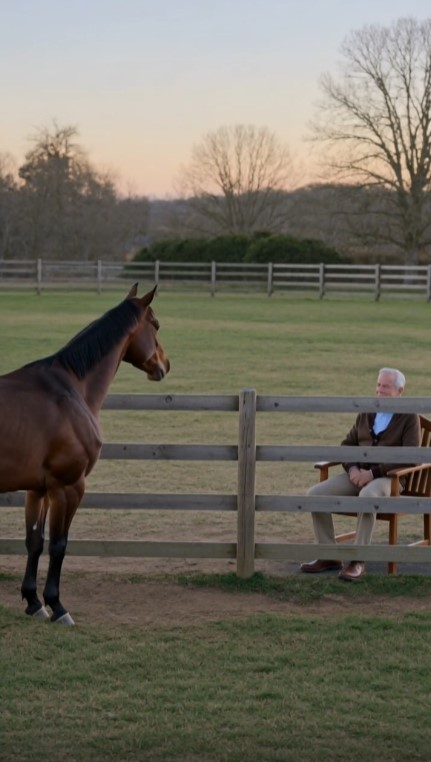
Every morning, the old horse walked to the fence before anyone arrived.
He stood there.
Watching the road.
The farm workers called him Henry’s clock.
Because at exactly 8:10…
he would lift his head.
And wait.
Years earlier, an elderly man named Henry had visited the farm every morning.
He never rode the horse.
Never brought treats.
He simply sat outside the fence…
and talked.
About his wife.
His children.
The life he’d lived.
The horse, Jasper, always stood beside him.
Then Henry stopped coming.
One week passed.
Then a month.
Jasper still waited at 8:10.
Every morning.
The workers eventually learned Henry had moved away to live with his daughter.
A year passed.
Then one morning…
at exactly 8:10…
a car stopped.
Jasper lifted his head.
The door opened.
Henry stepped out.
Jasper didn’t run wildly.
He simply walked to the fence…
and stood in the same place he always had.
Henry approached.
“You waited?”
Jasper gently rested his muzzle against the wooden rail.
Henry laughed through tears.
His daughter asked:
“Do you think he remembers you?”
Henry looked at Jasper.
“No.”
“He remembers us.”
Then Henry sat in his old chair.
And started talking.
Jasper stayed beside him.
Just like no time had passed at all.
Henry’s daughter, Emily, stood several feet away and watched.
She had heard about Jasper for years.
At first, she assumed he was simply another farm horse her father enjoyed visiting.
Then after her mother died, the stories changed.
Henry began mentioning Jasper constantly.
“Jasper stood with me today.”
“Jasper didn’t move for twenty minutes.”
“Jasper ignored everyone else until I started talking.”
Emily used to laugh.
“Dad, he’s a horse.”
Henry always answered:
“I know.”
That was exactly why he liked him.
Jasper never interrupted.
Never offered advice.
Never said Henry should “move on.”
Never changed the subject when Henry talked about Margaret.
Henry’s wife had died after fifty-two years of marriage.
Afterward, the house became unbearably quiet.
Every object seemed to belong to two people.
Two coffee mugs.
Two chairs.
Two places at the kitchen table.
Henry tried staying busy.
He walked.
Read.
Visited neighbors.
But mornings were the worst.
For more than five decades, Margaret had been there.
Then suddenly she wasn’t.
One morning, Henry walked farther than usual.
He ended up near the farm.
Jasper was standing by the fence.
Henry stopped.
The horse looked at him.
That was all.
Henry said:
“Morning.”
Jasper stayed.
The next day Henry came again.
8:10.
Same road.
Same fence.
Same horse.
Henry started talking.
At first about nothing.
Weather.
His bad knee.
The price of groceries.
Then about Margaret.
How they met at a dance.
How she hated his first car.
How she once threw a dish towel at him because he forgot their anniversary.
How he would give anything to hear her complain about him one more time.
Jasper stood beside the fence.
Henry kept talking.
The routine continued for nearly three years.
Farm workers got used to it.
One of them placed an old wooden chair near the fence.
Henry protested.
“I can stand.”
They ignored him.
Soon everyone called it Henry’s chair.
At exactly 8:10, Henry arrived.
Jasper appeared.
Some mornings Henry talked for an hour.
Other mornings he simply sat.
Jasper grazed nearby.
There was nothing dramatic about it.
That was what Henry loved.
Then his health changed.
A fall at home.
A hospital stay.
Doctors told him living alone was no longer a good idea.
Emily had been asking him to move in with her for years.
This time, he agreed.
Her house was nearly three hours away.
Henry’s final morning at the farm was difficult.
He sat in the chair longer than usual.
Jasper stood nearby.
Henry said:
“I’m leaving tomorrow.”
Jasper flicked an ear.
Henry smiled.
“Yeah, I know. You don’t care.”
Then:
“But I’m going to miss this.”
He rested his hand on the wooden rail.
“I’m going to miss you too.”
He did not try to hug Jasper.
Did not climb the fence.
Did not pretend the horse understood a farewell like a human would.
He simply sat.
Then left.
The next morning, Jasper appeared at 8:10.
The workers noticed.
He stood at the fence.
No Henry.
The next day, same thing.
Then the next.
After several weeks, the farm manager, Daniel, started paying attention.
Jasper’s behavior was consistent enough to be interesting.
He would approach the fence around the same time Henry had always arrived.
Stand.
Look toward the road.
Then eventually return to grazing.
Daniel did not call it grief.
Did not say Jasper was “waiting for Henry” as a fact.
Horses are highly sensitive to routine.
They learn schedules.
They notice people, vehicles, sounds, patterns.
For nearly three years, 8:10 had meant something predictable.
Henry’s footsteps.
His voice.
A quiet period beside the fence.
Jasper may simply have retained the routine.
But Daniel admitted:
“It still gets to you.”
One year later, Emily called the farm.
“My dad keeps asking about Jasper.”
Daniel laughed.
“Jasper’s fine.”
“Does he still go to the fence?”
Daniel paused.
“Yes.”
“Every day?”
“Most mornings.”
Emily became quiet.
Then she said:
“I need to bring him.”
Henry had been weaker.
But stable.
The drive would need planning.
They talked to his doctor.
Took breaks.
Made sure the visit would not exhaust him.
Henry was not told exactly which day.
Emily wanted it to be simple.
No crowd.
No cameras.
No spectacle.
Just a visit.
At 8:05 that morning, Jasper was grazing.
At 8:09, he lifted his head.
Daniel noticed.
At 8:10, the car turned onto the road.
Jasper looked toward it.
Emily parked near the gate.
Henry stepped out carefully with a cane.
Jasper walked toward the fence.
Not running.
Not calling wildly.
Just approaching.
Henry laughed before he even reached the chair.
“You old fool.”
Jasper stood where he always had.
Henry sat.
Then started talking.
“So, I moved.”
Jasper chewed.
“Emily makes terrible coffee.”
Emily called from behind him:
“I can hear you.”
Henry grinned.
“Good.”
Daniel stood farther back.
He had seen many emotional reunions between people and animals.
He knew how easy it was to interpret every movement as proof of something extraordinary.
But what mattered was simpler.
Jasper showed familiar behavior.
Henry showed obvious recognition.
The old routine resumed.
That was enough.
Henry visited for almost two hours.
Before leaving, he asked Daniel:
“Can I come again?”
“Anytime.”
So he did.
Not daily.
That was impossible.
But every few months.
Sometimes Jasper approached quickly.
Sometimes Henry waited.
Once Jasper barely acknowledged him because he was more interested in hay.
Henry laughed.
“That’s healthy.”
Emily smiled.
“You’re not offended?”
“He’s a horse.”
Henry said it proudly.
“He doesn’t owe me a performance.”
That became his favorite sentence.
Over time, Emily began understanding why her father valued the relationship so much.
Jasper had not replaced Margaret.
Nothing could.
The horse had simply been present during a lonely period.
And sometimes presence is enough.
Then Daniel found something unexpected.
While cleaning an old storage shed, he discovered a box of photographs from previous owners.
One showed Jasper much younger.
Another showed him beside an elderly woman.
Daniel stared.
He knew the woman.
Margaret.
Henry’s wife.
He called Emily.
“Did your mother ever come to the farm?”
Emily looked surprised.
“Not that I know of.”
Daniel sent the photograph.
Henry recognized it immediately.
“Oh.”
Emily asked:
“What?”
Henry held the photo carefully.
“That was before Jasper came here.”
Jasper had once belonged to a neighboring riding program.
Margaret volunteered there briefly after retirement.
Not as a rider.
She helped with paperwork and fundraising.
She knew Jasper years before Henry ever started visiting him.
Henry laughed.
“She never told me.”
Emily looked at the photo.
Margaret standing near Jasper.
Hand on the fence.
Same horse.
Same calm posture.
The date on the back was nearly twelve years earlier.
Henry sat quietly.
Then said:
“That’s funny.”
Emily expected tears.
Instead, he smiled.
“Your mother probably would’ve loved this.”
Then:
“Actually, no. She would’ve said I was being sentimental.”
Emily laughed.
That was Margaret.
The discovery changed something for Henry.
He had believed Jasper belonged only to the chapter after Margaret’s death.
Now he learned Margaret had crossed Jasper’s life before him.
Not deeply.
Not dramatically.
But enough for one photograph.
Henry brought the picture to the farm on his next visit.
He showed it to Jasper.
Jasper sniffed the paper.
Then tried to chew the corner.
Henry pulled it back quickly.
“Absolutely not.”
Daniel burst out laughing.
Emily did too.
Henry looked at Jasper.
“You have no respect for history.”
That photograph became one of Henry’s favorite possessions.
He framed it beside a picture of Margaret at home.
As years passed, Henry’s visits became shorter.
Jasper aged too.
The horse developed arthritis.
Daniel adjusted his care.
More rest.
Gentler movement.
Veterinary support.
No unnecessary stress.
Henry understood.
He was slowing down too.
One morning, he arrived at 8:10.
Jasper was not at the fence.
Henry waited.
Five minutes.
Ten.
Then Jasper emerged slowly from the shelter.
He walked toward the fence.
Henry watched him.
“Take your time.”
Jasper stopped beside him.
Henry said:
“Me too.”
That became their new rhythm.
Slow.
No rush.
One morning, Emily asked her father again:
“Do you think Jasper really remembers you?”
Henry thought longer this time.
“I think he knows something familiar happens when I’m here.”
“That sounds very careful.”
“I’ve had practice.”
Then he added:
“And I know I remember him.”
That was enough for Henry.
He did not need proof that Jasper carried a human-style memory of friendship.
He only needed the time they shared.
Eventually, Henry’s health declined more seriously.
Travel became impossible.
He asked Emily to call Daniel.
Not video.
Henry disliked video calls.
Just phone.
Daniel put the phone on speaker while standing near the fence.
Henry said:
“Morning, Jasper.”
Of course the horse gave no dramatic response.
He kept grazing.
Henry laughed from miles away.
“Perfect.”
Then Henry talked.
About Emily.
His grandchildren.
Margaret.
The weather.
The usual things.
Daniel stood there holding the phone like a fool and smiling.
When the call ended, Henry said:
“Thanks.”
Daniel answered:
“You’re welcome.”
Henry died peacefully several months later at eighty-seven.
Emily called Daniel.
Daniel stood quietly beside Jasper’s pasture after hanging up.
He did not take Henry’s chair away immediately.
For several months, it remained.
Jasper still approached the fence some mornings.
Perhaps because the routine had been reinforced for years.
Perhaps because the location itself had become familiar.
Eventually, Daniel noticed the horse spending less time there.
Then one spring morning, Jasper walked past the chair without stopping.
Daniel smiled.
“Good.”
Life continued.
A year after Henry died, Emily visited.
She brought the framed photograph of Margaret and Jasper.
Daniel looked surprised.
“You sure?”
“Yes.”
She wanted a copy displayed in the farm office.
Beside it she placed a second picture.
Henry in his chair.
Jasper at the fence.
Underneath, she wrote:
MARGARET — BEFORE
HENRY — AFTER
Daniel asked:
“No big quote?”
Emily smiled.
“My father hated big quotes.”
Then she reconsidered.
“There was one thing he said.”
She wrote a small line beneath the photographs:
HE DOESN’T OWE ME A PERFORMANCE.
Daniel smiled.
“That sounds like him.”
Jasper lived several more years.
When his health eventually declined enough that comfort could no longer be maintained, Daniel worked with the veterinarian and made the difficult decision to let him go peacefully.
Emily came.
She stood outside the fence area and watched from a respectful distance.
Afterward, Daniel gave her Henry’s old chair.
She looked surprised.
“I thought you’d keep it.”
“No.”
“It belongs with you.”
Emily took it home.
She placed it on her porch.
Not as a shrine.
Just a chair.
Sometimes she sat there in the morning with coffee.
One day her daughter asked:
“Is that Grandpa’s farm chair?”
Emily nodded.
“The one beside Jasper?”
“Yes.”
“Do you think Jasper waited for Grandpa?”
Emily smiled.
“I think Jasper learned a routine.”
Her daughter looked disappointed.
“That’s all?”
“No.”
Emily looked at the chair.
“I think Grandpa needed that routine too.”
That was the real story.
For nearly three years, one lonely widower walked to a farm every morning at 8:10.
He sat beside a fence.
A horse often stood nearby.
Henry talked because talking helped.
Jasper stayed because, for whatever reason, that place and time became part of his day.
Then Henry moved away.
The routine broke.
A year later, he came back.
At 8:10, Jasper walked to the fence.
Henry sat in the old chair.
Started talking.
And for a little while…
nothing needed to be explained.
Nothing needed to be proven.
An old man remembered.
An old horse responded to something familiar.
And two lives slipped quietly back into the same rhythm they had once shared.