
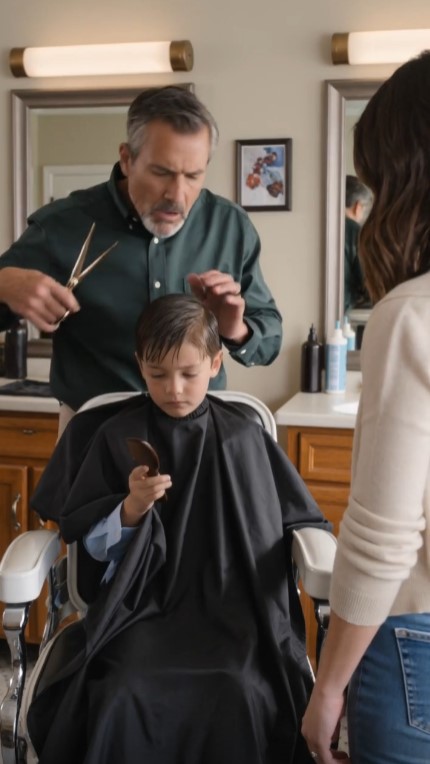
😱 The barber suddenly put the scissors down.
Ten-year-old Noah was sitting in the chair.
His mother had asked for one simple haircut.
But the barber kept staring at him.
Then at the old wooden comb Noah was holding.
“Where did you get that?”
“My dad’s.”
The barber’s face changed.
Noah’s father had died years earlier.
The boy carried the comb because it was one of the few things he had left.
The barber took it carefully.
Turned it over.
And rubbed his thumb across two tiny initials carved into the wood.
His hands started shaking.
“I made this.”
Noah’s mother stared at him.
“What?”
The barber looked at Noah again.
Then walked to an old cabinet.
He opened a drawer…
and removed another wooden comb.
Same wood.
Same carving.
The two fit together perfectly.
Noah whispered:
“Why did my dad have the other one?”
The barber sat down beside him.
Then said:
“Because your father was my brother.”
Noah’s mother went completely still.
She had been told her husband had no living family.
The barber’s name was Henry.
For several seconds, nobody spoke.
Noah looked at his mother.
“Mom?”
Rachel slowly lowered herself into the empty chair beside him.
Her face had gone pale.
“Your father told me he was an only child.”
Henry closed his eyes.
“He probably believed he had to.”
Noah frowned.
“What does that mean?”
Henry put the two combs on the counter.
Side by side.
Together they formed a narrow piece of dark maple with one carved line running through both halves.
The initials on Noah’s comb were:
D.H.
Daniel Harris.
Noah’s father.
The other comb had:
H.H.
Henry Harris.
Rachel whispered:
“You’re really his brother?”
Henry nodded.
“Younger by two years.”
Noah stared at him.
“Why didn’t Dad ever tell me?”
Henry looked toward the floor.
“That’s a long story.”
Rachel answered:
“We have time.”
Henry looked at the half-finished haircut.
Noah still had the cape around his shoulders.
One side of his hair was shorter than the other.
For the first time, Henry laughed.
“Maybe I should fix that before we destroy the family tree.”
Noah smiled.
“Probably.”
Henry finished the haircut carefully.
Then locked the front door.
Turned the sign to CLOSED.
And made coffee for Rachel.
Hot chocolate for Noah.
Then he told them.
Daniel and Henry had grown up together in a small town two hours away.
Their father, Thomas, was a carpenter.
Not a professional furniture maker.
Just someone who hated throwing away good wood.
When the brothers were teenagers, Thomas taught them how to shape small pieces by hand.
The two combs came from one leftover maple strip.
Daniel cut his crooked.
Henry sanded his too thin.
Thomas laughed at both of them.
Then carved a line across the original board before the final split so the two pieces would always match if placed together.
He said:
“If you two ever stop speaking, at least the wood will remember you came from the same place.”
Rachel looked at the combs.
“That sounds like something a father says when he knows his sons fight.”
Henry smiled.
“We fought constantly.”
Noah asked:
“Then why did you stop speaking?”
Henry’s smile disappeared.
Their father died when Daniel was twenty-three and Henry was twenty-one.
The death itself broke something.
But the real damage came afterward.
Thomas left behind a small house.
A workshop.
Tools.
And almost no money.
Daniel wanted to sell everything.
Henry wanted to keep the workshop.
Daniel argued they had debts.
Henry argued selling the place meant erasing their father.
The disagreement turned ugly.
Then Henry discovered that Daniel had already signed papers with a buyer.
Without telling him.
Henry felt betrayed.
Daniel said the taxes and medical debts left no choice.
Henry refused to believe him.
He accused Daniel of wanting quick money.
Daniel fired back.
Said Henry had spent years avoiding responsibility and suddenly wanted to play sentimental son.
They stopped speaking.
Not for a week.
Not for a month.
For years.
Rachel asked:
“But that doesn’t explain why Daniel told me he had no family.”
Henry nodded.
“There was more.”
After the house was sold, Henry left town.
He became a barber.
Daniel took construction work.
They lived separate lives.
Then, about six years later, Daniel tried to reconnect.
He walked into Henry’s first barbershop carrying the wooden comb.
Henry refused to talk.
Daniel left.
Henry still remembered the exact words he said:
“I don’t have a brother anymore.”
Noah looked hurt.
“You said that?”
Henry nodded.
“I did.”
“Why?”
“Because I was angry enough to think hurting him would make me feel better.”
“It didn’t.”
Henry shook his head.
“No.”
Daniel tried again twice.
Letters.
One phone call.
Henry ignored them.
Then Daniel disappeared from town.
Years later, Henry learned he had married Rachel.
Noah looked at his mother.
“You knew Grandpa Thomas?”
Rachel shook her head.
“No. He was already gone before I met your dad.”
She turned to Henry.
“Daniel told me both his parents were dead.”
“That part was true.”
“And no siblings.”
Henry looked ashamed.
“That was the lie.”
Rachel sat quietly.
Then said:
“Or maybe not entirely.”
Henry looked at her.
Rachel continued:
“If you told him you weren’t his brother anymore…”
Henry understood.
He covered his face.
“Yes.”
For years he had blamed Daniel for erasing him.
Now he had to admit he helped create that story.
Noah picked up both combs.
“Did Dad keep this the whole time?”
Rachel nodded.
“He kept it in his desk.”
Daniel used it rarely.
Mostly as a keepsake.
After he died, Noah found it.
He asked what it was.
Rachel said it belonged to Dad.
That was enough.
From then on, Noah carried it on days he missed him most.
First day of school.
Birthday.
Father-son event at school he didn’t want to attend.
And that morning.
His first proper haircut at a barbershop instead of Rachel trimming it at home.
Noah said:
“I brought it because Dad hated bad haircuts.”
Henry laughed.
“He absolutely did.”
Noah looked surprised.
“You remember?”
“I remember everything.”
That opened the door.
Henry began telling stories.
Daniel was afraid of dogs as a child.
Until he adopted one at nineteen.
Daniel cheated at cards.
Daniel once cut his own hair with kitchen scissors and wore a hat for three weeks.
Noah laughed.
Rachel did too.
Then Henry suddenly stopped.
He looked at Noah’s face.
“Your dad smiled exactly like that.”
Noah froze.
Nobody had said that to him before.
People told him he had Daniel’s eyes.
His chin.
His hands.
But never the smile.
He asked:
“Really?”
Henry nodded.
“Exactly.”
Rachel’s eyes filled.
Then she asked the question she had been avoiding.
“When did you last see Daniel?”
Henry looked toward the cabinet.
“Ten years ago.”
Rachel stared.
“That’s impossible.”
Daniel died six years earlier.
Henry explained.
Daniel came to the barbershop one final time.
No appointment.
No warning.
He looked older.
Tired.
He sat in the same chair Noah had just used.
Placed his comb on the counter.
Then said:
“I have a son.”
Henry froze.
Noah stared.
“Me?”
Henry nodded.
“You were a baby.”
Daniel showed a photograph.
Noah asleep in Rachel’s arms.
Henry still had it.
He went to the cabinet again.
Behind old tax folders was an envelope.
Inside was the photograph.
Rachel took it.
Her hands shook.
“I remember this picture.”
Daniel had taken it in the hospital.
She thought it was lost.
On the back, Daniel had written:
Rachel and Noah. My whole life.
Henry continued.
Daniel asked him that day:
“Do you want to meet them?”
Henry wanted to say yes.
But pride was still there.
Smaller.
Weaker.
Still there.
He asked:
“Does Rachel know about me?”
Daniel said no.
Henry took that as another insult.
He said:
“Then keep it that way.”
Rachel closed her eyes.
Noah looked at Henry.
“You could have met Dad again.”
“Yes.”
“You could’ve met me.”
“Yes.”
“And you said no?”
Henry nodded.
“I did.”
Noah’s voice was quiet.
“That was dumb.”
Henry almost smiled.
“Very.”
Daniel left.
They never saw each other again.
Two years later, Henry heard through an old acquaintance that Daniel was seriously ill.
He searched online.
Found nothing useful.
Then, six years ago, he saw the obituary.
Daniel Harris.
Husband of Rachel.
Father of Noah.
Henry sat alone in the barbershop after closing and cried.
Then he took his matching comb from the drawer.
For the first time in decades, he put it on the counter.
And left it there overnight.
He thought about contacting Rachel.
But shame stopped him.
He imagined saying:
Hello. I’m the brother your husband never told you about because I rejected him for half his life.
So he did nothing.
Again.
Noah asked:
“Why do adults wait so much?”
Henry looked at him.
“I wish I knew.”
Rachel smiled sadly.
“Usually because we’re afraid of what happens if we don’t.”
Noah shook his head.
“Seems worse.”
It was.
Then Rachel remembered something.
Daniel had left behind a small metal box she had never opened properly.
Not locked.
Just filled with receipts and old papers.
She went home and brought it back that afternoon.
Henry kept the barbershop closed.
The three of them sat in the back room.
Inside the box were tax papers.
Old licenses.
Photos.
Then letters.
Addressed to Henry.
Never mailed.
Henry recognized Daniel’s handwriting instantly.
The first was written a year after their father died.
Henry,
You think I sold the workshop because I didn’t care.
I sold it because Dad owed more than the house was worth.
Attached was a photocopy of debt records.
Henry stared.
He had never seen them.
The debt was real.
Substantial.
Daniel had not taken quick money.
He used nearly all proceeds to close medical accounts and taxes.
Henry whispered:
“I was wrong.”
Rachel said nothing.
Another letter:
I know you think I chose money over Dad.
The truth is I chose not to let his debts follow us.
Then another.
Years later:
I came to the shop today. You said you don’t have a brother. I’m trying not to hate you for that.
Henry put the page down.
Noah asked:
“Do you need a minute?”
Henry laughed through tears.
“Yes.”
The final letter was written after Noah’s birth.
Henry,
I have a son.
His name is Noah.
I wanted you to meet him.
You said no.
I’m done asking.
Then, lower on the page:
But I’m keeping the comb.
Dad said the wood would remember. Maybe he was right.
Henry couldn’t finish.
Rachel read the last line.
If Noah ever finds you somehow, don’t tell him I hated you. I didn’t.
The room went completely still.
Noah looked at Henry.
“Dad didn’t hate you.”
Henry nodded.
“I know.”
“Now.”
“Yes.”
Noah put the two combs together.
The old carved line matched exactly.
One piece slightly darker from age.
One smoother from decades of handling.
But they fit.
Noah asked:
“Can I keep both?”
Henry looked surprised.
“The other one is mine.”
“I know.”
Henry smiled.
“Then no.”
Noah laughed.
Good.
That answer mattered.
Henry was not going to turn guilt into surrendering everything.
Instead, he said:
“You keep your dad’s.”
“I keep mine.”
“And when you visit, we put them together.”
Noah agreed.
Visit.
That word changed everything.
Henry became part of their lives gradually.
Not instantly “Uncle Henry” in some perfect reunion.
At first Noah called him Mr. Henry.
Then Henry.
Then, one day without ceremony:
“Uncle Henry?”
Henry nearly dropped the scissors.
Noah laughed.
Rachel watched from a chair.
Henry said:
“Say that again.”
“No.”
“Please.”
“Nope.”
Henry spent the rest of the day smiling.
He taught Noah how to carve wood.
Carefully.
Not combs at first.
Small blocks.
Then a bird.
Then a ridiculous little boat.
Noah was terrible at sanding.
Henry told him:
“Your dad was worse.”
“That can’t be true.”
“It absolutely is.”
Rachel learned more about Daniel too.
Not only from Henry.
From the letters.
She discovered a version of her husband that existed before she knew him.
A grieving son.
A stubborn brother.
A young man forced to make decisions too big for his age.
It did not make Daniel perfect.
He had lied by omission.
He had told Rachel he had no living family.
But now she understood why.
Henry had told him he no longer had a brother.
Eventually Daniel stopped arguing with that verdict.
One evening, Rachel asked Henry:
“Do you forgive him?”
Henry looked confused.
“For what?”
“For saying you were gone.”
Henry thought.
“I think he was repeating what I taught him.”
That answer stayed with her.
Years passed.
Noah grew taller than Henry.
At sixteen, he started helping in the barbershop on Saturdays.
Sweeping hair.
Answering phones.
Eventually learning the trade.
Rachel teased him.
“I thought you wanted to be an engineer.”
“I can do both.”
Henry approved.
“No reason one person gets only one life.”
On Noah’s eighteenth birthday, Henry gave him something.
A small wooden box.
Inside were the two original combs.
Both.
Noah stared.
“I thought yours was yours.”
“It is.”
“Then why—”
Henry smiled.
“I’m lending it.”
“For how long?”
“Long time.”
Noah understood.
Henry was older now.
Hands less steady.
Working fewer hours.
The barbershop had become partly Noah’s responsibility.
Inside the box was a note.
Two brothers. One piece of wood. Too many wasted years.
Then:
Don’t inherit the silence.
Noah kept the note.
Henry died peacefully years later.
By then Noah was a young adult.
At the memorial, he placed the two combs side by side beneath a photograph of Daniel and Henry as teenagers.
Rachel stood beside him.
She said:
“They finally look like brothers.”
Noah smiled.
“They always were.”
Later, he framed the combs in the barbershop.
Not permanently sealed.
The case opened.
Sometimes he took them out.
Especially when children asked.
One day a ten-year-old boy sat in Noah’s chair holding an old toy car from his late father.
Noah recognized the way he held it.
Carefully.
Like an object can become heavier when it is one of the last things someone left behind.
The boy’s mother apologized.
“He takes it everywhere.”
Noah smiled.
“Let him.”
Then he pointed toward the two wooden combs.
“I understand.”
The boy asked why there were two.
Noah told him a shorter version.
His father had a brother.
They lost each other through anger and silence.
Years later, Noah walked into a random barbershop carrying one half of their shared history.
The barber recognized it.
And everything changed.
The boy asked:
“Was that lucky?”
Noah thought.
“Yes.”
Then:
“But the lucky part wasn’t finding Uncle Henry.”
“What was?”
“Getting enough time afterward to know him.”
That was the real gift.
Not the surprise.
Not the matching combs.
Not even the hidden letters.
Time.
Time Henry and Daniel never got back.
But time Noah and Henry still had.
Whenever Noah looked at those two pieces of maple, he remembered what his grandfather Thomas had supposedly said decades earlier:
If you two ever stop speaking, at least the wood will remember you came from the same place.
The wood did.
Long after anger blurred the rest.
Long after one brother died.
Long after the other decided he had waited too long.
The two halves still matched.
And one ordinary haircut finally brought them back together.