
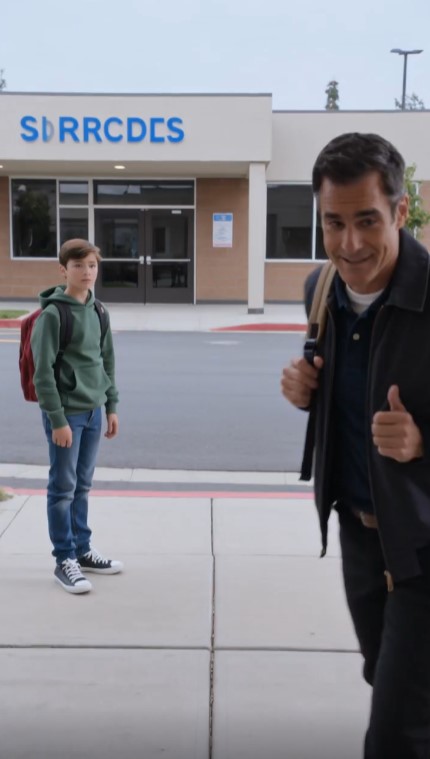
Noah thought his father worked until midnight.
He didn’t.
One evening, the 14-year-old followed him.
His father finished work at 9:00.
But instead of going home…
he entered a community center.
Noah watched through the open doorway.
His father sat at a desk.
Opened a textbook.
And started studying.
Noah couldn’t understand.
His dad was 47.
He worked all day.
Why was he going to school at night?
Then Noah saw the subject.
Math.
The same math Noah had been struggling with.
For months, his father had helped with homework every night.
Noah assumed Dad simply knew the answers.
He didn’t.
His father was secretly learning each lesson one week ahead…
so his son would never feel alone when he asked for help.
Noah walked inside.
His father looked up.
Embarrassed.
“You weren’t supposed to see this.”
Noah sat beside him.
“Why didn’t you tell me?”
His father smiled.
“Because you’re supposed to worry about being fourteen.”
“I’m supposed to worry about being your dad.”
Noah opened his own textbook.
“Then tonight…”
“we both study.”
His father’s name was Daniel.
He worked maintenance at a downtown office building.
Long shifts.
Early mornings.
Late evenings.
For years, Noah had believed his dad was simply good at fixing things.
Leaking pipes.
Broken cabinet hinges.
Loose bike chains.
Anything with screws, wires, or tools.
Math was different.
Daniel had left school young.
Not because he wanted to.
His own father had become sick.
Bills piled up.
Daniel took a job.
Then another.
School became something he always planned to return to.
But life kept moving.
Then Noah was born.
Daniel’s plans became smaller.
Practical.
Rent.
Food.
Shoes.
Doctor visits.
School supplies.
He never complained about it.
But there was one thing he hated.
The feeling of not being able to help when Noah asked a question.
At first, the homework was easy.
Addition.
Fractions.
Basic algebra.
Daniel could figure it out.
Then Noah reached harder material.
Equations.
Functions.
Geometry.
Daniel started getting stuck.
The first time it happened, Noah pushed the worksheet toward him and said:
“Dad, how do you do number eight?”
Daniel stared at it.
His stomach dropped.
He said:
“Give me a second.”
Then went into the kitchen with his phone.
He searched the lesson.
Watched two videos.
Tried three practice problems.
Came back ten minutes later.
“Okay.”
Noah never knew.
The next week, the same thing happened.
Then again.
Daniel realized he couldn’t keep improvising.
So he found a free evening math class at the community center.
Adult education.
Twice a week.
He registered quietly.
The instructor, Mrs. Carter, was surprised.
“What level are you trying to complete?”
Daniel said:
“Whatever my son is doing.”
She smiled.
“That’s not a level.”
He pulled Noah’s syllabus from his pocket.
“This.”
Mrs. Carter looked at it.
Then at him.
“You want to stay one lesson ahead?”
“Yes.”
“Why?”
Daniel shrugged.
“He asks me questions.”
That was all.
So every Tuesday and Thursday night, Daniel left work at nine.
Walked six blocks to the community center.
Sat in a plastic chair.
Opened a textbook.
And learned.
He made mistakes constantly.
Mrs. Carter would write something on the board.
Daniel would stare.
Erase.
Try again.
Sometimes he stayed after class.
Sometimes the security guard had to remind him the building was closing.
He kept a notebook titled:
NOAH MATH
Inside were pages of examples.
Not for Daniel.
For his son.
He wrote explanations in the simplest way he could.
If Noah gets confused here, show him this.
Remember: negative times negative = positive.
Draw the triangle first.
Don’t rush him.
Mrs. Carter found the notes one evening.
She said:
“You know you’re allowed to learn this for yourself too.”
Daniel laughed.
“I am.”
But they both knew the truth.
Noah was the reason he kept showing up.
That night Noah followed him because he had become suspicious.
His father had started saying:
“Extra shift.”
Too often.
Noah worried.
Money had been tight before.
He thought something was wrong.
So he waited outside Daniel’s workplace.
Saw him leave.
Then followed from a distance.
When Daniel entered the community center, Noah expected something serious.
A second job.
A meeting.
Maybe something Dad had hidden because he didn’t want him worried.
Then Noah saw the textbook.
Same chapter.
Same equations.
He felt something in his chest tighten.
All those nights.
Dad sitting beside him.
Saying:
“Try again.”
“Slow down.”
“You’re closer than you think.”
Noah had assumed Daniel remembered everything from school.
He didn’t.
He was learning it first.
Noah walked into the room.
Daniel looked up.
His face turned red.
“What are you doing here?”
Noah put his backpack down.
“You first.”
Daniel sighed.
“Your mother know you followed me?”
“No.”
“That’s going to be a problem.”
“Dad.”
Daniel looked at Mrs. Carter.
She tried not to smile.
Then he told the truth.
“I didn’t want you thinking I couldn’t help.”
Noah frowned.
“Why would I care?”
Daniel laughed.
“Because dads are supposed to know things.”
Noah shook his head.
“You know tons of things.”
“Not this.”
“So?”
Daniel didn’t have an answer.
Noah opened his own textbook.
“Then tonight we both study.”
Mrs. Carter pulled over another chair.
“Good. You can both do problem twelve.”
Daniel groaned.
“That one’s terrible.”
Noah smiled.
“I know.”
They worked for an hour.
Daniel got one answer wrong.
Noah got the same one wrong.
They stared at each other.
Then laughed.
Mrs. Carter said:
“Excellent teamwork.”
Daniel pointed at her.
“Not helpful.”
After that night, the secret ended.
But the classes didn’t.
Noah started going with him once a week.
Not because Daniel needed supervision.
Because they liked it.
At home, homework stopped feeling like a test of who was smarter.
Sometimes Noah understood first.
Sometimes Daniel did.
Sometimes neither knew.
Then they looked it up.
That changed something.
Noah had always thought adults either knew things or didn’t.
Daniel showed him another option.
You can not know something…
and still sit down and learn it.
Months passed.
Noah’s math grade improved.
Not dramatically at first.
A C became a C+.
Then a B-.
Daniel celebrated the B- like Noah had won a national award.
His mother Rachel laughed.
“It’s a B-minus.”
Daniel pointed at the paper.
“It has a B.”
Noah smiled.
“Barely.”
“Still counts.”
Then came the parent-teacher conference.
Noah’s math teacher, Mr. Harris, told Daniel:
“He’s changed.”
Daniel looked concerned.
“Good changed?”
“Yes.”
“He asks questions now.”
That surprised Daniel.
Noah used to hate asking.
He thought questions made him look stupid.
Then Mr. Harris said:
“He told me something interesting.”
Daniel glanced at Noah.
“What?”
Noah looked embarrassed.
Mr. Harris smiled.
“He said, ‘My dad says not understanding something just means you found what to learn next.’”
Daniel went quiet.
He didn’t remember saying that.
Maybe he had.
Maybe Noah made it better.
Either way, Daniel carried that sentence home.
The community center eventually offered Daniel the chance to work toward his high school equivalency credential.
He refused at first.
“I’m here for Noah.”
Mrs. Carter said:
“No.”
“You started for Noah.”
“Now you’re here too.”
Daniel thought about it.
He had spent decades treating his own unfinished education like a closed door.
Maybe it wasn’t.
So he enrolled.
This time he told Noah immediately.
No more secrets.
Noah became the one helping him study.
Reading.
Science.
Math.
Especially math.
One night Daniel got frustrated with a practice exam.
He pushed it away.
“I’m too old for this.”
Noah looked at him.
“You’re 47.”
“Exactly.”
“That’s not old.”
“Tell my knees.”
Noah laughed.
Then pushed the paper back.
“Try again.”
Daniel stared.
That was his line.
Noah smiled.
“Sounds familiar?”
Daniel picked up the pencil.
Months later, Daniel passed.
The community center held a small ceremony.
Nothing fancy.
Folding chairs.
Coffee.
Cookies.
Paper certificates.
Daniel almost skipped it.
Noah refused to allow that.
Rachel came too.
When Daniel’s name was called, he walked to the front.
Accepted the certificate.
Then looked toward Noah.
Noah stood and clapped louder than everyone.
Daniel laughed.
Afterward, Noah handed him a cheap plastic trophy.
Daniel read the label.
WORLD’S MOST ANNOYING MATH STUDENT
He laughed so hard he had to sit down.
“Where did you get this?”
“Internet.”
“Of course.”
Daniel kept it.
Years passed.
Noah graduated high school.
Math never became his favorite subject.
That part always made Daniel laugh.
“You made me go back to school and you still hate math?”
“Yes.”
“Unbelievable.”
But Noah passed.
More importantly, he stopped fearing subjects he didn’t immediately understand.
When he went to college, he chose social work.
Daniel asked:
“No engineering?”
“No.”
“Waste of all that algebra.”
“Completely.”
Daniel eventually moved into a supervisory role at work.
Then started taking evening courses in building management.
Not because Noah needed help anymore.
Because he had discovered something he should have known years earlier.
Learning didn’t expire.
One evening, years after the community center secret, Noah came home carrying his own work folder.
He was twenty-six now.
He sat at Daniel’s kitchen table.
“I need help.”
Daniel looked suspicious.
“With math?”
“No.”
“Good.”
“I’m applying for a promotion.”
Daniel smiled.
“What do you need?”
“I don’t know how to write the statement.”
Daniel pulled over a chair.
“Okay.”
Noah laughed.
“You don’t know either.”
“Nope.”
“Then what are we doing?”
Daniel opened the laptop.
“Learning.”
That word had become part of the family.
Not:
“I know.”
Not:
“You should already know.”
Just:
“Let’s learn.”
Later, when Noah had a son of his own, Daniel became Grandpa Daniel.
One afternoon, the boy brought home math homework.
Daniel looked at it.
Then immediately said:
“No.”
Noah laughed.
“What?”
“They changed math.”
“They did not.”
“This is different.”
Noah sat down.
His son sat beside him.
Daniel pulled out a pencil.
Three generations stared at the worksheet.
Nobody understood the first problem.
Daniel smiled.
“Perfect.”
His grandson looked confused.
“Why perfect?”
“Because now we know what to learn.”
Noah looked at his father.
Same sentence.
Still working.
Years later, Noah found Daniel’s old notebook in a drawer.
NOAH MATH
He had forgotten it existed.
He opened it.
Page after page.
Equations.
Examples.
Little notes.
Explain slowly.
Don’t make him feel bad if he forgets.
Remember to ask how school went first.
Then near the middle:
I think I understand this one. Finally.
Noah laughed.
Then cried.
He had understood his father’s sacrifice in broad terms.
Working late.
Money.
Fatigue.
But the notebook showed all the invisible minutes.
The videos.
The erased answers.
The lessons.
A tired 47-year-old man sitting under fluorescent lights after a full workday because his son might ask about algebra tomorrow.
Noah kept the notebook.
Not as proof Daniel was a perfect father.
He wasn’t.
They argued.
Daniel made mistakes.
Sometimes he was impatient.
Sometimes too tired to listen.
Sometimes he got the math wrong anyway.
But when he didn’t know how to help…
he learned.
That was what Noah remembered.
And whenever people praised Daniel later for going back to school, he always corrected them.
“I didn’t start because I believed in myself.”
“I started because my kid believed I knew the answer.”
Then he would smile.
“And I needed a week to catch up.”
For Noah, the most important night was never the certificate ceremony.
It was the first one.
Fourteen years old.
Following his father because he thought something was wrong.
Standing outside a community-center classroom.
Watching Daniel bend over the same math book Noah complained about every night.
Then walking inside.
Daniel looking embarrassed.
“You weren’t supposed to see this.”
And Noah sitting beside him.
Opening his own book.
No speeches.
No miracle.
Just two people at one table.
One father.
One son.
Both confused by the same math problem.
Both willing to stay until they understood it.