
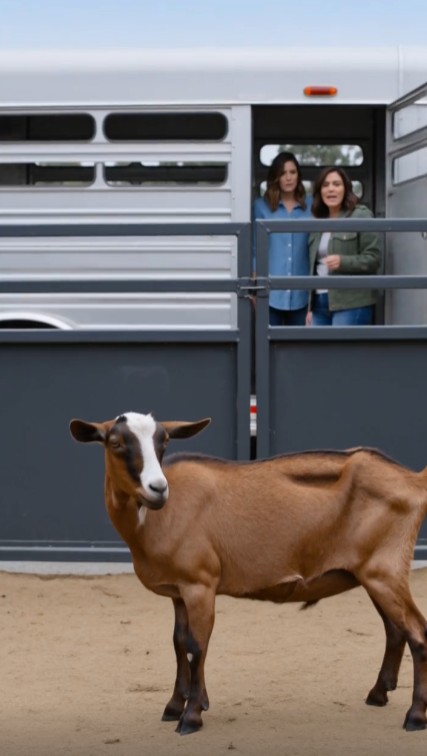
The rescue goat had finally been adopted.
The family opened the trailer.
Everyone expected him to walk inside.
He refused.
They tried again.
Nothing.
He wasn’t scared.
He wasn’t fighting.
He simply kept looking behind him.
The rescue worker followed his stare.
At the far end of the paddock…
An elderly goat was standing alone.
The adopter asked:
“Are they friends?”
The worker shook her head.
“They’ve never shared a pen.”
They opened the safe connecting gate.
The younger goat immediately walked toward him.
Then something strange happened.
The elderly goat turned away…
And walked toward the back fence.
The younger goat followed.
The workers watched.
Both goats stopped at exactly the same spot.
The elderly goat scratched gently at the dirt.
The worker frowned.
“What are they doing?”
Then she remembered something.
She ran back to the office…
Opened the intake records…
And went completely still.
“What?”
The adopter asked.
She looked through the window at both goats.
Then whispered:
“They arrived here three years apart.”
“So?”
The worker turned the records around.
“But they came from the same place.”
The adopter looked back toward the paddock.
The younger goat was now standing shoulder-to-shoulder with the older one.
Then the worker noticed one more detail in their records…
Something nobody at the rescue had connected before.
And suddenly they understood why he had refused to leave alone.
The rescue worker’s name was Rachel Carter.
She had worked at Green Valley Animal Sanctuary for six years.
The younger goat was Jasper.
He was approximately five years old and had arrived at the sanctuary eleven months earlier.
The older goat was Henry.
He was estimated to be around eleven.
Henry had arrived almost four years earlier.
They had always been housed separately.
Jasper lived with a small group of younger goats in the east paddock.
Henry lived with two older goats in a quieter enclosure because of his age and arthritis.
Their pens were separated by a service lane and two fences.
They could occasionally see one another.
But according to the sanctuary’s daily records, they’d never been intentionally introduced.
At least that was what Rachel believed.
Until she opened their intake files.
Jasper’s paperwork listed his previous location:
Miller Family Farm.
Henry’s paperwork listed:
Miller Farm Property.
Same road.
Same town.
Rachel immediately pulled up the original intake reports.
Henry had been surrendered after the elderly owner of the farm, Thomas Miller, became too ill to continue caring for all his animals.
Several animals were placed with different rescues.
Henry came to Green Valley.
But not every animal left.
According to the report, a relative had agreed to keep a small number of younger animals on the property.
Three years later, the remaining farm animals were surrendered after the property was sold.
Jasper was among them.
Rachel looked at the dates.
Then at the identification descriptions.
Her eyes stopped on one line.
Henry’s original intake paperwork said:
Previously housed with adult female goat, Daisy, and her young offspring.
Rachel grabbed Jasper’s file.
His early veterinary record included a handwritten note from the farm:
Dam: Daisy.
Rachel stared at it.
“No way.”
The adopter, Emily Wilson, leaned closer.
“What?”
Rachel placed the two pages beside each other.
“Henry lived with a goat named Daisy.”
“Okay.”
“Jasper’s mother was named Daisy.”
Emily looked toward the paddock.
“Are you saying Henry is his father?”
Rachel shook her head immediately.
“No. We don’t know that.”
The records didn’t establish parentage.
Henry had been neutered before arriving at the sanctuary, and the paperwork didn’t contain enough history to determine whether he’d ever sired offspring.
But there was something the records did support.
Henry and Jasper had almost certainly lived together during Jasper’s earliest months.
Rachel checked the dates again.
Henry left Miller Farm when Jasper would have been less than a year old.
They hadn’t arrived at Green Valley together.
They hadn’t been housed together at the sanctuary.
But years earlier, they had shared the same farm.
Possibly even the same group.
Emily looked through the window.
“So they knew each other?”
Rachel answered carefully.
“They may have.”
“May have?”
“We know they lived at the same property during an overlapping period.”
“And Henry’s records specifically mention Jasper’s mother.”
“Yes.”
Emily looked back at the goats.
Jasper was standing beside Henry.
Neither animal was doing anything dramatic.
They were simply close.
Shoulder to shoulder.
Quiet.
Emily asked:
“Could Jasper remember him after all this time?”
Rachel smiled.
“It’s possible for goats to recognize familiar individuals and cues, but we can’t know exactly what either of them remembers from watching this.”
“So we shouldn’t say they definitely recognized each other?”
“Exactly.”
Rachel looked toward the paddock.
“But we also shouldn’t ignore what they’re showing us now.”
That was the important part.
Whatever Jasper and Henry remembered—or didn’t remember—the younger goat had refused to enter the trailer while repeatedly looking toward Henry.
When safely given access, he approached the older goat.
And now neither seemed interested in separating.
Rachel decided the adoption would wait.
Emily immediately agreed.
“We’re not taking him today.”
Rachel looked relieved.
“Thank you.”
“Don’t thank me. I don’t want to drag him away when he’s clearly focused on something here.”
Emily’s husband Daniel and their twelve-year-old daughter Lily had been waiting beside the trailer.
Lily came over.
“Is Jasper okay?”
“He’s fine.”
“Then why isn’t he coming home?”
Emily crouched beside her.
“He might have found somebody he knew before he came here.”
Lily looked toward Henry.
“The old goat?”
“Maybe.”
“Is that his dad?”
“We don’t know.”
Lily thought for a moment.
“Can we adopt him too?”
Daniel laughed.
“We haven’t even gotten Jasper into the trailer.”
Lily pointed.
“That’s because we forgot his friend.”
Everyone smiled.
But adopting Henry wasn’t automatically simple.
He was older.
He had arthritis.
He required regular hoof care and veterinary monitoring.
He needed shelter that was easy to access.
And most importantly, the sanctuary wasn’t going to place two animals together based on one emotional moment.
Rachel wanted to observe them.
So did the sanctuary’s animal-care manager.
For the next several days, staff arranged safe, supervised contact.
The results were remarkably consistent.
When Jasper entered the shared area, he often approached Henry.
Henry tolerated his presence immediately.
They rested near one another.
They ate calmly within appropriate distance.
Jasper sometimes followed Henry across the paddock.
Henry occasionally initiated movement toward Jasper.
There was no significant aggression.
No persistent displacement.
No obvious stress.
On the third morning, a worker found them resting against opposite sides of the same low barrier.
Rachel photographed them for the care record.
Not social media.
Not a viral post.
The sanctuary wanted to document behavior before making a decision.
Then another staff member, Marcus, asked:
“What about the fence?”
Rachel looked at him.
“What fence?”
“The spot they went to on adoption day.”
Rachel had almost forgotten.
Henry had walked directly to the back fence.
Jasper followed.
Both stopped at the same location.
Henry scratched at the dirt.
Rachel and Marcus inspected the area.
At first, there was nothing unusual.
Then Marcus noticed a small piece of weathered wood partly buried beside the fence post.
He carefully loosened it.
It wasn’t part of the current fence.
It was an old wooden tag.
Most of the writing had disappeared.
But two letters remained.
M.F.
Rachel frowned.
“Could mean anything.”
Marcus turned it over.
There was a faded number.
7
The sanctuary property manager happened to be nearby.
He looked at it.
“That came with the old fencing.”
“What?”
Several years earlier, Green Valley had purchased used agricultural fencing and gates from a farm liquidation.
Rachel felt something tighten in her chest.
“Which farm?”
The manager didn’t remember.
But the accounting office still had invoices.
They searched.
There it was.
A purchase from the liquidation company that had handled equipment from several properties.
One was Miller Farm.
Rachel stared at the document.
The back section of Green Valley’s paddock contained several fence posts and gate panels salvaged from the same property where Henry and Jasper had once lived.
That explained something the staff hadn’t even known needed explaining.
The goats had not only come from the same farm.
Part of that farm had, in a small physical way, come here too.
Rachel contacted the company that had handled the liquidation.
Most records were gone.
But an old listing photograph remained online in their archived database.
It showed a row of fencing from Miller Farm.
Several posts carried small numbered wooden markers.
Rachel enlarged the photograph.
Marker 7 stood beside a small goat shelter.
She called Emily.
“You need to see this.”
The family returned that afternoon.
Rachel showed them the photograph.
Lily pointed immediately.
“That’s the same number.”
“Yes.”
“Was that their pen?”
“Possibly.”
Rachel didn’t want to claim more than the records established.
But Henry’s original intake photograph had been taken beside a shelter that looked extremely similar.
And the paperwork placed Daisy’s group in the smaller north paddock.
The liquidation map labeled the same area:
PEN 7 — SMALL LIVESTOCK
Daniel looked through the sanctuary window.
“So Henry walked to a fence post that used to be part of his old farm?”
“That’s what the records suggest.”
“And Jasper followed him.”
“Yes.”
“That’s unbelievable.”
Rachel smiled.
“It’s a remarkable coincidence.”
Lily had a different question.
“Does Henry know it’s his old fence?”
Rachel crouched beside her.
“We don’t know.”
“But why did he go there?”
“He might recognize something about it. The appearance, smell, location, or it may simply be a place he likes here.”
Lily frowned.
“That’s not a very exciting answer.”
Rachel laughed.
“No.”
“What’s the exciting answer?”
“That he remembered everything.”
“Can we say that?”
“No.”
Lily thought about it.
“Then we shouldn’t.”
Rachel smiled.
“Exactly.”
They didn’t need to invent anything.
The facts were already enough.
Two goats arrived at the same sanctuary three years apart.
Records showed they’d previously lived on the same farm.
The older goat’s paperwork specifically mentioned the younger goat’s mother.
And pieces of fencing from that farm had later been installed at the sanctuary.
Whether the animals understood any of those connections in the human way was impossible to know.
But their current preference for one another could be observed.
That was what mattered for the adoption decision.
Emily asked Rachel:
“What happens now?”
“We continue observing.”
“And if they stay like this?”
Rachel smiled.
“Then we talk about whether Henry could be part of your adoption.”
Lily immediately whispered:
“Yes.”
Daniel looked at her.
“You don’t get the final vote.”
“I should.”
“You’re twelve.”
“Exactly. I’ll be taking care of them longer than you.”
Daniel stared at her.
Rachel tried not to laugh.
Over the following two weeks, the family learned everything involved in caring for an older goat.
Henry wasn’t simply an extra animal.
His needs were different.
The family’s property already had appropriate livestock fencing and shelter for Jasper.
But they modified the entrance so Henry wouldn’t have to step over a raised threshold.
They added nonslip surfaces.
They arranged an area where he could rest without younger animals bothering him.
Their veterinarian reviewed Henry’s medical history.
The family also agreed to continue the management plan for his arthritis.
Rachel visited the property.
She inspected the fencing.
Water access.
Shelter.
Feed storage.
Everything passed.
Then came another question.
Would Henry actually be comfortable leaving the sanctuary?
His relationship with Jasper appeared positive.
But that didn’t automatically mean a move was best.
The sanctuary’s care team considered his health and behavior.
They conducted short loading exercises without forcing him.
Henry remained calm.
Jasper stayed nearby.
On the final practice day, something happened that made Rachel laugh.
The trailer doors opened.
Jasper walked inside.
Then stopped.
He turned around.
Everyone looked toward Henry.
The elderly goat stood several feet away.
Lily whispered:
“Here we go again.”
Henry slowly walked toward the trailer.
He paused at the ramp.
Sniffed it.
Then stepped inside.
Jasper moved farther forward.
Henry followed.
Rachel closed the internal divider according to the transport plan.
Lily smiled.
“Now he’ll go.”
Rachel nodded.
“Looks like it.”
The adoption was scheduled for the following Saturday.
Before they left, Rachel gave Emily copies of both goats’ historical records.
She also included a copy of the old Miller Farm photograph.
Emily looked at it.
“You’re giving us this?”
“They came with history.”
Lily pointed toward the old Pen 7 marker in the photograph.
“Can we take the wooden piece too?”
Rachel shook her head.
“That stays here.”
“Why?”
“Because it’s part of the sanctuary now.”
Lily considered that.
Then nodded.
“Okay.”
She ran toward the trailer.
Rachel watched Henry and Jasper leave together.
This time, Jasper didn’t look back.
Their new home was twenty-three miles away.
For the first few days, Emily sent updates.
Both goats were eating.
Henry found the easiest route into the shelter.
Jasper usually rested nearby.
Sometimes they separated.
Sometimes they chose different areas.
That reassured Rachel.
Healthy companionship didn’t require them to be attached every second.
They were simply two goats who appeared comfortable together.
Three months later, Rachel visited.
Lily met her at the gate.
“You have to see something.”
She led Rachel toward the back pasture.
Henry was resting beneath a tree.
Jasper was grazing nearby.
Nothing unusual.
Then Lily pointed toward a small wooden sign attached outside the fence.
Rachel read it.
PEN 7
She laughed.
“You recreated it?”
“Only the sign.”
“Good.”
“Dad wouldn’t let me buy an old fence.”
“Your dad is wise.”
Daniel called from across the yard.
“Finally somebody says it!”
Emily came outside carrying coffee.
She looked at the goats.
“Jasper still follows Henry a lot.”
Rachel nodded.
“How’s Henry doing?”
“Good days and slower days.”
That was expected.
Henry was old.
Nobody knew how much time he had.
But he had settled.
A year passed.
Then another.
Henry slowed considerably during the second winter.
The family worked closely with their veterinarian.
His arthritis became more difficult to manage.
Eventually, the conversation everyone knew would come had to happen.
Lily was fourteen now.
She sat beside her mother after the veterinarian left.
“Is he dying?”
Emily didn’t lie.
“He’s very old.”
“That’s not what I asked.”
Emily took her daughter’s hand.
“He may not have much time.”
Lily looked toward Jasper.
“Does he know?”
“I don’t know.”
For the next several weeks, the family focused on Henry’s comfort.
Warm bedding.
Easy access to food and water.
Medication according to veterinary guidance.
Quiet.
Jasper continued spending time near him.
Then one morning, Henry didn’t want to stand.
The veterinarian came.
After evaluating him, the adults made the difficult decision not to prolong suffering that could no longer be adequately managed.
Lily sat with Henry.
She rubbed the side of his neck.
“You almost got left behind.”
Emily put an arm around her.
Lily smiled through tears.
“But Jasper was stubborn.”
Rachel drove out from the sanctuary too.
She stood beside the family.
Henry died peacefully.
Afterward, Jasper searched the immediate area and called several times.
The family kept his routine stable and monitored him carefully.
He had other goats on the property.
Gradually, he spent more time with them.
But for several weeks, he still rested near the place where Henry had usually slept.
Lily asked Rachel:
“Does that mean he misses him?”
Rachel answered carefully.
“We can’t know exactly what he’s experiencing the way we’d describe human grief.”
“But he knows Henry isn’t here.”
“He’s clearly responding to a change in his social environment.”
Lily sighed.
“You always give the science answer.”
Rachel smiled.
“Somebody has to.”
“Can I give the other answer?”
“What’s yours?”
“I think he misses his friend.”
Rachel looked toward Jasper.
“I think that’s a perfectly understandable way to feel about what you’re seeing.”
Several months later, Daniel built a small wooden box.
Inside, Lily placed a copy of the Miller Farm photograph.
Henry’s sanctuary intake photograph.
Jasper’s intake photograph.
And a picture of both goats standing together at their new home.
On the lid she painted:
PEN 7
The original wooden marker remained at Green Valley.
Rachel eventually placed it inside the sanctuary office to protect it from weather.
Beside it, she added a small card explaining only the documented facts.
Henry arrived from Miller Farm.
Jasper arrived three years later from the same property.
Records indicated that Henry had once lived with Jasper’s mother.
Used fencing from Miller Farm was later installed at Green Valley.
When Jasper was scheduled for adoption, he repeatedly focused on Henry.
After safe introductions, the goats showed a compatible social relationship.
The adopting family eventually adopted both.
No claims about destiny.
No claim that Henry definitely recognized Jasper as a youngster he’d once known.
No claim that either goat understood the significance of the old fence.
Rachel didn’t need those additions.
The real story was better because it was real enough on its own.
Years later, Lily volunteered at Green Valley.
On her first day, another family arrived to adopt two goats.
One of them was reluctant to enter the trailer.
The new volunteer beside Lily immediately said:
“Maybe he’s trying to tell us something.”
Lily smiled.
“Maybe.”
“What should we do?”
“Pay attention.”
They checked the goat.
Checked the trailer.
Checked his companion.
Checked for signs of fear or discomfort.
Nothing dramatic happened.
The goat eventually loaded calmly.
But Rachel, now the sanctuary’s senior animal-care manager, overheard the conversation.
Later she told Lily:
“You learned the right lesson.”
“What lesson?”
“Not that every animal behavior hides a mystery.”
Lily nodded.
“Then what?”
“That when an animal suddenly refuses something, don’t immediately force the outcome you already planned.”
Lily smiled.
“Watch first.”
“Exactly.”
That was what had changed Jasper’s adoption.
The family could have become impatient.
They could have assumed he was being difficult.
Someone could have pushed him into the trailer and driven away.
Instead, they noticed where he was looking.
At the far end of the paddock stood an elderly goat he’d supposedly never met.
They opened a safe connecting gate.
Jasper walked directly toward him.
Henry walked toward the back fence.
Jasper followed.
Then two old intake records revealed that the animals’ histories had crossed years before either arrived at Green Valley.
Same farm.
Overlapping years.
The same goat named Daisy in both records.
And, through an extraordinary chain of ordinary events, even part of the fencing from that old farm had ended up at the sanctuary.
Nobody could say exactly what Jasper remembered that afternoon.
Nobody could know what Henry recognized.
But the sanctuary could observe what was happening in front of them.
Jasper didn’t want to leave while Henry remained behind.
Once the animals were safely introduced, they consistently chose to spend time together.
And when the family learned Henry might be part of the adoption too, they didn’t ask:
“Why should we take an old goat?”
They asked:
“What would he need?”
That question gave Henry two more comfortable years.
It gave Jasper a familiar companion.
And it gave Lily a story she would remember for the rest of her life.
Years later, she still kept the photograph of the two goats.
Henry stood beneath the tree.
Jasper beside him.
Shoulder to shoulder.
On the back, Lily had written:
We went to adopt one goat.
Then underneath:
He had other plans.
But Rachel later added a final line:
Or maybe he simply gave us a reason to look twice.
And sometimes…
looking twice is all it takes to realize that the animal you’re trying to take home may already be telling you something important about who shouldn’t be left behind.