
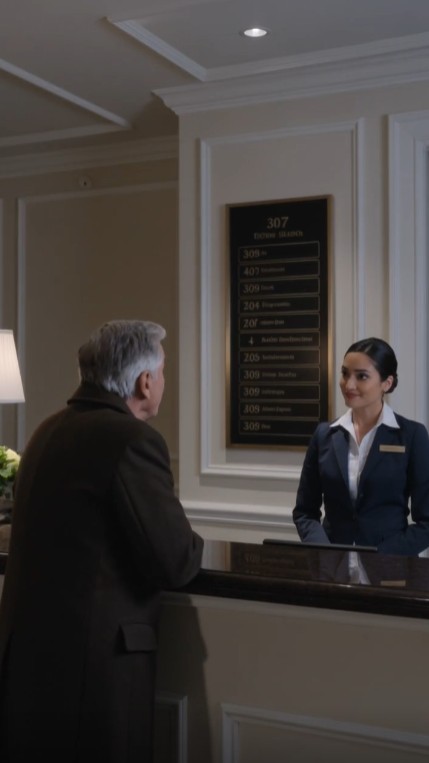
For three nights…
The elderly hotel guest asked the same question.
“Is Room 308 available?”
Every time, the receptionist gave him the same answer.
“Sir… this hotel doesn’t have a Room 308.”
The third floor went from 307…
Straight to 309.
The man simply smiled.
“It used to.”
The receptionist laughed nervously.
“I’ve worked here six years.”
“Then you’ve never seen the old floor plan.”
That got her attention.
She called the hotel manager.
He came downstairs.
The moment he saw the elderly guest…
He stopped walking.
The receptionist noticed.
“You know him?”
The manager didn’t answer.
The elderly man smiled.
“Hello, Thomas.”
The manager looked pale.
“You shouldn’t be here.”
Now the receptionist was completely confused.
“What is Room 308?”
The manager looked toward the elevator.
Then at the elderly man.
“There hasn’t been a Room 308 for thirty-one years.”
The guest nodded.
“I know.”
“Then why are you asking for it?”
The elderly man reached into his pocket…
But instead of producing a key or photograph…
He pulled out a simple folded list of names.
The manager saw the first one.
And immediately said:
“Where did you get this?”
The old man answered:
“From the people who stayed in 308.”
The receptionist stared at them.
“How many people stayed there?”
The elderly man unfolded the rest of the list.
It kept going.
And going.
Then he pointed toward one name near the bottom.
The manager stopped breathing for a second.
Because it was his.
THOMAS MILLER — AGE 17
Thomas stared at the paper.
“Put that away.”
The elderly man’s expression softened.
“Why?”
“Henry.”
“It’s just a list.”
“No.”
Thomas looked toward receptionist Emily Carter.
“It’s not.”
Henry Wilson was eighty-two years old.
Thirty-one years earlier, he had worked at the hotel.
Not as a manager.
Not as an owner.
Henry had been the night maintenance supervisor.
He fixed leaking faucets.
Unclogged drains.
Replaced locks.
Carried luggage when the bell staff were overwhelmed.
And whenever the ancient boiler stopped working at two in the morning, Henry was the person everyone called.
Thomas had been seventeen when he met him.
He hadn’t seen Henry since.
Emily looked between them.
“What happened in Room 308?”
Thomas didn’t answer.
Henry folded the list again.
“Maybe we should talk somewhere private.”
Thomas nodded.
They went into the manager’s office.
Emily expected Thomas to ask her to leave.
Instead, he closed the door and said:
“You might as well stay.”
Henry sat down.
Thomas remained standing.
Then Emily asked the obvious question.
“Why doesn’t Room 308 exist anymore?”
Thomas looked at Henry.
Henry answered.
“Because it was never really supposed to exist.”
Emily frowned.
“What does that mean?”
The Riverside Hotel had opened in 1948.
By the early 1990s, parts of the building had been renovated several times.
On the third floor, between Rooms 307 and 309, there had originally been a small guest room.
But by the time Henry started working at the hotel, the room had been removed from normal booking inventory.
There were plumbing problems.
The bathroom needed repairs.
The window didn’t close properly.
The carpet was old.
It wasn’t suitable to rent to paying guests.
So the hotel stopped selling it.
But the room remained.
Bed.
Desk.
Bathroom.
Locking door.
Thomas finally sat down.
“And then you started using it.”
Henry nodded.
Emily looked confused.
“Using it for what?”
Henry unfolded the list again.
“People who needed one night.”
Emily stared.
Henry explained.
It started during a snowstorm.
A woman named Margaret Reed arrived at the hotel with her eight-year-old daughter.
Their car had broken down several miles away.
A tow-truck driver brought them into town.
Every room at the Riverside was occupied.
Margaret had very little money.
The nearest motel with availability was miles away.
The roads were becoming dangerous.
The front-desk clerk told her there was nothing they could do.
Henry overheard.
He knew about 308.
The room had heat.
The bed was clean.
The bathroom worked well enough.
And maintenance was scheduled to begin the following month.
Henry called the night manager.
“Can we put them in 308?”
“No.”
“Why?”
“It’s out of service.”
“They’re not asking for room service.”
“Henry.”
“It’s ten degrees outside.”
The manager finally agreed.
One night.
No charge.
Margaret and her daughter slept safely.
The next morning, Margaret tried to pay.
The manager refused.
So she wrote her name on a piece of hotel stationery.
Underneath:
If someone else needs this room more than I did, give it to them.
Henry kept the paper.
A few months later, there was another person.
Then another.
Not every week.
Not even every month.
Room 308 never became an unofficial shelter.
The hotel wasn’t equipped for that.
But occasionally, when there was a legitimate short-term emergency and management approved it, the unused room provided a safe place until proper arrangements could be made.
A family displaced overnight by an apartment fire.
An elderly couple stranded after their vehicle broke down.
A mother and child waiting until a domestic-violence support organization could arrange appropriate accommodation.
A college student whose bus connection had been canceled during a storm.
A man traveling to see his hospitalized brother who discovered he’d arrived with almost no money left.
The circumstances were different.
The rule remained simple.
One night when appropriate.
Privacy.
No photographs.
No publicity.
And whenever possible, staff connected the guest with whatever legitimate assistance they needed next.
Emily looked at the list.
“All those names?”
Henry nodded.
“People who used 308.”
“Why write them down?”
“I didn’t.”
Thomas looked up.
“Then who did?”
“The guests.”
Henry explained.
After Margaret left the first note, he placed it inside the desk drawer.
Months later, another guest found it.
That person added a name.
Then another did the same.
Eventually Henry put a notebook in the drawer.
On the cover he wrote:
ROOM 308
Inside:
You don’t owe the hotel anything. If you want to leave something, leave your first name.
Over the years, the pages filled.
Some people wrote only names.
Some wrote one sentence.
Got the job.
Made it home.
My daughter slept safely tonight.
Thank you for not asking questions in front of my children.
I’ll help somebody else when I can.
Emily looked toward Thomas.
“And you stayed there?”
Thomas didn’t answer.
Henry did.
“One night.”
Thomas stood abruptly.
“I said this shouldn’t be discussed.”
Henry looked at him.
“Why?”
“Because I don’t want my employees hearing some sentimental version of my childhood.”
“Then tell the real one.”
Thomas stared at him.
For several seconds, neither spoke.
Finally Thomas sat down again.
“My mother and I stayed in 308.”
Emily hadn’t expected that.
Thomas continued.
He was seventeen.
His mother, Rachel Miller, worked at a bakery.
His father had died two years earlier.
After his death, debts accumulated.
Then the building where Rachel rented an apartment changed ownership.
There were disputes over repairs and rent.
Eventually Rachel and Thomas had to leave.
Thomas didn’t tell anyone at school.
He continued attending classes.
Continued working evenings at a grocery store.
Continued pretending everything was normal.
For several nights, he and his mother stayed with friends.
Then those arrangements ended.
One evening they sat in Rachel’s car trying to decide where to go.
The temperature was dropping.
Rachel had forty-three dollars.
Thomas had twelve.
They walked into the Riverside Hotel because Rachel knew someone who had once worked there.
That person was gone.
The hotel was almost full.
Rachel asked the price of the cheapest room.
She couldn’t afford it.
Thomas remembered her saying:
“Thank you anyway.”
Then Henry walked through the lobby carrying a toolbox.
He noticed Rachel crying outside.
He asked whether the car had broken down.
She said no.
He asked whether they had somewhere to stay.
She lied.
“Yes.”
Thomas interrupted.
“No, we don’t.”
Rachel became furious.
“Thomas.”
“What?”
“We don’t.”
Henry looked at them.
Then said:
“Wait here.”
Ten minutes later, he returned with a key.
Thomas remembered the room perfectly.
Brown carpet.
One lamp that buzzed.
A window with a towel pushed along the bottom to stop the draft.
Two clean blankets.
And a television that only received three channels.
“It wasn’t exactly luxury,” Henry said.
Thomas looked at him.
“It was the best room I’ve ever stayed in.”
Emily lowered her eyes.
Thomas continued.
That night, he found the notebook.
He read the names.
People he didn’t know.
People who had been there before him.
Then he wrote:
THOMAS MILLER — AGE 17
Underneath:
I’M GOING TO OWN A HOTEL ONE DAY.
Henry laughed.
“You wrote it in capital letters.”
“I was seventeen.”
“You also underlined it twice.”
“I was very seventeen.”
Emily smiled.
Thomas didn’t.
Because there was another line.
Henry remembered it.
Thomas did too.
Underneath the promise, Thomas had written:
AND NOBODY WILL HAVE TO ASK TWICE.
The following morning, Henry helped Rachel contact a local family-support organization.
They didn’t magically receive a new apartment that afternoon.
It took time.
But within several weeks, they had stable temporary accommodation.
Rachel found additional work.
Thomas finished high school.
Then he did exactly what he’d written in that notebook.
He entered hospitality.
First as a dishwasher in a hotel restaurant.
Then night clerk.
Front-desk supervisor.
Assistant manager.
General manager.
Eventually, he became part owner of a small hotel.
Years later, he joined an investment group that purchased the Riverside.
Emily stared.
“You own this hotel because you stayed here?”
Thomas shook his head.
“No.”
“I own part of this hotel because I spent thirty years working in hotels.”
He looked at Henry.
“But I chose this business because of one night.”
Henry smiled.
“That’s more accurate.”
Thomas asked:
“What happened to the notebook?”
Henry’s expression changed.
“That is why I’m here.”
During a major renovation thirty-one years earlier, the old third-floor layout was redesigned.
Room 308 was removed.
The wall between 307 and 308 was reconfigured.
Part of the old room became storage.
Another section became part of 309.
The door disappeared.
The number disappeared.
The room stopped existing.
Henry retired shortly afterward.
But before construction began, he emptied the old desk.
Inside was the notebook.
He took it home.
“I shouldn’t have,” Henry admitted.
Thomas shook his head.
“I’m glad you did.”
Henry kept it for more than three decades.
A few months earlier, he began sorting through his belongings.
His wife had died.
He was moving into a smaller apartment.
He found the notebook inside a box marked:
RIVERSIDE
He opened it.
Read the names.
Then wondered what had happened to those people.
Henry began searching.
Not invasively.
Not to expose anyone’s past.
He simply contacted the few people he could reasonably locate and asked whether they remembered Room 308.
Some didn’t respond.
Some had died.
Some couldn’t be found.
But several answered.
Margaret Reed—the first guest—was still alive.
Her daughter, Laura, was now a nurse.
The stranded college student became a mechanic.
The man visiting his hospitalized brother became a high-school counselor.
A mother who’d stayed one night with her young son eventually became a librarian.
None of their later lives proved that Room 308 had “saved” them.
Henry was careful about that.
One free hotel night doesn’t create someone’s future.
It doesn’t erase hardship.
It doesn’t solve housing instability.
It doesn’t replace professional support.
But nearly everyone Henry reached remembered the same thing.
For one difficult night…
someone had treated them like a guest instead of a problem.
Henry asked whether they’d like to write something for the old hotel.
Most did.
That was the folded list he carried.
Not merely the old names.
Updates.
Next to Margaret Reed:
Laura says I still overpack for every trip. She’s right.
Next to Daniel Harris:
My brother recovered. I stayed with him for another week. I never forgot the room.
Next to Maria Lopez:
My son doesn’t remember that night. I’m glad.
And beside Thomas Miller’s name…
nothing.
Henry had left it blank.
Thomas looked at him.
“Why?”
“Because I couldn’t find you.”
Thomas laughed.
“You found the hotel.”
“I didn’t know you owned it.”
“You could’ve called.”
Henry smiled.
“I wanted to see whether 308 was available.”
Thomas finally laughed.
“That was you testing the staff?”
“Three nights.”
“You’ve been staying here for three nights just to ask that question?”
“I had vacation savings.”
“You’re eighty-two.”
“I still take vacations.”
Emily laughed.
Thomas shook his head.
“You could’ve just asked for me.”
“Wouldn’t have been as interesting.”
Then Henry reached into his coat again.
This time, he removed something larger.
A thin, weathered notebook.
Thomas stopped smiling.
The cover was faded.
But the handwritten words were still visible.
ROOM 308
Henry placed it on the desk.
Thomas didn’t touch it immediately.
Then he opened it.
The first page contained Margaret’s name.
The next pages contained dozens more.
Some handwriting neat.
Some barely readable.
Some entries only initials.
Thomas turned pages slowly.
Then found his own.
THOMAS MILLER — AGE 17
I’M GOING TO OWN A HOTEL ONE DAY.
AND NOBODY WILL HAVE TO ASK TWICE.
Thomas laughed.
Then covered his eyes.
Emily quietly left the office to give them privacy.
When she returned twenty minutes later, Thomas and Henry were still talking.
Thomas had one question.
“Why did Room 308 stop?”
Henry understood what he meant.
Why hadn’t the tradition continued somewhere else after the renovation?
Henry answered:
“Because informal kindness isn’t always a system.”
The room had existed because a few managers made case-by-case decisions.
When renovations happened and staff changed, there was no formal program to replace it.
Thomas looked embarrassed.
“I’ve owned this place for eight years.”
Henry nodded.
“I know.”
“I never created another 308.”
“No.”
“I wrote that nobody would have to ask twice.”
“You were seventeen.”
“That’s not an excuse.”
Henry leaned forward.
“Thomas, you run a hotel, not an emergency housing service.”
Thomas looked at him.
“So?”
“So don’t turn an old memory into something irresponsible because you feel guilty.”
Thomas smiled faintly.
“You haven’t changed.”
“I’m older.”
“You were old then.”
“I was fifty-one.”
“Ancient.”
Henry laughed.
Then became serious.
“If you want to honor the room, do it properly.”
That sentence stayed with Thomas.
Over the following months, he met with local organizations experienced in emergency housing and family support.
He asked what a hotel could realistically do.
Not what would make a good newspaper story.
What would actually help.
The answer was not to secretly reopen a room and allow random people to stay there.
Instead, the hotel established a small formal partnership.
A limited number of emergency overnight stays could be referred through participating organizations when appropriate and when rooms were available.
The partner organizations handled eligibility and support.
The hotel provided rooms discreetly.
No photographs.
No public donor wall.
No social-media posts identifying guests.
Thomas had one rule.
Nobody receiving help was required to tell their story.
Henry approved.
“Evelyn would’ve liked that.”
“Who’s Evelyn?”
“My wife.”
“What would she say?”
“That you’re finally using your hotel for something besides charging twelve dollars for orange juice.”
Thomas laughed.
“We don’t charge twelve dollars.”
“Eleven?”
“Seven.”
“Still criminal.”
The hotel staff eventually learned the history of Room 308.
But Thomas didn’t tell them every detail about his own night there.
He didn’t need to.
He did show them one line from the notebook:
AND NOBODY WILL HAVE TO ASK TWICE.
Emily suggested displaying the notebook in the lobby.
Henry immediately objected.
“No.”
“Why?”
“Those names belong to people.”
She realized he was right.
The notebook contained personal history.
It wasn’t decoration.
So it was placed in the hotel’s private historical archive with restricted access.
Instead, Thomas commissioned a small plaque.
It didn’t mention names.
It didn’t describe anyone’s hardship.
It simply read:
ROOM 308
1948–1995
Sometimes hospitality means more than having a reservation.
Thomas hung it between Rooms 307 and 309.
Guests occasionally asked about it.
Staff gave a simple answer.
“There used to be a room there.”
If someone wanted more history, they could explain that the hotel once occasionally used the out-of-service room, with management approval, to provide temporary accommodation during emergencies.
Nothing more.
Henry stayed involved.
Every few months, he came to the hotel for coffee.
He refused free rooms.
Thomas ignored him and gave him one anyway.
“Not 308,” Henry always complained.
“It doesn’t exist.”
“It used to.”
The same argument.
Every time.
Then, one Friday afternoon, Henry entered the lobby carrying an envelope.
Thomas was waiting.
“What now?”
“One more name.”
Henry handed it to him.
Inside was a letter from Laura Reed.
Margaret’s daughter.
The eight-year-old girl who had stayed in 308 during the snowstorm that started everything.
Laura was now sixty.
She remembered very little about that night.
But she remembered one detail.
Hot chocolate.
Henry had brought her a cup.
Too hot.
She burned her tongue.
Henry stared at the letter.
“I forgot that.”
Thomas smiled.
“Apparently she didn’t.”
Laura wrote:
My mother always told me the hotel gave us a room when we had nowhere safe to go that night.
I don’t remember being afraid.
I remember the hot chocolate.
Maybe that’s the best thing you gave us.
Henry read the sentence twice.
Then said:
“Terrible hot chocolate.”
Thomas laughed.
Years passed.
Henry’s health declined.
He visited less often.
Then one morning Thomas received a call from Henry’s niece.
Henry had died peacefully at eighty-six.
Thomas sat in his office for a long time.
Then he walked upstairs.
Past 307.
Past the small Room 308 plaque.
Toward 309.
He stopped.
Thirty-five years earlier, he’d stood almost exactly there as a frightened seventeen-year-old.
He had no idea where he and his mother would live.
No idea whether he’d finish school.
No idea what his future looked like.
Then a maintenance worker gave them a key to a room nobody was using.
Thomas touched the plaque.
“Thank you, Henry.”
A week later, Henry’s niece brought a box to the hotel.
Inside were photographs.
Old Riverside employee badges.
A maintenance log.
And one sealed envelope.
FOR THOMAS
Thomas opened it.
Henry had written:
You said nobody would have to ask twice.
That’s a good promise, but don’t misunderstand it.
You can’t say yes to everyone.
You can’t fix everyone’s life.
You can build a place where people are treated decently when the answer has to be no.
Thomas stopped reading.
Then continued.
Room 308 mattered because people weren’t embarrassed inside it.
Remember that part.
At the bottom:
Also, your orange juice is too expensive.
Thomas laughed through tears.
He framed that final line in his office.
Not the rest.
The rest stayed private.
Years later, Thomas retired.
Emily became general manager.
On her first official day, Thomas gave her two things.
The key to his office.
And a copy of Henry’s letter.
Emily read it.
Then asked:
“What happens to the eighth-floor partnership?”
Thomas corrected her.
“Third-floor.”
“No, I mean our emergency-stay program.”
Thomas smiled.
“You’re the manager now.”
“I know.”
“So manage it.”
Emily continued the partnership.
She improved parts of it.
Added additional community contacts.
Updated staff training.
Made sure employees understood boundaries.
And kept the privacy rules Henry had valued.
The old plaque remained upstairs.
Then the plaque.
Then 309.
New employees always noticed.
“Why isn’t there a 308?”
Eventually someone would tell them.
Not the dramatic version.
The real one.
There had once been a room.
It fell out of normal service.
During certain emergencies, with management approval, it occasionally became a temporary place for someone who needed one safe night.
One of those guests was a seventeen-year-old boy named Thomas Miller.
He later became the hotel’s manager and part owner.
Decades later, the maintenance worker who’d helped him returned with the old notebook.
That reunion inspired Thomas to create something more sustainable than the informal arrangement had ever been.
One evening, years after Thomas retired, he returned to the Riverside for dinner.
He took the elevator to the third floor afterward.
He walked toward the old plaque.
A young hotel employee happened to pass.
“Can I help you, sir?”
Thomas smiled.
“Is Room 308 available?”
The employee looked confused.
“Sir, there isn’t a Room 308.”
Thomas laughed.
“Good answer.”
The employee frowned.
Thomas pointed toward the plaque.
“It used to.”
Then he walked away.
He didn’t explain.
He didn’t need to.
Because the most important part of Room 308 had survived even after the walls changed.
Not the number.
Not the bed.
Not the old desk where frightened guests wrote their names.
It was the idea behind it.
A room doesn’t have to solve someone’s life to matter.
Sometimes one safe night is simply one safe night.
And sometimes that’s exactly what someone needs before morning.
Thomas had learned that at seventeen.
Henry had remembered it for more than thirty years.
And when the elderly maintenance worker finally returned to the hotel carrying a folded list of names, Thomas initially thought Henry had come to remind him of a promise he’d forgotten.
Instead, Henry reminded him of something more important.
The people on that list hadn’t been projects.
They hadn’t been stories.
They had been guests.
People having difficult nights.
And one of them had been Thomas.
That’s why the manager stopped breathing when he saw his own name near the bottom of Henry’s list.
Not because Room 308 hid some dark secret.
Not because something mysterious had happened behind a missing door.
But because thirty-one years earlier, when Thomas Miller had nowhere else to go…
someone at the Riverside Hotel had looked at an unused room and decided that, for one night, it didn’t need to stay empty.