
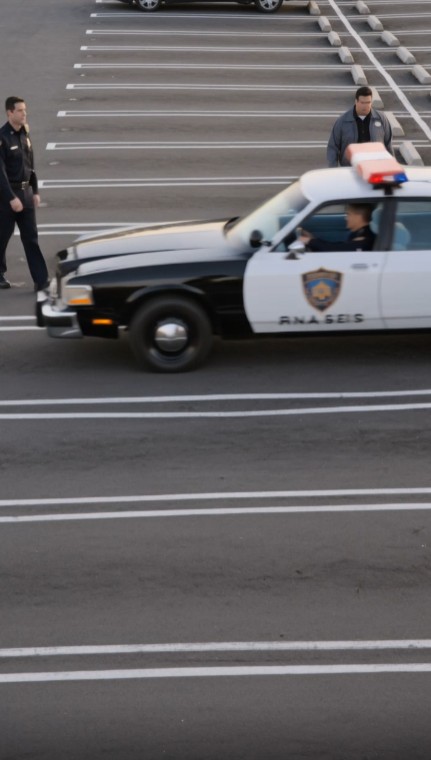
The same police officer pulled into a downtown parking lot.
He paid for two spaces.
Then parked in only one.
The space beside him always stayed empty.
Week after week.
Finally, the attendant asked:
“Officer… why do you keep paying for a space nobody uses?”
The officer looked at the empty spot.
“Because somebody used to.”
The attendant assumed that was the end of it.
Until one Friday…
A beat-up blue car entered the lot.
The officer saw it…
And immediately stood up.
The car stopped in the empty space.
The attendant stared.
An elderly man stepped out.
He looked at the officer.
Neither spoke.
Then the old man said:
“You kept paying for it?”
“Every Friday.”
“For how long?”
“Eleven years.”
The elderly man shook his head.
“You shouldn’t have.”
The officer smiled.
“You told me you’d come back.”
The parking attendant couldn’t stay quiet.
“Who is he?”
The officer looked at the elderly man.
“The reason I’m wearing this uniform.”
The old man immediately shook his head.
“No.”
“You did that yourself.”
Then the officer said something strange.
“Open your trunk.”
The elderly man froze.
“Why?”
“Because I know you didn’t come here empty-handed.”
The old man slowly opened it.
The officer looked inside…
And started laughing through his tears.
The parking attendant stepped closer.
Inside were dozens of identical plain boxes.
“What are those?”
The elderly man looked at the officer.
“The promise I couldn’t keep eleven years ago.”
The officer’s name was Marcus Reed.
The elderly man was Henry Walker.
And the story of those two parking spaces had started twenty-three years earlier.
Marcus was fifteen.
His father had died when he was nine.
His mother, Anna, worked two jobs.
For several years they managed.
Then Anna became ill.
Nothing happened all at once.
That was almost worse.
First she missed several shifts.
Then came medical appointments.
Then reduced hours.
Then overdue bills.
Eventually, mother and son lost their apartment.
They stayed with Anna’s sister for a while.
Then with a friend.
When those arrangements became impossible, Anna and Marcus spent several weeks moving between inexpensive motels and their old blue sedan.
Marcus told almost nobody.
Every morning he went to school.
Every afternoon he changed clothes in a public restroom and walked to his part-time job.
He became very good at appearing normal.
Then one Friday evening, everything went wrong.
Marcus finished work at 5:20.
He walked toward the downtown parking lot where his mother was supposed to meet him.
The blue sedan wasn’t there.
He waited.
5:30.
5:45.
6:00.
Marcus had no phone.
Finally the car appeared.
Anna parked crookedly.
She didn’t get out.
Marcus opened the passenger door.
“Mom?”
She looked exhausted.
“I need five minutes.”
Marcus noticed she was shaking.
“You okay?”
“I’m fine.”
She wasn’t.
A man in uniform was walking toward them.
Marcus saw him and immediately became nervous.
He assumed someone had reported the car.
They had stayed too long.
Maybe they were going to be told to leave.
The officer stopped beside Anna’s window.
“Everything okay?”
“Yes.”
Anna tried to smile.
“We’re leaving.”
“You don’t have to leave.”
“We were just leaving.”
The officer looked at Marcus.
Then back at Anna.
“Ma’am, are you feeling well?”
“I said I’m fine.”
Marcus expected the officer to become impatient.
Instead, he crouched slightly beside the window.
“My name is Henry.”
Anna stared at him.
“Okay.”
“I’m not asking because of the parking.”
That was when Marcus noticed Henry wasn’t wearing the uniform of the city police department.
He was a county officer assigned nearby who had stopped after seeing Anna sitting strangely behind the wheel.
Henry asked whether she needed medical help.
Anna refused.
Marcus didn’t.
“My mom’s sick.”
Anna turned.
“Marcus.”
“You are.”
“I’m tired.”
“You almost fell over yesterday.”
Henry didn’t dramatize the situation.
He simply asked a few more questions.
Eventually Anna agreed to be evaluated.
A medical issue related to her treatment and dehydration was addressed before it became more serious.
But Henry learned something else that evening.
Anna and Marcus didn’t have a stable place to stay.
Marcus hated that he knew.
He expected pity.
Instead, Henry asked:
“Have you eaten?”
Marcus lied.
“Yes.”
Henry looked at Anna.
She looked away.
Henry said:
“Okay.”
He didn’t challenge the lie.
He left.
Twenty minutes later, he returned carrying a plain cardboard box.
Marcus stared at it.
“What is that?”
“Some things I had in my car.”
Henry placed it in the back seat.
Inside were groceries.
Bread.
Canned soup.
Peanut butter.
Fruit.
Crackers.
Bottled water.
Nothing expensive.
Nothing dramatic.
Anna immediately objected.
“We can’t take this.”
Henry answered:
“Sure you can.”
“We can’t pay you.”
“I didn’t ask you to.”
Anna looked embarrassed.
Henry noticed.
He lowered his voice.
“This isn’t charity.”
“What is it?”
“Dinner.”
That answer stayed with Marcus.
Henry also gave Anna information for legitimate local services that could help with temporary housing and medical-related support.
He didn’t pretend a box of groceries would solve their problems.
It wouldn’t.
But that Friday night, it helped.
The following Friday at 5:30, Marcus returned to the same parking lot after work.
Henry’s patrol car was there.
Parked beside the blue sedan.
Another plain box sat between them.
Marcus frowned.
“You again?”
Henry smiled.
“You sound disappointed.”
“My mom says we can’t keep taking things from you.”
“Good.”
Marcus looked confused.
Henry pointed toward the box.
“So this one’s not for you.”
“Then who?”
“You tell me.”
Marcus stared.
Henry explained.
Inside were basic groceries.
There was a community pantry several blocks away.
Henry had planned to drop the box there after his shift.
But he wanted Marcus to do it.
“Why?”
“Because you need to learn something.”
“What?”
“Being helped doesn’t mean you’re permanently the person who needs help.”
Marcus didn’t understand.
Henry handed him the box.
“Some Fridays you carry one home.”
“Some Fridays you carry one somewhere else.”
Marcus looked down at it.
“That’s it?”
“That’s it.”
That became their Friday routine.
Not every week.
Not formally.
But often enough.
Henry would finish his shift.
Marcus would finish work.
They’d meet around 5:30.
Sometimes Henry brought a box.
Sometimes Marcus did.
Sometimes there was nothing in either car and they simply talked.
Henry never asked Marcus to tell him every painful detail of his life.
He mostly asked about school.
Grades.
Work.
Plans.
Marcus didn’t have many.
At seventeen, he told Henry:
“I’ll probably just keep working.”
“Doing what?”
“Anything.”
“That isn’t a plan.”
“It pays.”
“That’s not what I asked.”
Marcus became irritated.
“What do you want me to say?”
“I don’t want you to say anything.”
Henry pointed toward him.
“I want you to decide something before life decides everything for you.”
Marcus rolled his eyes.
Henry ignored it.
A few weeks later, Marcus saw Henry helping after a traffic collision.
Nobody was seriously injured.
But one driver was frightened and confused.
Marcus watched Henry speak calmly to him.
No shouting.
No showing off.
No unnecessary drama.
Later Marcus asked:
“How do you stay calm like that?”
Henry laughed.
“I don’t.”
“You looked calm.”
“That’s different.”
Marcus thought about that.
Then asked:
“What do you have to do to become a police officer?”
Henry looked at him.
“Why?”
“I just asked.”
“No. You didn’t.”
Marcus looked away.
Henry smiled.
“You’re thinking about it.”
“Maybe.”
Henry didn’t tell Marcus he should become an officer.
He didn’t tell him it was his destiny.
Instead, he explained the requirements.
Education.
Background standards.
Physical requirements.
Training.
Responsibility.
The parts that were difficult.
The parts that weren’t glamorous.
Then he said:
“If you’re serious, I’ll help you find accurate information.”
Marcus nodded.
Henry kept his word.
But Henry never filled out Marcus’s applications.
Never completed his coursework.
Never took an exam for him.
Never did the training.
That’s why, decades later, when Marcus called Henry the reason he wore the uniform, Henry immediately corrected him.
“You did that yourself.”
Marcus knew Henry was right.
But he also knew there was a difference between walking someone’s road for them…
and showing them that a road exists.
Henry had done the second.
Anna’s health eventually improved enough for her to return to steadier work.
With help from family and community resources, she and Marcus moved into a small apartment.
It had one bedroom.
Marcus slept on a foldout couch.
To him, it felt enormous.
The first Friday after they moved in, Marcus arrived at the parking lot carrying a box.
Henry looked surprised.
“What’s that?”
“Groceries.”
“For you?”
“No.”
Henry smiled.
Marcus had purchased them with part of his paycheck.
Not much.
Pasta.
Rice.
Canned vegetables.
Cereal.
He wanted to donate the box.
Henry looked inside.
“You don’t need to spend money you don’t have.”
Marcus answered:
“We have enough this week.”
Henry looked at him for a long moment.
Then nodded.
“Okay.”
Together, they delivered it to the community pantry.
That became known between them as a Friday box.
No organization.
No logo.
No photographs.
Just a box.
Sometimes Henry paid.
Sometimes Marcus did.
Later Anna joined them.
Then one of Marcus’s coworkers.
Eventually a few people knew.
But Henry had a strict rule.
“If you’re helping somebody, don’t turn their hard week into your advertisement.”
Marcus never forgot it.
Years passed.
Marcus graduated.
He worked.
Took community-college classes.
Applied to the police academy.
The first time he applied, he wasn’t accepted.
Marcus was devastated.
He drove to the parking lot on Friday.
Henry was already there.
“I didn’t get in.”
Henry nodded.
“I know.”
“How?”
“Your mother called me.”
Marcus groaned.
“Of course she did.”
Henry opened his trunk.
There was a box inside.
Marcus stared.
“I’m not doing that tonight.”
“Yes, you are.”
“I failed.”
“You weren’t accepted.”
“Same thing.”
“No.”
“Feels the same.”
Henry lifted the box.
“Take this side.”
Marcus reluctantly helped.
They delivered it.
On the walk back, Henry said:
“You know what I like about carrying boxes?”
“What?”
“They don’t care how important you think your problems are.”
Marcus looked at him.
“That’s terrible advice.”
“Probably.”
Henry smiled.
“But you still carried your end.”
Marcus applied again.
This time he was accepted.
On the morning he left for training, Henry gave him something.
Not a police badge.
Not a watch.
Not some dramatic family heirloom.
A flattened cardboard box.
Marcus stared.
“You’re kidding.”
Henry had written on it:
FIRST FRIDAY BOX
Marcus laughed.
“You saved this?”
“No.”
Marcus looked disappointed.
Henry smiled.
“I found another box and wrote that on it ten minutes ago.”
Marcus started laughing.
“That isn’t even sentimental.”
“Life is disappointing.”
Then Henry became serious.
“Remember what it means.”
Marcus nodded.
“Some weeks you carry one home.”
Henry finished:
“Some weeks you carry one somewhere else.”
Marcus completed training.
He became an officer.
Anna cried at the ceremony.
Henry stood at the back.
Afterward, Marcus found him.
“You couldn’t sit with us?”
“I was there.”
“Mom saved you a seat.”
“I saw.”
“Then why didn’t you use it?”
Henry shrugged.
“Your day.”
Marcus hugged him anyway.
Their Friday meetings continued.
5:30.
Same downtown lot.
Two cars.
Two spaces.
Sometimes one box.
Sometimes ten.
Then, eleven years ago, everything changed.
Henry arrived late.
Marcus knew immediately something was wrong.
Henry didn’t get out of his car.
Marcus walked over.
“What happened?”
Henry handed him a piece of paper.
It was an address nearly nine hundred miles away.
“My wife.”
Henry’s wife, Evelyn, had been diagnosed with a serious illness.
Their daughter Rachel lived in another state and wanted them nearby during treatment.
Henry was retiring.
They were leaving within days.
Marcus stared at him.
“For how long?”
“I don’t know.”
“What about Friday?”
Henry smiled.
“You’ll survive.”
“That’s not what I asked.”
Henry looked toward the two parking spaces.
For years, they’d parked beside each other.
Henry in one.
Marcus in the other.
Sometimes Marcus arrived first.
Sometimes Henry did.
Marcus asked:
“Are you coming back?”
Henry hesitated.
Then:
“Yes.”
“When?”
“One Friday.”
“That’s not an answer.”
“It’s the best one I have.”
Marcus looked angry.
Henry reached into his trunk.
One final plain box was inside.
He handed it to Marcus.
“This one’s yours.”
Marcus opened it.
It was empty.
He looked at Henry.
“You forgot the groceries.”
“No.”
“Then what’s this?”
“A promise.”
Marcus rolled his eyes.
“Now you’re becoming sentimental?”
“Age.”
Henry tapped the empty box.
“I was going to start something when I retired.”
“What?”
“Friday boxes.”
“You already do Friday boxes.”
“I mean properly.”
Henry had been speaking with the community pantry.
Instead of random grocery donations, he wanted to help create a structured program where volunteers could prepare standardized boxes based on what the organization actually needed.
Food.
Basic toiletries.
Other approved essentials.
No handing random bags to strangers.
No photographs.
No asking recipients to explain why they needed help.
The community organization would manage distribution.
Henry would help with donations and packing.
Marcus smiled.
“That actually sounds organized.”
“Evelyn’s idea.”
“I knew it couldn’t be yours.”
Henry laughed.
Then his expression changed.
“I can’t start it now.”
“Your wife needs you.”
“I know.”
“So go.”
Henry looked at him.
“When I come back, we’ll fill this lot with boxes.”
Marcus nodded.
“Deal.”
Henry drove away.
At first, Marcus and Henry spoke regularly.
Evelyn’s treatment was difficult.
Months became years.
Henry stayed.
Marcus understood.
Then Anna’s health declined again.
Marcus became busy caring for his own mother.
Calls became less frequent.
Evelyn eventually died.
Henry remained near his daughter.
Then Henry himself had health problems.
One year became five.
Five became eight.
But every Friday Marcus could…
he returned to the parking lot at 5:30.
He paid for two spaces.
He parked in one.
The other remained empty.
At first, it was habit.
Then remembrance.
Then simply part of his week.
The parking attendants changed.
Businesses around the lot changed.
The payment machines changed.
Marcus got older.
But the second space remained.
And Marcus did something else.
He started the Friday box program without Henry.
Not alone.
He contacted the same community organization.
He asked what they needed.
He recruited volunteers carefully.
Anna helped until her health no longer allowed it.
Other officers participated on their own time.
Teachers joined.
Local businesses occasionally contributed supplies.
The program stayed small.
Then grew.
Marcus never named it after Henry.
He knew Henry would hate that.
They simply called it:
Friday Boxes.
Eleven years after Henry left, the program was preparing its largest distribution yet.
Marcus hadn’t told him.
In fact, Marcus hadn’t spoken to Henry in nearly a year.
Then, at exactly 5:30 on a Friday…
a beat-up blue car entered the parking lot.
Marcus recognized the driver immediately.
Older.
Thinner.
White-haired.
But Henry.
And somehow, despite all those years, Henry drove directly into the empty space.
“You kept paying for it?”
“Every Friday.”
“For how long?”
“Eleven years.”
“You shouldn’t have.”
“You told me you’d come back.”
Then Marcus told him to open the trunk.
Henry hesitated.
Because Marcus knew him too well.
The trunk opened.
Inside were dozens of plain cardboard boxes.
Marcus started laughing through his tears.
The parking attendant stepped closer.
“What are those?”
Henry looked at Marcus.
“The promise I couldn’t keep eleven years ago.”
Marcus opened the first box.
Inside were neatly packed groceries and basic household supplies.
A printed inventory sheet sat on top.
Marcus lifted it.
“You finally learned organization?”
“My daughter.”
“I knew it.”
Henry laughed.
Then Marcus noticed something written on the inside flap.
Not a charity slogan.
Not Henry’s name.
Just:
Some Fridays you carry one home.
Marcus opened the next box.
Inside the flap:
Some Fridays you carry one somewhere else.
Marcus stopped laughing.
Henry looked nervous.
“Too much?”
“You’ve gone soft.”
“I’m eighty-one.”
Marcus hugged him.
For several seconds, neither moved.
The parking attendant quietly walked away.
Then Marcus said:
“You’re late.”
Henry laughed into his shoulder.
“Eleven years.”
“Five minutes would’ve been rude.”
They unloaded the boxes.
Henry expected Marcus to explain where they should be delivered.
Instead, Marcus said:
“Get back in your car.”
“Why?”
“Follow me.”
Marcus drove three blocks.
Henry followed.
They stopped outside a community center.
When Henry walked inside, he froze.
Tables filled the room.
On them were boxes.
Hundreds of them.
Volunteers were packing supplies.
Some wore police uniforms because they’d come after their shifts.
Others were teachers.
Students.
Retirees.
Business owners.
At the far end was a small sign:
FRIDAY BOXES
Nothing else.
No photograph of Henry.
No story about Marcus.
No giant sponsor names.
Henry looked at Marcus.
“You did it.”
Marcus shook his head.
“We did it.”
“No.”
Henry smiled.
“You did this.”
Marcus pointed around the room.
“They did it.”
That answer made Henry happier.
A woman approached them.
She was in her seventies.
Henry stared.
“Anna?”
Marcus’s mother smiled.
“You took long enough.”
Henry covered his mouth.
Anna’s health was fragile, but she’d insisted on coming when Marcus told her Henry might return.
Henry hugged her.
“You look exactly the same.”
“You’ve become a terrible liar.”
“Retirement.”
Anna looked toward the boxes.
“Remember the first one?”
Henry smiled.
“Bread. Soup. Peanut butter.”
“You forgot the crackers.”
“I did not.”
“You did.”
Marcus interrupted.
“You two have had twenty-three years to settle this.”
Anna pointed at Henry.
“He forgot the crackers.”
Henry looked at Marcus.
“She was this difficult when I met her.”
“I know.”
Then a teenage volunteer walked past carrying a box.
Henry watched him.
Something about the sight made him quiet.
Marcus noticed.
“What?”
Henry shook his head.
“Nothing.”
“Henry.”
The old man looked around the room.
“I thought I failed.”
Marcus frowned.
“At what?”
“I told you I’d come back.”
“You did.”
“Eleven years later.”
“You had a wife who needed you.”
“Then after Evelyn died, I should’ve returned.”
“You were sick.”
“After that?”
Marcus waited.
Henry looked ashamed.
“After enough time passed, I didn’t know how.”
Marcus understood immediately.
The same thing happens with old friends.
Unanswered letters.
Missed calls.
Promises delayed too long.
Eventually the delay itself becomes another reason to wait.
Henry continued.
“Every Friday I’d think, next week.”
Marcus smiled.
“I know something about waiting until Friday.”
Henry looked at him.
“Then Rachel found the old papers.”
“What papers?”
Henry’s daughter had been helping him move to a smaller home.
She found his notes about the Friday box program.
She also found an old parking receipt.
Two spaces.
Friday.
5:30.
Rachel asked what it meant.
Henry told her about Marcus.
She said:
“Call him.”
Henry refused.
So Rachel asked:
“What did you promise him?”
Henry answered:
“That I’d come back with boxes.”
Rachel said:
“Then stop calling and start packing.”
Over several weeks, Henry worked with a community organization near his home.
Friends contributed.
His daughter helped.
His grandchildren packed.
Thirty-six boxes went into the blue car.
“Why the blue car?” Marcus asked.
Henry smiled.
“It was Evelyn’s.”
Marcus looked again.
The car wasn’t the same blue sedan Anna had owned decades earlier.
But the color was almost identical.
“Did you choose that on purpose?”
“Evelyn did.”
“She remembered?”
“I told her the story a thousand times.”
Henry opened his wallet.
Inside was a photograph.
Evelyn stood beside the blue car.
On the back she’d written:
FOR THE FRIDAY TRIP YOU KEEP TALKING ABOUT.
Marcus read it.
“She knew you’d come back.”
Henry nodded.
“She usually knew me better than I did.”
They packed boxes until almost nine.
When the work ended, Marcus and Henry returned to the parking lot.
Two spaces.
Two cars.
Henry looked at the payment receipt on Marcus’s dashboard.
“You really paid for both?”
“Every Friday I came.”
“That’s ridiculous.”
“Probably.”
“How much money have you wasted?”
Marcus laughed.
“Don’t calculate it.”
“I will.”
“Don’t.”
Henry looked at the empty cardboard box in Marcus’s back seat.
“Do you still have mine?”
“The one you gave me before leaving?”
“Yes.”
Marcus nodded.
“At home.”
“Why?”
“Because you’re not the only sentimental old man now.”
Henry smiled.
The following Friday, Henry returned at 5:30.
Then the Friday after that.
And the next.
He didn’t come every week.
At eighty-one, he had medical appointments and slower days.
But whenever he could, the blue car appeared.
Marcus stopped paying for the second space.
Henry insisted.
“My space. My bill.”
The parking attendant who had watched their reunion eventually learned the whole story.
His name was Daniel.
One evening, he asked Marcus:
“So Henry made you become a cop?”
Marcus shook his head.
“No.”
“But you said he’s the reason you’re wearing the uniform.”
“There’s a difference.”
“What difference?”
Marcus thought for a moment.
“Henry never told me what to become.”
“He just made sure I didn’t decide what I could become based on the worst year of my life.”
Daniel nodded.
That was the real reason.
Not because Henry rescued Marcus.
Marcus didn’t need his life turned into a rescue story.
Anna had worked enormously hard.
Marcus had worked too.
Family members helped.
Community programs helped.
Teachers helped.
Marcus made his own choices.
Henry was simply one person who appeared during a difficult period and refused to treat a struggling teenager as though his future had already been decided.
Years later, Henry’s health worsened.
The Friday visits became rare.
Marcus started driving to him instead.
Sometimes he brought a box.
Henry always inspected it.
“Too much pasta.”
“Stop complaining.”
“No oatmeal?”
“You don’t even like oatmeal.”
“Families do.”
“You’re retired.”
“Badly.”
Eventually Henry could no longer drive.
Marcus bought both parking spaces one final Friday.
Then drove to Henry’s apartment.
He helped him into the passenger seat.
“Where are we going?”
“5:30 appointment.”
Henry smiled.
They reached the parking lot.
Marcus parked in his usual space.
The spot beside him was empty.
Henry looked at it.
“Where’s my car?”
“You don’t drive anymore.”
“Details.”
Marcus opened the trunk.
Inside were two empty boxes.
He handed one to Henry.
“Ready?”
“For what?”
“To carry your end.”
Henry smiled.
Together, they took the boxes to the community center.
Volunteers had already filled most of the tables.
A seventeen-year-old boy named Ethan was working near the entrance.
He’d recently started volunteering through a school program.
Henry watched him pack canned vegetables.
Then asked:
“You know the rule?”
Ethan looked confused.
“What rule?”
Henry pointed at the box.
“Some Fridays you carry one home.”
Ethan waited.
Henry finished:
“Some Fridays you carry one somewhere else.”
Ethan smiled.
“Which Friday is this?”
Henry looked around the room.
“That depends on who you ask.”
Henry died the following spring.
He was eighty-three.
At his memorial, Marcus didn’t wear his police uniform.
He sat beside Anna.
Rachel spoke about her father.
Henry’s grandchildren spoke.
There was no exaggerated story about one man changing hundreds of lives.
Henry would have hated that.
At the end, Marcus carried one plain cardboard box to the front.
Inside were copies of photographs.
The first community-center packing day.
Henry beside his blue car.
Anna arguing with him.
Volunteers filling boxes.
And the old flattened cardboard box Henry had once given Marcus.
On the bottom, Marcus had written:
HE CAME BACK.
After Henry’s death, Marcus continued going to the parking lot on Fridays.
But he stopped paying for two spaces.
The empty spot had done its job.
One Friday, Marcus arrived at 5:30.
Another car was already parked beside him.
Daniel, the former parking attendant, stepped out.
Marcus laughed.
“What are you doing?”
Daniel opened his trunk.
Inside were four plain boxes.
“I figured somebody has to carry these.”
Marcus stared at him.
“You remembered.”
“Hard story to forget.”
They each took two boxes.
As they walked toward the community center, Daniel asked:
“Do you ever miss the empty space?”
Marcus looked back.
For eleven years, he’d kept it open because Henry had promised to return.
But the space had never really been about a car.
It was about leaving room for someone who mattered.
Leaving room for a promise that had taken longer than expected.
Leaving room for the possibility that absence wasn’t always permanent.
Marcus smiled.
“No.”
“Why not?”
He looked at the boxes in their hands.
“Because it isn’t empty anymore.”
Daniel glanced toward the parking space.
A stranger’s car was parked there.
“I mean this.”
Marcus lifted his box.
Daniel understood.
Henry’s promise hadn’t ended when he returned.
It had multiplied.
The first box Henry gave Marcus contained ordinary groceries.
It didn’t fix Anna’s illness.
It didn’t give them a home.
It didn’t guarantee Marcus a career.
But it came with something Marcus needed just as much.
Dignity.
Henry never told him:
“You’re poor.”
He never said:
“Look what I did for you.”
He never asked Marcus to perform gratitude.
He simply gave him dinner.
Then, the following week, he gave Marcus a box meant for somebody else.
That was the lesson Marcus carried longer than the groceries.
Needing help once didn’t define which side of the box he’d stand on forever.
Sometimes you receive.
Sometimes you give.
Sometimes you do both.
And sometimes a promise takes eleven years longer than expected.
But every Friday at 5:30, Marcus had kept one parking space empty because an elderly man once told him:
“I’ll come back.”
Eleven years later, a beat-up blue car finally pulled into that space.
Henry stepped out.
Opened his trunk.
And showed Marcus thirty-six plain cardboard boxes.
The parking attendant thought he was looking at groceries.
Marcus knew better.
He was looking at a promise that had finally found its way home.