
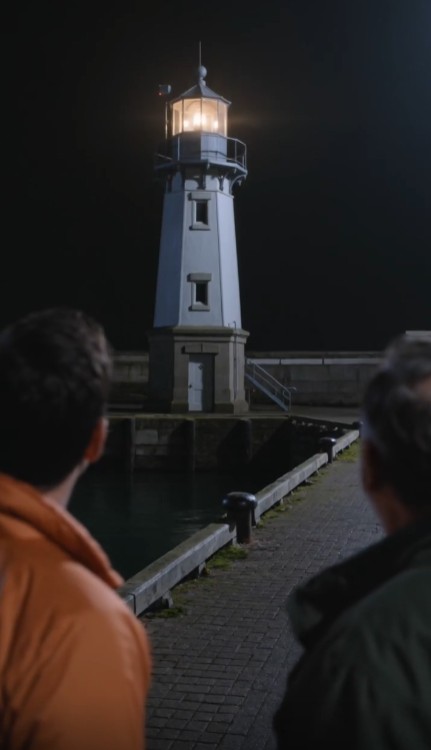
At exactly 11:42 PM…
The abandoned lighthouse suddenly turned on.
The harbor worker stopped walking.
That lighthouse hadn’t operated in 34 years.
Then the light flashed.
Three times.
Pause.
Twice.
Pause.
Three times again.
An elderly fisherman standing nearby dropped his coffee.
“No…”
The worker looked at him.
“You know what that means?”
The fisherman didn’t answer.
The signal repeated.
Three.
Two.
Three.
He started walking toward the harbor office.
“Call the lighthouse keeper.”
“There isn’t one.”
The fisherman stopped.
“There used to be.”
The worker frowned.
“Thirty-four years ago?”
The old man nodded.
Then he said something stranger.
“That signal was never for ships.”
“What was it for?”
The fisherman stared across the dark water.
“One person.”
The lighthouse flashed again.
Suddenly…
A car pulled into the harbor parking area.
An elderly woman stepped out.
She saw the flashing light…
And covered her mouth.
The fisherman whispered:
“Eleanor…”
The woman looked at him.
“You saw it too?”
The harbor worker stared at both of them.
“What does 3-2-3 mean?”
Neither answered.
Then Eleanor asked:
“Who’s inside the lighthouse?”
The worker shook his head.
“Nobody.”
Eleanor’s face changed.
“Then that’s impossible.”
The fisherman looked toward the lighthouse.
“No.”
He pointed toward a small building beside it.
“Someone finally found the old control room.”
Eleanor began crying.
“After all these years?”
The worker asked:
“Who would know the signal?”
The fisherman turned toward him.
“Only three people ever knew it.”
“One is standing here.”
“One is Eleanor.”
“And the third…”
He looked toward the lighthouse.
Then the door at its base opened.
A man stepped outside.
He was carrying a small metal box.
Eleanor took one look at him.
Then whispered a name she hadn’t spoken aloud in decades.
“Daniel?”
The man stopped.
He was about sixty.
Gray hair.
Dark jacket.
Glasses.
He looked at Eleanor.
Then at the elderly fisherman.
“Thomas?”
Thomas Walker gripped the harbor railing.
For several seconds, nobody moved.
The young harbor worker looked from one face to another.
“You all know each other?”
Eleanor didn’t answer.
She walked toward Daniel.
Slowly at first.
Then faster.
When she reached him, she stopped just a few feet away.
Daniel smiled nervously.
“Hello, Eleanor.”
She slapped him across the arm.
Not hard.
But hard enough to make Thomas laugh through his tears.
“Thirty-four years!”
“I know.”
“You couldn’t call?”
“I tried.”
“For thirty-four years?”
Daniel looked down.
“No.”
That answer stopped her.
Thomas approached.
He stared at Daniel as if he were trying to decide whether the man in front of him was real.
Then he asked:
“Was that you?”
Daniel looked toward the lighthouse.
“The signal?”
Thomas nodded.
“Yes.”
“Why?”
Daniel lifted the metal box.
“Because I finally found what your father hid.”
Thomas’s expression changed.
“My father?”
Daniel nodded.
“And I think you both need to see it.”
Thirty-four years earlier, the lighthouse had been very different.
It stood on a rocky point at the edge of a small fishing harbor.
Back then, fishing boats still left before dawn almost every morning.
The harbor office operated around the clock during busy seasons.
And the lighthouse had a keeper.
His name was Henry Walker.
Thomas’s father.
Henry had maintained the lighthouse for twenty-seven years.
He knew every bolt.
Every wire.
Every stair.
Every sound the mechanism made.
He could apparently tell when something was wrong simply by listening from his kitchen.
Thomas grew up around the lighthouse.
So did Eleanor Miller.
Her father owned a small marine repair shop nearby.
And Daniel Carter arrived when he was sixteen.
Daniel’s mother had died several years earlier.
His father worked on commercial boats and was away for long stretches.
Henry noticed the teenager hanging around the harbor and began giving him small jobs.
Painting railings.
Cleaning equipment.
Carrying tools.
Checking batteries.
Thomas initially hated him.
“He thinks he owns the place,” Thomas complained to Eleanor.
Eleanor laughed.
“So do you.”
“My father works here.”
“That doesn’t mean you own the Atlantic Ocean.”
Within a year, the three teenagers were inseparable.
Thomas.
Eleanor.
Daniel.
They spent summers around the harbor.
They fished badly.
Fixed things they sometimes broke themselves.
And occasionally climbed the lighthouse stairs to watch storms from behind the thick glass.
Henry pretended not to know.
One night, when they were seventeen, a heavy fog rolled over the harbor.
Eleanor was supposed to meet Thomas and Daniel near the lighthouse after finishing work at her father’s shop.
She never arrived.
Thomas became worried.
Daniel tried calling the shop.
No answer.
Henry told them to stop panicking.
Then the lighthouse lamp began flashing strangely.
Three.
Two.
Three.
Thomas looked at his father.
“What’s that?”
Henry said:
“Nothing.”
“That’s not the normal pattern.”
“I know.”
Minutes later, Eleanor appeared through the fog.
She had taken the wrong path around a storage building and become disoriented.
She wasn’t in serious danger.
She was embarrassed more than anything.
When she reached them, she looked up at the lighthouse.
“What was that?”
Henry shrugged.
“Thought you might recognize where home was.”
Eleanor laughed.
“Three-two-three?”
Henry nodded.
“Easy to remember.”
“Why those numbers?”
Henry pointed at the three teenagers.
“Three fools.”
Then at himself and Eleanor’s father.
“Two adults trying to keep you alive.”
“And the last three?”
Henry smiled.
“Still three fools.”
The explanation was ridiculous.
The signal stuck anyway.
From then on, 3-2-3 became theirs.
Not an official navigational signal.
Not something used when vessels were in danger.
Just a private pattern.
Sometimes Henry flashed a small maintenance lamp in the pattern when the teenagers were walking home.
Sometimes Thomas tapped it against the harbor office window.
Daniel wired a little light in the workshop that could blink the same sequence.
Eleanor once baked Thomas a birthday cake with three candles, then two, then three.
“It doesn’t even match my age.”
“That’s the point.”
Eventually, 3-2-3 stopped meaning anything specific.
It meant:
I’m here.
And sometimes:
Come home.
Then the three grew older.
Thomas joined his uncle’s fishing business.
Eleanor studied accounting in another town but returned to help her father.
Daniel became fascinated with electrical systems.
Henry encouraged him to study engineering.
“You understand machines better than people,” Henry told him.
Daniel laughed.
“Is that a compliment?”
“From me? Absolutely.”
Daniel left for college.
But he returned during summers.
And when he came home, the first thing he often saw from the road was the lighthouse.
Sometimes…
three flashes.
Two.
Three.
Henry letting him know he’d been seen.
Then everything changed.
A severe winter storm damaged several structures around the harbor.
The lighthouse itself survived.
But the electrical system was aging.
Modern navigational equipment was already making the old staffed lighthouse less essential.
The authorities eventually decided to decommission it.
Henry was devastated.
Not because he lost his job.
He was already approaching retirement.
He simply hated the idea of the light going dark.
On the final night of operation, Thomas, Eleanor and Daniel returned.
They stood outside with Henry.
At 11:42 PM, the official light was switched off.
Henry waited.
Then, using the small maintenance control he’d kept separate from the navigational system, he flashed one final private signal.
Three.
Two.
Three.
Eleanor cried.
Thomas pretended he wasn’t crying.
Daniel stared upward.
Henry said:
“That’s enough of that.”
The lighthouse went dark.
And for thirty-four years…
it stayed dark.
But the friendships didn’t survive nearly as well.
Daniel left again for work.
Thomas married.
Eleanor married too.
Children arrived.
Parents became ill.
Jobs changed.
Life became complicated.
They wrote occasionally.
Then less often.
Thomas and Eleanor remained in the same general region and saw each other from time to time.
Daniel moved across the country.
For a while, he sent Christmas cards.
Then those stopped.
Thomas assumed Daniel had simply moved on.
Eleanor took it more personally.
Daniel had once been her closest friend.
For a brief period in their twenties, perhaps something more.
Neither ever defined it.
Then Daniel disappeared from their lives.
The truth was less dramatic.
And sadder.
Daniel’s father became seriously ill.
Daniel moved to care for him.
After his father died, Daniel accepted an engineering position overseas.
He intended to be gone for two years.
He stayed eleven.
Addresses changed.
Letters were returned.
Thomas’s old fishing company closed.
Eleanor moved after her marriage.
Daniel lost track of both.
By the time the internet made finding people easier, enough years had passed that he convinced himself they probably didn’t want to hear from him.
He searched occasionally.
Never seriously enough.
That was something he now admitted was his mistake.
Meanwhile, Henry died eight years after the lighthouse closed.
Thomas cleaned out his father’s small workshop.
Tools.
Manuals.
Old harbor maps.
Boxes of electrical parts.
Nothing seemed unusual.
But Henry had left one instruction in his will.
Do not let them demolish the small service building until somebody checks behind the north panel.
Thomas remembered the sentence.
He told harbor officials.
They inspected the building.
Nobody found anything.
The panel appeared to be part of the wall.
Eventually the service building was locked and forgotten.
The lighthouse became a local landmark.
Visitors photographed it during the day.
But nobody used it.
No light.
No keeper.
No reason to enter except periodic structural inspections.
Then, thirty-four years after decommissioning, the harbor authority approved a restoration project.
Not to return the lighthouse to active navigation.
Modern systems made that unnecessary.
The plan was to preserve it as a historical site.
Workers cleaned the tower.
Repaired stairs.
Replaced unsafe wiring.
Cataloged old equipment.
Then one restoration technician noticed something inside the small service building.
A section of the north wall sounded hollow.
Behind an old electrical cabinet was a narrow wooden panel painted to match the wall.
They removed it.
Inside was a tiny control room.
Not a secret room in any dramatic sense.
More like a forgotten maintenance compartment.
Old switches.
A manual signaling circuit.
A disconnected auxiliary lamp system.
And a metal box.
The restoration team contacted the historical society.
The historical society contacted Daniel Carter.
Because Daniel’s name was written on an old maintenance diagram found beside the equipment.
Daniel was stunned.
He hadn’t been back in thirty-four years.
He flew in two days later.
Inside the metal box, he found three envelopes.
One labeled:
THOMAS
One:
ELEANOR
And one:
DANIEL
There was also a note from Henry.
If all three of you are standing here together, you’ve taken too long.
Daniel laughed when he read it.
Then cried.
He tried to find Thomas.
That was easy.
Thomas still lived near the harbor.
Finding Eleanor took a little longer.
Daniel located her daughter Rachel through an old community directory.
Rachel agreed to bring Eleanor to the harbor.
But she didn’t tell her why.
Thomas wasn’t told anything.
Daniel wanted to do it the way Henry would’ve done it.
With the light.
The restoration crew confirmed the auxiliary lamp could be safely powered independently from the original navigational system.
It wouldn’t function as an official beacon.
It wouldn’t interfere with marine navigation.
They tested it under controlled conditions.
Then Daniel asked for one thing.
At exactly 11:42 PM…
the same time the lighthouse had gone dark thirty-four years earlier…
he wanted to send 3-2-3.
The harbor authority approved the brief historical demonstration.
That was why the light suddenly appeared.
That was why Thomas dropped his coffee.
And that was why Eleanor arrived just minutes later.
Daniel hadn’t expected Thomas to be standing nearby.
Thomas had simply been finishing a late check on his fishing equipment.
When Daniel emerged from the lighthouse, all three were finally there.
Just as Henry’s note had predicted.
Not because Henry knew the future.
Because Daniel and Rachel had arranged for Eleanor to come, and Daniel had planned to contact Thomas immediately afterward.
Thomas’s presence at the exact moment was the only unplanned part.
The young harbor worker followed them into the service building.
“Am I allowed in here?”
The restoration supervisor smiled.
“Tonight, yes.”
Inside, Daniel placed the metal box on a workbench.
Thomas stared at his father’s handwriting.
“That’s his.”
Daniel nodded.
Eleanor touched the envelope bearing her name.
“He wrote these before he died?”
“Apparently.”
Thomas opened his first.
Inside was a short letter.
Henry had never been a man who wrote long emotional messages.
His letter reflected that.
Thomas,
If you’re reading this, somebody finally found the panel I told everyone about. Congratulations to modern engineering.
Thomas laughed.
Daniel smiled.
“Keep going.”
Thomas read silently.
His expression softened.
Henry wrote that he knew the three friends had begun drifting apart.
He’d watched it happen.
He didn’t blame them.
People grew up.
They moved.
They built lives.
But Henry had kept the old 3-2-3 circuit because it reminded him of the summers when all three teenagers believed the harbor was the entire world.
At the bottom:
Don’t spend your life confusing distance with anger. They’re not the same thing.
Thomas stopped reading.
Eleanor looked at him.
“What?”
He handed her the letter.
She read the final line.
Then looked toward Daniel.
Daniel lowered his eyes.
Eleanor opened her envelope.
Henry reminded her of the foggy night when the signal began.
He wrote:
You weren’t lost nearly as badly as those boys claimed. Thomas panicked. Daniel panicked worse. I promised not to tell you. That promise has expired.
Eleanor burst out laughing.
Thomas protested.
“I did not panic.”
“You absolutely did.”
Daniel raised his hand.
“I definitely did.”
The young harbor worker smiled.
For the first time that night, the three looked less like elderly strangers and more like teenagers who had never stopped arguing.
Then Daniel opened his envelope.
It was slightly longer.
Henry wrote about the first summer Daniel arrived.
How quiet he’d been.
How he pretended not to need anyone.
How quickly Thomas and Eleanor pulled him into their friendship.
Then came a line Daniel had to read twice.
You always believed you were a guest here. You weren’t.
Daniel stopped.
Thomas looked at him.
Daniel continued.
If life takes you somewhere else, go. But don’t mistake leaving for being unwanted.
Daniel removed his glasses.
For a moment, nobody spoke.
Then Thomas asked:
“Why didn’t you come back?”
Daniel answered carefully.
“At first? Because life got complicated.”
“And later?”
Daniel looked at both of them.
“Because I was embarrassed that I’d waited so long.”
Eleanor shook her head.
“You idiot.”
“I know.”
“You thought after ten years we’d be angry?”
“Yes.”
“So you waited thirty-four?”
“When you say it like that, the strategy sounds weak.”
Thomas laughed.
“It was terrible.”
Daniel nodded.
“It was.”
Then Thomas asked the question that had bothered him for decades.
“Did you ever get my letter?”
“What letter?”
Thomas’s face changed.
After Henry died, Thomas had sent Daniel a letter to the last address he had.
He told him about Henry.
He included the date of the memorial.
Daniel never responded.
Daniel shook his head.
“I never saw it.”
Thomas stared at him.
“I thought you didn’t care.”
Daniel’s voice became quiet.
“I didn’t know.”
Eleanor closed her eyes.
There it was.
Thirty-four years of assumptions reduced to two sentences.
Thomas thought Daniel had ignored Henry’s death.
Daniel hadn’t known Henry was dead until years later, when an online archive mentioned him.
By then, Daniel felt even more ashamed to make contact.
Nobody had deliberately abandoned anyone.
They had simply allowed silence to explain itself.
And silence had done a terrible job.
Daniel reached back into the metal box.
“There is one more thing.”
At the bottom was an old photograph.
Three teenagers sitting on the lighthouse steps.
Thomas on the left.
Eleanor in the middle.
Daniel on the right.
Henry had written on the back:
3-2-3
Below that:
If they ever forget, turn the light on.
Eleanor began crying again.
Thomas put an arm around her.
Daniel looked away.
The young harbor worker finally understood.
“So 3-2-3 wasn’t a distress signal.”
Thomas shook his head.
“No.”
“It didn’t mean danger?”
“No.”
“What did it mean?”
The three looked at one another.
Eleanor answered.
“I’m here.”
Daniel added:
“And sometimes come home.”
Thomas smiled.
“Mostly it meant my father was tired of yelling for us.”
They stayed in the control room until almost two in the morning.
They talked about marriages.
Children.
Grandchildren.
Jobs.
Deaths.
Mistakes.
Ordinary things.
Daniel learned Thomas had become a grandfather four times.
Thomas learned Daniel had a daughter in Seattle.
Eleanor showed them photographs of her three grandchildren.
Then they argued about who had broken Henry’s old radio in 1978.
Thomas blamed Daniel.
Daniel blamed Eleanor.
Eleanor calmly informed them both that she’d broken it and had allowed them to blame each other for forty-eight years.
“You’re terrible,” Thomas said.
“I know.”
Before leaving, Daniel asked the restoration supervisor:
“Can we flash the signal again?”
The supervisor shook his head.
“Not tonight.”
Thomas laughed.
“Henry would’ve ignored him.”
The supervisor smiled.
“Henry isn’t responsible for the permits.”
Several months later, the lighthouse reopened as a small maritime museum.
The original beacon remained retired.
Modern navigation continued to handle what ships actually needed.
But the restored auxiliary equipment became part of the exhibit.
Visitors learned about lighthouse maintenance.
Harbor history.
The families who worked there.
And the three teenagers who once used a private pattern of flashes to find one another in the fog.
Once each year, during the museum’s anniversary event, the harbor authority permits a brief controlled demonstration of the old auxiliary lamp.
Three flashes.
Pause.
Two.
Pause.
Three.
The museum display explains clearly that it was never an official maritime signal.
It belonged to three friends and one lighthouse keeper.
Thomas, Eleanor and Daniel attended the first anniversary together.
At 11:42 PM, the harbor lights were dimmed where safely possible.
The auxiliary lamp came on.
Three.
Two.
Three.
Daniel looked toward Thomas.
Thomas tapped the railing.
Three.
Two.
Three.
Eleanor rolled her eyes.
“You two are seventy years old.”
Thomas smiled.
“And?”
“Nothing.”
She tapped the pattern too.
Afterward, they walked toward the parking lot.
Daniel stopped.
“I should’ve come back sooner.”
Thomas looked at him.
“Yes.”
Daniel seemed surprised.
“You’re supposed to say it doesn’t matter.”
“It matters.”
Eleanor nodded.
“Thomas is right.”
Daniel smiled sadly.
“I know.”
Then Thomas added:
“But you’re here now.”
That was different from pretending the lost years hadn’t happened.
They had.
There were weddings they’d missed.
Funerals.
Birthdays.
Ordinary afternoons they would never get back.
No lighthouse could restore them.
No letter could erase thirty-four years.
But the letters did something else.
They corrected the story each person had been telling himself.
Thomas had believed Daniel stopped caring.
He hadn’t.
Eleanor had believed their friendship simply meant less to Daniel than it had to her.
It hadn’t.
Daniel had believed that after so many years, returning would only reopen old resentment.
He was wrong.
Henry had apparently understood something all three of them hadn’t.
Distance could become silence.
Silence could become assumption.
And assumption, left alone long enough, could begin feeling like fact.
Years later, when visitors asked Thomas about the night the lighthouse mysteriously came back on, he always corrected them.
“There was nothing mysterious about it.”
Someone found an old control room.
Electricians restored a safe auxiliary circuit.
Daniel arranged the signal.
Eleanor was invited.
Thomas happened to be nearby.
No ghost had switched on the lighthouse.
No impossible message had crossed thirty-four years.
The extraordinary part was simpler.
Three people had once shared a tiny signal.
They lost one another.
An old lighthouse keeper preserved the equipment and left them letters.
Decades later, somebody finally opened the right wall.
And at exactly 11:42 PM…
a light that had been dark for thirty-four years flashed:
Three.
Two.
Three.
Thomas recognized it.
Eleanor recognized it.
Daniel was waiting inside.
And for the first time in decades…
all three finally understood what Henry had been trying to tell them.
I’m here.
Come home.