
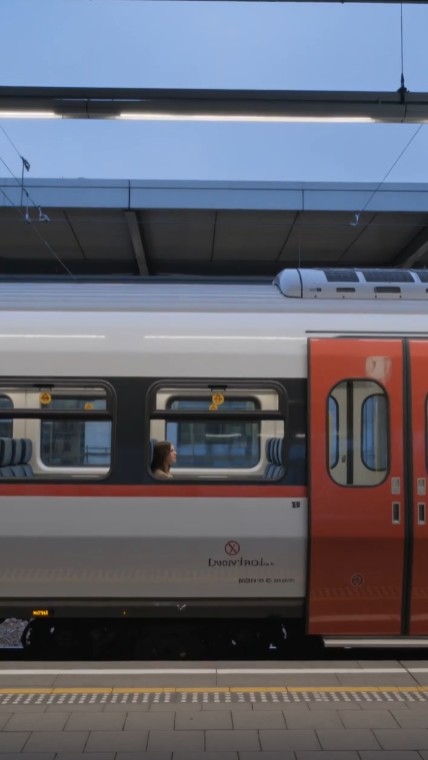
When every conductor suddenly stepped onto the platform.
The passengers looked confused.
Nobody was getting off.
Nobody was getting on.
Then the station announcement stopped mid-sentence.
Complete silence.
A young woman inside the train looked around.
“What happened?”
One conductor walked directly toward her window.
And pointed at her.
She looked behind herself.
Nobody.
Then the doors reopened.
The conductor stepped inside.
“Are you Anna?”
Her face changed.
“Yes…”
“You need to come with me.”
Everyone stared.
Anna stood slowly.
“Am I in trouble?”
The conductor shook his head.
“No.”
“Then what’s happening?”
He looked toward the platform.
“Someone has been waiting for you.”
Anna frowned.
“Nobody knows I’m here.”
The conductor replied:
“I know.”
Anna stepped onto the platform.
It looked completely empty.
Then…
one station clock suddenly stopped.
Exactly 7:26.
Anna stared at it.
“No…”
The conductor noticed.
“You recognize that time?”
Anna didn’t answer.
Then a voice came through the station speaker.
Not an announcement.
A man’s voice.
“Anna…”
She covered her mouth.
The conductor whispered:
“You know that voice?”
Anna’s eyes filled with tears.
“I haven’t heard it since I was twelve.”
Then the voice said:
“Go to Platform 4.”
Anna turned toward the conductor.
“Who is doing this?”
He answered:
“That’s what we’ve been trying to figure out.”
But that wasn’t completely true.
By then, several people at Riverside Central knew exactly where the voice had come from.
What they didn’t understand…
was why a recording made twenty-six years earlier had Anna’s name on it.
Or how the man who recorded it seemed to know she would eventually hear it in that station.
Anna Carter was thirty-eight.
She hadn’t planned to be at Riverside Central that evening.
Her original train had been canceled because of a mechanical problem.
She’d been transferred to the 7:18 service.
Her new route required a connection through Riverside.
She almost didn’t take it.
She’d considered renting a car instead.
But eight minutes before departure, Anna boarded.
She chose a window seat.
Put her suitcase beside her.
And waited.
Then the conductors stepped onto the platform.
What Anna didn’t know was that, less than ten minutes earlier, station supervisor Daniel Reed had received a phone call from the railway’s archive department.
Riverside Central was undergoing renovation.
Workers had been clearing an old communications room scheduled to be converted into office space.
Behind a cabinet, they found a narrow storage compartment.
Inside were old maintenance logs.
Cassette tapes.
Uniform badges.
Photographs.
And a small metal box.
Written across the front in faded black marker were four words:
FOR ANNA — PLATFORM 4
The box had apparently belonged to Michael Carter.
Anna’s father.
Daniel recognized the name immediately.
Almost everyone who had worked at Riverside Central long enough knew Michael Carter’s story.
He’d been a conductor there for nineteen years.
And twenty-six years earlier…
he disappeared from Anna’s life.
At least that was the story Anna had believed.
Michael and Anna’s mother, Rachel, separated when Anna was eleven.
It wasn’t a peaceful separation.
There were arguments.
Financial problems.
Resentment.
Michael moved into a small apartment near the station.
For several months, Anna still saw him every weekend.
Every Sunday evening, Michael brought her to Riverside Central before driving her back to her mother’s house.
Anna loved trains.
Michael would walk her along Platform 4 and explain things she barely understood.
Signals.
Schedules.
Why conductors checked their watches constantly.
Why passengers always seemed to run faster when they heard a whistle.
There was one clock at the end of Platform 4.
Old.
Round.
Black hands against a white face.
One Sunday, Anna asked:
“Dad, why do you always look at that clock?”
“Because clocks run train stations.”
“No. That one.”
Michael smiled.
“Because that’s our clock.”
“Why?”
He checked his watch.
It was 7:26.
“Because you’re usually asking me that question at exactly this time.”
Anna laughed.
From then on, 7:26 became a joke.
Whenever they passed the clock, Michael would ask:
“What time is it?”
Even if it was 3:00 in the afternoon, Anna answered:
“7:26.”
Then everything changed.
When Anna was twelve, Michael told her he was leaving Riverside.
He had accepted a railway job several states away.
Anna was furious.
“You said you’d stay.”
“I said I’d try.”
“Mom was right.”
Michael froze.
“What did she say?”
“That trains matter more than people to you.”
Michael looked devastated.
But twelve-year-old Anna didn’t notice.
She ran to her mother’s car.
That was the last conversation she remembered having with him.
Michael called afterward.
At first, Anna refused to speak.
Then Rachel changed their telephone number after moving.
Letters arrived occasionally.
Rachel kept some.
Returned others.
There were legal disagreements Anna didn’t understand.
Eventually the letters stopped.
As Anna grew older, the story became simple in her mind.
Her father had left.
He had chosen a new job.
A new city.
A new life.
And eventually…
he stopped trying.
Anna told people her father had abandoned her.
She hadn’t heard his voice since she was twelve.
What she didn’t know was that Michael’s version of those years looked very different.
He did leave Riverside.
But not because he wanted distance from Anna.
He’d been offered a better-paying railway position.
Michael was behind on child-support payments after months of reduced hours.
The new job paid considerably more.
He believed taking it would help.
Instead, distance made an already difficult family situation worse.
He called.
He wrote.
He tried arranging visits.
Some happened.
Others fell apart.
Then Rachel moved again.
Michael lost the new address for several months.
By the time he found it, Anna was fourteen.
His letter came back unopened.
On the front, someone had written:
SHE DOESN’T WANT CONTACT.
Michael believed the handwriting was Rachel’s.
He kept the envelope.
He shouldn’t have stopped trying.
Years later, he admitted that.
But he did.
Not immediately.
Gradually.
One unanswered call became ten.
One returned letter became five.
Embarrassment became shame.
Shame became silence.
And silence became years.
Michael eventually returned to railway work near Riverside.
But he never returned to the station permanently.
Then, when Anna was seventeen, Michael was diagnosed with an aggressive illness.
He was fifty-one.
Treatment initially worked.
Then it didn’t.
Michael knew he might never repair the relationship.
So he contacted an old colleague at Riverside Central.
Henry Walker.
Henry was a station technician.
Michael gave him a metal box.
Inside were letters.
Photographs.
A cassette.
And a small brass conductor’s watch.
Michael told Henry:
“If Anna ever comes back here, give her this.”
Henry stared at him.
“How am I supposed to know?”
Michael smiled.
“You won’t.”
“Then what’s the plan?”
“There isn’t one.”
Henry thought that was ridiculous.
Michael agreed.
Then he added:
“Just don’t mail it.”
“Why?”
“Because if she doesn’t want it, I don’t want it arriving at her house like an obligation.”
Michael wanted Anna to choose whether to open it.
If she ever returned to the station where they’d spent those Sunday evenings, perhaps someone could ask.
It wasn’t a good plan.
Michael knew that too.
But he was running out of time.
Henry put the box inside the communications room.
Then Michael died.
Anna was eighteen.
She didn’t know.
Her mother had received a short notice through an old mutual acquaintance.
Rachel believed telling Anna would reopen something she’d finally moved beyond.
So she said nothing.
Years later, Anna learned that Michael had died.
By then, the funeral had happened long ago.
She never knew about the box.
Henry Walker retired.
Before leaving, he wrote a note in a maintenance log:
Carter box behind communications cabinet. Do not discard. Family item.
The communications room was remodeled twice.
The cabinet was never moved.
The log was archived.
And Michael’s box remained behind the wall.
For twenty-six years.
Until that afternoon.
A renovation worker pulled out the cabinet.
Found the compartment.
And handed the box to station management.
Daniel Reed opened only enough to identify its owner.
The first thing he saw was Michael’s old employee badge.
The second was an envelope:
ANNA CARTER
Daniel contacted the railway archive.
They confirmed Michael’s employment history.
Then someone remembered Henry Walker.
Henry was eighty-one now.
He still lived nearby.
Daniel called him.
Henry answered on the third ring.
When Daniel mentioned the box, Henry became silent.
“You found it?”
“Yes.”
“Oh, thank God.”
“Who’s Anna?”
“Michael’s daughter.”
“Do you know where she is?”
“No.”
Then something extraordinary happened.
Not supernatural.
Not impossible.
Just a coincidence nobody expected.
While Daniel was speaking with Henry, the passenger service system showed the names associated with several rebooked tickets requiring manual assistance after the earlier cancellation.
One of them was:
ANNA CARTER
Daniel stared at the screen.
He knew the name was common enough that it could easily be someone else.
Age and identity weren’t available to him in a way he could casually use.
So he didn’t assume.
He contacted the conductor assigned to the service and explained that the station had found a decades-old personal item belonging to a former railway employee whose daughter shared the passenger’s name.
The conductor agreed to ask discreetly.
The train was already scheduled for a short operational hold because its departure clearance had been delayed.
No train was stopped purely for the reunion.
The staff simply used those few minutes.
But before the conductor reached Anna…
Henry arrived at the station.
He’d driven there immediately after Daniel’s call.
In his hands was another cassette.
Henry had kept it separately all these years.
It was a copy of Michael’s recording.
Daniel found an old digitization unit used by the archive team.
They transferred the audio.
Then Henry explained the clock.
“7:26.”
Daniel frowned.
“What?”
“If it’s really her, she’ll understand.”
The old Platform 4 clock had been disconnected during renovations.
Its hands could be manually positioned.
Henry asked Daniel to set it to 7:26.
Then they played the first seconds of Michael’s tape over an isolated platform speaker during the operational hold.
Not across the entire active station.
Just the temporarily closed Platform 4 area.
The conductor brought Anna out.
She saw the clock.
7:26.
Then Michael’s voice came through the speaker.
“Anna…”
Twenty-six years disappeared in a second.
Anna covered her mouth.
She knew the voice.
Older than she remembered.
Tired.
But unmistakable.
Her father.
“Go to Platform 4.”
That line wasn’t originally intended as a live instruction.
Michael had recorded:
Anna, if you’re hearing this, I suppose somehow you made it back to Platform 4.
Daniel had paused the recording after the opening line so Anna could decide whether she wanted to continue.
But in the confusion, the clipped audio sounded as though someone were speaking directly to her.
Anna followed the conductor down the corridor.
Her legs felt weak.
“What is happening?”
The conductor didn’t pretend anymore.
“They found something that belonged to your father.”
Anna stopped.
“My father is dead.”
“I know.”
“How do you know?”
“There’s someone here who can explain.”
When Anna reached Platform 4…
she saw one elderly man sitting beneath the stopped clock.
Henry Walker.
Beside him was the metal box.
Anna had never seen Henry before.
But Henry recognized her immediately.
“You have Michael’s eyes.”
Anna froze.
“Who are you?”
“My name is Henry.”
He stood slowly.
“I worked with your father.”
Anna looked at the box.
“Was that his voice?”
“Yes.”
“How old is that recording?”
“About twenty-six years.”
Anna looked toward the speaker.
“Why did he record it?”
Henry took a breath.
“For you.”
Anna’s expression hardened.
“Why didn’t he send it?”
“He asked me not to.”
“Why?”
“Because he thought you hated him.”
Anna stared at Henry.
“He left.”
Henry nodded.
“Yes.”
“He stopped calling.”
“Eventually.”
“He stopped writing.”
“Eventually.”
“So don’t tell me some story where he was secretly perfect.”
Henry shook his head.
“I wouldn’t.”
That answer surprised her.
“Michael made mistakes,” Henry continued. “A lot of them.”
Anna said nothing.
“He should’ve kept trying.”
Her eyes filled.
“Yes.”
“He should’ve found another way to contact you.”
“Yes.”
“He shouldn’t have let shame become an excuse.”
Anna looked down.
Henry continued quietly.
“But he didn’t stop loving you.”
Anna’s voice broke.
“That’s easy to say now.”
Henry nodded.
“That’s why I’m not asking you to believe me.”
He pointed at the box.
“Believe whatever you decide after you see what’s inside.”
Anna sat on the bench.
The same bench, Henry explained, had replaced an older one that once stood in nearly the same spot.
Daniel brought the metal box closer.
Anna opened it.
On top was a photograph.
Anna at seven years old.
Sitting on Michael’s shoulders at the station.
Another photograph.
Anna at ten, wearing Michael’s conductor hat.
Then letters.
Dozens.
Some opened.
Some returned.
Some apparently never mailed.
Dates stretched across years.
Anna picked up one.
Her hands trembled.
Dear Anna,
She stopped.
“Can I have a minute?”
Everyone stepped away.
Anna read.
Michael didn’t defend himself.
He wrote that he’d accepted the distant job because he believed money would fix problems that were never really about money.
He wrote that leaving had been a mistake.
Another letter was from two years later.
I called today. No answer. I’ll try Sunday.
Another:
Your mother says you don’t want to speak to me. I need to respect that, but I don’t know whether respecting it and giving up are the same thing.
Anna closed her eyes.
Another letter had never been sent.
You turn sixteen tomorrow. I don’t know what you like anymore. That sentence is probably the hardest thing I’ve ever written.
Anna began crying.
Henry remained several yards away.
Then she found the cassette.
Written on it:
7:26
Anna looked at Henry.
“Can I hear it?”
“Only if you want to.”
She nodded.
Daniel played the recording from the beginning.
Michael’s voice filled the quiet platform.
“Anna.”
A pause.
“If you’re hearing this, then somebody finally found you, or you finally found this place.”
Anna laughed through her tears.
Michael continued.
“I don’t know how old you’ll be.”
Another pause.
“I don’t know whether you’ll want to hear me.”
Then:
“If you don’t, turn this off.”
Daniel instinctively reached toward the controls.
Anna shook her head.
“No.”
The recording continued.
Michael told her he wasn’t making the tape to ask forgiveness.
He didn’t believe forgiveness could be requested like a favor.
He simply wanted Anna to know what happened from his side.
He explained the job.
The returned letters.
The calls.
The mistakes.
And then he said something Henry had remembered for twenty-six years.
“I kept waiting until I had a good explanation for why so much time had passed.”
Michael sighed on the recording.
“There isn’t one.”
Anna stared at the floor.
“The longer I waited, the harder it became to call.”
Another pause.
“That’s not your fault.”
Then Michael mentioned Platform 4.
The clock.
7:26.
Anna covered her face.
“You used to ask me what time it was even when you could see the clock.”
On the recording, Michael laughed.
“And I’d say 7:26.”
Anna whispered the answer with him.
“7:26.”
Henry looked away.
Michael continued:
“I don’t know whether you remember that.”
Anna was crying too hard to answer.
Then came the final part.
“If you remember nothing else about me, that’s okay.”
“If you’re angry, you earned that.”
“But please don’t believe I forgot you.”
The recording became quiet.
Then Michael tapped something near the microphone.
Three soft taps.
A pause.
Then he said:
“Your train is probably late.”
Anna laughed suddenly.
The conductor smiled.
Michael’s final words were simple.
“Wherever you’re going, Anna, I hope it’s somewhere good.”
The recording ended.
Nobody spoke.
The old clock still showed 7:26.
Anna looked inside the box again.
At the bottom was Michael’s brass railway watch.
It had stopped.
She turned it over.
Engraved on the back were two words:
For Anna.
She held it tightly.
Then she asked Henry:
“When did he die?”
Henry told her.
Anna calculated quickly.
“I was eighteen.”
“Yes.”
“Did he know where I was?”
“Not exactly.”
“Did he know I’d graduated?”
“I told him you’d probably finished school. We didn’t know where.”
Anna nodded.
Then she asked:
“Was he alone?”
Henry understood what she really meant.
“No.”
Anna looked at him.
“I was there.”
“Until the end?”
“Yes.”
Henry hesitated.
“Your photograph was beside his bed.”
Anna looked down.
The train conductor approached carefully.
“Anna?”
She looked up.
“Our departure clearance is ready. But there’s another service in forty minutes if you’d rather stay.”
Anna looked toward her train.
Passengers were waiting.
The entire interruption had taken only a few minutes, though to Anna it felt much longer.
She looked at the box.
Then at Henry.
“Forty minutes?”
“Yes.”
Anna picked up her suitcase.
“I’ll take the next one.”
The conductor nodded.
Before leaving, Anna stopped him.
“Why did everyone get off the train?”
He smiled.
“We were already under a short operational hold. Once we knew we needed to locate you, the crew stepped onto the platform to coordinate without making an announcement about your personal business.”
“So the train wasn’t stopped because of me?”
“No.”
Anna laughed.
“Good.”
Then she looked toward the clock.
“And that?”
“Henry.”
Henry raised his hand.
“Guilty.”
Anna smiled for the first time.
She and Henry sat on Platform 4 for thirty-five minutes.
He told her about Michael.
Not the saint Anna feared people would try to create after his death.
The real man.
Impatient.
Funny.
Terrible at cooking.
Obsessed with train schedules.
Always losing pens.
A man who had made decisions he regretted.
A man who loved his daughter.
Both things could be true.
Anna told Henry about her own life.
She was married.
She had a nine-year-old son named Noah.
Henry smiled.
“Michael would’ve liked that.”
Anna didn’t answer immediately.
Then:
“I think Noah would’ve liked him.”
Before Anna boarded the next train, Henry handed her the box.
“All yours.”
Anna looked at the letters.
“I don’t know if I can read all of these tonight.”
“You don’t have to.”
“Maybe not ever.”
“You don’t have to do that either.”
That mattered.
Nobody was asking Anna to rewrite her childhood because a box had been found.
Her father had still left.
He had still failed to maintain contact.
Her mother had made choices Anna would later have difficult questions about.
And Michael had allowed rejection and shame to silence him for too long.
The box didn’t erase any of that.
It simply revealed that the story was more complicated than Anna had known.
Two weeks later, Anna returned to Riverside.
This time deliberately.
She brought Noah.
Henry met them at Platform 4.
Noah immediately pointed at the clock.
“Mom says this is your clock.”
Anna smiled.
“Apparently.”
“What time is it?”
The restored clock was working again.
It showed 2:14.
Anna looked at Henry.
Henry smiled.
Anna answered:
“7:26.”
Noah frowned.
“You’re really bad at clocks.”
Henry laughed.
Anna took her son through the station.
She showed him where Michael used to work.
The old communications room.
The archive display.
Then Daniel showed them something the renovation team had decided to preserve.
Michael’s metal box wasn’t displayed.
That belonged to Anna.
Neither were the letters.
Those were private.
Instead, the station mounted a small photograph of several railway employees from decades earlier.
Michael stood in the back row.
Young.
Smiling.
Anna stared at him for a long time.
Noah pointed.
“That’s Grandpa?”
“Yes.”
“What was he like?”
Months earlier, Anna would’ve answered:
“He left.”
Now she thought before speaking.
“He made some mistakes.”
Noah waited.
Anna smiled.
“And apparently he was terrible at cooking.”
Henry laughed from behind them.
“Dangerously terrible.”
Anna looked at the photograph again.
That became the beginning.
Not of some perfect reunion.
Michael was gone.
There could be no reunion.
There were questions no recording could answer.
Arguments they could never have.
Apologies Anna would never hear in person.
But she could finally stop arguing with a version of her father built entirely from silence.
Over the following months, she read every letter.
Some made her angry.
Some made her cry.
Some were boring.
Weather.
Work.
Train schedules.
A movie Michael thought she’d like.
One contained nothing except:
Saw a girl wearing purple sneakers today. You wanted purple sneakers when you were eight. I wonder if you still hate green.
Anna laughed.
She still hated green.
The final unsent letter was written shortly before Michael entered the hospital.
At the bottom he wrote:
I kept thinking there would be a perfect time to try again.
There isn’t.
There is only the time you still have.
Anna carried that sentence with her.
Years later, Riverside Central completed its renovation.
The old clock on Platform 4 remained.
The station considered replacing it with a digital display.
Henry objected loudly.
Anna joined him.
The clock stayed.
And whenever Anna passed through Riverside with Noah, he asked the same question.
“What time is it?”
No matter what the clock actually showed…
Anna answered:
“7:26.”
Because that was the part she chose to keep.
Not because one stopped clock magically reunited a family.
Not because a dead man somehow knew which train his daughter would board twenty-six years later.
He didn’t.
A renovation crew found a box.
An old friend remembered what it meant.
A canceled train unexpectedly brought Anna through the same station.
And a railway crew used a brief operational delay to ask one passenger a question.
That was all.
But sometimes ordinary events collide at exactly the right moment.
At thirty-eight years old, Anna stepped onto a platform believing her father had forgotten her.
Then an old clock stopped at 7:26.
A recording began.
And the voice she hadn’t heard since she was twelve said her name.
By the time Anna boarded the next train, she still couldn’t change the past.
But for the first time…
she knew the silence had never meant what she thought it did.