
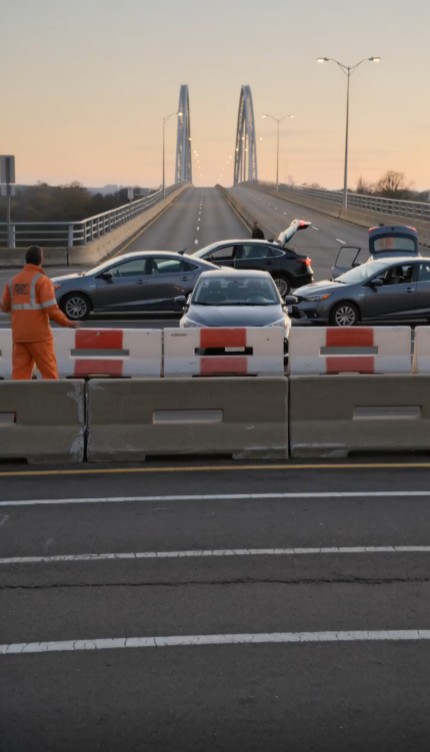
At exactly 6:30 PM…
The first car reached the old bridge…
and stopped.
Nothing was blocking it.
The light was green.
Then a second car stopped behind it.
Then a third.
Within minutes…
18 cars were waiting.
But nobody honked.
Nobody complained.
Instead…
the drivers got out.
A bridge worker ran over.
“You can’t stay here. What’s happening?”
The first driver pointed toward the railing.
“Is Thomas working tonight?”
The worker froze.
“Why?”
“Just tell me.”
The worker pointed toward a man in an orange safety jacket farther down the pedestrian maintenance area.
“That’s Thomas.”
The driver smiled.
“Good.”
Then every driver opened their trunk.
Thomas saw them.
“What are they doing?”
His coworker shrugged.
Then the first driver removed something.
A small battery lantern.
Then another driver did the same.
Then another.
Soon…
18 lights were glowing.
Thomas stopped walking.
“No…”
His coworker looked at him.
“You know what this is?”
Thomas stared at the lights.
“Twenty years ago…”
He couldn’t finish.
The first driver called out:
“Thomas!”
Thomas slowly approached from the safe walkway.
The driver asked:
“Do you remember keeping this bridge open during the storm?”
Thomas nodded.
“Of course.”
The man smiled.
“You remember the bridge.”
Thomas looked confused.
The driver continued:
“But apparently you don’t remember what you did after everyone crossed it.”
Thomas looked at the 18 people.
“What did I do?”
Then one final vehicle safely arrived.
Its passenger stepped out holding a nineteenth lantern.
Thomas saw the person…
and immediately removed his work gloves.
“Wait…”
The stranger smiled.
“Now you remember.”
Her name was Emily Carter.
Thomas hadn’t seen her in twenty years.
But he recognized her eyes immediately.
“Emily?”
She nodded.
“Hello, Thomas.”
For several seconds, Thomas couldn’t move.
The bridge.
The lanterns.
The storm.
And now Emily.
Memories he’d spent years rarely thinking about suddenly returned all at once.
Thomas looked at the other drivers.
Then back at Emily.
“What is this?”
Emily held up the nineteenth lantern.
“Something we should’ve done a long time ago.”
Twenty years earlier, Thomas Miller was thirty-eight.
He worked maintenance on the old Riverside Bridge.
It wasn’t a large bridge.
It connected two rural communities separated by a wide river.
Most people crossed it without thinking about the workers who inspected its surface, cleared debris, checked lighting and closed it whenever conditions became unsafe.
Thomas preferred it that way.
He wasn’t interested in attention.
He arrived.
Did his job.
Went home.
His wife, Rachel, often joked that Thomas could work beside the same people for ten years and still not know their birthdays.
Then came the storm.
It began on a Thursday afternoon.
Heavy rain.
Strong wind.
Falling temperatures.
By 5:00 PM, water had begun rising near the lower roads.
The state highway farther north was already closed.
That made Riverside Bridge one of the few remaining routes for residents trying to reach the western side of the river.
Thomas and his supervisor monitored conditions constantly.
At 6:10 PM, they received instructions.
The bridge would close.
But several vehicles were already approaching from the east.
Eighteen in total.
Thomas remembered the number because he’d counted them personally.
A school employee heading home.
A young couple with a toddler.
Two nurses.
An elderly man.
Several workers.
And one small blue car driven by a twenty-four-year-old woman named Emily Carter.
Thomas didn’t know Emily.
Not then.
She was eight months pregnant.
And terrified.
Her mother lived west of the river.
Emily had been staying with her for several weeks while her husband worked out of state.
That afternoon, Emily had driven east for a medical appointment.
The storm worsened much faster than forecast.
Now she was trying to get back.
The bridge supervisor wanted to close immediately.
Thomas understood.
Safety came first.
But the eighteen vehicles had already reached the controlled approach area.
Turning them around meant sending them toward roads that were beginning to flood.
So the supervisor coordinated with emergency officials.
The decision was made to allow the vehicles already inside the controlled queue to cross one at a time.
Then the bridge would close.
Thomas stood outside in the rain.
He guided each vehicle.
Slowly.
One at a time.
No stopping.
No overtaking.
The wind shook the reflective sign in his hands.
Vehicle one crossed.
Then two.
Three.
Four.
By the time Emily reached Thomas, the rain was coming sideways.
He leaned toward her window.
“You okay?”
She nodded too quickly.
Thomas could see she wasn’t.
“Stay behind the car ahead. Keep moving until you’re completely off the bridge.”
Emily gripped the steering wheel.
“Is it safe?”
“For this controlled crossing, follow the instructions exactly.”
She nodded.
Then Thomas noticed her other hand resting on her stomach.
“You pregnant?”
“Eight months.”
“Anyone waiting for you?”
“My mother.”
“Good. Go straight there.”
Emily started forward.
Then stopped.
Thomas immediately waved.
“Keep moving!”
She lowered the window.
“What about you?”
“What?”
“Are you crossing?”
Thomas almost laughed.
“I work here.”
Emily stared at him as though that were a ridiculous answer.
Then the car behind her waited.
Thomas pointed ahead.
“Go.”
Emily crossed.
She was vehicle seventeen.
The eighteenth vehicle followed.
At 6:42 PM, the bridge was closed.
Thomas remembered watching the final taillights disappear.
He thought his job was finished.
Then the power failed.
Not across the entire region.
Only part of the bridge approach and nearby roads.
The storm had damaged a utility line.
Emergency backup lighting covered critical bridge systems, but the small roadside rest building on the western side went dark.
Thomas and another worker crossed using an authorized maintenance vehicle.
They needed to check equipment and secure the western gate.
That was when Thomas saw the eighteen cars again.
They hadn’t gone far.
A tree had fallen across the county road less than a mile from the bridge.
The vehicles were trapped between the closed bridge and the blocked road.
Nobody could continue west.
Nobody could return east.
And the weather was worsening.
Thomas radioed it in.
Emergency crews were already dealing with flooded roads, fallen branches and power outages.
Help would come.
But not immediately.
The safest option was for everyone to remain in the designated roadside area near the bridge facility.
Thomas went from car to car.
“Stay here.”
“Keep your hazard lights on.”
“Don’t walk toward the bridge.”
“Emergency crews know where you are.”
Most people understood.
Then he reached Emily’s blue car.
She was crying.
“What’s wrong?”
“My phone’s almost dead.”
Thomas looked at her stomach.
“The baby?”
“No. I’m fine.”
“Any pain?”
“No.”
“My mother doesn’t know where I am.”
Thomas tried his radio.
Communication was inconsistent.
But eventually he reached the emergency coordinator.
They relayed a message.
Emily Carter was safe at the western bridge facility.
Her mother would be informed.
Emily exhaled.
“Thank you.”
Thomas moved to the next car.
For almost two hours, the eighteen vehicles waited.
The rest building had emergency supplies.
Not much.
Bottled water.
First-aid equipment.
Reflective blankets.
A few flashlights.
And an old box of battery lanterns used during nighttime maintenance.
Thomas took the lanterns outside.
He placed one near each group of vehicles.
The lanterns weren’t for decoration.
They made the waiting area easier to navigate safely without people using headlights constantly.
One lantern.
One cluster.
Then another.
Eventually, nineteen small lights glowed through the rain.
Eighteen for the stranded groups.
One beside the bridge building.
Emily remembered that image for the rest of her life.
Darkness.
Rain.
Cars lined up.
And little lights showing everyone exactly where to remain.
But that still wasn’t what the drivers had returned to remember.
The fallen tree was finally cleared around 9:00 PM.
Emergency workers arrived.
Most drivers prepared to leave.
Thomas should have returned to the bridge office.
Instead, he noticed one car wasn’t starting.
An elderly man named Henry Walker was sitting behind the wheel.
Dead battery.
Thomas helped move the vehicle safely out of the traffic route.
Then another driver said she didn’t feel comfortable continuing alone because debris still covered parts of the road.
Thomas coordinated with emergency personnel so several vehicles could leave together behind an authorized road crew.
Then Emily approached him.
“My car’s fine.”
“Good.”
“But…”
Thomas waited.
She looked embarrassed.
“I don’t want to drive.”
“Then don’t.”
“My mother is only six miles away.”
“Six miles in this weather is still six miles.”
Emily started crying again.
“I feel stupid.”
Thomas shook his head.
“Being scared in a storm isn’t stupid.”
He found her a chair inside the bridge facility.
He gave her water.
Then he called his wife.
Rachel answered.
“Are you okay?”
“Yeah.”
“Are you coming home?”
“Not yet.”
Thomas looked at Emily.
“I’ve got a young woman here who’s pregnant and doesn’t want to drive the rest of the way.”
Rachel didn’t hesitate.
“What’s her mother’s address?”
Thomas asked Emily.
Then gave it to Rachel.
Twenty-five minutes later, Rachel arrived with Emily’s mother, Margaret.
Margaret ran through the door.
“Emily!”
Emily stood.
Her mother hugged her.
Thomas stepped away.
He considered the matter finished.
But Margaret stopped him.
“Thank you.”
Thomas shrugged.
“I didn’t do anything.”
“You stayed.”
“It’s my job.”
Margaret shook her head.
“The bridge is your job.”
She pointed toward her daughter.
“She isn’t.”
Thomas never forgot the sentence.
But over time, he forgot almost everything that happened afterward.
The eighteen stranded motorists did not.
The next morning, Thomas returned to work.
The bridge remained closed while inspectors checked it.
The storm passed.
Roads reopened.
Life continued.
A week later, Emily gave birth to a healthy baby boy.
She named him Daniel.
Thomas didn’t know.
Three weeks later, Henry Walker—the man with the dead battery—returned to the bridge office carrying nineteen inexpensive battery lanterns.
Thomas wasn’t working.
Henry left them with the supervisor.
Attached was a note:
For the next people who have to wait in the dark.
Thomas saw the lanterns the following morning.
He laughed.
Then placed them in storage.
Months passed.
Some were used.
Some disappeared.
Eventually they were replaced with newer emergency equipment.
Thomas assumed the story ended there.
But Henry had done something else.
Before leaving, he’d written down the names and phone numbers of several people stranded that night.
He wanted to make sure everyone got home safely.
Those people stayed in touch.
Not closely.
A Christmas card.
An occasional phone call.
Then, on the first anniversary of the storm, Henry mailed a small card to the people whose addresses he had.
On the front was a drawing of a lantern.
Inside:
One year since Riverside. Hope your light is still on.
Emily received one.
So did nine others.
The next year, Emily sent cards too.
By the fifth anniversary, fourteen of the eighteen groups had been located.
By the tenth, all eighteen had been identified.
They began calling themselves the Riverside Eighteen.
Not publicly.
There was no organization.
No website.
No fundraising campaign.
Just people connected by one unpleasant evening none of them had expected to remember.
But something strange happened.
The lantern became a tradition.
Whenever one of them heard that another family was going through a difficult period, someone sent a lantern.
When Henry’s wife died…
a lantern appeared on his porch.
When one of the nurses from the bridge was diagnosed with cancer and began treatment…
several lanterns arrived at her home.
When Emily’s son Daniel graduated from high school…
Henry gave him a lantern.
Daniel laughed.
“What am I supposed to do with this?”
Emily answered:
“Keep it until somebody needs it.”
The tradition spread to their families.
A lantern didn’t mean someone could fix your problem.
It meant something simpler.
You don’t have to wait in the dark alone.
Thomas knew none of this.
He continued working on the bridge.
His hair turned gray.
His knees started hurting.
Rachel died after a brief illness six years before the twentieth anniversary.
Thomas almost retired.
Then decided he wasn’t ready.
The bridge had become familiar.
Predictable.
Every bolt.
Every railing.
Every maintenance cabinet.
He knew where ice formed first in winter.
He knew which light flickered whenever temperatures dropped.
He knew the sound trucks made crossing the expansion joints.
Work gave his days structure.
So he stayed.
Meanwhile, Emily and the Riverside Eighteen began planning something.
The twentieth anniversary was approaching.
Henry Walker was now eighty-four.
His health had declined.
He no longer drove.
But he had one request.
“Find Thomas.”
Emily laughed.
“He still works there.”
“You sure?”
“I called.”
Henry smiled.
“Then it’s time.”
“Time for what?”
“To return the lanterns.”
Emily didn’t understand.
Henry explained.
For twenty years, Thomas had believed he was simply the worker who kept the bridge open long enough for eighteen vehicles to cross.
But the drivers remembered something different.
Thomas didn’t leave when the official crossing ended.
He stayed.
He checked cars.
Found help.
Relayed messages.
Made sure nobody wandered into unsafe areas.
Helped coordinate transportation.
Called his own wife when Emily was too frightened to drive.
And when darkness fell…
he put out lanterns.
One for each group.
Henry wanted Thomas to see what that small act had become.
So they contacted everyone.
Some lived hundreds of miles away.
Not all could come personally.
But every original vehicle would be represented.
Eighteen cars.
Eighteen families.
Eighteen lanterns.
Henry would bring the nineteenth.
The one representing Thomas.
They coordinated with the bridge authority so the gathering could happen safely in a designated area without blocking normal traffic longer than authorized.
That detail mattered.
Thomas had spent his life enforcing bridge safety.
The last thing anyone wanted was to honor him by creating a dangerous traffic jam.
So at 6:30 PM, under an approved temporary traffic hold, the first car entered the designated area.
Thomas hadn’t been told.
He saw the vehicles.
Saw people stepping out.
Saw lanterns appearing.
And thought he’d somehow traveled backward twenty years.
Then Emily arrived.
Now she stood in front of him holding the nineteenth lantern.
Thomas looked at her.
“Your mother came to get you.”
Emily smiled.
“You remember.”
“Rachel drove her.”
“I know.”
Thomas looked down.
“Rachel died six years ago.”
Emily’s expression softened.
“I heard. I’m sorry.”
Thomas nodded.
“She remembered you too.”
Emily blinked.
“What?”
“Every time there was a bad storm, she’d ask if I had any pregnant women trapped at work.”
Emily laughed through tears.
“That sounds like her.”
Then another man stepped out of Emily’s vehicle.
Tall.
Nineteen years old.
Dark hair.
Thomas stared.
Emily placed a hand on his shoulder.
“This is my son.”
Thomas smiled.
“The baby.”
“The baby.”
Daniel extended his hand.
“My name’s Daniel.”
Thomas shook it.
“You’re twenty?”
“Nineteen. Twenty next month.”
Thomas stared at Emily.
“I’m getting old.”
Henry’s voice came from behind them.
“You’re just noticing?”
Thomas turned.
An elderly man was being helped from the passenger side of another vehicle.
Thomas stared.
“Henry Walker?”
Henry lifted a hand.
“Battery still works.”
Thomas laughed.
Then walked over and hugged him.
It surprised both men.
Henry held on.
When they separated, Thomas looked at the eighteen lanterns.
“Why did you all keep these?”
Emily explained.
Not the exact lanterns from that storm.
Most of those were long gone.
These represented them.
But the tradition had survived.
She told him about Henry’s cards.
The Riverside Eighteen.
The lanterns sent during illnesses.
Deaths.
Births.
Job losses.
Difficult years.
Good years.
Thomas listened.
Then shook his head.
“All because of some maintenance lights?”
Henry answered:
“No.”
Thomas looked at him.
“Then what?”
“Because of what happened after.”
Henry pointed toward the bridge.
“Getting us across safely was your job.”
Then he pointed toward the people.
“Staying with us afterward was a choice.”
Thomas became quiet.
“I couldn’t leave eighteen cars stranded.”
“You could’ve stayed inside.”
“I was working.”
“You called your wife for Emily.”
Thomas looked at the ground.
“She needed her mother.”
“You sat with me while we waited for a jump.”
“You were eighty—”
“I was sixty-four.”
“Same thing.”
Henry laughed.
Then another woman stepped forward.
Her name was Anna Reed.
She had been one of the nurses.
“You gave me your dry jacket.”
Thomas frowned.
“I did?”
Anna nodded.
“My coat was soaked.”
“I don’t remember that.”
“We do.”
Another driver spoke.
“You found formula for my daughter.”
Thomas turned.
A man named Marcus held up a photograph.
In it, he was twenty-nine.
Beside him stood his wife and their toddler.
“The emergency kit had powdered formula samples.”
Thomas stared.
“I’d forgotten.”
Marcus smiled.
“We hadn’t.”
Another person stepped forward.
Then another.
Tiny memories Thomas no longer carried.
He’d found a phone charger.
Shared coffee.
Helped secure a loose trunk.
Walked an elderly passenger to the restroom under an umbrella.
Gave someone a blanket.
Repeated the same weather update twenty times because people were anxious.
None of it seemed important to Thomas.
That was exactly why everyone remembered.
He hadn’t behaved as though he was doing something extraordinary.
He simply noticed what needed doing.
Then did it.
Emily raised her lantern.
“Thomas, this isn’t about pretending you rescued eighteen families.”
Thomas nodded.
“Good.”
“The emergency crews cleared the road. Your team managed the bridge. Everyone did their part.”
She looked around.
“But you gave us something we kept.”
Thomas stared at the lights.
“What?”
Henry answered:
“A way to remind people they’re not waiting alone.”
Thomas looked away.
His eyes had filled.
His coworker Michael stood several feet behind him.
He’d worked beside Thomas for seven years.
He had never seen him cry.
Thomas cleared his throat.
“So what happens now?”
Emily smiled.
“Now we give you the nineteenth lantern.”
“No.”
Everyone laughed.
Thomas shook his head.
“I don’t need a lantern.”
Henry held it toward him.
“Neither did we.”
Thomas looked at him.
Henry continued:
“That was never the point.”
Thomas finally accepted it.
The lantern was small.
Battery-powered.
Black handle.
Warm light.
A metal plate had been attached underneath.
Thomas turned it over.
Engraved on it were nineteen names.
Eighteen representing the stranded vehicles.
The nineteenth:
THOMAS MILLER
Underneath:
6:30 PM — RIVERSIDE BRIDGE
And one sentence:
For the person who stayed until everyone could go home.
Thomas read it.
Then read it again.
He couldn’t speak.
Emily didn’t ask him to.
The bridge authority had arranged a safe commemorative moment before traffic resumed.
The eighteen lanterns were placed along the designated pedestrian area.
The nineteenth stayed in Thomas’s hands.
A photographer took one group picture.
Nothing elaborate.
Thomas in his orange work jacket.
Henry beside him.
Emily and Daniel.
Eighteen families or their representatives.
Nineteen lights.
Then the official traffic hold ended.
Everyone cleared the area.
The bridge reopened normally.
Thomas immediately started checking that nobody had left anything behind.
Emily laughed.
“Twenty years and you’re still working.”
“Somebody has to.”
Before leaving, Daniel approached him.
“Can I ask you something?”
Thomas nodded.
“My mom says she named me Daniel because she liked the name.”
Emily shouted from several feet away:
“That is true!”
Daniel smiled.
“But she also told me she decided on it that night.”
Thomas looked at Emily.
She shrugged.
“There was a bridge worker named Daniel on the emergency radio.”
Thomas laughed.
“So you’re not named after me.”
“No.”
“Good. That would’ve been too much.”
Daniel smiled.
“But every birthday, Mom tells the bridge story.”
Thomas shook his head.
“Your mother needs new material.”
Daniel looked at the lantern.
“I don’t think she does.”
The families left gradually.
Henry was last.
Before getting into the car, he turned toward Thomas.
“Keep the light.”
Thomas nodded.
“You keep your battery charged.”
Henry laughed.
“No promises.”
Thomas watched him leave.
Then returned to work.
That evening, he took the nineteenth lantern home.
His house felt unusually quiet.
Rachel’s photograph stood on the living room shelf.
Thomas placed the lantern beside it.
Then he sat down.
For years after Rachel died, people had told him stories about her.
Things she’d said.
Small kindnesses he’d never known about.
At first, those stories hurt.
Then he began to treasure them.
Now he understood something he’d never considered.
Maybe other people carried pieces of us we didn’t know we’d given them.
A sentence.
A meal.
A ride.
A coat.
A lantern.
Thomas had forgotten most of that storm.
The people on the bridge had remembered for him.
The following winter, a severe snowstorm hit Riverside again.
The bridge closed early.
Nobody was stranded.
Thomas was finishing his shift when Michael received a phone call.
An elderly couple had pulled into a nearby service area after their car developed a mechanical problem.
Roadside assistance was on the way.
They were safe.
But frightened.
Michael looked at Thomas.
“We’ve got blankets.”
Thomas nodded.
“And?”
“Water.”
“Good.”
Michael hesitated.
Thomas understood.
He opened his locker.
Inside was the nineteenth lantern.
He’d started bringing it to work during storms.
Michael smiled.
“You actually use it?”
Thomas picked it up.
“That’s what lanterns are for.”
They drove the approved service route to the waiting area.
The couple remained safely inside their vehicle until assistance arrived.
Thomas didn’t tell them the story.
He didn’t mention the eighteen cars.
Or Emily.
Or Henry.
He simply placed the lantern on a nearby safe surface while workers handled the vehicle.
The elderly woman looked at it.
“That’s nice.”
Thomas smiled.
“Yeah.”
“Special?”
He looked at the little engraved plate underneath.
“Apparently.”
A year after the reunion, Henry Walker died peacefully at eighty-five.
Thomas attended the funeral.
He expected to recognize only Emily.
Instead, several members of the Riverside Eighteen were there.
Near Henry’s photograph stood a battery lantern.
No flowers around it.
Just one light.
Thomas approached Emily.
“He really kept this going for twenty years?”
She nodded.
“Every anniversary.”
Thomas looked at Henry’s photograph.
“He never told me.”
“He didn’t think the story belonged only to him.”
After the funeral, Henry’s daughter handed Thomas an envelope.
Inside was the first anniversary card Henry had mailed nineteen years earlier.
A lantern drawn on the front.
On the back, Henry had written something Thomas had never seen.
The bridge got us across the river.
The people got us through the night.
Thomas folded the card carefully.
He kept it inside his locker afterward.
Three years later, Thomas finally retired.
His coworkers organized a small gathering.
He specifically requested:
“No bridge speeches.”
Michael agreed.
Then gave a bridge speech anyway.
Thomas complained for fifteen minutes.
Before leaving for the final time, he emptied his locker.
Gloves.
Old flashlight.
Thermos.
Henry’s card.
And the nineteenth lantern.
Michael pointed at it.
“You taking that?”
Thomas looked offended.
“Of course.”
“What are you going to do with it?”
Thomas shrugged.
“Wait until somebody needs it.”
Retirement didn’t suit him immediately.
For the first month, Thomas woke at 5:15 every morning.
By 5:30, he was dressed.
Then he’d remember he had nowhere to go.
Eventually, he adjusted.
He volunteered twice a week at a community repair program.
He helped people fix bicycles, lamps and small household items.
He refused payment.
When someone insisted on giving him money, Thomas pointed toward the program’s donation box.
One rainy evening, a young father arrived just before closing.
He had a broken battery lantern.
Thomas laughed when he saw it.
“What?”
“Nothing.”
The father explained that his daughter was afraid of thunderstorms.
The lantern had stopped working.
Thomas replaced a corroded contact.
The light came on.
The father smiled.
“How much?”
“Nothing.”
“Seriously?”
Thomas nodded.
“Take it home.”
The man thanked him and left.
Another volunteer looked at Thomas.
“You could’ve charged him five dollars.”
Thomas shrugged.
“He needed the light.”
Years passed.
The Riverside Eighteen became fewer.
People moved.
Some died.
Families changed.
But Emily kept the anniversary list.
Every year, at 6:30 PM on the storm’s anniversary, those who remembered turned on a lantern.
No public event.
No ceremony.
Just a light.
Thomas did too.
One year, his grandson asked:
“Why do you do that?”
Thomas told him.
Not the dramatic version.
The real one.
A storm.
Eighteen vehicles.
A bridge closing.
A fallen tree.
People waiting.
Workers doing their jobs.
Neighbors and emergency crews helping.
And nineteen lanterns glowing beside a dark road.
His grandson listened.
Then asked:
“So you saved everybody?”
Thomas laughed.
“No.”
“But they came back because of you.”
“They came back because people like stories.”
The boy frowned.
Thomas smiled.
“Lots of people helped that night.”
“Then what did you do?”
Thomas looked at the lantern.
“I stayed.”
His grandson waited for more.
There wasn’t more.
Thomas had eventually realized that was the part everyone had been trying to tell him.
He stayed.
When the official task ended, he stayed.
When people were scared, he stayed.
When Emily needed her mother, he found a way to contact her.
When Henry’s car wouldn’t start, he stayed.
When eighteen families had crossed the bridge but still weren’t home…
Thomas stayed until they could continue.
Twenty years later, those same families returned.
They stopped eighteen cars near the old bridge.
They stepped out holding eighteen lanterns.
Thomas thought they had come to remember the storm.
They hadn’t.
They had come to remind him of something he’d forgotten.
A bridge can get someone from one side of a river to the other.
But sometimes…
what people remember isn’t who helped them cross.
It’s who remained beside them when they discovered they still had farther to go.
And at exactly 6:30 every year afterward…
nineteen little lights came on.
One for every family that waited in the storm.
And one for the man who refused to let them wait alone.