
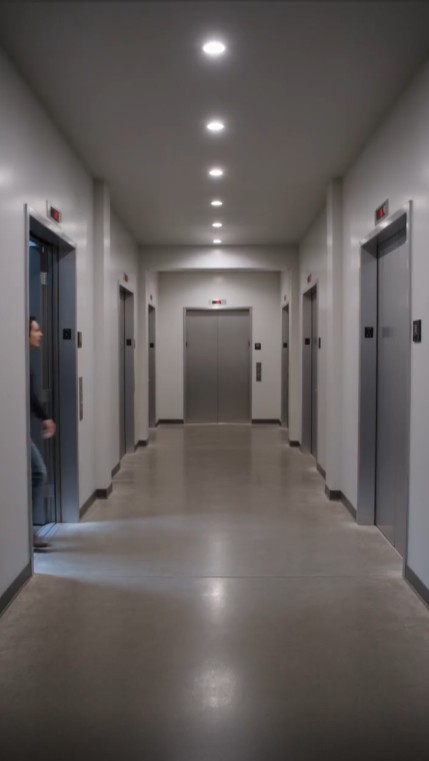
At exactly 8:03 PM…
Daniel stepped into his apartment hallway.
And every door opened.
Not one.
Not two.
The entire floor.
Then the floor above him.
Then the floor below.
People quietly stepped into the hall…
holding empty dinner plates.
Daniel froze.
“What is going on?”
Nobody answered.
Then the elevator opened.
More residents stepped out.
Every one of them carrying an empty plate.
Daniel’s wife, Rachel, came out behind him.
“Do you know about this?”
She shook her head.
Then the elevator bell sounded again.
An adult delivery driver stepped out…
pushing a cart covered with dozens of meals.
Daniel stared.
“I didn’t order anything.”
The driver looked at his phone.
“Actually… your name is on every order.”
Daniel’s face changed.
“What?”
One neighbor stepped forward.
“Daniel, do you remember the blackout last winter?”
“Yeah…”
“You cooked downstairs because everyone’s power was out.”
Daniel laughed.
“That was one night.”
The neighbor shook his head.
“No.”
“That was the first night.”
Daniel looked confused.
“First night of what?”
Then people began lifting their empty plates.
The delivery driver removed the cover from his cart.
Daniel looked underneath…
and stopped smiling.
He recognized what was there.
“Where did you get those?”
His neighbor smiled.
“From people you’ve never met.”
Daniel looked down the hallway.
“Why?”
The elevator opened one final time.
And the person who stepped out finally explained what Daniel’s one dinner had started.
Her name was Evelyn Walker.
Daniel hadn’t seen her in almost nine months.
She was seventy-six now.
Shorter than Daniel remembered.
Silver hair.
Dark blue coat.
And in both hands she carried an old red cooking pot.
Daniel stared at it.
Then at her.
“Mrs. Walker?”
Evelyn smiled.
“Hello, Daniel.”
He looked at the pot again.
That was what he’d recognized beneath the delivery cart’s cover.
Not just one pot.
There were several.
Red.
Blue.
Green.
Different sizes.
Different shapes.
Each had a small white card tied to one handle.
Daniel walked closer.
“What is this?”
Evelyn placed her pot on the cart.
“Dinner.”
“I can see that.”
A few neighbors laughed.
Daniel didn’t.
He was too confused.
Evelyn looked around the hallway.
“Do you remember what you made during the blackout?”
“Soup.”
“What kind?”
Daniel shrugged.
“Whatever-was-left-in-the-fridge soup.”
Evelyn smiled.
“Exactly.”
The blackout had happened eleven months earlier.
A winter storm knocked out power across several blocks.
Daniel and Rachel lived on the eighth floor of an older apartment building called Riverside Towers.
The emergency lights worked.
The elevators stopped.
Heating became unreliable.
Most residents expected electricity to return quickly.
It didn’t.
By the first evening, some people were becoming worried.
Especially the elderly residents.
Daniel had gone downstairs to check on the building superintendent.
In the basement storage area, he noticed the building’s small gas-powered emergency cooking station.
It wasn’t designed to serve the entire building.
But it worked.
Daniel went back upstairs.
He opened his refrigerator.
Chicken.
Carrots.
Celery.
Half a bag of potatoes.
A few onions.
He carried everything downstairs.
Rachel followed with canned beans and rice.
Their neighbor Michael Reed brought tomatoes.
Someone from the sixth floor contributed pasta.
A family from the tenth brought bread that needed to be used before it spoiled.
Nobody planned anything.
Daniel found the largest clean pot available.
And started cooking.
By 7:30 PM, the smell had traveled through the lobby.
The first person to appear was Evelyn Walker.
She lived alone on the seventh floor.
“What are you making?”
Daniel looked into the pot.
“I have absolutely no idea.”
Evelyn laughed.
“Good start.”
She had been widowed two years earlier.
Her husband, Henry, had done most of their cooking.
Since his death, Evelyn rarely prepared full meals for herself.
That evening, she ate two bowls.
Daniel remembered because she apologized after the second.
“Why are you apologizing?”
“Other people need food.”
Daniel pointed toward the enormous pot.
“Mrs. Walker, if you can finish that, I’ll personally give you an award.”
She laughed.
More residents arrived.
By 8:00 PM, almost forty people had eaten.
Nobody paid.
Nobody signed up.
Nobody photographed it for social media.
People simply brought whatever they had before it spoiled.
Daniel cooked.
Rachel organized plates.
Michael carried meals upstairs to residents who couldn’t manage the stairs.
Teenagers filled water bottles.
Children handed out napkins.
For one evening, a building full of people who usually passed one another without speaking sat together in the lobby.
The power returned shortly after midnight.
By morning, everything went back to normal.
At least Daniel thought it did.
Two days later, Evelyn knocked on his door.
She was carrying the red pot.
“I made too much stew.”
Daniel looked inside.
There was enough for at least eight people.
“You made too much?”
“Accidentally.”
Daniel smiled.
“Of course.”
Evelyn pointed across the hallway.
“Michael’s working late. Give him some.”
So Daniel did.
Michael ate the stew.
The following week, Michael made baked pasta.
He gave half to a single father on the fifth floor named Marcus.
Marcus worked two jobs and often arrived home after his eight-year-old daughter, Lily, had already eaten with her grandmother.
Marcus returned the container two days later.
Inside was chicken and rice.
He attached a note.
For whoever needs dinner tonight.
Daniel saw it.
He smiled.
Then forgot about it.
But the dinners continued.
Not every day.
Not even every week.
One resident made extra soup.
Another shared bread.
Someone left six portions of lasagna in the lobby refrigerator with a note:
Take one if today was a long day.
Another resident replaced the handwritten note with a small whiteboard.
EXTRA DINNER: 4 PORTIONS
By spring, the building manager had to establish rules.
Food needed dates.
Ingredients had to be listed when possible.
Nothing could be left unrefrigerated.
The building couldn’t operate an unlicensed restaurant.
Nobody wanted that anyway.
So the residents kept it simple.
Neighbors sharing extra home-cooked meals with neighbors.
Then Evelyn moved away.
Her daughter had convinced her to live closer to family.
Before leaving, she gave Daniel the red pot.
He refused.
“That was Henry’s.”
“I know.”
“Then keep it.”
Evelyn shook her head.
“Henry bought it because he always cooked too much.”
Daniel smiled.
“That sounds familiar.”
“He would’ve liked what happened here.”
Daniel accepted the pot.
Then stored it in his kitchen cabinet.
He thought that was the end of the story.
It wasn’t.
The idea had already left Riverside Towers.
Marcus told a coworker about it.
That coworker lived in another apartment building.
One evening she made too much chili.
Instead of freezing it, she texted three neighbors.
One was a nursing student studying for exams.
Another was an elderly man living alone.
The third had just brought a newborn home.
All three accepted.
The nursing student later cooked extra pasta.
She gave it to someone else.
Then a teacher heard about it.
Then a delivery driver.
Then a community center volunteer.
Nobody called it a movement.
Nobody even knew Daniel’s name.
They simply started using the same phrase.
One More Plate.
If you were already cooking…
and could afford it…
make one additional portion.
Give it to someone you knew.
A neighbor.
A coworker.
A friend caring for a sick relative.
Someone working late.
Someone who’d had a difficult week.
No strangers showing up unannounced.
No public lists of people who “needed help.”
No embarrassing anyone.
Just one extra plate when practical.
Evelyn was the person who gave the idea its name.
After moving, she’d told her daughter Anna about the blackout.
Anna worked at a community center.
She loved the concept but wanted to make sure it didn’t become unsafe or chaotic.
So she adapted it.
For informal neighbor sharing, people handled meals privately.
For larger community events, the center worked with licensed kitchens and followed local food-safety requirements.
On a bulletin board, Anna wrote:
IF YOU CAN, MAKE ONE MORE PLATE.
Someone photographed the sign.
It was shared in a neighborhood group.
Then another.
Within months, similar small meal-sharing groups appeared in several nearby buildings.
Daniel knew none of this.
At Riverside Towers, the tradition had become so normal that he barely noticed it anymore.
A container appeared in the lobby refrigerator.
Someone took it.
Another appeared.
Gone.
Daniel occasionally contributed.
But he never considered himself responsible for any of it.
Then, three weeks before that evening at 8:03 PM, something happened.
Daniel lost his job.
The company he’d worked for eleven years restructured.
His position disappeared.
Daniel told Rachel.
He told his brother.
He didn’t tell the neighbors.
He didn’t want sympathy.
They had savings.
Rachel still worked.
They weren’t facing immediate disaster.
But Daniel changed.
He stopped lingering in the lobby.
Stopped joking with Michael.
Stopped cooking large Sunday meals.
Every morning, he left the apartment carrying his laptop.
He spent hours at the library applying for jobs.
Then came home pretending the rejection emails didn’t bother him.
The neighbors noticed.
Especially Marcus.
One afternoon, Marcus asked Rachel quietly:
“Is Daniel okay?”
Rachel hesitated.
Then said:
“He will be.”
That was enough.
Marcus contacted Evelyn.
Evelyn contacted Anna.
Anna contacted the community center.
And someone suggested something Daniel would have hated if they’d described it as charity.
So they didn’t.
Instead, they organized dinner.
Not dinner for Daniel.
Dinner because of Daniel.
Each person who’d been touched by the One More Plate idea was invited to contribute one meal.
Not money.
Not gifts.
Dinner.
Some cooked.
Others ordered from local restaurants.
Several couldn’t attend but sent meals through the coordinated delivery.
And at exactly 8:03 PM…
the residents of Riverside Towers opened their doors holding empty plates.
Daniel stared at Evelyn.
“You did all this?”
“No.”
“Then who?”
She pointed toward the delivery cart.
“Read the cards.”
Daniel picked up the first one.
It was tied to a blue casserole dish.
From Sarah, Building 14.
Underneath:
A neighbor brought me dinner the week my mother was in the hospital. I never learned who started the idea. Thank you.
Daniel looked up.
“I don’t know Sarah.”
“I know.”
He picked up another.
From Thomas and June.
Someone in our building made us two meals after June’s surgery. Tonight we’re making one back.
Another.
From Emily, nursing student.
I ate somebody else’s chili during finals. I passed. This is not medical evidence that chili improves grades.
Daniel laughed despite himself.
Then another.
From the Wilson family.
Our first One More Plate came the week we brought our daughter home. Tonight she’s helping us cook yours.
Daniel’s smile disappeared.
He looked at Evelyn.
“How many people are involved in this?”
She shrugged.
“We don’t know.”
Daniel stared.
“What do you mean you don’t know?”
“There’s no organization keeping score.”
Anna stepped out of the elevator behind Evelyn.
She was carrying a folder.
Evelyn introduced her.
“My daughter.”
Anna shook Daniel’s hand.
“You’re the soup guy.”
Daniel looked embarrassed.
“I made one pot of soup.”
Anna smiled.
“I know.”
“Then why is everyone acting like I founded something?”
“They aren’t.”
Daniel looked around.
“It feels like they are.”
Anna opened the folder.
Inside were photographs.
Not of Daniel.
Of dinner plates.
Hundreds of them.
A bowl of soup beside a laptop.
A casserole outside an apartment door.
Two containers labeled DAY SHIFT and NIGHT SHIFT.
A plate of pasta beside a handwritten thank-you note.
An elderly couple holding matching bowls.
A firefighter eating stew at a community table.
A teacher carrying three packed meals.
Daniel flipped through them.
“Where did these come from?”
“People sent them after Evelyn told us what happened during the blackout.”
Daniel shook his head.
“But I didn’t feed these people.”
“No.”
“I don’t know them.”
“Exactly.”
Anna pointed toward the photographs.
“You fed people in this building.”
“Once.”
“And then Evelyn cooked for someone.”
Daniel looked at her.
“Michael.”
“Michael cooked for Marcus.”
Daniel nodded.
“Marcus shared the idea at work.”
Anna continued.
“Someone at his job tried it in another building.”
Then someone else.
Then another.
Daniel looked down at the photographs.
Anna closed the folder.
“You didn’t cook all these meals, Daniel.”
“Good, because I’m starting to feel very tired.”
Everyone laughed.
Anna smiled.
“You just made the first dinner anyone here remembers.”
Daniel became quiet.
Then Rachel finally understood something.
She looked at the empty plates.
“Why is everyone holding those?”
Michael stepped forward.
“Because tonight Daniel isn’t cooking.”
“Definitely not,” Daniel said.
Michael pointed toward the cart.
“Tonight he eats.”
The hallway erupted in laughter.
Residents began forming a line.
Not for Daniel.
For dinner.
The empty plates weren’t symbolic.
They were actually hungry.
Daniel stared.
“You people planned a building-wide dinner and didn’t tell me?”
Marcus smiled.
“If we’d told you, you’d have tried to cook.”
“That is absolutely true.”
The meals were taken downstairs to the building’s common room.
The residents had already arranged tables.
Daniel entered last.
He stopped in the doorway.
The room looked almost exactly as it had during the blackout.
Not because the electricity was gone.
The lights were bright.
The heat worked.
But the same people were sitting together.
Evelyn in the corner.
Michael carrying plates.
Marcus helping Lily pour water.
Rachel arranging bread.
People from floors Daniel rarely visited talking to one another.
And in the center of the room sat the old red pot.
Empty.
Daniel walked toward it.
Evelyn touched the handle.
“You recognize it?”
“You gave it to me.”
“I borrowed it from Rachel.”
Daniel turned toward his wife.
“You knew?”
“Only about the pot.”
Daniel narrowed his eyes.
“Traitor.”
Rachel kissed his cheek.
“Eat.”
The delivery driver who’d brought the cart was still standing near the door.
Daniel noticed he wasn’t eating.
“Hey.”
The man looked over.
“You want a plate?”
“I’m working.”
“So?”
The driver smiled.
“I have another delivery.”
Daniel picked up an empty container.
“Take something.”
“I can’t—”
“You brought fifty meals into my building. You’re leaving with one.”
The driver laughed.
Michael shouted from across the room:
“That’s how this whole problem started!”
Everyone laughed again.
The driver eventually accepted a sealed meal for later.
Daniel sat beside Henry Miller, an eighty-two-year-old resident from the ninth floor.
Henry had lived in Riverside Towers for twenty-one years.
Daniel knew him only well enough to say hello.
Henry pointed toward his plate.
“Chicken’s good.”
Daniel nodded.
“Who made it?”
“No idea.”
They ate quietly.
Then Henry said:
“My wife died four years ago.”
Daniel looked over.
“I’m sorry.”
“She did all the cooking.”
Henry smiled faintly.
“I lived on sandwiches for six months.”
Daniel listened.
“One day after the blackout, somebody knocked.”
“Who?”
“Still don’t know.”
Henry pointed toward the food.
“Left beef stew.”
Daniel smiled.
“Evelyn?”
“Maybe.”
Henry shook his head.
“Doesn’t matter.”
Then he said something Daniel remembered for years.
“People think eating alone is about food.”
Daniel waited.
“It isn’t.”
Henry looked around the room.
“Sometimes you just want proof somebody remembered there was supposed to be another plate.”
Daniel looked down at his own dinner.
For the first time that evening, he understood why everyone had carried empty plates into the hallway.
Not because Daniel had filled them.
Because over the previous eleven months…
people had been filling one another’s.
After dinner, Anna asked for everyone’s attention.
Daniel immediately protested.
“No speeches.”
“This isn’t a speech.”
“It looks like one.”
“Sit down.”
Rachel pulled Daniel back into his chair.
Anna held up one of the white cards from the meal containers.
“The community center wants to continue One More Plate.”
Daniel groaned.
“Please don’t name anything after me.”
“We aren’t.”
“Good.”
“We’re also not turning it into a charity based on your story.”
“Even better.”
Anna explained that the idea worked because it remained simple.
For neighbors and friends, people could share food informally and responsibly.
For larger meal programs, licensed partners and established community organizations would handle preparation and distribution.
Nobody would be required to participate.
Nobody’s private circumstances would be publicly identified.
Nobody would photograph recipients without permission.
The point wasn’t recognition.
It was connection.
Then Anna looked at Daniel.
“We did want to ask you one thing.”
“No.”
“You don’t know what it is.”
“Still no.”
Everyone laughed.
Anna held out a marker.
“Write the sentence.”
“What sentence?”
“The one from the blackout.”
Daniel frowned.
“I didn’t write anything.”
Evelyn corrected him.
“Yes, you did.”
She handed him an old photograph.
Daniel stared.
It showed the lobby during the blackout.
The giant pot was visible.
So was a piece of cardboard taped to the table.
Daniel had forgotten about it completely.
In thick black marker, he’d written:
TAKE WHAT YOU NEED. LEAVE ENOUGH FOR THE NEXT PLATE.
Daniel read it twice.
“I wrote that?”
Rachel nodded.
“You were trying to stop Marcus from taking six pieces of bread.”
Marcus raised his hand.
“I was hungry.”
Daniel laughed.
Anna placed a blank card in front of him.
“Write it again.”
Daniel hesitated.
Then wrote:
Take what you need. Leave enough for the next plate.
Anna took the card.
That sentence later went onto the community center’s meal-sharing board.
Daniel’s name did not.
He insisted.
The dinner ended around 10:30.
Residents carried dishes home.
Containers were labeled for return.
The common room emptied.
Daniel helped clean.
Of course he did.
Evelyn remained until almost everyone else had left.
Daniel found her washing the red pot.
“Leave that.”
“I know how to wash a pot.”
“That’s not what I meant.”
She handed it to him.
“It’s yours.”
Daniel looked at the faded red enamel.
“Henry really used this?”
“Every Sunday.”
“What did he cook?”
“Too much.”
Daniel laughed.
Evelyn smiled.
“That’s why I gave it to you.”
Daniel’s expression softened.
“I thought you gave it to me because of the blackout.”
“No.”
She dried her hands.
“I gave it to you because you had the same problem Henry had.”
“What problem?”
“You never learned how to cook for only yourself.”
Daniel looked around the empty room.
“Maybe that’s not such a bad problem.”
Evelyn smiled.
“No.”
Then she left.
Daniel carried the pot upstairs.
When he entered the apartment, Rachel was sitting at the kitchen table.
He placed it on the counter.
“You really didn’t know?”
“Not all of it.”
“You knew something.”
“I knew Evelyn wanted the pot.”
Daniel sat down.
Rachel studied him.
“You okay?”
He nodded.
Then shook his head.
Then laughed.
“I don’t know.”
She reached for his hand.
Daniel had spent three weeks feeling as though losing his job had somehow made him smaller.
He hadn’t said that aloud.
But Rachel knew.
Every rejection email had made it worse.
Every morning he’d dressed as though going to work, then sat at the library trying to figure out what came next.
Tonight hadn’t given him a job.
It hadn’t solved his problems.
It hadn’t magically changed his finances.
But it reminded him that usefulness wasn’t the same thing as employment.
His job had ended.
His place among people hadn’t.
The following Monday, Daniel returned to the library.
He applied for three more positions.
Two never responded.
One invited him for an interview.
He didn’t get it.
A week later, he interviewed again.
This time he did.
The new job paid slightly less than his previous position.
The commute was shorter.
Daniel accepted.
When he told the neighbors, Marcus asked:
“So are we having another dinner?”
Daniel stared at him.
“Why would we?”
“To celebrate.”
“You people need excuses to eat.”
Marcus nodded.
“Correct.”
They held another dinner.
Smaller.
No surprise.
Daniel cooked this time.
But the One More Plate idea continued independently.
A year after the blackout, Riverside Towers held its first official winter community dinner in partnership with a local licensed kitchen.
Daniel helped.
So did Rachel.
So did Marcus.
Evelyn returned.
Even the delivery driver from that night appeared.
His name was Thomas.
Daniel pointed at him.
“You.”
Thomas laughed.
“I wasn’t working tonight.”
“Good. Get a plate.”
Years passed.
Residents moved.
New families arrived.
The original story became less important.
Some people participating in One More Plate had never heard Daniel’s name.
That was exactly how he wanted it.
Once, a reporter from a small neighborhood paper asked whether Daniel considered himself the founder.
Daniel laughed.
“No.”
“But the first dinner happened because of you.”
“The first dinner I know about.”
“What does that mean?”
Daniel shrugged.
“People have been feeding neighbors since people had neighbors.”
The reporter smiled.
“So what’s special about this?”
“Nothing.”
Daniel thought for a moment.
“Maybe that’s why it works.”
There was no complicated formula.
Cook when you could.
Share when appropriate.
Accept when someone offered.
Return the container.
Remember another person might be having a harder day than you.
And don’t turn kindness into a performance.
The reporter asked Daniel what he remembered most about the blackout.
He expected Daniel to mention the soup.
Instead Daniel said:
“The empty plates.”
“During the blackout?”
“No. Eleven months later.”
Then he told the story.
At exactly 8:03 PM, Daniel had stepped into his hallway.
Every door opened.
Residents emerged from three floors carrying empty dinner plates.
At first he thought something was wrong.
Then the elevator opened.
A delivery driver arrived with meals from people Daniel had never met.
And one elderly woman stepped out carrying a red pot that Daniel recognized immediately.
That was when he learned what one improvised dinner had become.
Not a giant movement.
Not a miracle.
A habit.
One person cooked for another.
That person remembered.
Later, they cooked for someone else.
The meal moved farther than the person who made the first one ever could.
Daniel still had Evelyn’s red pot.
The enamel became more chipped every year.
Rachel once suggested replacing it.
Daniel looked horrified.
“You can’t replace this.”
“It leaks.”
“It has character.”
“It has a hole.”
Daniel eventually had it repaired.
On winter evenings, he still used it.
Sometimes for soup.
Sometimes stew.
Always too much.
And whenever Rachel saw him filling container after container, she’d smile.
“How many people are you cooking for?”
Daniel would look into the enormous pot.
Then give the same answer.
“One more.”
Because Daniel eventually understood something that had escaped him on the night of the blackout.
He thought he’d cooked dinner because the power was out.
He thought hungry neighbors needed food.
He thought the story ended when the lights came back on.
But almost a year later, at exactly 8:03 PM, every door around him opened.
People stepped into the hallway carrying empty plates.
And Daniel finally saw what his neighbors had understood long before he did.
Sometimes the most important part of a meal isn’t what’s on the plate.
It’s knowing somebody remembered to make one for you.