
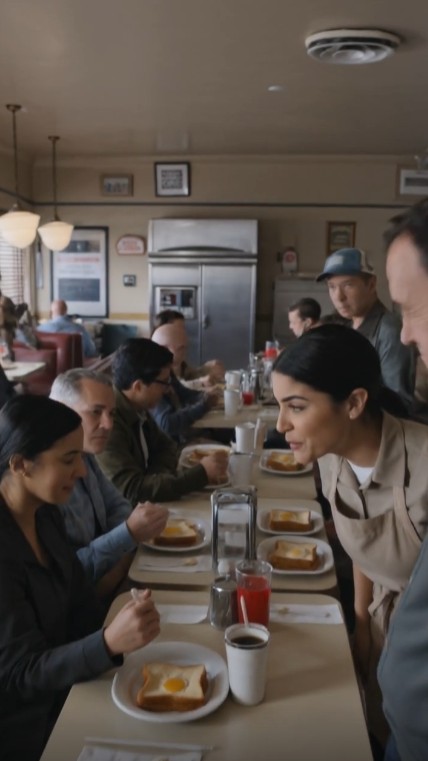
At 12:05 PM…
a man walked into a tiny diner.
He ordered:
“Coffee. Two eggs. Toast.”
Nothing unusual.
Then another customer entered.
“Coffee. Two eggs. Toast.”
Then another.
Same order.
By 12:20…
every table was full.
And all 43 customers had ordered the exact same thing.
The waitress finally whispered to the cook:
“What is happening?”
He had no idea.
Then customer number 44 entered.
An ordinary construction worker.
Dusty boots.
Work jacket.
Lunch bag.
The second he walked inside…
the entire diner went silent.
He stopped.
“Uh… is everything okay?”
Nobody answered.
He approached the counter.
The waitress asked:
“Coffee, two eggs and toast?”
He laughed.
“How did you know?”
Someone at the back stood up.
Then another person.
Then another.
Within seconds…
all 43 customers were standing.
The worker backed away.
“What is this?”
An elderly woman stepped forward.
“Do you remember me?”
He studied her face.
“No. Sorry.”
She smiled.
“I didn’t think you would.”
Then a man beside her said:
“Me either.”
Another woman:
“Or me.”
The worker looked around.
“I’ve never met any of you.”
The elderly woman nodded.
“That’s exactly why we’re here.”
She placed $4.25 on the counter.
The construction worker saw the amount…
and his expression completely changed.
“No…”
The waitress asked:
“What does $4.25 mean?”
The man looked around at all 43 strangers.
Then whispered:
“Where did you people hear about that?”
The elderly woman smiled.
“You really thought nobody remembered?”
Her name was Margaret Wilson.
The construction worker was Daniel Carter.
And although Daniel didn’t recognize Margaret…
he recognized those four dollars and twenty-five cents immediately.
He hadn’t seen that exact amount in almost twelve years.
Not since another diner.
Another morning.
And another stranger.
Daniel slowly removed his work gloves.
“Who told you?”
Margaret pointed toward an empty chair.
“Sit down.”
“I’ve only got thirty minutes for lunch.”
A man near the window laughed.
“So did most of us.”
Daniel looked toward the waitress.
She shrugged.
“I have absolutely no idea what’s happening.”
Margaret smiled.
“You will.”
Daniel sat.
Then Margaret placed an old photograph on the table.
Daniel picked it up.
It showed a diner.
Not this diner.
A different one.
Red booths.
Black-and-white floor tiles.
A long counter.
Daniel knew it immediately.
“Miller’s.”
Margaret nodded.
The photograph had been taken twelve years earlier.
Daniel was twenty-five then.
He had just started working construction.
His father had died the previous winter.
His mother lived two states away.
Daniel rented a tiny apartment and worked every hour he could get.
Every weekday morning, before reporting to the job site, he stopped at Miller’s Diner.
He always ordered the cheapest full breakfast on the menu.
Coffee.
Two eggs.
Toast.
$4.25.
The waitress, Rachel Miller, knew his order so well that eventually she stopped asking.
Daniel would walk through the door at 5:45 AM.
Rachel would look toward the kitchen and call:
“Four twenty-five.”
That was all.
Daniel would sit at the counter.
Eat.
Leave five dollars.
Then go to work.
It wasn’t a tradition Daniel considered important.
It was breakfast.
Until one Monday morning in February.
Daniel entered at his usual time.
The diner was nearly empty.
Only one other customer was there.
An elderly man sat in the corner booth.
Gray coat.
Old baseball cap.
Cup of coffee.
Daniel barely noticed him.
Rachel brought Daniel’s breakfast.
“Long day?”
“Concrete pour.”
“Cold.”
“That’s why they invented jackets.”
Rachel rolled her eyes.
Daniel ate.
Then reached for his wallet.
Nothing.
He checked his jacket.
Nothing.
His work pants.
Nothing.
Then he remembered.
He’d left his wallet on his kitchen table beside an electric bill.
Daniel called Rachel over.
“I messed up.”
“What happened?”
“Wallet’s at home.”
Rachel waved him away.
“Pay tomorrow.”
Daniel shook his head.
“No.”
“Daniel, you’ve eaten here five days a week for two years.”
“I’ll go get it.”
“You’ll be late for work.”
“I’ll come back.”
Rachel crossed her arms.
“You owe us $4.25, not a mortgage.”
Daniel laughed.
Then the elderly man in the corner spoke.
“I’ve got it.”
Daniel turned.
The man placed $4.25 on his table.
Exactly.
Daniel immediately shook his head.
“No, sir.”
The stranger smiled.
“Too late.”
“I can pay for my own breakfast.”
“I believe you.”
“Then don’t pay.”
The elderly man took another sip of coffee.
“Already did.”
Daniel walked over.
“Give me your address. I’ll send it back.”
“No.”
“Then your name.”
The man hesitated.
“Henry.”
“Henry what?”
“Just Henry.”
Daniel laughed.
“You’re making this difficult.”
Henry pointed toward Daniel’s construction jacket.
“You work around here?”
“Yeah.”
“Then you’ll see someone who needs $4.25 eventually.”
Daniel frowned.
“What am I supposed to do, walk around buying eggs for people?”
Henry smiled.
“Doesn’t have to be eggs.”
Daniel stared at him.
Henry continued:
“Don’t bring it back to me.”
Then he said the sentence Daniel would remember for the rest of his life.
“Send it forward until nobody knows where it started.”
Daniel laughed.
At the time, he thought Henry was simply an eccentric old man trying to make a tiny favor sound profound.
Daniel thanked him.
Went to work.
And forgot about it.
Mostly.
Three weeks later, Daniel stopped at a gas station after work.
A teenage boy stood at the register counting coins.
Bread.
Peanut butter.
Milk.
The cashier told him he was short.
“By how much?”
“Four dollars.”
Daniel heard it.
He remembered Henry.
Before he could overthink it, he placed $4.25 on the counter.
The teenager stared at him.
“I only need four.”
Daniel smiled.
“Keep the quarter.”
The boy tried to refuse.
Daniel repeated Henry’s words.
“Send it forward.”
The teenager looked confused.
“Where?”
Daniel laughed.
“That’s what I asked.”
He left.
Daniel never learned the teenager’s name.
He assumed that was the end of it.
It wasn’t.
The teenager was Michael Reed.
Michael was seventeen.
His mother had recently started working nights after losing her previous job.
That evening, she’d called Michael and asked him to pick up a few groceries.
He miscalculated the money.
Daniel’s $4.25 covered the difference.
Michael remembered.
Not because the amount was large.
Because Daniel didn’t make him feel embarrassed.
Two months later, Michael was walking home from school when he saw a woman struggling to carry a broken stroller and several bags up the stairs of an apartment building.
Michael carried everything to the third floor.
The woman offered him money.
He refused.
“Some construction guy helped me once.”
She laughed.
“What does that have to do with carrying a stroller?”
Michael shrugged.
“I don’t know. Apparently I’m sending it forward.”
Her name was Emily Carter.
She remembered the phrase.
Weeks later, Emily’s elderly neighbor, Thomas, became ill.
His daughter lived across the country.
Emily began checking on him.
She brought groceries.
Picked up prescriptions.
Sat with him.
Thomas tried repeatedly to pay her.
Emily refused.
“Send it forward.”
Thomas laughed.
“I’m seventy-eight. Where am I sending it?”
Emily smiled.
“You’ll figure it out.”
He did.
After recovering, Thomas returned to the small community library where he volunteered.
A young woman named Anna came in asking for help using the computers.
She was applying for jobs after several years away from the workforce.
Thomas spent two hours helping her create an email account, format a résumé and submit applications.
Anna thanked him.
Thomas smiled.
“Send it forward.”
Anna got a job.
Six months later, one of her coworkers arrived in tears because her car wouldn’t start and she couldn’t afford to miss another shift.
Anna drove twenty minutes in the opposite direction to pick her up.
That coworker later helped someone else.
And somewhere along the way…
the $4.25 story changed.
People didn’t always know about Henry.
Some knew only about Daniel.
Others knew about Michael.
Some had heard a version involving groceries.
Some thought the story began with a stroller.
But one phrase kept surviving.
“Send it forward.”
Eventually, the amount survived too.
$4.25.
Not as a required donation.
Not as a fee.
Just as a symbol.
Years later, Michael was working as a teacher.
One morning, he noticed a student sitting in the cafeteria without breakfast.
The school already had a meal-assistance program, and Michael made sure the student was connected to it properly.
But that afternoon, he remembered Daniel.
So Michael placed $4.25 into an envelope and gave it to a local community food fund.
On the front, he wrote:
“Send it forward.”
Another teacher asked what it meant.
Michael told the story.
Or at least the part he knew.
A construction worker had once paid $4.25 when Michael was short at a gas station.
The teacher laughed.
“All this over four dollars?”
Michael answered:
“No. Over how he did it.”
“What do you mean?”
“He didn’t make me explain why I was short.”
That mattered.
The teacher remembered.
The story traveled again.
But Daniel knew none of it.
He continued working construction.
He changed companies twice.
Became a site supervisor.
Got married.
Had a daughter.
Divorced.
Changed jobs again.
His life contained good years and difficult ones.
Miller’s Diner closed when Rachel’s parents retired.
The building was eventually demolished.
Daniel hadn’t thought about Henry in years.
Until one afternoon at work.
A new apprentice named Lucas arrived without lunch.
Daniel noticed him drinking water while everyone else ate.
“You forget your food?”
Lucas shrugged.
“Didn’t have time.”
Daniel opened his lunch bag.
Two sandwiches.
His daughter always complained that Daniel packed enough food for three people.
He handed Lucas one.
“I can’t take that.”
“I have two.”
“I’ll buy you lunch tomorrow.”
Daniel shook his head.
“Send it forward.”
The words came out automatically.
Lucas looked at him.
“What?”
Daniel froze.
Then laughed.
“Nothing. Something an old guy told me once.”
That evening, Daniel thought about Henry for the first time in years.
He wondered what had happened to him.
But there was no way to find “Henry.”
He didn’t know the man’s surname.
Didn’t know where he’d lived.
Didn’t know whether he was still alive.
So Daniel let it go.
Again.
Then came the day 43 strangers filled a tiny diner.
The place was called Sunny’s.
Daniel’s construction crew had been renovating an office building two blocks away for six months.
He ate lunch at Sunny’s three or four times a week.
Coffee.
Two eggs.
Toast.
The same breakfast he’d ordered since his twenties.
It was still one of the cheapest meals on the menu, although it certainly no longer cost $4.25.
Margaret had learned this.
She had spent weeks planning the gathering with the diner manager.
The 43 customers arrived in small groups so Daniel wouldn’t notice from the job site.
Every person ordered:
Coffee.
Two eggs.
Toast.
Then Daniel entered.
Now he sat surrounded by people who claimed they’d all somehow been touched by the same tiny favor.
Daniel looked at Margaret.
“How did you find me?”
Margaret smiled.
“Michael.”
Daniel frowned.
“The teenager?”
“He isn’t seventeen anymore.”
A man near the window raised his hand.
Daniel stared.
Michael Reed stood.
Older.
Teacher now.
Daniel studied his face.
Then recognition came slowly.
“Gas station.”
Michael smiled.
“You do remember.”
“You bought bread.”
“And peanut butter.”
Daniel laughed.
“You were short four dollars.”
“You gave me four twenty-five.”
Daniel shook his head.
“That was twelve years ago.”
“I know.”
Michael walked over.
“I’ve wanted to find you for years.”
Daniel looked around.
“You know all these people?”
“Some.”
“Then who are the others?”
Margaret answered.
“That’s the interesting part.”
She opened a folder.
Inside was a diagram.
Names.
Dates.
Arrows.
Michael had helped Emily.
Emily had helped Thomas.
Thomas had helped Anna.
Anna had helped Rachel.
Rachel had helped Marcus.
Marcus had helped Evelyn.
Some branches stopped.
Others divided.
One act led to two.
Two led to five.
Then the trail became almost impossible to follow.
The 43 people in the diner represented only the chains they could reasonably document.
Daniel stared at the pages.
“You tracked all this?”
Michael nodded.
“For almost a year.”
“Why?”
“Because I wanted to know whether the story was true.”
“What story?”
“That one small favor could keep moving.”
Daniel looked at the diagram.
“And?”
Michael smiled.
“It can.”
Then he added:
“But not the way people like to imagine.”
Daniel looked up.
Michael explained.
It wasn’t a perfect chain.
Some people received help and never passed anything forward.
Others probably would’ve helped someone anyway.
Some branches couldn’t be verified.
Some stories changed in the retelling.
And no one could honestly claim Daniel’s $4.25 had caused every good thing that followed.
Human beings were more complicated than that.
But there were 43 people in the diner who could each identify a specific moment when someone had helped them…
and then told them some version of:
“Send it forward.”
Every documented branch Michael could trace eventually connected backward.
To Daniel.
And Daniel connected backward…
to Henry.
Daniel leaned back.
“So you found Henry?”
Margaret’s smile disappeared.
“That’s why I’m here.”
The diner became quiet.
Daniel looked at her.
“You knew him?”
Margaret nodded.
“He was my husband.”
Daniel stood so quickly his chair scraped the floor.
“Henry was your husband?”
“For fifty-one years.”
Daniel looked at the photograph again.
“Where is he?”
Margaret’s eyes softened.
“He died three years ago.”
Daniel lowered his head.
“I’m sorry.”
“Thank you.”
“I wanted to pay him back.”
Margaret smiled.
“He would’ve hated that.”
Daniel laughed quietly.
“Yeah. I got that impression.”
Margaret sat beside him.
“Henry used to eat at Miller’s every Monday morning.”
Daniel looked surprised.
“You were there?”
“Sometimes.”
“I don’t remember you.”
“You shouldn’t.”
She pointed toward the old photograph.
“I usually came later.”
Henry had been retired from the postal service.
For years, he’d kept a peculiar habit.
Every Monday, he carried $4.25 in a separate pocket.
Margaret had teased him about it.
“Why exactly $4.25?”
Henry told her the story.
Years before Daniel ever entered Miller’s Diner, Henry had been the person who couldn’t pay.
It happened when Henry was thirty-two.
He and Margaret had two young children.
Henry’s car needed an unexpected repair.
Money was tight.
One morning, after working an overnight shift, Henry stopped at a diner.
Coffee.
Two eggs.
Toast.
The bill:
$4.25.
When Henry reached for his wallet…
he realized he’d left it at work.
A stranger at the counter paid.
Henry insisted on getting his name.
The stranger refused.
Instead, he said:
“Send it forward until nobody knows where it started.”
Daniel stared at Margaret.
“Henry didn’t invent that?”
She shook her head.
“No.”
“Who paid for his breakfast?”
“He never knew.”
Daniel laughed softly.
“So the whole thing doesn’t start with me.”
“No.”
“Or Henry.”
“No.”
Daniel looked at the 43 people.
“Then why are you all staring at me?”
Michael answered.
“Because you’re the oldest link we could actually find alive and identify.”
Margaret corrected him gently.
“One of the oldest.”
Daniel smiled.
“That’s less impressive.”
“That isn’t the point.”
Margaret reached into her handbag.
She removed a small envelope.
Inside was an old receipt.
The paper was faded.
At the bottom:
$4.25
Henry had kept it for more than forty years.
Daniel held it carefully.
“He kept the receipt?”
Margaret laughed.
“Henry kept everything.”
On the back, Henry had written:
Someday I’ll know why this mattered.
Daniel swallowed.
Margaret continued.
“After Henry helped you, he came home and told me he’d finally sent the breakfast forward.”
Daniel stared at her.
“He told you about me?”
“He said there was a young construction worker who looked annoyed that someone had paid his bill.”
Daniel laughed.
“That sounds right.”
“He liked you.”
“We spoke for about two minutes.”
“That was enough for Henry.”
Margaret looked around the diner.
“He never knew what you did afterward.”
Daniel’s smile faded.
“He died without knowing?”
Margaret nodded.
Then smiled.
“But I know now.”
Michael had found Margaret through old Miller’s Diner records and former staff.
Rachel Miller remembered Henry.
She remembered Daniel too.
When Michael contacted her asking about the $4.25 story, Rachel immediately remembered the morning.
From Rachel, he found Henry’s surname.
From public records and community contacts, he eventually found Margaret.
When Michael told her what had happened…
Margaret cried.
Then she laughed.
Then she said:
“We need breakfast.”
That was how the gathering began.
The waitress at Sunny’s, Emily Wilson, had been told only that a private group wanted to surprise a regular customer.
She hadn’t heard the whole story.
Now she stood behind the counter staring at the $4.25.
“So everyone ordered the same thing because that’s what Henry bought Daniel?”
Margaret shook her head.
“No.”
“Because that’s what the stranger bought Henry.”
Daniel looked at her.
“And probably what someone bought the stranger.”
Margaret smiled.
“Maybe.”
Nobody knew.
That was the beautiful part.
The origin was gone.
There was no founder.
No organization.
No person who could take credit.
Just a breakfast that had moved through time.
Not literally.
The kindness attached to it.
Michael stood.
“We brought something.”
Daniel groaned.
“No.”
Everyone laughed.
“You haven’t even seen it.”
“If it’s money, I’m leaving.”
“It isn’t.”
Michael carried over a wooden box.
Inside were 43 envelopes.
Each had $4.25 inside.
Daniel stared.
“You said it wasn’t money.”
“It’s not for you.”
“Then what is it?”
Each person had contributed exactly $4.25.
Total:
$182.75.
Not a fortune.
That was intentional.
The money would be donated to a local meal-assistance program chosen with the diner and community center.
But that wasn’t all.
Each envelope contained a handwritten note.
A story.
One person wrote:
Someone drove me to an interview when my car wouldn’t start. Months later, I drove a coworker to the hospital when his wife went into labor.
Another:
A neighbor watched my daughter during an emergency. I later watched another neighbor’s son while she attended a job interview.
Another:
Someone paid for my groceries when I was short. I later bought lunch for a stranger.
Another:
A teacher stayed after school to help me graduate. I now volunteer as a tutor.
Another:
A coworker brought dinner after my husband died. I now cook once a week for an elderly neighbor.
Daniel read silently.
Then stopped.
His eyes filled.
“I don’t know these people.”
Michael smiled.
“Exactly.”
Daniel wiped his face with the back of his hand.
“I hate all of you.”
The diner erupted in laughter.
Margaret handed him one final envelope.
Empty.
“What am I supposed to do with this?”
“Nothing.”
“Then why give it to me?”
“Keep it.”
Daniel looked at the front.
Written in Henry’s handwriting were the words:
SEND IT FORWARD.
Margaret had found the envelope among Henry’s belongings after his death.
“He kept that for years.”
Daniel turned it over.
Nothing else.
No instructions.
No name.
Just the phrase.
Lunch finally began.
Forty-four people ate coffee, two eggs and toast.
Daniel sat with Margaret and Michael.
The cook complained that he’d never wanted to see another egg again.
The waitress made everyone promise that if they ever returned, at least one person had to order pancakes.
Before leaving, Daniel placed money on the counter for his meal.
Emily tried to refuse.
Daniel shook his head.
“No free breakfast today.”
Then he placed an extra $4.25 beside it.
Emily looked at him.
“What’s that?”
Daniel smiled.
“You’ll figure it out.”
She laughed.
The gathering ended.
Everyone returned to ordinary life.
There was no viral campaign.
No foundation named after Daniel.
He would’ve refused anyway.
But Sunny’s Diner quietly added something to its community board.
Not a promotion.
Not a promise of free food.
Just a small card:
$4.25
Sometimes a little help doesn’t come back. It goes forward.
People occasionally asked what it meant.
Emily told them the story.
But she always began carefully.
“We don’t actually know where it started.”
That mattered.
Daniel hadn’t started it.
Henry hadn’t started it.
Even the unknown stranger who paid for Henry’s breakfast may have been passing along something someone once did for him.
The story had no owner.
Years passed.
Daniel eventually became a construction foreman.
One afternoon, a new worker named Ethan arrived on site.
Young.
Nervous.
First construction job.
At lunch, Ethan sat alone.
Daniel noticed he had no food.
“You forget lunch?”
Ethan looked embarrassed.
“Didn’t have time.”
Daniel opened his lunch bag.
Two sandwiches.
He laughed.
His daughter still packed too much food whenever she visited.
Daniel handed one over.
Ethan shook his head.
“I’m okay.”
“Take it.”
“I’ll pay you tomorrow.”
Daniel looked at him.
For a moment, he saw Henry sitting in the corner of Miller’s Diner.
Gray coat.
Old baseball cap.
$4.25 on the table.
Daniel smiled.
“No.”
Ethan frowned.
“Why not?”
Daniel almost said the words.
Then stopped.
Maybe the phrase didn’t matter.
Maybe telling people they owed a future good deed turned kindness into another kind of bill.
So Daniel simply said:
“Because I have two sandwiches and you have none.”
Ethan accepted.
“Thanks.”
“Sure.”
They ate.
Nothing dramatic happened.
No applause.
No 43 strangers.
Just lunch.
Several months later, Daniel saw Ethan helping an older worker carry equipment to his truck.
Maybe that had something to do with the sandwich.
Probably not.
Daniel didn’t need to know.
That was another lesson he’d learned.
You couldn’t track every arrow.
And you shouldn’t try.
On the fifth anniversary of Henry’s death, Margaret invited Daniel and Michael to breakfast.
They met at Sunny’s.
Three people.
Coffee.
Two eggs.
Toast.
Emily, still working there, placed the checks on the table.
Daniel looked.
His meal cost considerably more than $4.25 now.
He shook his head.
“Inflation ruined the symbolism.”
Margaret laughed.
Michael reached into his pocket.
He placed $4.25 on the table.
Then Daniel did the same.
Margaret added hers.
Emily stared.
“You people are strange.”
Daniel smiled.
“You knew that.”
The money went into the diner’s community meal fund.
Then they ate.
Before leaving, Margaret gave Daniel a photocopy of Henry’s old receipt.
Daniel framed it.
Not because $4.25 had changed the world.
It hadn’t.
But because it reminded him how little we usually know about what happens after we help someone.
Henry paid for Daniel’s breakfast and went home.
Daniel paid for Michael’s groceries and walked away.
Michael carried Emily’s stroller and kept walking.
Emily helped Thomas.
Thomas helped Anna.
Anna helped someone else.
Most of those people never saw the next part.
They weren’t supposed to.
Years later, Daniel’s daughter found the framed receipt in his house.
“Dad, why do you have a receipt for four dollars and twenty-five cents?”
Daniel smiled.
“Long story.”
She looked closer.
“What did you buy?”
“Nothing.”
“Then why keep it?”
Daniel thought about Henry.
Margaret.
Michael.
The 43 strangers standing inside a tiny diner.
Then he answered:
“It reminds me that you don’t always get to see what happens next.”
His daughter frowned.
“That doesn’t explain anything.”
Daniel laughed.
“No. It doesn’t.”
So he told her.
About forgetting his wallet.
About an elderly stranger named Henry.
About a breakfast.
About a teenager at a gas station.
About a chain nobody had planned.
And about the day Daniel walked into Sunny’s Diner expecting an ordinary lunch.
Every table was full.
Every customer had ordered exactly the same meal.
Coffee.
Two eggs.
Toast.
Then 43 strangers stood.
Daniel thought he’d never met any of them.
Mostly, he hadn’t.
But every person in that room had been connected by some small act that somebody else had chosen not to take back.
Instead…
they’d sent it forward.
And when Margaret placed $4.25 on the counter, Daniel finally understood something Henry himself had never lived long enough to see.
That ordinary breakfast hadn’t ended when the bill was paid.
It had traveled for decades.
Through people who didn’t know each other.
Through favors that cost money and favors that cost nothing.
Through rides.
Meals.
Groceries.
Conversations.
Hours of someone’s time.
And the most remarkable part was that even after 43 people traced the story backward…
they still couldn’t find where it truly began.
Just as Henry had hoped.
He had told Daniel:
“Send it forward until nobody knows where it started.”
Twelve years later…
43 strangers stood inside a diner.
And proved that somewhere along the way…
they had.