
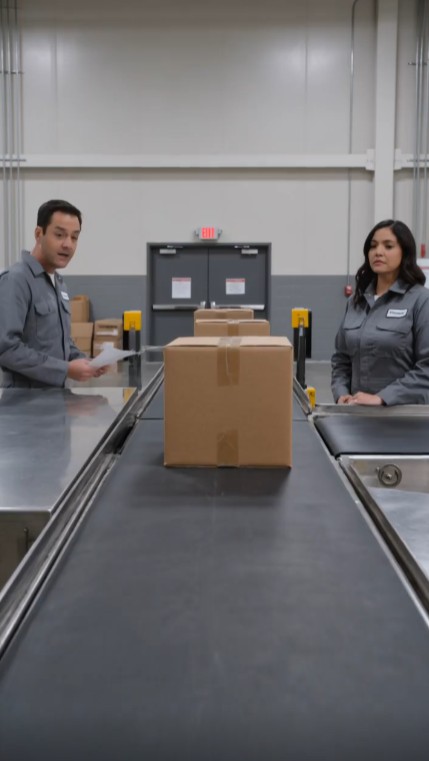
At exactly 2:03 PM…
an entire factory line suddenly stopped.
Hundreds of boxes had passed through normally.
9,997.
9,998.
9,999.
Then…
10,000.
Everything shut down.
A worker shouted:
“Machine problem?”
The supervisor shook his head.
“No.”
Then every employee removed their gloves.
One by one…
they began walking toward the same packing station.
A new employee named Jason looked confused.
“Are we evacuating?”
Nobody answered.
Then he noticed something stranger.
The workers were smiling.
The factory manager appeared.
He looked directly at Jason.
“Come here.”
Jason hesitated.
“Did I do something wrong?”
The manager shook his head.
“This has nothing to do with what you did.”
He pointed toward Box 10,000.
“It has everything to do with what’s inside that box.”
Jason laughed nervously.
“I’m the one who packed it.”
“I know.”
“Then what’s inside?”
The manager smiled.
“You tell me.”
Jason checked the packing sheet.
Ordinary household supplies.
Nothing special.
“I don’t understand.”
The manager asked:
“Where did you work before coming here?”
Jason answered.
“Harbor House Distribution.”
The room suddenly became quiet.
Then one woman in the crowd started crying.
Jason noticed her.
“Do I know you?”
She shook her head.
“No.”
Then another worker stepped forward.
“I don’t know you either.”
Then another.
“But we all know what you did.”
Jason looked around.
“What did I do?”
The manager turned Box 10,000 around.
There was one small mark on the bottom.
Jason saw it…
and his face changed.
A tiny house.
Four simple lines drawn in blue marker.
One wall.
Another wall.
A roof.
And a short line where a door should have been.
Jason stepped closer.
“Where did you get that?”
The manager answered:
“That’s exactly what these people came here to explain.”
Jason reached toward the box.
Then stopped.
“That isn’t mine.”
The manager, Daniel Carter, looked confused.
“You recognize it.”
“I recognize the mark.”
Jason stared at the little blue house.
“But I didn’t draw this one.”
Daniel smiled.
“We know.”
That made even less sense.
Jason looked around at the employees.
“What is going on?”
The woman who’d started crying stepped forward.
Her name was Rachel Miller.
She had worked at the factory for almost seven years.
She wiped her eyes.
“Do you remember why you used to draw that house?”
Jason didn’t answer.
For several seconds, he simply stared at the mark.
Then he quietly said:
“So people would know the box was complete.”
Rachel nodded.
Jason looked at her again.
“How do you know that?”
Rachel took something from behind a nearby cart.
An old cardboard box.
It was battered.
The corners were taped.
One side had been flattened and repaired.
Across the front was the faded logo of Harbor House Distribution.
Jason’s former workplace.
Rachel turned it over.
On the bottom was another blue house.
This one was faded almost gray.
Jason touched it.
“That one is mine.”
Rachel smiled through tears.
“I know.”
Eight years earlier, Jason Reed had been working the night shift at Harbor House Distribution.
Despite the name, Harbor House wasn’t a charity.
It was a commercial warehouse that supplied inexpensive household goods to retailers, apartment complexes and local organizations.
Towels.
Kitchen utensils.
Lamps.
Storage containers.
Sheets.
Basic cleaning supplies.
Nothing glamorous.
Jason was twenty-seven.
He loaded pallets.
Checked damaged shipments.
Repacked returns.
And complained about the vending-machine coffee almost every night.
Then a major storm hit the region.
Rain fell for three days.
Several neighborhoods flooded.
Hundreds of families were temporarily displaced.
One of Harbor House’s customers was a local housing organization called New Start Community Services.
The organization helped families moving from emergency accommodation into temporary or permanent apartments.
After the storm, New Start called Harbor House.
They needed basic household supplies.
Immediately.
Harbor House donated several pallets.
Employees volunteered to prepare boxes.
Jason was one of them.
The first boxes were simple.
Towels.
Soap.
A pan.
Two plates.
Cups.
Basic utensils.
Cleaning cloths.
A small blanket.
Whatever could be safely and appropriately donated from available inventory.
But Jason noticed a problem.
Some boxes were missing items.
Not because anyone was careless.
The warehouse was overwhelmed.
Regular commercial orders still had to ship.
Employees were volunteering between shifts.
Supplies were coming from different parts of the building.
One box might have towels but no cups.
Another had kitchen supplies but no cleaning items.
Jason asked his supervisor:
“How do we know which ones are finished?”
The supervisor, Thomas Wilson, handed him a roll of stickers.
“Put one on the top after you check it.”
That worked for about an hour.
Then several stickers came loose.
Boxes were stacked.
Tops were retaped.
Jason grabbed a blue permanent marker.
After checking each completed box, he drew a tiny house on the bottom corner.
Thomas saw him.
“What is that?”
“A house.”
“I can see that.”
“It means I checked it.”
“Why a house?”
Jason shrugged.
“Because that’s where the stuff is going.”
Thomas laughed.
“You’re a terrible artist.”
“It takes two seconds.”
The mark stayed.
Jason checked dozens of boxes that night.
Then dozens more.
Eventually, other employees began bringing unfinished boxes to him.
“House this one.”
That became their shorthand.
If Jason drew the little house, the box contained the standard list.
It wasn’t an official company system.
It wasn’t used on commercial shipments.
It was simply something the volunteers understood during those hectic nights.
Three weeks later, the emergency donation project ended.
Harbor House returned to normal.
Jason forgot about the little houses.
But one of those boxes went to Rachel Miller.
At the time, Rachel was thirty-four.
She had two children.
Her son Ethan was nine.
Her daughter Sophie was six.
Their ground-floor apartment had taken in several inches of water during the storm.
Nobody was injured.
But much of what they owned was damaged.
Furniture.
Clothes.
School supplies.
Kitchen items.
Rachel had insurance, but processing the claim took time.
For several weeks, she and her children stayed with Rachel’s older sister.
Then New Start helped them secure a temporary apartment.
It was almost empty.
Rachel remembered walking inside with Ethan and Sophie.
There were two mattresses.
A small table.
Four chairs.
A refrigerator.
That was about it.
Sophie looked around.
“Are we living here?”
“For a little while.”
“Where are our things?”
Rachel didn’t know how to answer.
Then a New Start volunteer arrived carrying boxes.
One contained bedding.
Another had children’s supplies.
Then came the Harbor House box.
Rachel opened it on the kitchen floor.
Two towels.
Washcloths.
Plates.
Cups.
A saucepan.
Cooking utensils.
Cleaning supplies.
A small lamp.
Nothing inside was expensive.
But Rachel remembered one specific moment.
Sophie picked up a blue plastic cup.
“This one’s mine.”
Ethan immediately said:
“Why?”
“Because I found it.”
“There are four cups.”
“This one is mine.”
For the first time since the flood, the children argued about something completely ordinary.
Rachel started laughing.
Then crying.
Ethan stared at her.
“Mom?”
“I’m okay.”
She wasn’t crying because of a cup.
She was crying because for several weeks everything had been about the storm.
Insurance.
Damage.
Temporary housing.
Forms.
Calls.
Lost possessions.
And suddenly her children were fighting over a plastic cup.
Normal life had entered the room again.
That night, after the children were asleep, Rachel broke down the cardboard boxes.
When she turned over the Harbor House box…
she saw the little blue house.
She assumed a child had drawn it.
Rachel almost threw the cardboard away.
Instead, she cut out the small section containing the mark.
She kept it.
She couldn’t explain why.
Months later, Rachel and her children moved into a permanent apartment.
Life stabilized.
The insurance claim was settled.
Rachel found better work.
The temporary dishes were gradually replaced.
The towels wore out.
The lamp eventually stopped working.
But the piece of cardboard with the blue house remained in a kitchen drawer.
Three years later, Rachel began working at Carter Home Products.
The factory where Jason now stood.
Carter manufactured and packed basic household goods.
Storage products.
Kitchen accessories.
Cleaning items.
Small home essentials.
Rachel worked in quality control.
One December, the company organized a donation drive for a local housing program.
Employees were asked to contribute unopened household items if they wished.
Rachel immediately thought about the flood.
She brought a box.
Then another.
Daniel Carter, the factory manager, noticed her carrying them.
“You moving in?”
Rachel laughed.
“Donation drive.”
“You brought half a kitchen.”
Rachel told him why.
She told him about the temporary apartment.
The box.
The blue cup.
And the strange little house someone had drawn underneath.
Daniel smiled.
“You kept the box?”
“Part of it.”
The next day, Rachel brought the cardboard piece to work.
Daniel looked at the tiny house.
“You know who drew it?”
“No.”
“Why keep it?”
Rachel thought about that.
“Because somebody checked.”
Daniel frowned.
“What do you mean?”
Rachel explained.
She didn’t know who packed the box.
She didn’t know whether the mark had any real meaning.
But when she received it, nothing important was missing.
Someone somewhere had taken time to make sure the box was useful.
Daniel liked that idea.
So did the other employees.
That year’s donation drive produced 117 boxes.
Before the boxes left the factory, Rachel and several volunteers checked each one against the requested supply list.
A worker named Michael picked up a blue marker.
“Should we do the house?”
Rachel laughed.
“No.”
“Why not?”
“It wasn’t our mark.”
Michael shrugged.
“It can be.”
Rachel thought about it.
Then she drew one.
Four lines.
Terrible roof.
Tiny door.
The first copied house.
That should have been another ending.
Instead, it became a tradition.
The following year, Carter Home Products worked directly with several established local housing and community organizations.
Rather than simply collecting random items, the company asked those organizations what was actually needed.
They created standardized household starter boxes.
Everything was new or appropriately approved.
Everything was checked.
Nothing unsafe.
Nothing expired.
Nothing unusable.
And every completed box received a tiny blue house.
Employees called them Home Boxes.
The company did not sell them.
They weren’t part of the commercial production line.
Employees could volunteer for packing events.
The company contributed selected goods and logistics support.
Other local businesses occasionally donated appropriate supplies.
The partner organizations handled distribution based on their own programs and eligibility processes.
Year one:
117 boxes.
Year two:
Year three:
Then other departments joined.
Office employees.
Drivers.
Maintenance workers.
Supervisors.
Families of employees volunteered during scheduled packing days.
The blue house spread.
Nobody knew who had originally drawn it.
Rachel told the story every year.
“A box helped my family after a flood. There was a little house underneath. I never knew what it meant.”
Eventually, employees developed their own interpretation.
It meant:
Checked.
Complete.
Ready for a home.
By the sixth year, more than 6,000 boxes had been prepared through the program.
By the seventh…
9,000.
Daniel began tracking the approach to 10,000.
He wanted the milestone to belong to the employees.
No huge ceremony.
No media event.
No giant banner.
Just a moment on the factory floor.
Then something happened nobody planned.
Three weeks before Box 10,000 was expected…
Jason Reed applied for a job.
Daniel didn’t recognize the name.
Why would he?
Jason’s résumé listed:
Harbor House Distribution — Warehouse Associate
Rachel saw it during a routine introduction after Jason was hired.
She froze.
“Harbor House?”
Jason nodded.
“Years ago.”
Rachel immediately went to Daniel.
“What if he knows?”
“Knows what?”
“The house.”
Daniel didn’t want to make assumptions.
Harbor House had employed hundreds of people.
Jason might know nothing about Rachel’s box.
So they didn’t ask him.
Jason began work.
Quiet.
Reliable.
A little nervous.
He was starting over after the distribution company he’d worked for most recently had downsized.
His first week, he learned the packing stations.
Second week, inventory procedures.
Third week, quality checks.
He noticed the tiny blue house printed on some internal Home Box materials.
But he never commented.
Why would he?
The house had changed slightly over the years.
Employees had cleaned up the design.
It looked more like a proper symbol now.
Jason’s original mark had been crooked.
Then Rachel found the old box.
Not just the cardboard piece.
The actual box.
She’d thought it was gone.
Her sister had stored several flattened moving boxes in a basement.
While clearing the basement, she discovered one with the faded Harbor House logo.
Rachel turned it over.
Blue house.
Still there.
She brought it to Daniel.
Daniel compared the old mark with the one used by the factory.
Almost identical in concept.
But they still had no proof Jason had drawn it.
Until Daniel contacted Thomas Wilson.
Jason’s old Harbor House supervisor.
Thomas was retired.
Daniel explained the situation.
Thomas laughed immediately.
“The houses?”
“You remember them?”
“Jason drew those.”
Rachel covered her mouth.
Thomas continued:
“He checked almost every relief box that first week.”
Daniel asked:
“Why?”
“Because he was annoyingly thorough.”
Thomas laughed.
“He’d unpack a whole box if he thought somebody forgot one spoon.”
“Did he know who received them?”
“No.”
“Did he ever ask?”
“Not that I remember.”
Thomas paused.
“Why?”
Daniel told him.
There was silence.
Then Thomas said:
“You’re telling me you’re still drawing those little things?”
“Almost eight years later.”
Thomas laughed.
“You have to tell him.”
Daniel looked toward Rachel.
“We will.”
They realized Box 10,000 would likely be completed during Jason’s shift.
Daniel could have manipulated the count to make sure Jason packed it.
He decided not to.
If Jason happened to pack the milestone box, fine.
If not, the story still mattered.
At 1:57 PM that afternoon, Box 9,994 passed inspection.
9,995.
9,996.
Jason worked at Station 4.
Another employee packed 9,997.
Rachel packed 9,998.
Michael packed 9,999.
Then a box reached Jason.
He checked the sheet.
Kitchen towels.
Cleaning cloths.
Basic utensils.
Food-storage containers.
Cups.
Several other requested household items.
Everything matched.
Jason sealed it.
Scanned it.
The counter changed.
10,000
Daniel stopped the line.
Now Jason stood surrounded by employees.
Rachel held the original Harbor House box.
And suddenly…
the new job he had taken only weeks earlier didn’t feel new at all.
Jason looked at Daniel.
“You’ve been doing this for eight years?”
“Almost.”
“With the house?”
“Yes.”
Jason turned toward Rachel.
“And you got one of my boxes?”
Rachel nodded.
“After the flood.”
Jason sat on the edge of the packing station.
“I don’t remember packing it.”
“I know.”
“I don’t remember you.”
“I know.”
“I didn’t even know where most of those boxes went.”
Rachel smiled.
“That was kind of the point.”
Jason looked at the original box again.
“You kept cardboard for eight years?”
Rachel laughed.
“When you say it like that, I sound ridiculous.”
Jason touched the faded mark.
“I must’ve drawn hundreds of these.”
Thomas had later checked old Harbor House records.
Jason had personally inspected at least 312 boxes during the original storm response.
Possibly more.
Jason shook his head.
“It was just a check mark.”
Rachel nodded.
“To you.”
Then she told him about the blue cup.
Her daughter Sophie.
The temporary apartment.
The first night.
How the box hadn’t rebuilt their home.
It hadn’t solved the insurance problems.
It hadn’t replaced what they’d lost.
It simply gave them enough ordinary things to begin functioning again.
“That mattered,” Rachel said.
Jason looked uncomfortable.
“Harbor House donated the stuff.”
“Yes.”
“New Start delivered it.”
“Yes.”
“There were probably twenty people involved before that box reached you.”
“Probably more.”
“So why is everyone looking at me?”
Rachel smiled.
“Because you drew the house.”
Jason laughed.
“That’s it?”
“No.”
She pointed toward Box 10,000.
“You accidentally gave us the symbol.”
Daniel stepped forward.
“And Rachel gave us the idea.”
Rachel immediately shook her head.
“No. The program was everybody.”
Daniel nodded.
“Exactly.”
That was what he wanted Jason to understand.
Nobody was claiming Jason had personally created 10,000 boxes.
He hadn’t.
He hadn’t even known the program existed.
Rachel hadn’t packed all 10,000.
Daniel hadn’t paid for all 10,000.
No single person could claim them.
Employees.
Partner organizations.
Donors.
Drivers.
Volunteers.
Warehouse workers.
Quality staff.
Hundreds of people had contributed.
The little house was simply the thread connecting the first box Rachel remembered to the milestone sitting in front of them.
Jason looked around.
“Why did that woman say you all know what I did?”
Michael answered.
“Because Rachel has told that story about 400 times.”
Rachel looked offended.
“Maybe 300.”
Everyone laughed.
Jason looked again at Box 10,000.
“Who gets this one?”
Daniel smiled.
“We don’t know.”
The boxes would go to partner organizations.
Those organizations would determine where they were needed.
Jason nodded.
“Good.”
“Why good?”
“Because that’s how the first ones worked.”
Then Rachel handed him the blue marker.
Jason stared at it.
“What?”
“Box 10,000 needs its house.”
Jason shook his head.
“You guys already have a stamp or something.”
“We do.”
“Use that.”
Rachel held out the marker.
“Not on this one.”
Jason hesitated.
Then took it.
Daniel turned the box carefully.
Jason knelt.
For several seconds, he didn’t draw anything.
Michael called from behind him:
“Don’t mess it up.”
Jason laughed.
“Apparently I’ve had eight years of people improving my design.”
Then he drew.
One line.
Second line.
Roof.
Door.
Crooked.
Exactly like the old one.
Employees applauded.
Jason stood.
His eyes were wet.
Then he looked at Rachel.
“Can I ask you something?”
“Sure.”
“Do you still have the blue cup?”
Rachel laughed.
“No.”
“Good.”
“My daughter took it to college.”
Jason stared.
“You’re kidding.”
“Yes.”
Everyone laughed again.
But Rachel’s expression softened.
“Sophie is fourteen now. The original cup broke years ago.”
Jason nodded.
“That’s probably normal.”
“It is.”
Rachel smiled.
“The box wasn’t supposed to last forever.”
That sentence stayed with Jason.
After the gathering, the line restarted.
At 2:19 PM…
Box 10,001 passed the station.
No applause.
10,002.
10,003.
Employees returned to work.
Jason liked that.
The milestone mattered.
But the work didn’t stop at 10,000.
Several days later, Rachel found Jason in the break room.
He was looking at a photograph someone had taken during the gathering.
“You okay?”
“Yeah.”
“You seem disappointed.”
“No.”
He paused.
“It’s strange.”
“What?”
“I spent years thinking that job didn’t matter.”
Rachel sat down.
Jason explained.
At Harbor House, he had wanted to become a supervisor.
It never happened.
He left after four years.
He’d bounced between warehouses and construction supply jobs ever since.
Whenever anyone asked what he’d done at Harbor House, he usually said:
“Moved boxes.”
That was how he’d thought about it.
Boxes in.
Boxes out.
Scan.
Tape.
Stack.
Repeat.
Rachel looked at him.
“You did move boxes.”
Jason laughed.
“Thanks.”
“But that’s not the same as saying it didn’t matter.”
She pointed toward the factory floor.
“Most of what we do here looks ordinary too.”
Jason nodded.
Rachel continued:
“A towel isn’t life-changing.”
“No.”
“A saucepan isn’t life-changing.”
“No.”
“A plastic cup definitely isn’t life-changing.”
Jason smiled.
“Careful. Sophie might disagree.”
Rachel laughed.
“But when you have almost nothing in a new apartment, ordinary things feel different.”
Jason understood.
The next month, he volunteered for his first Home Box packing event.
Rachel expected him to take over quality checks.
Instead, Jason stayed near the back.
He assembled cardboard boxes.
For almost two hours.
Rachel finally asked:
“You’re not going to draw houses?”
“Nope.”
“Why?”
Jason pointed toward a teenage volunteer at the checking station.
“She is.”
The teenager was carefully comparing each box with the requested supply list.
When she finished, she stamped the bottom.
Tiny blue house.
Jason smiled.
“Looks better than mine.”
The program continued.
10,500.
11,000.
12,000.
Eventually, the factory replaced the old manual counter with a digital tracking system.
The blue house remained.
But Daniel made one change.
Every new employee learned the actual meaning.
Not a legend about Jason.
Not a story suggesting one man had created everything.
The training explanation was simple:
The house meant the box had been checked against the partner organization’s requested list.
Then, if there was time, Rachel told the history.
A family displaced after a storm.
A warehouse worker checking boxes.
A small blue mark.
A tradition copied years later.
Jason always hated when she told the story while he was nearby.
He would suddenly find something urgent to do elsewhere.
One afternoon, a young employee named Ethan caught him leaving.
“That’s you?”
Jason kept walking.
“No.”
“Rachel literally said Jason Reed.”
“Common name.”
“She pointed at you.”
“Unreliable witness.”
Ethan laughed.
Then asked:
“Why’d you draw a house instead of your initials?”
Jason stopped.
He thought for a moment.
“I don’t know.”
“Seriously?”
“Seriously.”
He had given Rachel an explanation earlier.
Because the boxes were going to homes.
That was partly true.
But years later, he remembered something else.
During the storm response, Thomas had told volunteers:
“Don’t pack these like leftovers. Pack them like they’re going into somebody’s kitchen tonight.”
Maybe that was why Jason drew a house.
He couldn’t remember anymore.
Memory had blurred.
So he didn’t invent an answer.
“I probably just thought it was easy to draw.”
Ethan smiled.
“You’re still bad at it.”
Jason pointed at him.
“Get back to work.”
Two years after Box 10,000, Rachel brought someone to the factory’s volunteer packing day.
A young woman.
Jason recognized the name immediately.
“Sophie?”
Sophie Miller smiled.
“The cup girl.”
Jason laughed.
“You know about that?”
“My mother has told that story my entire life.”
Rachel appeared behind her.
“It’s a good story.”
Sophie rolled her eyes.
“It was a plastic cup, Mom.”
“See?” Jason said. “Finally, someone reasonable.”
Sophie was sixteen now.
She volunteered for the afternoon.
At the end of the event, Jason handed her the blue marker.
Sophie drew a house beneath the final box.
It was terrible.
Jason stared.
“Wow.”
“What?”
“That may actually be worse than mine.”
Sophie laughed.
Rachel took a photograph.
Not for publicity.
Just for herself.
Years earlier, Sophie had stood inside an almost-empty apartment holding a blue cup from a box Jason had checked.
Now she was checking a box for another household.
No one pretended the circumstances were identical.
No one knew who would receive it.
And nobody expected that family to someday return the favor.
The box was simply there because it was needed.
That was enough.
When Jason eventually became a shift supervisor, employees joked that the blue house had finally earned him a promotion.
Jason corrected them.
“My attendance record earned me a promotion.”
Daniel agreed.
The program had nothing to do with Jason’s advancement.
He had earned the job through his work.
That distinction mattered to him.
But Jason did change one thing after becoming supervisor.
He began asking new employees a question during training.
“Who uses what we make?”
Most answered:
“Customers.”
Jason would nod.
Technically correct.
Then he’d remind them that every box eventually reached a person.
A warehouse worker might never meet that person.
A packer might never see the kitchen where an item was used.
A driver might never know who opened the carton.
That didn’t make the work meaningless.
It simply meant the next part of the story happened somewhere else.
Five years after Box 10,000, the Home Box program passed 20,000.
There was no factory shutdown this time.
Jason requested that.
“Keep the line running.”
Daniel agreed.
At 20,000, a small notification appeared on the internal screen.
Employees applauded for a few seconds.
Then continued working.
Rachel walked over to Jason.
“No speech?”
“No.”
“No crying?”
“Definitely no.”
Rachel handed him something.
The original Harbor House cardboard box.
Jason groaned.
“You still have this?”
“Of course.”
“You need hobbies.”
Rachel turned it over.
The blue house was barely visible now.
Time had faded the ink.
Jason touched the mark.
“It’s disappearing.”
Rachel nodded.
“Cardboard does that.”
“What are you going to do when it’s gone?”
Rachel smiled.
“Nothing.”
Jason looked at her.
She pointed toward the boxes moving down the line.
Thousands of newer blue houses had already replaced it.
The original mark didn’t need to survive forever.
Neither did the original box.
Neither did the towels or plates or cups.
The useful part had already happened.
Years later, when Rachel retired, the factory gave her a framed photograph.
Not of Box 10,000.
Not of Jason.
It showed an ordinary packing station.
Several completed Home Boxes sat on a pallet.
On the bottom corner of the nearest one…
a tiny blue house.
Jason signed the back:
You were right to keep the cardboard.
Rachel laughed when she read it.
Then underneath he had written:
But you were still weird for keeping cardboard.
She laughed harder.
Before leaving, Rachel handed Jason the original Harbor House box.
“No.”
“Yes.”
“I don’t want it.”
“Too bad.”
“What am I supposed to do with it?”
“Your problem now.”
Jason took it home.
For months, it remained folded in a closet.
Then one evening, his young nephew found it.
“What’s this?”
“Old box.”
“Why are you keeping it?”
Jason smiled.
“Long story.”
His nephew saw the blue mark.
“Is that supposed to be a house?”
“Unfortunately.”
“You drew that?”
“Yeah.”
“It’s bad.”
“I’ve been told.”
Then Jason explained.
Not that he’d changed thousands of lives.
He hadn’t.
Not that every Home Box existed because of him.
It didn’t.
He explained one box.
One storm.
One mother.
Two children.
A few household supplies.
And a mark he drew because he wanted the next volunteer to know the box had been checked.
Years later, the woman who received it went to work at another factory.
She remembered.
Other people joined.
They created something bigger.
Jason’s nephew listened.
Then asked:
“So what was inside Box 10,000?”
Jason smiled.
“Nothing special.”
“Toys?”
“No.”
“Money?”
“No.”
“What then?”
“Towels. Kitchen stuff. Cleaning things.”
His nephew looked disappointed.
“That’s boring.”
Jason laughed.
“Very.”
“Then why did everyone stop the factory?”
Jason thought about Rachel.
About Sophie and the blue cup.
About Thomas telling volunteers to pack boxes as though they were going into someone’s kitchen that night.
About thousands of people he’d never meet.
Then he answered:
“Because sometimes boring things are exactly what somebody needs.”
The original blue house eventually faded almost completely.
But at Carter Home Products, the mark continued.
One on every completed Home Box.
Checked.
Complete.
Ready.
And years after Jason first walked into the factory as a nervous new employee, workers still told the story of the afternoon the line stopped at exactly 2:03.
9,997.
9,998.
9,999.
Then…
10,000.
Jason had thought the machine was broken.
He thought he might have packed something incorrectly.
Instead, the manager turned the box around.
On the bottom was a tiny blue house.
A mark Jason hadn’t used in years.
A mark he’d once drawn on relief boxes at a warehouse he believed nobody remembered.
He looked around at 43 coworkers, then at Rachel holding a battered old carton.
And for the first time, Jason saw something warehouse workers almost never get to see.
What happened after the box left.
He hadn’t created the program.
He hadn’t packed all 10,000 boxes.
He hadn’t even known they existed.
He had simply checked one box years earlier…
drew a tiny house underneath…
and sent it somewhere he’d never see.
But the person who opened it remembered.
And sometimes that is how an ordinary action travels.
Not because one person changes everything.
But because someone on the other end decides the ordinary thing mattered enough to carry forward.