
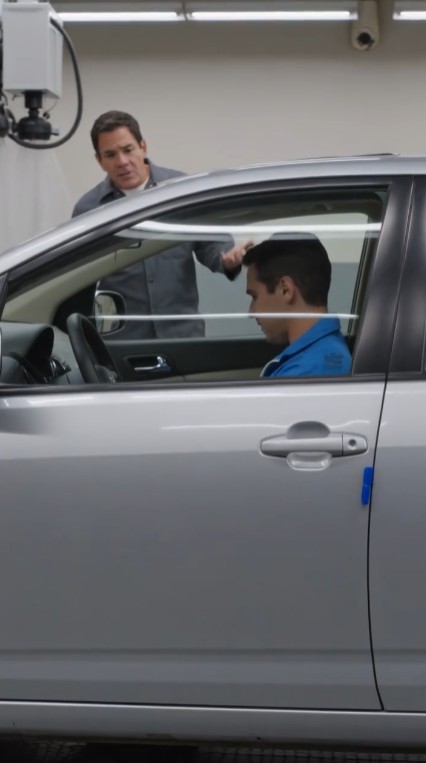
Halfway through the wash…
the entire machine stopped.
The driver looked around.
No emergency.
No malfunction.
Then three employees came walking toward his car.
He lowered his window.
“What’s wrong?”
The manager stared at the vehicle.
“Where did you get this car?”
The driver laughed nervously.
“I bought it yesterday.”
“From who?”
“Used-car lot across town.”
The manager walked toward the rear.
Then crouched down.
Not looking at the license plate.
Not looking at the bumper.
He was looking underneath.
The driver stepped out only after employees confirmed the equipment was safely shut down.
“What did you find?”
The manager pointed.
Three tiny blue dots.
The driver shrugged.
“Paint?”
The manager shook his head.
Then another employee saw them.
“No way…”
The driver was getting confused.
“Would somebody tell me what’s happening?”
The manager asked:
“Can you open the trunk?”
The driver did.
Empty.
The manager lifted the removable trunk mat.
Nothing.
Then he pressed one ordinary plastic panel.
Click.
A small harmless compartment opened.
Inside was…
not money.
Not anything dangerous.
Just dozens of tiny laminated cards.
The manager picked up the first one.
Read the name.
Then sat down.
The driver asked:
“You know that person?”
The manager looked at him.
“I am that person.”
Silence.
Then he pulled out another card.
Another name.
He knew that one too.
And another.
The driver whispered:
“Who owned this car?”
The manager looked at the stack.
“Someone we’ve been trying to find for eleven years.”
The manager’s name was Daniel Carter.
The new owner of the car was Marcus Reed.
And the name printed on the first laminated card was:
DANIEL CARTER
Underneath were three handwritten lines.
First week.
Wouldn’t eat lunch because he was sending money home.
Pretended he wasn’t hungry.
Daniel stared at the card.
Marcus looked over his shoulder.
“What does that mean?”
Daniel didn’t answer.
He turned the card over.
On the back:
Turkey sandwich. Apple. Coffee.
Never let him know.
Daniel’s face changed.
“I knew it.”
“Knew what?”
Daniel looked toward the old silver sedan.
“I knew somebody was doing that.”
One of the employees beside him, Rachel Miller, picked up another card.
She read the name.
Then covered her mouth.
“Thomas Wilson.”
Daniel looked at her.
Rachel turned the card over.
Car wouldn’t start after closing.
Battery was nearly dead.
Jumped it, then followed him home because his headlights kept flickering.
He thought I was going the same direction.
Rachel whispered:
“Thomas talked about that for years.”
Marcus was completely lost.
“Who is Thomas?”
“He worked here,” Daniel said.
“When?”
“Twelve years ago.”
Another employee reached into the compartment.
Another card.
RACHEL MILLER
Rachel froze.
“That’s me.”
She took it.
The front contained a date from eleven years earlier.
The back read:
Daughter sick. Rachel used last vacation day.
Covered closing shift. Told manager we traded.
She never asked.
Rachel sat beside Daniel.
“I remember that night.”
Marcus looked from one to the other.
“So somebody kept records of helping you?”
Daniel shook his head.
“I don’t think that’s what these are.”
“Then what are they?”
Daniel picked up another.
MICHAEL REED
Another.
ANNA WILSON
Another.
HENRY MILLER
Some names Daniel recognized immediately.
Others belonged to people who had worked at the car wash years before Daniel became manager.
Then he reached the final card in the first stack.
No employee name.
Only two words:
KEEP GOING.
Underneath was a small symbol.
Three blue dots.
Marcus pointed toward it.
“That’s what’s under the car.”
Daniel nodded.
Exactly.
Three dots.
Same spacing.
Same blue.
Daniel stood and walked around the sedan again.
He crouched.
The dots were old.
Faded.
Almost invisible beneath years of road dirt and weather.
Marcus asked:
“Who put them there?”
Daniel looked toward the cards.
“His name was Samuel Walker.”
Rachel closed her eyes.
“Sam.”
Marcus waited.
Daniel stood.
“Eleven years ago, this car wash almost closed.”
The business had looked very different then.
The equipment was older.
The office was smaller.
There were only nine employees.
Daniel was twenty-three.
He’d moved to the city after his father became ill.
Most of Daniel’s paycheck went toward rent and helping his mother with bills.
He never told his coworkers.
But Sam noticed.
Samuel Walker was fifty-eight.
Officially, he was a maintenance technician.
Unofficially, he seemed capable of fixing anything.
Wash pumps.
Vacuum motors.
Door hinges.
Coffee makers.
Broken chairs.
Once, when a delivery driver’s glasses snapped at the bridge, Sam repaired them with wire and tape well enough to get the man home.
Sam drove an old silver sedan.
The same model Marcus had just purchased.
Nobody thought much about the car.
It was always parked in the same corner.
Sam arrived first.
Left last.
And carried a blue paint marker in his shirt pocket.
He used it to mark maintenance parts after inspection.
One dot meant checked.
Two dots meant repaired.
Three dots meant, in Sam’s words:
“Stop bothering me. It’s fixed.”
Employees laughed about it.
The three blue dots became his signature.
Daniel had forgotten all about them.
Until now.
“He put three dots under his own car?” Marcus asked.
Daniel nodded slowly.
“Apparently.”
“Why?”
“I don’t know.”
Rachel looked toward the compartment.
“I think we’re about to find out.”
Daniel asked Marcus if they could move the car safely out of the wash bay before continuing.
Marcus agreed.
The equipment was restarted only after the vehicle had cleared the system and staff confirmed everything was safe.
Then Daniel closed one lane temporarily.
Not because the car was dangerous.
Because half the employees were now standing around it instead of working.
Marcus parked near the office.
They carried the cards inside.
There were 47.
Forty-seven names.
Forty-seven small stories.
Daniel knew 31 of them.
Rachel knew 38.
Some were former employees.
Some were vendors.
Two were customers.
One was a delivery driver.
Another was a teenager who had worked there for only six weeks during summer break.
Every card followed roughly the same format.
A name.
A date.
A short observation.
Then something Sam had done.
Nothing enormous.
Nothing heroic.
Henry Miller
Boot sole split during shift.
Used shop adhesive and clamps. Left repaired boots beside locker before morning.
Henry blamed Daniel.
Daniel laughed.
“He did.”
Rachel smiled.
“You took credit?”
“No. Henry assumed.”
“You didn’t correct him?”
“I didn’t know Sam did it.”
Another card.
Anna Wilson
First day. Too nervous to ask where anything was.
Made simple map of supply room. Left it in locker.
Rachel smiled.
“Anna kept that map for years.”
Another.
Michael Carter
Couldn’t afford birthday cake for son after reduced hours.
Bought grocery-store cake. Asked cashier to say another customer had left it.
Daniel stopped.
“I remember Michael talking about that.”
Marcus looked at him.
“What did he say?”
“He said some stranger bought his son’s cake.”
The room became quiet.
Daniel looked at the card.
“It was Sam.”
Card after card revealed the same pattern.
Sam saw something small.
Then quietly fixed what he could.
A flat bicycle tire.
A forgotten lunch.
A bus fare.
A torn winter coat.
A coworker who needed someone to cover fifteen minutes so she could call her doctor.
A customer who left a child’s stuffed rabbit near the vacuum station.
Sam drove the toy across town after his shift because the phone number on the lost-item form wasn’t working.
Nothing on the cards would have made the news.
That seemed to be exactly how Sam preferred it.
Then Daniel reached his own card again.
Turkey sandwich.
Apple.
Coffee.
He stared at it.
During his first month at the car wash, Daniel had stopped buying lunch.
He told coworkers he preferred eating after work.
That wasn’t true.
His father had needed medication.
Daniel was sending money home.
For six days, a brown paper bag appeared inside the employee refrigerator.
No name.
Inside was always something simple.
A sandwich.
Fruit.
Sometimes crackers.
Daniel initially assumed the manager was buying extra food.
When he asked, the manager knew nothing.
Daniel eventually stopped asking.
After two weeks, the bags stopped appearing.
By then, his mother had received assistance through a local program and Daniel’s finances were slightly less strained.
He had never discovered who left the food.
Until now.
Marcus looked at him.
“Eleven years?”
Daniel nodded.
“You remembered a sandwich for eleven years?”
Daniel smiled.
“When you’re hungry enough, you remember.”
Then Rachel found something different.
At the bottom of the compartment was a sealed plastic envelope.
Inside was a folded sheet of paper.
On the front:
IF THIS CAR EVER COMES BACK
Daniel stared at the words.
“Back where?”
Rachel opened it.
The note was written in Sam’s handwriting.
If somebody at Riverside Wash finds this, I’m guessing the old car survived longer than expected.
Daniel laughed.
“That sounds like him.”
Rachel continued.
The cards are not debts. Nobody owes me anything.
They are reminders.
I started writing them because I kept forgetting the good days and remembering only the bad ones.
Daniel’s smile disappeared.
Rachel read on.
When the wash was struggling, everybody complained. Me included. Machines broke. Hours got cut. People quit. Customers yelled.
But every week, somebody still did something decent for somebody else.
Most of it disappeared because nobody wrote it down.
So I started writing down the things I saw.
Rachel stopped.
Marcus frowned.
“But these cards are things Sam did.”
Daniel looked at the remaining stack.
“Maybe not all of them.”
They checked again.
Daniel had misunderstood.
Some cards documented things Sam had done.
Others documented things he had seen other people do.
DANIEL CARTER
There was a second card.
Daniel read it.
Elderly customer couldn’t figure out vacuum payment. Daniel used his own token and stayed five minutes after shift to help clean spilled cereal.
Daniel blinked.
“I don’t remember that.”
Rachel laughed.
“Sam did.”
Another card:
RACHEL MILLER
New employee Anna crying in restroom after mistake. Rachel sat with her through entire break. Came back hungry. Never complained.
Rachel went quiet.
“I remember Anna.”
Another:
THOMAS WILSON
Found $60 beside vacuum. Customer already gone. Thomas spent three days checking receipts until he found her.
Marcus understood.
“These aren’t records of what Sam did.”
Daniel nodded.
“They’re records of everybody.”
They returned to the letter.
Some cards are about me because I needed proof that I wasn’t as useless as I sometimes felt.
That line stopped Daniel.
Rachel whispered:
“What?”
Daniel looked at her.
“Sam was having problems before he left.”
Rachel nodded.
They both remembered.
Samuel’s wife, Evelyn, had died after a long illness.
Sam returned to work only three weeks later.
He became quieter.
Still kind.
Still fixing things.
But different.
Then one Monday…
Sam didn’t arrive.
The manager called.
No answer.
They assumed he was sick.
Tuesday passed.
Then Wednesday.
Finally, Sam called Daniel.
Not the manager.
Daniel remembered standing beside Bay 3.
Sam’s voice sounded tired.
“I’m leaving town.”
Daniel thought he’d misheard.
“What?”
“My sister needs help.”
“When are you coming back?”
“I don’t know.”
“What about work?”
“Tell them I’m sorry.”
“Sam, what’s happening?”
There was a long silence.
Then Sam said:
“Sometimes you need to start somewhere nobody knows your worst year.”
Daniel never forgot that sentence.
He asked where Sam was going.
Sam only said:
“West.”
Then the call ended.
The manager mailed Sam’s final paycheck to an address supplied later.
The letter was returned months afterward.
Phone disconnected.
The silver sedan disappeared with him.
Several former coworkers tried searching.
Nothing.
Years passed.
Daniel became supervisor.
Then manager.
Rachel remained.
Most of the original staff moved on.
Every few years, someone mentioned Sam.
Nobody knew what had happened.
Now his car had rolled back into Riverside Wash.
Without him.
Marcus looked uncomfortable.
“I bought it from a normal used-car dealer.”
Daniel nodded.
“I believe you.”
“I have the paperwork.”
“You don’t need to prove anything.”
“Should we call the dealer?”
Daniel thought.
“Yes. But only to ask what they can appropriately tell us about the car’s history.”
Marcus called.
The dealer checked the inventory records.
The sedan had arrived through a wholesale auction.
Before that, records showed several ownership transfers.
Nothing suspicious.
No dramatic mystery.
Sam had apparently sold the car years earlier.
The hidden compartment had simply gone unnoticed.
Marcus laughed.
“So these cards have probably been driving around with strangers for years.”
Rachel nodded.
“Apparently.”
Daniel returned to the letter.
If I sold the car and forgot to remove this box, whoever finds it can throw it away.
Marcus smiled.
“At least I have permission.”
Rachel gave him a look.
“You’re not throwing it away.”
He laughed.
“I wasn’t planning to.”
The next lines explained the three blue dots.
Three dots used to mean fixed.
Later I started putting them on things I wanted to remember were worth keeping.
Not perfect. Not new. Just still good.
Daniel read that line twice.
Then he looked toward the old sedan outside.
Faded paint.
High mileage.
Small dent near the rear door.
Still running.
“That’s Sam,” he whispered.
The final paragraph contained no address.
No phone number.
No explanation of where Sam had gone.
Just this:
If Daniel is still there, tell him the lunches were terrible because I made them myself.
Daniel started laughing.
Then crying.
Rachel put a hand on his shoulder.
Marcus smiled.
“Apparently he knew you’d find these.”
“No.”
Daniel wiped his face.
“He hoped someone might.”
There was one final line.
And if Rachel is still there, tell her Anna wasn’t crying because of the mistake. She was crying because she thought nobody wanted her there. Rachel changed that.
Rachel covered her mouth.
Nobody spoke for several seconds.
Then Marcus asked:
“Can we find him?”
Daniel looked at the letter.
“We tried.”
“Eleven years ago.”
Daniel understood.
The world had changed.
Records were easier to search.
Former employees were connected online.
Businesses had digital archives that hadn’t existed then.
But they also had to respect Sam’s privacy.
If Sam had intentionally disappeared from old coworkers, they had no right to force contact.
So Daniel made a decision.
“We don’t hunt him down.”
Marcus frowned.
“Then what?”
“We leave a door open.”
Riverside Wash had a small social media page.
Daniel posted a photograph.
Not of the cards.
Not of personal names.
Not of Sam’s letter.
Just three blue dots on a piece of cardboard.
Underneath, he wrote:
Sam Walker, if this reaches you: the old silver car came through Riverside today. Something you left inside finally made it back. No questions. No pressure. We’d just like you to know we remembered.
Then they waited.
Nothing happened.
One day.
Three days.
A week.
Former employees saw the post.
Comments appeared.
Sam fixed my first car.
He taught me how to change a belt.
He covered my Christmas Eve shift.
Tell him Thomas still has the boots.
That last comment made Daniel laugh.
Then people began sending photographs.
Anna still had Sam’s hand-drawn supply-room map.
Michael’s son, now an adult, remembered the mysterious birthday cake.
Thomas photographed the repaired work boots.
The adhesive had failed years earlier, but he’d kept them in his garage.
The cards began making sense in both directions.
Sam had recorded kindness because he feared it disappeared.
Instead, pieces of it had survived in other people’s memories too.
Marcus returned to the car wash twice during the next two weeks.
Not because his car needed cleaning.
He wanted updates.
“Anything?”
“Nothing.”
By the fourth week, Daniel assumed there would be no response.
Then an envelope arrived.
No return address.
Inside was a photograph.
An elderly man stood beside a vegetable garden.
Older.
Thinner.
White hair.
But unmistakable.
Samuel Walker.
On the back were three blue dots.
And one sentence:
Tell me the coffee is better now.
Daniel sat down.
Rachel started crying before he could even show her.
“He’s alive?”
Daniel nodded.
Marcus happened to arrive that afternoon.
Daniel held up the photograph.
Marcus grinned.
“Where is he?”
“No idea.”
The envelope had been postmarked in another state, but that didn’t necessarily reveal where Sam lived.
Two days later, Riverside received an email.
Subject:
THREE DOTS
Daniel opened it.
You people are terrible at leaving old men alone.
Daniel laughed.
The email continued.
Sam explained that after leaving Riverside, he’d moved near his sister.
She’d been struggling after her husband died.
Sam stayed.
Then stayed longer.
Eventually, he found maintenance work at an apartment complex.
He sold the silver sedan eight years earlier when repairs became too expensive.
He thought he’d removed everything personal.
He’d forgotten the compartment.
Daniel replied with one question:
Why didn’t you ever call?
Sam’s answer came the following morning.
At first I was embarrassed. Then too much time passed. Then I convinced myself nobody cared.
Daniel stared at that sentence.
He wrote:
You kept cards proving people cared about each other and somehow decided nobody cared about you?
Sam replied:
People are inconsistent.
That sounded exactly like him.
They began exchanging emails.
Slowly.
No pressure.
Rachel wrote.
Thomas wrote.
Anna wrote.
Michael wrote.
Marcus did not.
He had never met Sam.
He felt the reunion belonged to the people on the cards.
But Sam asked about him.
Who bought the car?
Daniel answered.
Marcus Reed. Nice guy. Very confused.
Sam replied:
Tell him to check the oil.
Marcus laughed when Daniel showed him.
“I changed it the day I bought it.”
Daniel emailed Sam.
The response:
Maybe he’s qualified to own it.
Six months later, Sam returned to Riverside.
No giant crowd.
No media.
No banner.
He asked Daniel specifically not to turn it into a spectacle.
So on a Saturday morning, before opening, twelve former employees gathered at the car wash.
Rachel.
Thomas.
Anna.
Michael.
Henry.
Several others.
And Marcus.
Sam arrived in a rental car.
Daniel saw him first.
For a moment, neither man moved.
Then Sam looked toward the wash equipment.
“You still using that terrible conveyor?”
Daniel laughed.
“Replaced twice.”
“Good.”
Then they hugged.
Sam looked embarrassed by the applause.
“Stop that.”
Nobody stopped.
Marcus stood near the silver sedan.
Sam noticed it.
He walked slowly around the car.
Touched the roof.
Looked at the old dent.
Then crouched.
Three blue dots.
Barely visible.
“You didn’t repaint them.”
Marcus shook his head.
“Daniel threatened me.”
“I did not.”
Rachel interrupted:
“He absolutely did.”
Sam laughed.
Then Marcus opened the trunk.
The compartment was empty.
Sam’s expression changed.
“Where are the cards?”
Daniel pointed toward the office.
They’d placed every card in protective sleeves.
Not as a museum display.
Not for customers.
Just for the people involved.
Sam picked up Daniel’s first card.
Turkey sandwich.
Apple.
Coffee.
“Terrible sandwich,” Sam said.
Daniel smiled.
“I remember.”
“You ate it.”
“I was hungry.”
Sam looked through the cards.
Then stopped at one.
It carried his own name.
SAMUEL WALKER
Sam frowned.
“I didn’t write this.”
Rachel smiled.
“No.”
The back contained 47 signatures.
Former coworkers.
Underneath, Daniel had written:
Left when he thought nobody needed him.
Eleven years later, his car came back and proved otherwise.
Sam stared at it.
Then shook his head.
“Too sentimental.”
Daniel smiled.
“Keep reading.”
At the bottom:
Three dots.
Still good.
Sam sat down.
For a long time, he said nothing.
Then he placed the card beside Daniel’s.
“Okay.”
That was all.
But Rachel knew him well enough to see his eyes.
Later that morning, Marcus asked Sam something he’d wondered since finding the cards.
“Why laminate them?”
Sam laughed.
“I didn’t.”
Everyone looked confused.
“Then who did?”
Sam explained.
His wife Evelyn had found the cards in a drawer before she died.
Sam had been writing them on scraps of paper.
Receipts.
Index cards.
Pieces of packaging.
Evelyn told him they would fall apart.
So she rewrote several neatly and laminated them using a small machine from the school where she’d worked.
After she died, Sam finished the rest himself.
Marcus looked toward the stack.
“So these were about her too.”
Sam nodded.
“After Evelyn got sick, I got angry at everything.”
He looked down.
“The cards helped.”
“Why?”
Sam thought.
“Because a bad year can convince you every year was bad.”
The room went quiet.
Sam tapped the stack.
“These reminded me that wasn’t true.”
Daniel finally understood.
The compartment had never been a secret record of favors.
It wasn’t Sam keeping score.
It wasn’t a list of people who owed him gratitude.
It was evidence he had collected for himself.
Evidence that ordinary people were still capable of doing decent things on ordinary days.
Some cards documented Sam helping others.
Some documented others helping Sam.
Most documented people helping each other.
He had needed those reminders during the hardest period of his life.
Then he accidentally left them in a car.
The car changed owners.
Crossed cities.
Passed through auctions and used-car lots.
And eleven years after Sam left Riverside…
it rolled into the exact car wash where many of the names on those cards had once worked.
Not because anyone planned it.
Not because the car was destined to return.
Just coincidence.
A used vehicle bought by a man who happened to choose Riverside for a wash.
And three faded blue dots that happened to catch Daniel’s eye before the brushes covered them with foam.
Marcus eventually asked:
“Do you want the car back?”
Sam laughed.
“Absolutely not.”
“You sure?”
“That thing needed a transmission when I owned it.”
Marcus’s smile disappeared.
“Wait. What?”
“Relax. That was eight years ago.”
Everyone laughed.
Sam walked around the car once more.
Then pointed toward the trunk.
“Can I put something back?”
Marcus opened it.
Sam placed one new laminated card inside the compartment.
Marcus didn’t read it.
Not then.
He waited until he got home.
The card said:
MARCUS REED
Bought an old car.
Could have thrown away what he found.
Instead, he waited while strangers read 47 stories that meant nothing to him.
On the back:
Sometimes taking time to understand what matters to someone else is its own kind of kindness.
Underneath:
Three blue dots.
Marcus kept the card.
But he didn’t hide it in the compartment.
He placed it inside his desk.
The car lasted another four years.
When Marcus finally sold it, he removed all personal items.
This time, nothing was accidentally left behind.
Except the three blue dots.
They were still underneath.
Marcus considered covering them.
He didn’t.
The new owner probably never noticed.
And that was fine.
Riverside changed too.
Daniel eventually installed new equipment.
Rachel became assistant manager.
Some employees retired.
Others moved away.
Sam visited once or twice a year.
He never returned to work there.
He had built a life elsewhere.
But inside the employee break room, Daniel placed a small corkboard.
At the top were three blue dots.
Employees could pin notes to it.
Not grand achievements.
Small things they noticed.
Marcus covered my shift when my son was sick.
Anna stayed late to help the new employee learn the register.
Someone left coffee for the morning crew.
Thomas found a customer’s keys and drove back after closing to return them.
No rewards.
No employee-of-the-month competition.
No scores.
Just things worth remembering.
Daniel had learned something from Sam’s cards.
People were very good at remembering the shift when everything went wrong.
The rude customer.
The broken equipment.
The mistake.
The exhausting week.
The argument.
They weren’t always as good at remembering the ordinary Tuesday when somebody quietly helped.
So they wrote some of those days down too.
Years later, a teenage employee named Ethan asked Daniel:
“What do the three dots mean?”
Daniel smiled.
“Depends who you ask.”
“What did they originally mean?”
“Fixed.”
“And now?”
Daniel looked at the board.
Then toward the wash bay where another ordinary line of cars was moving through.
“Still good.”
Ethan frowned.
“That doesn’t make sense.”
“It will.”
Daniel never told the story every time someone asked.
It was too long.
And the meaning didn’t belong only to Sam anymore.
But occasionally…
when a new employee noticed the dots and had enough time…
Daniel told them about an old silver sedan.
A maintenance worker named Samuel Walker.
A hidden compartment.
Forty-seven laminated cards.
And the afternoon the entire wash stopped because Daniel recognized three faded blue dots beneath a stranger’s newly purchased car.
He always included one detail.
The cards hadn’t contained money.
There had been no treasure.
No dangerous secret.
No dramatic crime.
Just names.
Dates.
Sandwiches.
Car batteries.
Shift changes.
Birthday cakes.
Lost toys.
Repaired boots.
Small moments most people would’ve forgotten.
But Sam hadn’t forgotten.
He’d written them down because during the worst year of his life, he needed evidence that the world wasn’t made only of bad days.
Eleven years later…
the evidence came home.
And the new owner of the car had stood beside Daniel while they read every single card.
Marcus had arrived expecting a five-minute car wash.
He stayed almost three hours.
Before finally leaving, he’d asked Daniel one question.
“Which card matters most?”
Daniel had looked through all 47.
Then he shook his head.
“Probably one that was never written.”
Marcus frowned.
“What do you mean?”
“For every moment Sam recorded, there were probably hundreds nobody noticed.”
Marcus looked at the three blue dots beneath the car.
Then smiled.
“Maybe that’s better.”
Daniel nodded.
Maybe it was.
Because the point had never been to record every good thing.
It was simply to remember that ordinary kindness happened far more often than people realized.
Sometimes nobody saw it.
Sometimes nobody thanked anyone.
And sometimes…
eleven years later…
it came back through a car wash hidden inside the trunk of an old silver sedan.
Forty-seven names.
Forty-seven reminders.
And three tiny blue dots that once meant only one thing:
Fixed.
But after everything that happened…
Daniel thought Sam’s later definition was better.
Not perfect.
Not new.
Not without scratches, losses or difficult years.
Just…
still good.