
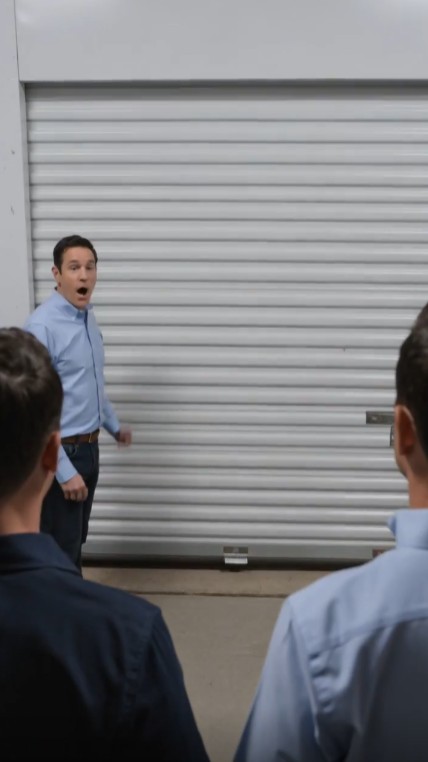
Thirty people showed up for the same storage-unit auction.
That alone was unusual.
The unit was in an older facility on the edge of town.
Nothing about it looked valuable.
No expensive furniture.
No boxes stacked to the ceiling.
No electronics.
When the metal door rolled upward, everyone could see almost the entire contents immediately.
One wooden chair.
One lamp.
Dozens of empty shelves.
That was it.
The auctioneer looked at the crowd.
“Opening bid: fifty dollars.”
Silence.
He tried again.
“Twenty-five?”
Nobody raised a hand.
The auctioneer frowned.
“You all came for this unit, didn’t you?”
Still nobody answered.
Then an elderly woman moved slowly through the crowd.
She wasn’t holding a bidder number.
She wasn’t registered.
She simply walked to the open doorway and stared inside.
Her eyes filled with tears.
“You found it.”
Everyone turned toward her.
The auctioneer lowered his clipboard.
“Ma’am, is this your unit?”
She shook her head.
“It used to be.”
A man near the front stepped forward.
“Are you Evelyn?”
The woman froze.
“How do you know my name?”
The man smiled.
“My family has been looking for you.”
Before Evelyn could answer, another bidder spoke.
“So has mine.”
Then another.
“And mine.”
Evelyn looked around at the thirty strangers.
“You all know me?”
They shook their heads.
“No.”
The auctioneer looked completely lost.
“Then why are thirty people here?”
A woman pointed toward the empty shelves.
“Because they weren’t always empty.”
Evelyn stared at her.
Then she slowly entered the unit.
She walked directly to the back wall.
No hesitation.
She crouched beside the lowest shelf.
Ran one hand underneath it.
Then pressed something hidden beneath the wood.
CLICK.
A narrow panel released.
The auctioneer stepped closer.
“What is that?”
Evelyn pulled the panel open.
Behind it was a hidden compartment running almost the entire length of the wall.
Inside were envelopes.
Hundreds of them.
Some yellowed with age.
Some newer.
Most carefully labeled with names and dates.
Everyone gasped.
The auctioneer stared.
“What is all that?”
Evelyn touched one envelope.
Then whispered:
“I wondered if anyone ever received them.”
A man standing behind her answered:
“We did.”
Evelyn turned slowly.
His name was Michael.
He looked to be in his fifties.
He held an old envelope in one hand.
“I received mine when I was twelve.”
Evelyn stared at it.
“You still have it?”
Michael nodded.
“My mother kept it.”
Another woman stepped forward.
“So did mine.”
Then another person.
Within seconds, nearly everyone in the crowd was holding something.
Old envelopes.
Photographs.
Small cards.
Receipts.
One man carried a faded school notebook.
Evelyn covered her mouth.
The auctioneer asked the obvious question.
“What did she send all of you?”
Michael smiled.
“Second chances.”
Twenty-eight years earlier, Evelyn had managed a small neighborhood assistance office.
Officially, it helped families fill out forms, apply for jobs and find temporary support.
Unofficially, Evelyn did much more.
She kept track of people quietly.
A father whose electricity was about to be shut off.
A teenager who couldn’t afford school supplies.
A widow who needed a deposit for a new apartment.
A young mechanic who needed tools to start working.
Evelyn rarely gave help directly.
She believed pride could make people refuse what they genuinely needed.
So she found other ways.
A store gift card would arrive anonymously.
A utility payment would be credited as an “adjustment.”
A child would receive a backpack through a “school program.”
A mechanic would discover a used tool set supposedly donated by someone moving away.
Michael looked at her.
“You made people think help just happened.”
Evelyn smiled weakly.
“Sometimes that made it easier to accept.”
The hidden compartment held the records.
Not financial records.
Stories.
Names.
Dates.
What each person needed.
What Evelyn arranged.
And one final note beside each:
Passed forward?
The auctioneer frowned.
“What does that mean?”
A woman named Teresa answered.
“She asked us to help somebody else when we could.”
Evelyn looked surprised.
“You knew?”
Teresa nodded.
“Not at first.”
When Teresa was fifteen, her family had almost been evicted.
Someone anonymously covered part of the overdue rent.
Years later, her mother received a letter.
No demand for repayment.
Just one sentence:
When you can, make somebody else’s difficult month easier.
Teresa’s mother eventually did.
She helped another family with groceries.
That family later helped someone with transportation.
The idea spread.
Not formally.
No organization.
No membership.
Just people helping the next person.
Michael looked around the storage unit.
“That’s why we’re here.”
Evelyn frowned.
“How did you find this place?”
Michael held up a photocopy.
It was one of Evelyn’s old handwritten notes.
At the bottom was the storage facility address.
For years, nobody paid attention to it.
Then one recipient died.
His daughter found the letter among his belongings and posted about it online.
Other people recognized the handwriting.
Stories began connecting.
Different families.
Different decades.
Same anonymous helper.
Eventually, someone discovered Evelyn’s name.
Then the old storage unit.
Word spread that the contents were being auctioned after years of unpaid fees.
Thirty people registered.
Not because they wanted whatever was inside.
Because they wanted to protect it.
Evelyn sat down on the wooden chair.
“I thought all of this was gone.”
Michael crouched beside her.
“Why did you disappear?”
Evelyn looked away.
Years earlier, the assistance office lost funding.
Then Evelyn’s husband became ill.
She left work to care for him.
After he died, she moved to live with her sister.
The storage unit remained.
At first she paid for it.
Then money became tight.
Eventually, letters from the facility stopped reaching her after another move.
She assumed the unit had been cleared long ago.
The auctioneer looked uncomfortable.
“If I’d known…”
Evelyn smiled.
“You couldn’t have.”
Then Michael remembered something.
“But there’s one person here who was never supposed to find out.”
The room went quiet.
Every person turned toward the same stranger standing near the entrance.
A man in his forties.
He looked startled.
“Me?”
Evelyn stared at him.
She didn’t recognize him.
Michael did.
“This is Daniel.”
Evelyn frowned.
“Should I know him?”
Daniel stepped forward.
“My mother was Anna Mercer.”
Evelyn’s face changed instantly.
“No.”
Daniel stopped.
“You knew her.”
Evelyn slowly stood.
Anna had been different from the others.
She wasn’t someone Evelyn helped once.
She had been Evelyn’s closest friend.
They worked together at the assistance office.
Anna helped identify families who needed support.
She delivered envelopes.
Made phone calls.
Invented harmless explanations for anonymous payments.
Most of the people in the room had received help from Evelyn.
But many of those acts had actually been carried out by Anna.
Daniel looked stunned.
“My mother never told me any of this.”
Evelyn whispered:
“She made me promise not to.”
“Why?”
Because Anna had grown up poor herself.
She hated the idea of anyone praising her for helping.
Whenever Evelyn suggested recording her name, Anna refused.
“People don’t need to know who helped them,” she would say.
“They just need to know somebody did.”
Daniel looked around at the thirty strangers.
“So all of you knew my mother?”
They shook their heads.
Michael answered.
“No.”
“But many of us are standing here because of something she did.”
Daniel’s eyes filled.
His mother had died seven years earlier.
He had always known her as practical.
Quiet.
Not particularly sentimental.
She worked.
Raised her family.
Paid bills.
Never talked much about the past.
Now he was standing in a storage unit full of people whose lives she had quietly touched.
Evelyn returned to the hidden compartment.
At the very back was a small metal box.
She opened it.
Inside was one envelope.
Daniel’s name was written on the front.
He stared.
“That’s mine?”
Evelyn nodded.
“Your mother made me write it.”
“When?”
“Years ago.”
Daniel opened it.
Inside was a letter from Anna.
If Daniel ever finds out about this, it means Evelyn broke her promise or I’m no longer there to complain.
Several people laughed softly through tears.
Daniel continued reading.
Anna wrote that she never wanted her son to think kindness required being extraordinary.
She didn’t want him building a monument to her.
She didn’t want speeches.
She wanted him to understand something simple.
Most of the things we did cost less than people imagine.
A ride.
A meal.
A phone call.
A few hours.
Sometimes people are not asking you to fix their life.
They just need help getting through Tuesday.
Daniel stopped reading.
Michael looked down.
That sentence had been written on several of the old notes too.
Daniel turned toward Evelyn.
“Why keep all these records?”
Evelyn smiled.
“Because your mother said one day I would convince myself none of it mattered.”
She pointed toward the hidden compartment.
“She told me to keep proof.”
The thirty people began sharing what happened after receiving help.
One had become a teacher and kept emergency school supplies for students.
Another ran a small repair shop and quietly fixed cars for struggling families.
A woman owned a bakery and gave leftover food to a shelter every evening.
Michael had started a fund at his workplace for employees facing emergencies.
None of them considered themselves part of anything.
Yet all had followed the same instruction.
Help the next person.
The auctioneer looked around.
“So what happens to the unit?”
Michael raised his bidder number.
“I’ll give fifty dollars.”
Teresa immediately lifted hers.
“One hundred.”
Someone else called:
“Two hundred.”
Evelyn laughed.
“You people refused to bid five minutes ago.”
Michael smiled.
“We didn’t know whether you were coming.”
The auctioneer understood.
They had planned to buy the unit together if Evelyn never appeared.
Not for the chair.
Not for the lamp.
For the hidden records.
In the end, the storage facility manager arrived and stopped the auction.
After hearing the story and confirming Evelyn’s identity, the company arranged for her to recover the personal materials through the proper process.
The thirty bidders still collected money.
But instead of buying the unit, they used it to restart something Evelyn thought had ended decades earlier.
They created a small community assistance fund.
No elaborate organization.
No publicity campaign.
People could nominate someone who needed a little help.
A utility bill.
Groceries.
Work shoes.
School supplies.
Just enough to get through a difficult moment.
They named it Tuesday.
Daniel laughed when he saw the name.
“My mother would’ve hated having her name on it.”
Michael smiled.
“That’s why we didn’t use it.”
The old hidden compartment was eventually removed from the storage unit.
Evelyn kept only one piece of it.
The small wooden panel with the concealed button.
Daniel asked why.
She smiled.
“Because for years, all those stories were hidden behind it.”
Months later, thirty-one people gathered at a community center.
The original bidders.
And Evelyn.
On the wall was one simple sign:
YOU DON’T HAVE TO FIX SOMEONE’S LIFE.
SOMETIMES YOU JUST HELP THEM THROUGH TUESDAY.
Daniel stood beneath it holding his mother’s letter.
For most of his life, he had believed Anna lived an ordinary life.
Now he understood that she had.
That was the point.
No fame.
No recognition.
No grand gestures.
Just one ordinary person helping another.
Then another.
And another.
Until decades later, thirty strangers stood inside an almost empty storage unit and discovered that the shelves had never really been empty at all.