
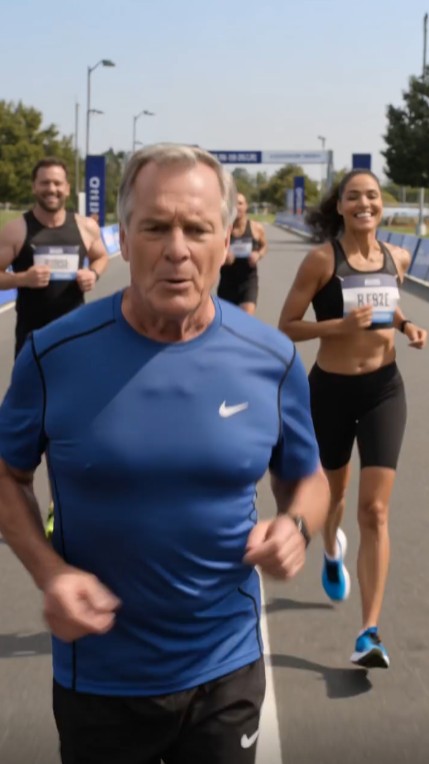
Seventy people entered the charity race that morning.
Thomas Reed was one of them.
At sixty-eight, he was older than most of the runners.
He wasn’t famous.
He wasn’t especially fast.
And as far as he knew, there was absolutely nothing unusual about the event.
The starting signal sounded.
Everyone ran normally.
Thomas settled into a comfortable pace.
Some runners passed him.
Others stayed behind.
Volunteers cheered from the roadside.
For most of the race, nothing seemed strange.
Then they reached the final stretch.
Thomas noticed the runner beside him slowing down.
Then another.
Then another.
Within seconds, people who had been ahead of him were deliberately dropping back.
Thomas looked over his shoulder.
“What’s happening?”
Nobody answered.
“Come on!”
A woman nearby simply smiled.
Thomas kept running.
The finish line was directly ahead.
He expected someone to sprint past him at any moment.
Nobody did.
Thomas crossed first.
Cheers erupted.
He stopped immediately and turned around.
“No. No, I didn’t win this.”
The woman behind him laughed.
“Yes, you did.”
Thomas shook his head.
“You all let me.”
Then he noticed something strange.
Every runner wore a different race number.
But in the lower corner of each number was the same tiny symbol.
A circle.
A short line through the center.
And three small marks beneath it.
Thomas stared.
“Where did you get that?”
The woman looked at him.
“You recognize it?”
Thomas nodded slowly.
“I drew that symbol when I was seventeen.”
The crowd became quiet.
Someone asked:
“What did it mean?”
Thomas looked embarrassed.
“Nothing important.”
He gave a small laugh.
“It was just something my friends and I used.”
The woman smiled.
“It stopped being ‘just something’ a long time ago.”
Thomas looked around.
Then she asked:
“Everyone here who has been affected by that symbol, raise your hand.”
Every runner did.
Thomas stared at them.
All seventy.
“I don’t know any of you.”
The woman answered:
“That’s exactly why you’re here.”
Thomas looked completely lost.
Then the race organizer approached carrying a clear protective folder.
Inside was an old sheet of paper.
Yellowed.
Folded.
Covered in faded handwriting.
He handed it to Thomas.
Thomas read the heading.
SUMMER RUN — 1975.
His expression changed.
“Where did you get this?”
The organizer pointed toward someone slowly approaching the finish line.
Thomas looked up.
An elderly man was walking toward them with the help of a cane.
Thomas stopped breathing for a moment.
“David?”
The man smiled.
“Still slow, I see.”
Thomas laughed.
Then covered his mouth.
He hadn’t seen David Collins in more than fifty years.
When they were seventeen, Thomas and David had been best friends.
They ran everywhere.
Not competitively.
They simply liked running.
Through parks.
Along river paths.
Across empty school fields.
One summer, they decided to organize a race.
There was no official permit.
No professional timing.
No medals.
Just seven teenagers who agreed to meet on a Saturday morning and run five miles.
Thomas drew a small symbol on the registration sheet.
The same symbol now printed on every runner’s number.
David pointed toward it.
“You remember what it meant?”
Thomas shook his head.
“I remember drawing it.”
David laughed.
“You really forgot?”
Thomas looked again.
Then something returned.
The circle represented a finish line.
The three marks represented three people running together.
And the line through the middle meant:
Nobody finishes alone.
Thomas stared at David.
“That’s what we said?”
“That’s what you said.”
Thomas smiled faintly.
The phrase had started as a joke.
During their first unofficial race, one boy named Peter twisted his ankle.
Thomas and David turned around.
Instead of continuing, they helped him walk to the finish.
The others came back too.
All seven crossed together.
Afterward, Thomas drew the symbol.
Nobody finishes alone.
For the rest of that summer, they used it everywhere.
On notebooks.
On homemade race cards.
On the side of an old wooden sign.
Then school ended.
Life moved on.
Thomas left town.
David stayed.
The group slowly lost contact.
Thomas eventually stopped running for years.
He married.
Raised children.
Worked as an electrician.
The little symbol disappeared from his life.
But not from David’s.
David kept the original registration sheet.
Then, years later, something happened.
His younger sister became seriously ill.
Friends organized a small charity run to help the family with expenses.
David used the old symbol on the race flyer.
Nobody finishes alone.
The fundraiser succeeded.
Afterward, another family asked to use the symbol for a community event.
Then a teacher used it for a school race supporting a student in need.
A local running club adopted it for charity events.
The symbol spread.
Not quickly.
Quietly.
One event at a time.
Thomas stared at the seventy runners.
“You’re telling me all of you came through those races?”
The woman beside him nodded.
Her name was Rachel.
“When I was twelve, my father lost his job.”
A charity race using that symbol helped their family pay rent for two months.
Another runner stepped forward.
“My daughter needed specialized equipment. People ran for her.”
Another:
“My wife was recovering from surgery. That community helped us.”
Another:
“I was the one running for someone else.”
One story became ten.
Then twenty.
Thomas listened in disbelief.
The symbol he had drawn at seventeen had become a quiet sign used by local charity races for decades.
It never became a major organization.
There was no national brand.
No famous campaign.
People simply kept using it.
Sometimes they knew the story.
Sometimes they didn’t.
But the phrase survived.
Nobody finishes alone.
Thomas looked at David.
“Why didn’t you ever tell me?”
David smiled.
“I tried.”
Thomas laughed.
“I moved three times.”
“And you were terrible at answering letters.”
“That’s true.”
David eventually stopped trying.
But he never stopped saving pieces of the old story.
The original registration sheet.
A photograph of the seven teenagers.
One of Thomas’s hand-drawn signs.
Then, six months earlier, David learned something.
Thomas had moved back to the area.
More importantly, he had entered the annual charity race.
David contacted the organizers.
When they heard the story, they decided to do something.
They found former race beneficiaries.
Volunteers.
Runners.
Families.
Seventy people signed up.
Every race number included Thomas’s old symbol.
But nobody told him.
Rachel looked toward the finish line.
“That’s why we slowed down.”
Thomas shook his head.
“You shouldn’t have.”
David laughed.
“Why not?”
“I didn’t earn first place.”
David tapped the old registration sheet.
“Neither did anyone in the first race.”
Thomas stared at him.
Then remembered.
All seven teenagers had crossed together.
David continued.
“This wasn’t about being fastest.”
Thomas looked at the crowd.
“Then why did you want me first?”
The race organizer answered.
“Because everyone standing here has crossed a finish line that started with something you drew.”
Thomas immediately shook his head.
“No.”
He pointed toward David.
“He kept it going.”
David smiled.
“And you started it.”
Thomas looked overwhelmed.
Then he noticed the original registration sheet again.
Seven names were written on it.
Thomas Reed.
David Collins.
Peter Hall.
James Monroe.
Alan Price.
Steven Ward.
Robert Ellis.
Thomas touched the page.
“What happened to everyone?”
David’s expression softened.
Some had moved away.
Two had died.
One could no longer travel.
Another had lost contact.
But David had found one more member of the original group.
The race organizer pointed toward the far side of the finish area.
Another elderly man was approaching.
He walked slowly.
Thomas stared.
“Peter?”
Peter smiled.
“Still got both ankles.”
Thomas laughed so hard he had to wipe his eyes.
Peter had been the boy who injured himself during that first race.
The boy whose accident created the phrase.
Nobody finishes alone.
Peter reached them.
Thomas hugged him.
Then looked around at the seventy runners.
“I still don’t deserve this.”
Rachel stepped closer.
“Maybe not as a race result.”
She smiled.
“But that’s not what today was.”
The organizer brought out a small wooden plaque.
Thomas immediately shook his head.
“No awards.”
David laughed.
“Read it first.”
Thomas looked down.
There was no mention of first place.
It simply showed the old symbol.
Underneath were four words:
STILL FINISHING TOGETHER — 51 YEARS.
Thomas stared at it for a long time.
Then something occurred to him.
“The others haven’t crossed yet.”
Everyone looked around.
Several runners were still farther down the course.
Some were walking.
One woman was helping another participant.
Thomas stepped away from the celebration.
“Where are you going?”
He looked back.
“We’re not finished.”
Rachel smiled.
Within seconds, dozens of runners turned around.
They walked back along the course.
Thomas joined them.
David and Peter remained near the finish.
Several minutes later, the final runner appeared.
She was exhausted.
Embarrassed.
“I’m sorry everyone had to wait.”
Thomas shook his head.
“No one’s waiting.”
He looked at the runners gathered beside her.
“We’re finishing.”
Together, they walked toward the line.
This time, Thomas didn’t cross first.
Nobody did.
Seventy runners stepped across together.
David watched from the side.
Peter laughed.
And Thomas finally remembered why he had drawn that strange little symbol more than half a century earlier.
It had never meant winning.
It meant turning around when someone needed you.
It meant slowing down.
Waiting.
Going back.
Making sure the person behind you still reached the line.
Fifty-one years after seven teenagers invented a race nobody remembered, the rule was still alive.
Nobody finishes alone.