
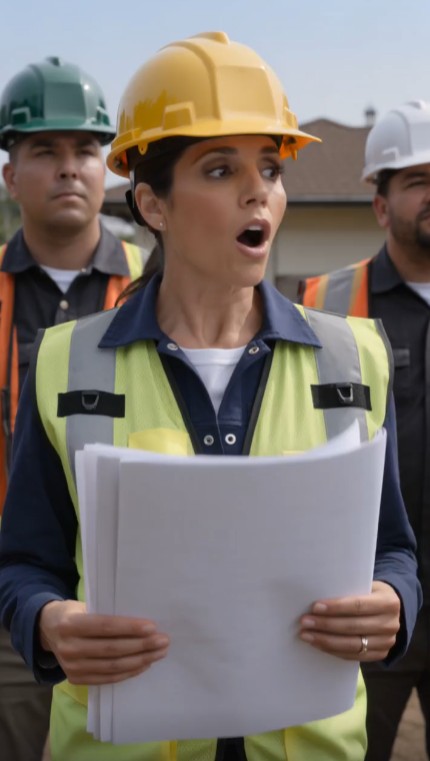
Thirty contractors arrived early Monday morning to demolish an old neighborhood playground.
By eight o’clock, the equipment was in place.
Work orders had been signed.
The city representative had already marked the area that needed to be cleared.
But when the time came to begin, nobody moved.
The representative looked around.
“What’s the problem?”
Silence.
“You already signed the work orders.”
Still nobody touched the equipment.
Finally, one contractor stepped forward.
His name was Michael.
“We’ll rebuild it.”
The representative frowned.
“That’s not the contract.”
“We know.”
“Then why are you refusing?”
Michael looked toward the fence.
An elderly man stood outside watching quietly.
He wore an old brown jacket and held a folded newspaper beneath one arm.
The city representative pointed.
“Who is he?”
Nobody answered.
The elderly man noticed everyone looking at him and slowly approached the gate.
“I’m sorry,” he said. “Am I causing a problem?”
Michael laughed.
“You seriously don’t remember us?”
The man looked confused.
“Should I?”
Then one by one, all thirty contractors removed their hard hats.
The elderly man stared at them.
“I don’t understand.”
Michael pointed toward the playground.
“You built this place.”
The man smiled.
“That was forty years ago.”
Michael shook his head.
“No.”
Then he pointed toward the workers.
“You built us.”
The smile disappeared from the old man’s face.
The contractors began saying their names.
Some he didn’t recognize.
Others seemed familiar.
Then one man stepped forward.
“Michael Turner.”
The old man froze.
“Michael?”
Michael nodded.
“You gave me my first toolbox when I was twelve.”
Another contractor stepped forward.
“You taught me how to use a level after school.”
Another:
“You helped me get my first summer job.”
Another:
“You showed me how to fix a broken fence instead of throwing it away.”
The elderly man looked around.
His name was Henry Lawson.
Forty years earlier, Henry had worked as a carpenter.
The neighborhood had almost no public spaces for children.
The city had approved a small playground, but the budget was limited.
Henry volunteered to help build it.
At first, it was supposed to take a few weekends.
Instead, it became a two-year project.
Henry convinced local businesses to donate lumber.
He repaired used equipment.
He built benches himself.
Then something unexpected happened.
Children began showing up while he worked.
At first, they simply watched.
Then Henry started letting them help with safe, simple tasks.
Holding measuring tape.
Sorting screws.
Painting boards.
Learning the names of tools.
Michael had been one of those children.
His father had recently left the family.
Money was tight.
Michael spent most afternoons wandering the neighborhood because he didn’t want to go home to an empty apartment.
Henry noticed.
Instead of sending him away, he handed him a small wooden toolbox.
“Every builder needs one.”
Michael still had it.
He opened the back of his truck and brought it out.
The wood was scratched.
The metal latch was rusty.
But Henry immediately recognized it.
“You kept that?”
“For thirty-eight years.”
Henry laughed.
Then his eyes filled.
Michael wasn’t the only one.
Several other contractors had similar stories.
Henry had never created an official program.
There were no registrations.
No classes.
No certificates.
He simply taught whichever child happened to be around.
Some came for a week.
Others returned for years.
He taught them how to measure twice.
How to repair things.
How to finish what they started.
How to show up on time.
But most importantly, according to Michael, Henry treated them like they were useful before anyone else did.
One contractor named Daniel spoke.
“My teachers thought I was trouble.”
Henry looked at him.
Daniel smiled.
“You told me I was impatient, not useless.”
Henry laughed.
“That sounds like something I’d say.”
Daniel had eventually become an electrician.
Another boy Henry remembered as shy and awkward now ran a roofing company.
One owned a plumbing business.
Several had become carpenters.
Others worked in concrete, landscaping, engineering and building inspection.
Not every child from those afternoons had gone into construction.
But thirty of them had.
And now, four decades later, all thirty had somehow ended up on the same demolition project.
Henry looked toward the playground.
“But why are you all here?”
Michael answered.
“We heard they were tearing it down.”
Henry sighed.
“It’s old.”
He looked at the rusted equipment and worn wooden structures.
“Maybe it’s time.”
Michael shook his head.
“That’s why we’re not saving the old playground.”
Henry frowned.
“Then what are you doing?”
Michael turned toward the contractors.
They walked together toward a large construction sign near the gate.
It had been covered by a blue tarp.
The city representative looked confused.
“I didn’t approve that sign.”
Michael smiled.
“Not yet.”
The contractors pulled the cover away.
Henry read the first line.
HENRY LAWSON COMMUNITY PLAYGROUND
He immediately sat down on the nearest bench.
“No.”
Michael smiled.
“Yes.”
Henry wiped his eyes.
“I don’t want my name on it.”
“Keep reading.”
Beneath the first line was another.
BUILT BY THE CHILDREN HE TAUGHT — FOR THE CHILDREN THEY HAVEN’T MET YET.
Henry stared at the words.
That second line broke him.
He covered his face with both hands.
Michael sat beside him.
“You thought this place was just a playground.”
Henry looked around.
“What else was it?”
“For a lot of us?”
Michael pointed toward the thirty workers.
“It was the first place somebody trusted us with something.”
The plan had started months earlier.
When the demolition contract was announced, Michael recognized the address immediately.
He contacted a few people from the old neighborhood.
They contacted others.
Soon they had found dozens of adults who remembered Henry.
Thirty of them worked in trades.
Together, they developed another plan.
They would still remove the unsafe playground.
But instead of simply clearing the lot, they wanted to donate labor and materials toward a new one.
The city representative crossed his arms.
“You can’t just rewrite a municipal project because you feel like it.”
Michael nodded.
“We know.”
“So what exactly are you proposing?”
One contractor handed him a folder.
Inside were engineering drawings.
Insurance documents.
Material commitments.
Safety plans.
Letters from neighborhood businesses.
A fundraising pledge.
Everything needed to submit a formal rebuilding proposal.
The representative stared at the documents.
“You already prepared all this?”
“For six months.”
Henry looked shocked.
“You planned this before you even knew you had the demolition contract?”
Michael laughed.
“We made sure one of us got it.”
Over the following weeks, the city reviewed the proposal.
Several details had to be changed.
Modern playground standards were stricter.
The old wooden structures couldn’t simply be recreated.
Accessibility had to be improved.
New safety surfacing was required.
But eventually, the plan was approved.
The old playground came down.
Henry insisted on being there.
He watched Michael remove the same wooden climbing frame they had built together decades earlier.
For a moment, Henry looked sad.
Michael noticed.
“You okay?”
Henry nodded.
“Just strange watching something disappear.”
Michael pointed toward the construction plans.
“It’s not disappearing.”
Then the rebuilding began.
Each contractor took responsibility for one part.
Concrete.
Electrical.
Fencing.
Drainage.
Landscaping.
Shade structures.
Benches.
The project quickly attracted attention from former neighborhood families.
Donations arrived.
Some were small.
Twenty dollars.
Fifty dollars.
One retired teacher donated enough for several new trees.
A restaurant provided lunches for the crew.
A hardware store supplied materials.
Henry tried to work too.
Michael refused to let him lift anything heavy.
So Henry did what he had always done.
He taught.
Teenagers from the neighborhood began stopping by the construction fence.
Henry answered questions.
Eventually, the crew established supervised workshops where older students could learn basic trade skills safely.
How to read a tape measure.
How to use hand tools.
How to plan a project.
How different trades worked together.
Michael watched Henry with a group of teenagers one afternoon.
Henry was explaining why a board had been measured twice.
Michael laughed.
“What?”
Henry looked at him.
“You taught me that exact lesson.”
“Then apparently it worked.”
Months later, the new playground opened.
It looked nothing like the old one.
It was safer.
Larger.
Fully accessible.
There were shaded seating areas.
New trees.
A small climbing structure.
A paved path.
And beside the entrance stood one simple display.
Not a statue.
Henry had refused that immediately.
Instead, the display held an old wooden toolbox.
Michael’s first toolbox.
Beside it was a short explanation.
Forty years ago, a carpenter built a playground and let neighborhood children help.
Some of those children became builders.
They came back to build the next one.
Henry stood in front of it for a long time.
Then he noticed something.
There was an empty shelf beneath the toolbox.
“What’s that for?”
Michael smiled.
“We’re waiting.”
“For what?”
“The next toolbox.”
Henry laughed.
Opening day brought hundreds of people.
Children ran toward the equipment.
Parents filled the benches.
Several of Henry’s former students brought their own children and grandchildren.
Then Michael handed Henry a small object.
A brand-new child-sized wooden toolbox.
Henry stared at it.
“What am I supposed to do with this?”
Michael pointed toward a twelve-year-old boy standing near the workshop demonstration area.
The boy had been there almost every afternoon during construction.
His mother worked late.
He loved watching the crew.
Henry smiled.
He understood.
He walked toward the boy.
“Do you know how to use a tape measure?”
The boy shrugged.
“A little.”
Henry handed him the toolbox.
“Then we’ll start there.”
Michael watched from a distance.
Forty years earlier, Henry had believed he was building swings, benches and climbing equipment.
He never realized he was also building confidence.
Careers.
Friendships.
People.
And decades later, when thirty contractors refused to destroy the place where it all began, they weren’t trying to preserve old wood.
They were preserving the one thing Henry had taught them that never wore out:
If someone trusts you enough to teach you how to build, eventually you build something for the next person.