
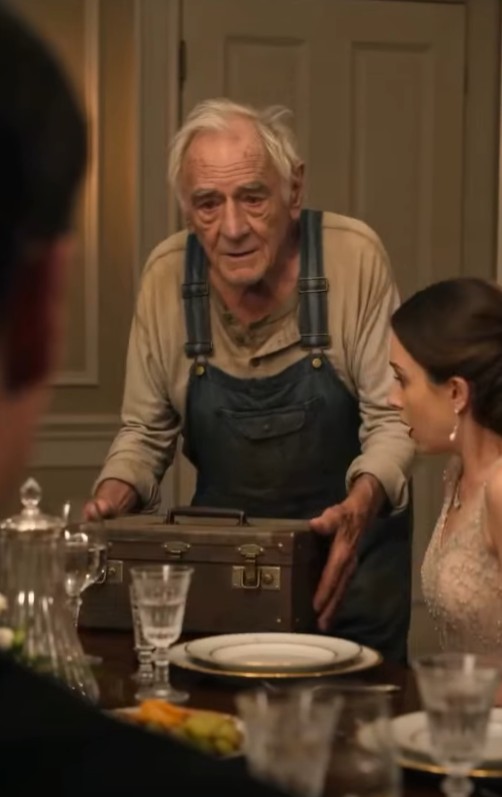
Everyone at the rich family dinner laughed when the old gardener walked into the dining room.
His boots were muddy.
His jacket was torn.
And he still had dirt beneath his fingernails.
The millionaire’s son stood immediately.
“You don’t belong in here.”
The gardener ignored him.
He looked toward the young woman sitting quietly at the far end of the table.
“I came for her.”
The room went silent.
Her name was Anna.
Twenty-eight years old.
And only minutes earlier, her stepmother, Victoria, had announced that the family estate would be sold.
The mansion.
The land.
The gardens.
Everything.
Anna would receive almost nothing.
Victoria claimed Anna’s late father had transferred control of the estate to her before he died.
The family lawyer had been invited to dinner to discuss the sale.
Anna had spent most of the evening fighting tears.
Her father had always told her one thing.
“This house belongs to your future.”
But he had died seven years earlier.
No one had ever found a final will saying that.
Now the gardener stepped forward.
His name was Samuel.
He had worked on the property for nearly thirty years.
Most members of the family barely noticed him.
He trimmed hedges.
Repaired fences.
Planted roses.
Opened the greenhouse every morning.
To them, he was simply staff.
Samuel placed a rusty metal box on the table.
Victoria went pale.
Anna noticed immediately.
“What is that?”
Samuel looked at her.
“Your father buried this before he died.”
The millionaire’s son, Richard, laughed.
“This is ridiculous.”
Samuel didn’t react.
He took an old key from around his neck.
Inserted it into the box.
And turned it.
Inside were three things.
A wedding photograph.
Another smaller key.
And a sealed envelope.
The lawyer at the table, Mr. Harris, slowly stood.
“May I?”
Samuel nodded.
The envelope had Anna’s father’s signature across the seal.
Mr. Harris opened it carefully.
Inside was a handwritten document.
He read the first page.
Then the second.
His expression changed.
Victoria gripped the edge of the table.
“What does it say?”
The lawyer did not answer immediately.
He checked the signature.
Then looked toward Anna.
“The estate was never hers to sell.”
No one moved.
Anna covered her mouth.
Richard stood.
“That’s impossible.”
Mr. Harris looked at him.
“Sit down.”
The document was a will.
Not the one the family had been using.
An earlier notarized copy of the same provisions was later found with Anna’s father’s former attorney.
The handwritten version in the box contained additional instructions explaining why he had hidden it.
The core message was clear.
The family estate was intended for Anna.
Not Victoria.
Not Richard.
Anna.
The mansion.
The original farmland.
The greenhouse.
And the adjoining cottages.
Everything her father had owned before his second marriage was to pass to his daughter.
Victoria’s voice shook.
“He changed that.”
Samuel looked at her.
“No.”
She turned toward him.
“You know nothing about this family.”
Samuel finally raised his voice.
“I knew her father before you did.”
The room became quiet again.
Anna stared at him.
Samuel had always seemed private.
She remembered him from childhood.
He taught her how to plant tomatoes.
How to tell when roses needed pruning.
How to rescue earthworms after heavy rain.
But she had never known he and her father were close.
Samuel looked at Anna.
“Your father was my best friend.”
Richard laughed again.
“A gardener?”
Samuel turned toward him.
“Yes.”
That ended the laughter.
Anna’s father, David, had met Samuel when they were teenagers.
David’s family owned the estate.
Samuel’s father worked on it.
The boys grew up together anyway.
They fished in the river.
Fixed old tractors.
Got into trouble.
And years later, when David inherited the property, Samuel became head gardener.
Not because he had nowhere else to go.
Because he loved the land.
David trusted him completely.
Samuel pointed toward the wedding photograph inside the box.
Anna picked it up.
It showed her parents.
David and Anna’s mother, Elena.
They were standing beneath the old oak tree behind the mansion.
Samuel stood beside them.
Smiling.
Anna had never seen the picture.
“You were at their wedding?”
Samuel nodded.
“I was your father’s witness.”
Anna stared.
Victoria looked increasingly uncomfortable.
Seven years earlier, when David became ill, tensions in the family had grown.
Victoria had married him late in life.
Richard was her son from a previous marriage.
At first, everything seemed normal.
Then David’s health declined.
Victoria began handling more financial matters.
Banking.
Appointments.
Property documents.
David became worried.
He told Samuel that several papers had appeared for his signature that he did not understand.
Samuel urged him to call his lawyer.
David did.
But then things became complicated.
One week later, David quietly asked Samuel to meet him near the greenhouse.
He carried the metal box.
“He told me to bury it.”
“Why?” Anna asked.
Samuel answered:
“Because he was afraid the papers in the house would disappear.”
Anna looked toward Victoria.
She said nothing.
Samuel continued.
David placed the will inside.
The photograph.
And a key.
Then told him:
“If Anna ever needs proof, give this to her.”
Samuel buried it beneath an old stone bench near the greenhouse.
Anna frowned.
“Why wait seven years?”
Samuel looked ashamed.
“Because your father gave me instructions.”
The estate, he said, was supposed to remain intact until Anna turned twenty-eight.
David did not want her pressured into selling while she was younger.
He believed Victoria would try.
So Samuel was told to wait.
If the estate remained safe, do nothing.
But if someone attempted to sell it once Anna reached twenty-eight, bring the box.
Anna’s birthday had been three weeks earlier.
Tonight was the first time Victoria formally announced the sale.
Samuel came immediately.
Richard slammed his hand against the table.
“This is nonsense.”
Mr. Harris looked up from the will.
“It may not be.”
Then he pointed toward the smaller key.
“What does this open?”
Samuel looked at Anna.
“Your father’s old study cabinet.”
Victoria froze.
The study had been locked for years.
She claimed the key was lost.
It wasn’t.
Samuel had it.
Everyone moved to the study.
The old cabinet stood behind a bookshelf.
Anna inserted the key.
The lock opened.
Inside were files.
Letters.
Property records.
And copies of correspondence between David and his attorney.
Mr. Harris started reading.
Within twenty minutes, the story changed again.
David had indeed been concerned about changes to his estate plan.
Several documents showed that Victoria had encouraged him to sign a new property transfer.
But those papers had never been completed properly.
One lacked a witness.
Another contained terms David had crossed out.
A third had never been filed.
The legal position was more complicated than one hidden handwritten will.
So Mr. Harris did not declare Anna the owner on the spot.
Instead, he stopped the planned sale.
Immediately.
The following morning, outside estate lawyers were brought in.
The documents were authenticated.
Old legal files were recovered.
Witnesses were contacted.
Then a notarized will matching the one Samuel had preserved was found in an archived office file.
That document settled the central question.
Anna was the primary heir to the original estate.
Victoria had rights to certain personal assets and financial provisions.
But she did not own the mansion.
She could not sell it.
Richard had no ownership claim to the land at all.
The legal review lasted several weeks.
During that time, Anna spent more time with Samuel than she had in years.
One afternoon, they walked through the gardens.
Anna asked:
“Did Dad really trust you more than his own family?”
Samuel shook his head.
“Not more.”
“Differently.”
“What does that mean?”
“He knew I didn’t want anything from him.”
Samuel pointed toward the trees.
“I already had what I wanted.”
“The work?”
“The place.”
He smiled.
“Some people need their name on land to feel like it belongs to them.”
“I didn’t.”
Anna understood.
Samuel had spent most of his life caring for land he never expected to own.
That made him the perfect person to protect it.
Then Anna asked the question that had bothered her.
“Did you know Victoria was trying to change everything?”
Samuel sighed.
“I knew your father was afraid she might.”
“That’s different.”
“Yes.”
He never claimed more than he knew.
That mattered.
The evidence had to stand on its own.
Eventually, it did.
The planned sale was canceled.
Anna officially took control of the estate months later.
But she made one decision immediately.
Samuel would no longer be called “the gardener.”
Not because there was anything wrong with the work.
Because the title had become a way the family dismissed him.
Anna appointed him estate grounds director.
He hated the title.
“Sounds expensive.”
Anna laughed.
“You are expensive now.”
He shook his head.
“I’m still planting roses.”
“Then plant them with authority.”
For the first time in months, Anna felt like herself again.
Victoria moved out after the estate matter was settled.
Richard stopped visiting.
There was no dramatic scene.
No locked doors.
No guards chasing anyone.
Just lawyers.
Documents.
Signatures.
And the truth slowly replacing a story everyone had accepted because the people telling it were wealthier and louder.
Anna did not sell the mansion.
But she did not keep it frozen in the past either.
She opened part of the grounds to the public.
The greenhouse became a community gardening center.
Several unused cottages became affordable housing for estate staff and local families.
Samuel helped design everything.
One day, Anna found him beside the old stone bench.
The place where he had buried the box.
He was holding the rusty key.
“You kept that?”
He nodded.
“Your father told me to.”
“The box is empty now.”
“I know.”
“Then what does it open?”
Samuel smiled.
“Nothing.”
Anna laughed.
“Why keep it?”
He looked toward the mansion.
“Because sometimes a key matters before you know what it opens.”
Anna rolled her eyes.
“That sounds like something Dad would say.”
“It was.”
She became quiet.
Then Samuel handed it to her.
“He told me this part too.”
“What?”
“When everything is settled, the key belongs to Anna.”
She took it.
For seven years, Samuel had kept the box hidden.
He had watched people walk past him.
Order him around.
Talk over him.
Treat him as if he were invisible.
He said nothing.
Because he had promised David he would not speak until the moment mattered.
And when it finally did, he walked into the dining room in muddy boots carrying a rusty box.
Everyone laughed.
Then the box opened.
And suddenly the poorest-looking man at the table was the only person carrying the truth.
Years later, Anna framed the old wedding photograph from the box.
Beside it, she placed a second picture.
Her father and Samuel as young men.
Both covered in dirt.
Both laughing beside a broken tractor.
Underneath she wrote:
Some people inherit property.
Others inherit trust.
And sometimes the person everyone treats like a servant is the one who quietly protects what an entire family is about to lose.