
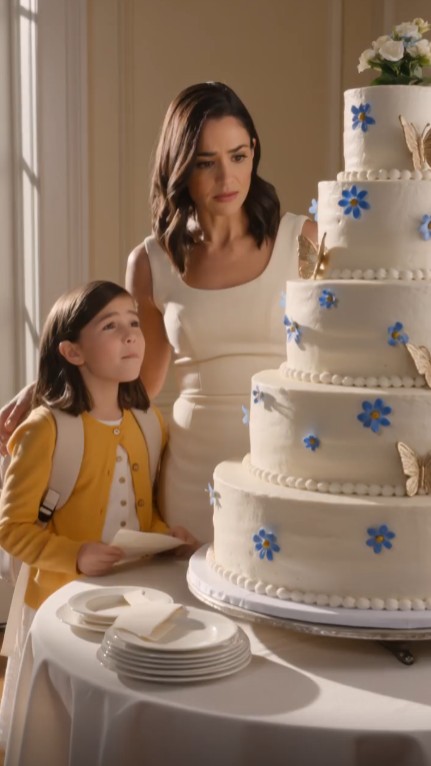
An eight-year-old girl walked into a wedding hall and stopped so suddenly that her mother nearly bumped into her.
“Mom…”
Her name was Lily.
She was staring toward the center of the reception room.
“Mom, you drew that cake.”
Her mother, Anna, laughed.
“Sweetheart, I’ve never seen that cake before.”
Lily didn’t move.
She pointed.
On a decorated table stood an enormous white wedding cake.
Three tiers.
Tiny blue flowers.
A golden butterfly on top.
And one flower near the bottom painted upside down.
Lily looked at her mother.
“You did.”
Anna’s smile slowly disappeared.
Because now she saw it too.
Years earlier, long before Lily could remember much, Anna had gone through a period when she drew wedding cakes constantly.
She had once dreamed of becoming a pastry designer.
But life changed.
Work.
Bills.
Single motherhood.
Eventually the drawings disappeared into notebooks and boxes.
One design had always stood out.
Three white tiers.
Blue flowers.
A golden butterfly.
And one upside-down flower Anna had accidentally drawn while talking on the phone.
She never fixed it.
Lily loved that drawing.
She had found it in an old notebook and carried a folded copy in her backpack for months.
Anna stepped closer to the cake.
“No.”
Every detail matched.
Not almost.
Exactly.
The wedding coordinator noticed their expressions.
“Is everything okay?”
Anna pointed toward the cake.
“Who ordered this?”
The coordinator smiled uncertainly.
“The bride’s family, I assume.”
“Can you check?”
Something in Anna’s voice made her stop.
The coordinator walked to a small desk and opened the event file.
She searched through several envelopes.
Then frowned.
“That’s strange.”
“What?”
“This cake wasn’t ordered by the bride.”
Anna stared.
The coordinator checked the paperwork again.
“It was prepaid eighteen months ago.”
Anna shook her head.
“That doesn’t make sense.”
Lily suddenly opened her backpack.
“Look.”
She pulled out a folded piece of paper.
Anna recognized it immediately.
Her old drawing.
Lily handed it to the coordinator.
The woman unfolded it.
Then looked at the cake.
Then back at the drawing.
Her face changed.
“Where did you get this?”
“My mom drew it.”
The coordinator looked at Anna.
“When?”
“Almost nine years ago.”
The woman sat down.
“The person who ordered this cake gave very specific instructions.”
Anna felt something cold move through her stomach.
“What instructions?”
“She said the design could not be changed.”
“Not the colors.”
“Not the butterfly.”
“Not even the upside-down flower.”
Lily smiled.
“That was Mom’s mistake.”
The coordinator did not smile.
She opened the original order envelope.
Inside was a photograph.
Not of the cake.
Of Anna.
Much younger.
Standing outside a small bakery.
Anna took one look and covered her mouth.
“That’s impossible.”
The photograph had been taken more than ten years earlier.
She remembered the day.
She had been twenty-two.
Standing outside the bakery where she worked weekends while studying.
Beside her was another woman.
Older.
Thin.
Smiling.
Anna whispered:
“Margaret.”
Lily looked up.
“Who’s Margaret?”
Anna sat down.
For years, she had avoided telling Lily much about that period of her life.
Margaret had been the owner of the bakery.
But she had been more than Anna’s employer.
She had been the first person to take Anna’s drawings seriously.
Anna came from a family where creative work was considered impractical.
Her parents wanted her to find a stable office job.
Margaret disagreed.
Every Saturday morning, after the bakery opened, she taught Anna.
How to pipe flowers.
How to shape sugar decorations.
How to balance a cake.
How to turn a sketch into something real.
One afternoon, Anna showed her the drawing of the three-tier wedding cake.
Margaret studied it.
Then laughed.
“One flower is upside down.”
Anna groaned.
“I know.”
“Leave it.”
“Why?”
“Because perfection is boring.”
That became a joke between them.
Margaret kept the original sketch pinned inside the bakery office for years.
Then everything changed.
Margaret became ill.
The bakery closed.
Anna was pregnant with Lily.
Money became tight.
She stopped thinking about pastry work and focused on survival.
She visited Margaret several times during her illness.
Then Margaret moved away to live with relatives.
They lost contact.
Anna later heard that she had died.
That was nearly eight years ago.
Anna looked at the photograph again.
“If Margaret died, who ordered the cake?”
The coordinator reached into the envelope.
“There’s more.”
Inside was a handwritten note.
The coordinator read it first.
Then slowly handed it to Anna.
Across the top were the words:
For Anna, if she comes.
Anna’s hands began shaking.
She unfolded it.
The handwriting was unmistakable.
Margaret.
Anna,
If you are reading this, then Lily recognized the cake.
I hope she did.
Anna stopped.
Lily moved closer.
“What does it say?”
Anna continued.
You once told me that if you ever had a daughter, you wanted her to know there had been a version of you who dreamed without being afraid of whether the dream was practical.
I remembered.
Anna pressed the paper against her mouth.
She had forgotten saying that.
Margaret hadn’t.
The message continued.
I also knew you would probably put yourself last once Lily arrived.
You always did that with people you loved.
So I arranged something you couldn’t easily talk yourself out of.
This cake was ordered for the first wedding held here after Lily turned eight.
Anna looked at the coordinator.
“Why eight?”
The coordinator pointed toward the bottom of the page.
Anna read on.
Because eight is old enough to remember a cake.
And old enough to ask her mother why she stopped drawing them.
Lily stared at her.
“Mom?”
Anna started crying.
The coordinator explained.
Margaret had made the arrangement shortly before she died.
She knew the owner of the wedding venue.
Years earlier, they had worked together.
Margaret paid for one elaborate cake in advance with very unusual instructions.
The design had to match Anna’s sketch exactly.
The cake did not belong to Anna.
It still belonged to that day’s bride and groom.
Margaret had simply paid for it as a gift.
But she had asked the coordinator to watch for Anna if she ever appeared at an event there.
“How would she know I’d be here?”
The coordinator smiled.
“She didn’t.”
Margaret had simply hoped.
Anna was attending the wedding because the bride was a former coworker.
Pure chance had placed her inside the room on exactly the right day.
But there was still something stranger.
The note was addressed to Lily.
Anna turned it over.
On the back was another message.
Lily,
I probably never met you.
But your mother talked about you before you even existed.
She said if she ever had a little girl, she would teach her that mistakes did not ruin beautiful things.
That is why the upside-down flower stayed.
Lily looked toward the cake.
Then back at Anna.
“What does that mean?”
Anna laughed through tears.
“It means I used to say a lot of dramatic things.”
The note continued.
Your mother once wanted to make beautiful things for people.
Maybe she still does.
Do not let her tell you she is too old.
And do not let her fix the upside-down flower.
Some mistakes deserve to stay because they remind us where the story started.
Anna could barely finish reading.
At the bottom was one final sentence.
P.S. — The real surprise is in the bakery box beneath the table.
Everyone looked down.
The coordinator crouched.
There was a small white box beneath the cake table.
It had been placed there that morning with instructions that it remain sealed unless Anna appeared.
The coordinator handed it to her.
Inside was an old pastry notebook.
Margaret’s.
Anna opened it.
Recipes filled the pages.
Measurements.
Corrections.
Notes.
But halfway through was something else.
Anna’s old cake sketches.
Margaret had kept them.
Every one.
Beside each drawing, she had written comments.
Good structure.
Too many flowers.
Try this in ivory.
This one is worth making.
Then Anna reached the three-tier cake design.
Beside it, Margaret had written:
Anna’s first real design.
Do not correct the flower.
Underneath that:
When she is ready, give this back to her.
Anna sat silently for several minutes.
Lily leaned against her.
“Mom, why did you stop making cakes?”
Anna looked at the wedding cake.
The answer seemed embarrassing now.
Life.
Fear.
Money.
Exhaustion.
The feeling that creative dreams belonged to younger people with fewer responsibilities.
“I thought I had to.”
Lily frowned.
“Do you still know how?”
Anna laughed.
“Probably badly.”
The coordinator heard her.
“Actually, there’s something else you should know.”
Anna looked up.
The bakery that had created the wedding cake belonged to one of Margaret’s former apprentices.
His name was Samuel.
He had received Margaret’s instructions years earlier.
When the venue finally called eighteen months ago to activate the prepaid order, Samuel personally recreated Anna’s design from the original sketch.
He even copied the upside-down flower.
The coordinator called him.
He arrived before the reception began.
Anna recognized him immediately.
Samuel had worked at Margaret’s bakery when Anna was young.
He stared at her.
“You finally saw it.”
Anna hugged him.
Then immediately apologized because they barely knew each other.
Samuel laughed.
“Margaret would have complained if you didn’t.”
He showed Anna photographs from the bakery.
One wall contained framed sketches by former apprentices.
Anna’s design was among them.
“She talked about you?” Anna asked.
“All the time.”
Samuel smiled.
“She said you were the most talented person she ever met who could talk herself out of anything.”
Anna laughed.
“That sounds like her.”
The wedding itself continued.
The bride eventually learned why several strangers were crying beside her cake.
Instead of being upset, she asked Anna to come forward before the cutting.
“This apparently has more history than my dress.”
Guests laughed.
The bride gave Anna the first slice.
Lily immediately inspected it.
“Does it taste like your drawing?”
Anna laughed.
“No idea.”
Then she tasted it.
Vanilla.
Lemon.
A light almond filling.
Anna froze.
Samuel noticed.
“What?”
“That was Margaret’s favorite.”
He nodded.
“Of course it was.”
Several weeks later, Lily came home from school and found flour all over the kitchen.
Anna stood beside the counter.
A cake leaned slightly to one side.
The frosting was uneven.
Lily stared.
“You made one!”
Anna looked embarrassed.
“I’m practicing.”
Lily walked around it.
Then pointed.
“You forgot something.”
“What?”
She took a piping bag.
Carefully made one tiny flower.
Upside down.
Anna laughed so hard she had to sit down.
That became their tradition.
Anna did not immediately quit her job and become a famous baker.
Life was not that simple.
She practiced on weekends.
Took a certification course.
Helped Samuel occasionally at his bakery.
Made birthday cakes for friends.
Then small wedding cakes.
Two years later, she opened a tiny studio.
She named it Blue Butterfly Cakes.
Her logo?
Three blue flowers.
One upside down.
And a small golden butterfly above them.
Lily kept Margaret’s note.
When people asked what the upside-down flower meant, she gave different answers depending on her mood.
Sometimes:
“It means mistakes can still be beautiful.”
Sometimes:
“It means my mom is stubborn.”
But Anna knew what it really meant.
It was proof that someone had remembered a dream after she herself had stopped remembering it.
Margaret had not known whether Anna would ever see that wedding cake.
She did not know whether Lily would recognize it.
She could not control when or how the message arrived.
All she could do was leave behind a design.
A notebook.
A note.
And one deliberate mistake.
Years later, Anna would still say the strangest part was not that the cake looked exactly like her drawing.
It was that Lily noticed first.
An eight-year-old child looked across a crowded wedding hall and recognized a dream her mother had abandoned before she was even born.
Then she pointed at it and said:
“Mom, you drew that.”
And suddenly Anna remembered that once, a long time ago, she had believed she could.