
Cooper ignored almost every toy in the shelter.
Squeaky balls.
Ropes.
Stuffed animals.
Puzzle feeders.
He was gentle.
Calm.
Easy to handle.
But nothing seemed to interest him for long.
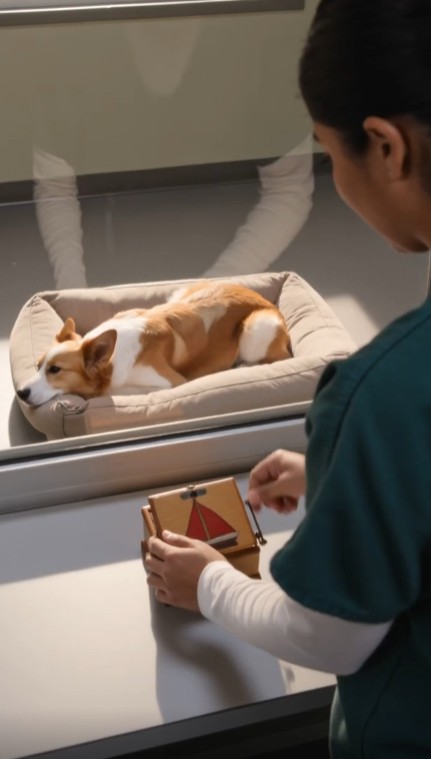
Then one afternoon, a caretaker named Emma carried a small wooden music box into the enrichment room.
It had arrived in a donation box the day before.
The moment she opened it, a soft melody began to play.
Cooper lifted his head.
His ears moved forward.
He stood.
Then slowly walked toward the sound.
Emma froze.
She had never seen him react like that.
Not to music from the radio.
Not to bells.
Not even to the familiar noises of feeding time.
But this melody was different.
Cooper stopped beside the table.
Then sat.
Quietly.
Listening.
Emma called the shelter manager.
“Daniel, you need to see this.”
Daniel entered.
“What happened?”
She wound the music box again.
The melody started.
Cooper immediately looked toward it.
Daniel frowned.
“Where did that come from?”
“Donation.”
He picked up the little wooden box.
On the lid was a painted red sailboat.
Daniel suddenly stopped.
“I’ve seen this before.”
Emma looked confused.
“Where?”
He hurried to the office.
Then opened Cooper’s historical records.
Cooper had arrived nearly eighteen months earlier.
His paperwork was incomplete.
He had been transferred through two different rescue groups after his owner could no longer keep him.
Daniel searched old intake photographs.
Then stopped.
There it was.
Cooper.
Much younger.
Curled up on a soft blanket.
Beside him sat the exact same wooden music box.
Red sailboat and all.
Emma covered her mouth.
“That was his old home?”
Daniel nodded.
Apparently.
The photograph had been submitted during Cooper’s first rescue intake.
But no one at the current shelter had ever noticed the music box in the corner.
Emma looked toward the enrichment room.
“So he remembers it?”
Daniel answered carefully.
“Maybe the melody.”
“Maybe the object.”
“Maybe just something familiar associated with his old routine.”
They did not want to turn one reaction into a magical story.
But the connection was real.
Daniel opened the donation record.
Then stopped again.
“Wait.”
Emma leaned closer.
“What?”
“The donor asked us not to contact them.”
“That’s strange.”
There was a photograph attached to the volunteer registration connected to the donation.
Emma recognized the person immediately.
A woman named Laura.
She had started volunteering at the shelter six weeks earlier.
Every morning, she walked past Cooper’s enclosure.
And every morning, she kept going.
She never stopped.
Not once.
Emma stared.
“That’s her?”
Daniel nodded.
Laura was listed as the donor.
Emma looked confused.
“If she knew Cooper, why wouldn’t she visit him?”
Daniel checked Cooper’s older file.
Then everything became clearer.
Laura had been Cooper’s owner.
Years earlier, she lived with her elderly father, Michael.
Cooper belonged to both of them.
Michael had built the music box by hand.
The red sailboat came from a story he used to tell Laura when she was a child.
Every evening, shortly before bed, he wound the box.
The melody played.
Cooper usually curled up nearby.
It became part of the household routine.
Then Michael became ill.
Laura became his full-time caregiver.
Money disappeared quickly.
Work became difficult to maintain.
After Michael died, Laura lost the house.
She moved into temporary accommodation that did not allow animals.
For months, she tried to find another solution.
Friends.
Relatives.
Affordable pet-friendly housing.
Nothing worked.
Eventually, she surrendered Cooper through a rescue organization.
The decision devastated her.
She asked one thing.
Please find him a stable home.
Cooper moved between foster placements.
Then shelters.
None became permanent.
Over time, Laura lost track of where he had gone.
She assumed he had been adopted.
Years passed.
Then, six weeks earlier, she applied to volunteer at Daniel’s shelter.
On her first morning, she walked through the kennel corridor.
And saw Cooper.
Older.
Gray around the muzzle.
But unmistakably Cooper.
She stopped.
He looked toward her.
Laura immediately turned away.
She spent the rest of the shift fighting tears.
Daniel eventually found notes from another volunteer.
“Laura avoids kennel 14.”
Kennel 14 was Cooper.
Emma whispered:
“She knew the whole time.”
Daniel nodded.
“But why not tell us?”
The answer came from Laura herself.
Daniel did not confront her publicly.
He asked if she could speak with him privately after her next shift.
Laura sat across from him in the office.
The wooden music box was on the desk.
The moment she saw it, her eyes filled.
“You opened it.”
Daniel nodded.
“Cooper recognized the melody.”
Laura covered her face.
For several seconds, she said nothing.
Then whispered:
“I hoped he might.”
Emma sat nearby.
“Why didn’t you tell us you knew him?”
Laura looked embarrassed.
“Because I gave him up.”
She had carried that guilt for years.
Even though the surrender happened because she had nowhere safe to keep him, she still believed she had failed him.
When she found him at the shelter, she did not know whether seeing her would help Cooper or confuse him.
So she kept her distance.
She volunteered.
Cleaned kennels.
Washed bowls.
Walked other dogs.
But every morning, she walked past Cooper without stopping.
Then she found the music box while unpacking one of her father’s old storage boxes.
The moment she opened it, she thought of Cooper.
She almost kept it.
Instead, she donated it anonymously.
“If it meant nothing to him, fine.”
“And if it did?”
Laura looked down.
“Then at least he’d have something familiar.”
Emma asked quietly:
“Did he ever hear it after your father died?”
“Every night.”
Laura had kept the same bedtime routine.
Wind the box.
Cooper on the blanket.
Lights off.
Even after everything else changed.
Daniel asked:
“Why ask us not to contact you?”
“Because I didn’t want anyone feeling sorry for me.”
“And I didn’t want you thinking I donated it so you’d let me see him.”
Daniel looked at her.
“You’re allowed to see him.”
Laura shook her head.
“I don’t know if I should.”
That decision was not made emotionally.
The shelter consulted Cooper’s behavior notes.
He was stable.
Social.
Not highly reactive.
So they arranged a controlled meeting.
No crowd.
No dramatic reunion staged for cameras.
Laura sat quietly in a neutral room.
Emma brought Cooper in on leash.
The dog entered.
Then stopped.
Laura did not call his name.
She waited.
Cooper looked at her.
Walked closer.
Sniffed her shoes.
Then her hands.
Laura started crying.
“Hi, Cooper.”
His ears lifted.
Then he moved closer.
Slowly.
He leaned against her knee.
Laura covered her mouth.
Emma looked away.
Daniel pretended to check something on his clipboard.
Nobody claimed Cooper understood the entire history.
But he was relaxed.
Comfortable.
And clearly interested in Laura.
Then Emma placed the music box on the floor several feet away.
She wound it.
The melody began.
Cooper lay down beside Laura.
Almost exactly as he had in the old photograph.
Laura cried harder.
“My dad used to say he only liked the song because it meant bedtime.”
Daniel smiled.
“Maybe he still does.”
Laura stayed with Cooper for nearly an hour.
Afterward, she asked the question Daniel had expected.
“Can I adopt him?”
There was a problem.
Laura’s housing situation had changed completely since the surrender.
She now had a stable apartment.
Pet-friendly.
Steady work.
Enough income for Cooper’s care.
But the shelter still followed the same adoption process it would use for anyone else.
Application.
Home check.
Veterinary planning.
Behavior assessment.
No shortcuts because of the emotional history.
Laura passed everything.
Two weeks later, Cooper left the shelter.
The staff packed his blanket.
His medication.
His food.
And the little wooden music box.
Emma handed it to Laura.
“You donated this.”
Laura smiled.
“I think I was only returning it.”
At home, Cooper explored slowly.
Kitchen.
Living room.
Bedroom.
Then he found a soft bed near the window.
Laura placed the music box on a shelf.
That night, she wound it once.
The melody filled the room.
Cooper turned in a circle.
Lay down.
And closed his eyes.
Laura sat beside him.
For the first time in years, the old routine returned.
Not exactly as before.
Michael was gone.
The old house was gone.
Cooper was older.
Laura was older too.
But something familiar had survived.
Months later, Laura sent the shelter a photograph.
Cooper asleep beside the sofa.
The music box visible on the shelf.
Daniel compared it with the old intake picture.
Younger Cooper.
Same box.
Same red sailboat.
Different home.
Same quiet routine.
The shelter later used Cooper’s story when training new volunteers.
Not as proof that dogs remember every detail of their past.
Not as a dramatic claim about perfect memory.
As a reminder that familiar sounds, smells, objects, and routines can matter.
And that surrender does not always mean someone stopped loving an animal.
Sometimes people lose housing.
Money.
Health.
Family.
Sometimes they make painful decisions because they believe it is the safest option available.
Laura had spent years believing Cooper would be better off forgetting her.
Instead, she found him again by accident.
Then spent six weeks walking past his enclosure because she was afraid her presence might reopen something painful.
It took one old music box to make her ask a different question.
What if something familiar could also mean safety?
The melody did not magically solve Cooper’s life.
The shelter staff did.
Care did.
A proper adoption process did.
But the music box revealed a history everyone had missed.
And in the end, the thing Cooper had ignored every toy for was not really a toy at all.
It was a sound from the home where he had once been loved.
And eventually, it helped lead him back to the person who had never stopped loving him either.