
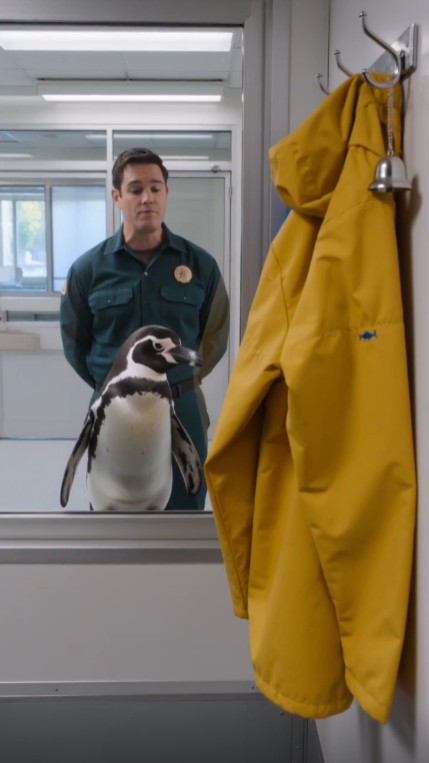
Every afternoon, a rescued penguin stood in the same corner of his sanctuary.
His name was Pip.
He wasn’t waiting for food.
He wasn’t trying to escape.
He simply stood beside the viewing barrier and stared toward the staff area.
Always the same place.
Always around the same time.
At first, the caretakers thought Pip had developed an ordinary routine.
Animals often become interested in familiar sounds, movements, or objects.
But Pip’s behavior was unusually consistent.
At 3:30 almost every afternoon, he waddled across the enclosure.
Stopped beside the barrier.
And looked toward an old yellow raincoat hanging from a hook in the staff corridor.
The coat had been discovered in a storage room months earlier.
Nobody knew who owned it.
It was too old to be part of the current uniforms.
The staff kept it because it was still useful during rainy maintenance work.
One sleeve had a tiny blue fish stitched near the cuff.
No one paid much attention to it.
Pip seemed to.
One afternoon, a visiting marine researcher named Dr. Eleanor Brooks was touring the sanctuary.
She had worked in seabird conservation for more than thirty years.
A caretaker named Daniel was explaining Pip’s history when Eleanor suddenly stopped walking.
She was staring at the yellow coat.
“Where did you find that?”
Daniel looked confused.
“The raincoat?”
“Yes.”
“In the old equipment room.”
Eleanor stepped closer.
She touched the sleeve carefully.
Then saw the blue fish.
Her hand went to her mouth.
“I made that.”
Daniel stared.
“You stitched this?”
Eleanor nodded slowly.
“About fifteen years ago.”
“For yourself?”
She shook her head.
“For my research partner.”
His name was Samuel Reed.
Samuel had worked at the sanctuary long before Pip arrived.
He was one of the first conservation workers assigned to a small rehabilitation program for injured coastal birds.
The sanctuary was much smaller then.
Fewer enclosures.
Older equipment.
Far less funding.
Samuel wore the yellow raincoat nearly every day during winter.
One evening, Eleanor stitched the little blue fish onto the sleeve because all the staff coats looked identical.
“He kept stealing mine by mistake,” she said.
Daniel laughed.
“So that was your solution?”
“He complained for months.”
Then Eleanor noticed something beside the coat.
A small silver chime hung from the same wooden rack.
It looked almost decorative.
Daniel followed her eyes.
“That was in the storage room too.”
Eleanor’s expression changed again.
She stepped toward it.
“No.”
Daniel frowned.
“What?”
Eleanor smiled through tears.
“It wasn’t the raincoat.”
“What wasn’t?”
“The thing Pip is watching.”
She pointed toward the silver chime.
“That sound was part of our old routine.”
Daniel looked toward Pip.
The penguin was standing near the barrier as usual.
Eleanor asked:
“May I?”
Daniel nodded.
She gently moved the chime.
A soft note rang through the corridor.
Pip immediately turned.
He lifted his head.
Then waddled several steps closer to the barrier.
Daniel froze.
“You’ve got to be kidding.”
Eleanor shook her head.
“No magic.”
“Just memory or learned association, maybe.”
“But Pip wasn’t here fifteen years ago.”
“I know.”
That was what made it strange.
Eleanor explained.
When she and Samuel worked at the sanctuary, the silver chime was used before certain feeding and rehabilitation routines.
Not as a performance trick.
It simply helped staff coordinate.
One gentle ring meant the preparation area was ready.
Two meant another worker was needed.
Over time, some animals appeared to associate the sound with activity around the rehabilitation pool.
But Pip had not even been born then.
Daniel opened the sanctuary database.
“Let’s check his transfer history.”
Pip had arrived four years earlier after being rescued from another coastal facility.
He had suffered an injury that made immediate release unsuitable.
After rehabilitation, specialists determined he would remain under managed care.
Daniel opened the first transfer record.
Nothing unusual.
Then the second.
And stopped.
“Wait.”
Eleanor leaned over.
“What?”
Daniel pointed toward the screen.
Before arriving at his previous facility, Pip had spent several months at North Shore Rehabilitation Center.
Eleanor became very still.
“That used to be our satellite program.”
Daniel looked at her.
“You worked there too?”
“For years.”
He searched older records.
North Shore had closed almost a decade earlier.
Much of its equipment had been transferred between partner facilities.
Daniel opened a scanned inventory list.
Yellow staff raincoat.
One.
Silver coordination chime.
One.
Eleanor laughed softly.
“So that’s how they got back here.”
But it still did not explain Pip.
Daniel kept scrolling.
Then he found an entry from Pip’s earliest rehabilitation period.
Behavioral notes.
The young penguin had initially been reluctant to approach feeding staff.
Caretakers began using a consistent sound cue before entering the recovery area.
Daniel read the note aloud.
“Single soft bell tone before feeding and health checks.”
Eleanor stared at him.
“No.”
Daniel continued.
The note said the bell had already been hanging in the old North Shore treatment room.
Staff simply kept using it.
There was even a photograph.
Daniel opened it.
A much younger Pip stood near the edge of a temporary recovery pool.
Behind the caretaker was the same silver chime.
Eleanor sat down.
“That’s the connection.”
Pip had never known Samuel.
He had never seen the yellow raincoat being worn by Eleanor’s old partner.
But he had heard the chime.
Probably hundreds of times.
At North Shore.
Before meals.
Before calm handling.
Before familiar caretakers appeared.
Then when the facility closed, the equipment eventually returned to the main sanctuary.
Nobody connected the old silver chime with Pip’s past.
It was simply hung beside the raincoat.
And every afternoon, routine maintenance caused the staff door to move slightly.
Sometimes the chime made a faint sound.
Barely noticeable to people.
Apparently not to Pip.
Daniel looked toward him.
“So he wasn’t staring at the coat.”
Eleanor smiled.
“No.”
“He was probably waiting for the sound.”
The staff tested the idea carefully over several days.
They did not deliberately ring the chime constantly or turn Pip’s behavior into entertainment.
Instead, they observed.
When the coat was moved elsewhere but the chime remained, Pip still approached the same area.
When the chime was temporarily removed during maintenance, his afternoon routine changed.
When it returned, so did the familiar behavior.
The evidence was not proof of some complex emotional memory.
But it strongly suggested a learned association with the sound.
Daniel found that more interesting than the dramatic explanation.
A simple auditory cue had survived through facilities, staff changes, transfers, and years.
Eleanor asked to see more of Pip’s old files.
They found photographs from North Shore.
Then older staff notes.
One name appeared repeatedly.
Thomas Reed.
Eleanor stared.
“Samuel’s son.”
Daniel looked surprised.
“His son worked there?”
“Yes.”
Eleanor had not known.
Samuel retired after health problems.
His son Thomas later became an animal-care technician.
Apparently Thomas had worked with Pip during his first months of rehabilitation.
The records described him as Pip’s primary afternoon caretaker.
Daniel looked toward the chime.
“Did Thomas use the same routine?”
The notes suggested he did.
Single bell tone.
Approach slowly.
Feeding.
Health check.
Quiet recovery period.
Eleanor smiled.
“Samuel taught him that.”
“How do you know?”
“Because Samuel did everything that way.”
She laughed.
“Same chime. Same routines. Same stubborn obsession with consistency.”
Then Daniel found a photograph.
Thomas stood beside Pip’s recovery pool.
And over the back of his chair hung the yellow raincoat.
Not because Thomas knew Eleanor.
Because it had belonged to his father.
Samuel had given it to him after retiring.
The tiny blue fish was still visible on the sleeve.
Eleanor covered her mouth.
“That’s why everything stayed together.”
The coat.
The chime.
The routines.
None had been passed down as sentimental artifacts for Pip.
They simply moved through people who worked in the same conservation network.
Samuel used the coat and chime.
His son Thomas inherited the coat and kept using the old routine.
Pip learned the sound while Thomas cared for him.
Later, Pip transferred away.
Years afterward, old North Shore equipment was returned to the main sanctuary.
Eventually Pip arrived there too.
Different paths.
Same destination.
Daniel said:
“You realize people are going to say he remembered Samuel.”
Eleanor shook her head.
“He couldn’t.”
“But he may remember the sound.”
“Or the routine associated with it.”
“That’s enough.”
Eleanor looked through the glass.
Pip was still near the barrier.
Daniel rang the chime once during the next approved enrichment period.
Pip turned immediately.
Then walked toward the section where staff normally appeared.
Eleanor smiled.
“Hello, Pip.”
The penguin watched her.
No special recognition.
No dramatic reunion.
Just an animal responding to something familiar.
That made Eleanor happy.
She had spent her career telling people that animals did not need magical stories to be remarkable.
Their real behavior was interesting enough.
The sanctuary contacted Thomas.
He was living several hours away.
When Daniel explained what they had discovered, Thomas laughed.
“That old bell still exists?”
“Yes.”
“And the coat?”
“Yes.”
“My dad would find that hilarious.”
Thomas visited a month later.
He stood quietly beside Eleanor in the staff corridor.
They had never met before.
But both had known Samuel in different ways.
Eleanor as a research partner.
Thomas as a father.
Thomas touched the tiny blue fish on the raincoat.
“You did that?”
Eleanor nodded.
“He hated it.”
Thomas laughed.
“He told me he loved it.”
“That liar.”
They both laughed.
Then Thomas saw Pip.
The penguin approached the familiar area.
Thomas did not claim Pip remembered him after so many years.
Instead, he said:
“He always liked predictable afternoons.”
Daniel smiled.
“Apparently he still does.”
Thomas looked at the silver chime.
“My dad taught me that consistency made nervous animals easier to care for.”
Eleanor nodded.
“He believed routines were promises.”
“What do you mean?”
“If you make the same sound before doing something safe, eventually the sound itself can become part of the predictability.”
Daniel looked toward Pip.
“That seems to be what happened.”
The sanctuary eventually moved the old raincoat into its small historical display because the fabric was deteriorating.
They kept the blue fish visible.
The chime remained in staff care.
It was no longer used as a routine cue except when behavior specialists considered it appropriate.
Pip did not need to spend every afternoon waiting for an old sound.
Instead, staff built new predictable routines around him.
New cues.
New enrichment.
New associations.
Over time, he began spending more afternoons elsewhere in the habitat.
Swimming.
Exploring.
Interacting with enrichment.
But occasionally, when the silver chime sounded softly from the staff area, Pip still turned.
Eleanor visited once a year.
Each time, she stopped beside the yellow coat.
Not because she thought Pip understood what it represented.
Because she did.
It connected Samuel.
Thomas.
North Shore.
Pip.
And decades of conservation work that rarely made headlines.
On her final visit before moving farther away, Eleanor gave the sanctuary an old photograph.
It showed Samuel standing beside a rehabilitation pool fifteen years earlier.
Yellow raincoat.
Blue fish on the sleeve.
Silver chime hanging behind him.
Daniel placed it beside the newer photograph of Thomas and Pip.
Underneath, he wrote:
The animals change.
The people change.
Good routines remain.
Years later, new caretakers sometimes heard the story differently.
They thought Pip had been staring at the coat because he remembered its owner.
Daniel always corrected them.
“No.”
“He never knew Samuel.”
Then he would explain the real connection.
The coat belonged to Samuel.
The chime belonged to the old rehabilitation program.
Samuel taught the routine to Thomas.
Thomas later cared for Pip using that same sound.
And through a long series of transfers, both Pip and the old equipment eventually arrived at the same sanctuary.
It was not a story about a penguin remembering a man he never met.
It was about something quieter.
A familiar sound.
A learned routine.
And the way careful animal care can continue through generations of people without anyone realizing how far it has traveled.
Every afternoon, Pip stood near that wall.
Workers thought he was staring at an old yellow raincoat.
Then one woman heard a tiny silver chime.
And suddenly, fifteen years of history made sense.