
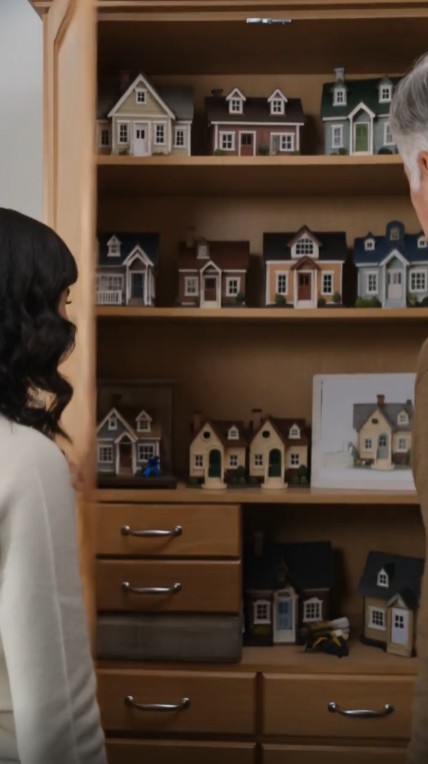
A daughter opened her father’s old garage cabinet and discovered something he had been hiding for nearly twenty-five years.
Dozens of miniature houses.
Every single one handmade.
Tiny windows.
Beautiful doors.
Little gardens.
Perfect staircases.
Her father stood quietly behind her.
His name was Daniel.
His daughter, Anna, turned slowly.
“Dad… you made all these?”
He nodded.
“Every single one.”
Anna reached for a miniature house with a green front door.
It had three round windows.
Curved front steps.
A small tree beside the porch.
The moment she saw it, she froze.
“Dad…”
Daniel looked at her.
“What is it, sweetheart?”
Anna stared at the little house.
“I drew this when I was seven.”
Daniel smiled.
“I remember.”
Anna almost laughed.
“No, I mean exactly this.”
She remembered sitting at the kitchen table with crayons.
She had drawn a strange house with three circular windows because she thought square ones were boring.
The green door had been enormous.
The steps curved like a smile.
Her father had pinned the picture to the refrigerator.
Then, years later, it disappeared.
Anna assumed it had been thrown away.
Instead, Daniel had built it.
She picked up another model.
A narrow white house with a glass roof.
“I drew something like this too.”
“You were eleven.”
Another.
A tall wooden house wrapped around a tree.
“Thirteen,” Daniel said.
Then a tiny modern building with huge windows.
“Sixteen.”
Anna looked around the cabinet.
There were dozens.
Some crude.
Others incredibly detailed.
The earliest models had rough edges.
The later ones were precise enough to look professional.
Anna stared at her father.
“You never told me you could do this.”
Daniel shrugged.
“I couldn’t.”
“What do you mean?”
“I learned.”
She looked again.
Every miniature represented a house Anna had once imagined.
When she was a child, she drew constantly.
Homes on cliffs.
Homes beside lakes.
Homes with libraries instead of dining rooms.
Homes with gardens on the roof.
Daniel had saved the drawings.
Then built them after she went to bed.
Anna felt tears forming.
“Why?”
Daniel answered softly:
“Because you kept dreaming bigger.”
Anna grew quiet.
As a child, she had wanted to become an architect.
Everyone knew it.
Then life changed.
Her mother became ill during Anna’s final years of school.
Money became tight.
Anna abandoned the idea of architecture and studied accounting instead because it felt safer.
She built a good career.
Married.
Had a daughter.
Bought a house.
She was not unhappy.
But every once in a while, she still found herself sketching buildings in the margins of notebooks.
Daniel noticed.
He always noticed.
Anna looked toward another row of models.
“You kept building these even after I stopped drawing?”
Daniel nodded.
“Sometimes from memory.”
“Sometimes from things you said.”
Anna laughed through tears.
“That’s insane.”
“Probably.”
Then she noticed something different.
At the very back of the cabinet stood one miniature house inside a clear display case.
It was larger than the others.
More detailed.
White stone walls.
Blue shutters.
A long porch.
Two wings extending from the center.
A tiny blue ribbon was attached to its base.
Anna leaned closer.
“This one isn’t mine.”
Daniel’s smile faded.
“No.”
“Whose house is it?”
For a moment he said nothing.
Then he opened a drawer beneath the cabinet.
Inside was a rolled architectural drawing.
Old.
Carefully preserved.
Daniel placed it on the workbench and slowly unrolled it.
Anna leaned over.
The design matched the model.
Then she noticed the signature in the lower corner.
Her hand went to her mouth.
“Elena Morgan.”
Anna knew the name.
But not from family stories.
Elena Morgan was an architect.
One of the first women from their region to become locally recognized for designing community buildings.
Anna had studied her work briefly in school.
She stared at Daniel.
“How do you have an original drawing by Elena Morgan?”
Daniel looked toward the miniature house.
“Because she gave it to me.”
Anna blinked.
“You knew her?”
“Yes.”
“How?”
Daniel pulled out a chair.
“Sit down.”
Anna did.
He began with a story he had never told her.
Before Anna was born, Daniel worked as a carpenter.
Not the small repair work Anna remembered from childhood.
He worked on major construction projects.
Schools.
Libraries.
Community centers.
One of those projects was designed by Elena Morgan.
Daniel met her when he was twenty-eight.
Elena was already in her sixties.
She had a reputation for being demanding.
Daniel laughed.
“She rejected an entire staircase because the handrail was two centimeters wrong.”
Anna smiled.
“That sounds like an architect.”
“She was terrifying.”
But Elena liked Daniel’s craftsmanship.
Unlike some builders who complained when architects asked for revisions, Daniel asked questions.
Why this angle?
Why this window?
Why this material?
Elena noticed.
One afternoon, she asked:
“Did you ever study design?”
Daniel laughed.
“No.”
“You should have.”
“I have a family to feed.”
Elena looked at him.
“That wasn’t the question.”
Daniel never forgot that.
They became unlikely friends.
Elena began showing him drawings.
Explaining scale.
Proportion.
Sight lines.
How buildings could make people feel safe or uncomfortable without them knowing why.
Then Anna was born.
Daniel showed Elena photographs constantly.
When Anna started drawing houses as a little girl, he brought one of the pictures to work.
The green-door house.
Elena studied it.
Then laughed.
“Three round windows?”
“She insists.”
“She has terrible respect for construction costs.”
Daniel smiled.
Elena told him:
“Build it.”
Daniel thought she meant someday as a real house.
Elena shook her head.
“No.”
“Small.”
“Let her see that ideas can become objects.”
That weekend, Daniel built the first miniature.
The green-door house.
It was terrible.
The roof leaned.
The windows were uneven.
Anna loved it.
Or at least she would have.
But Daniel never showed her.
Anna frowned.
“Why?”
Daniel looked embarrassed.
“I was going to.”
“Then I made another one.”
“And another.”
“Eventually I thought I’d give them to you when you became an architect.”
Anna looked down.
“But I didn’t.”
“No.”
Daniel never blamed her.
He understood why she changed direction.
Her mother needed care.
The family needed stability.
And Anna had always been practical.
Still, Daniel kept building.
Elena kept encouraging him.
Then, when Anna was fourteen, Elena showed Daniel the drawing now lying on the workbench.
It was not for a wealthy client.
It was a design for a small residential center.
A home for young people leaving foster care.
Private rooms.
Shared kitchen.
Workshop.
Garden.
Library.
Nothing institutional.
Elena wanted it to feel like a real home.
But the project lost funding before construction began.
The drawings were stored away.
Years later, Elena gave Daniel one copy.
“She told me to build it someday.”
Anna looked at the miniature.
“You mean the model.”
Daniel nodded.
But that was not the whole story.
Elena died before seeing it completed.
Daniel built the miniature afterward.
The blue ribbon came from her memorial service.
Anna touched the base carefully.
“Why did you say it wasn’t yours to build?”
“Because she designed it.”
“No.”
Daniel shook his head.
“I mean the real one.”
Anna stared at him.
“What real one?”
Daniel stood.
“There’s someone you need to meet.”
They drove across town.
Daniel would not explain more.
Eventually, they stopped outside a modest office in an old brick building.
On the door was a sign:
MORGAN COMMUNITY HOUSING TRUST.
Anna turned toward him.
“What is this?”
Daniel smiled.
“Come inside.”
A woman in her fifties greeted them.
Her name was Claire.
She looked at Anna for several seconds.
Then smiled.
“You have your mother’s eyes.”
Anna frowned.
“You knew my mother?”
Claire shook her head.
“No.”
“I knew Elena.”
Claire was Elena Morgan’s granddaughter.
She had inherited boxes of drawings, correspondence, and unfinished projects after her grandmother’s death.
Among them was the residential center.
And dozens of letters mentioning Daniel.
Then Claire discovered something else.
A folder labeled:
ANNA.
Inside were copies of several childhood drawings.
Green door.
Round windows.
Tree house.
Glass roof.
All the designs Daniel had shown Elena through the years.
Anna sat down.
“She kept these?”
Claire nodded.
“She wrote notes on them.”
Claire opened the folder.
Beside the drawing of the green-door house, Elena had written:
She understands invitation.
Anna frowned.
“What does that mean?”
Claire explained.
The oversized front door, although childish, made the entrance feel welcoming.
On another drawing Elena wrote:
She keeps putting windows where people can see one another.
And another:
She thinks houses should have places to hide and places to gather.
Anna stared at the notes.
She had been a child.
She had not consciously thought about any of those things.
But Elena saw something.
Claire handed Anna one final sheet.
It was a letter written by Elena to Daniel.
If she becomes an architect, wonderful.
If she doesn’t, leave her alone.
Do not turn talent into an obligation.
But keep the drawings.
People sometimes return to the thing they love after they are done becoming who everyone needed them to be.
Anna stopped reading.
Daniel looked away.
“Dad…”
“I never wanted you to feel guilty.”
Anna understood why he had hidden the models.
They were not reminders of a dream she had abandoned.
They were a record.
Something waiting without demanding anything.
Then Claire showed her the real reason for the meeting.
The trust had recently regained ownership rights to a small piece of land Elena had originally hoped to use for the residential center.
Funding was now available for a new community housing project.
Not the exact old design.
Building codes had changed.
Accessibility requirements had changed.
The community’s needs had changed.
They needed a new architect.
Anna almost laughed.
“You can’t possibly mean me.”
Claire smiled.
“No.”
Anna looked relieved.
“You’re not an architect.”
“Exactly.”
“But we want you involved.”
The actual architect had already been selected.
A licensed professional named Maya Chen.
Claire wanted Anna to join the community design committee.
Not because she had childhood drawings.
Because Anna had spent years working in finance and project management.
She understood budgets.
Operations.
Long-term costs.
And, according to Daniel, she still saw buildings differently from most people.
Anna laughed.
“My father says lots of things.”
“True.”
Daniel looked offended.
Claire continued.
“We need people who understand that a building has to work after the ribbon-cutting ceremony.”
That interested Anna.
So she agreed.
At first, only as a volunteer.
Then the project grew.
Anna attended design meetings.
Asked questions.
Made sketches.
Worked closely with Maya.
For the first time in years, she found herself talking about windows.
Light.
Shared spaces.
Entrances.
Not numbers.
Maya noticed.
“You ever think about architecture?”
Anna laughed.
“A long time ago.”
“You still think like one.”
That sentence stayed with her.
Anna did not quit her job.
She did not suddenly enroll in school the next morning.
Life was not that simple.
But over the next two years, she began taking evening courses in design and drafting.
Not because Daniel pushed her.
He didn’t.
Not because she needed a dramatic career change.
Because she wanted to know whether the old interest was still hers.
It was.
She eventually reduced her accounting work.
Then returned to university part-time.
At forty-two, surrounded by students half her age, Anna began formal architectural training.
Daniel attended her first student exhibition.
He stood beside one of her models.
A small building with three round windows.
Anna caught him staring.
“Don’t say anything.”
Daniel smiled.
“I wasn’t going to.”
“You were.”
“I absolutely was.”
Meanwhile, the community housing project moved forward.
Anna was not legally responsible for the architectural design.
Maya remained the project architect.
But Anna contributed to planning.
Residents helped too.
The final building was different from Elena’s original drawing.
It had to be.
But one element remained.
A long shared porch.
Elena had written in her original notes:
People who are beginning again should not have to enter through a door that feels hidden.
When the building finally opened, Claire brought the old miniature.
They displayed it inside the common room.
Not as the design that was built.
As the idea that started everything.
Beside it sat Daniel’s first miniature.
The green-door house.
Anna laughed when she saw it.
“You brought that?”
Daniel nodded.
“It’s historically important.”
“The roof is crooked.”
“Artistic freedom.”
At the opening ceremony, Anna’s daughter wandered between the models.
She was nine.
Then she handed Daniel a folded piece of paper.
“What’s this?” he asked.
“A house.”
He opened it.
A purple roof.
A glass tower.
A ridiculous bridge between two trees.
Daniel stared at Anna.
Anna pointed at him.
“Don’t you dare.”
He smiled.
“I’m retired.”
“Good.”
The following Christmas, Anna opened a package from her father.
Inside was a miniature house.
Purple roof.
Glass tower.
Ridiculous bridge.
Anna laughed until she cried.
Daniel had never really been interested in architecture.
Not in the way Anna once assumed someone had to be.
He had been interested in her.
That was different.
For nearly twenty-five years, every time his daughter described a place that did not exist, he went into the garage and tried to make it real in miniature.
He was never trying to decide her future.
He was preserving the evidence that she had once imagined one.
And the final house in the cabinet had never belonged to Anna at all.
It belonged to Elena Morgan.
The architect who saw something in a seven-year-old’s drawing.
The woman who told Daniel not to turn his daughter’s talent into pressure.
And the person whose unfinished project eventually gave Anna something she had not expected.
Not a second chance to become the child she used to be.
A chance to discover whether part of that child was still there.
Years later, Anna kept the green-door miniature in her own office.
Visitors often asked about it.
She would smile.
“My first design.”
Then they would point to the crooked roof.
Anna laughed.
“My father’s first build.”
And behind her desk hung Elena Morgan’s old sentence:
People sometimes return to the thing they love after they are done becoming who everyone needed them to be.