
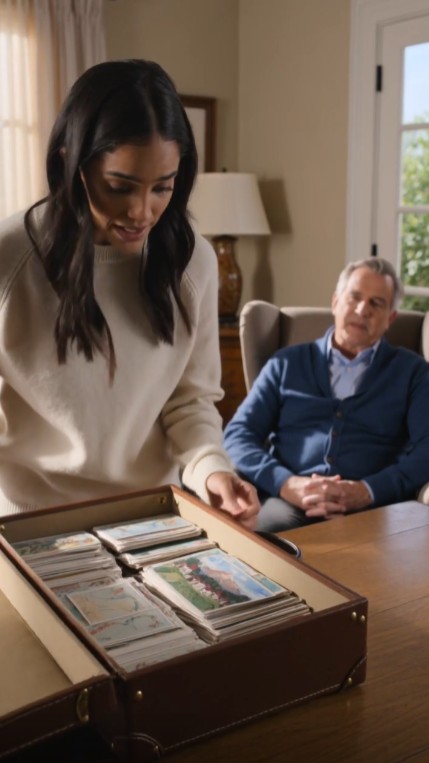
A daughter opened her father’s old suitcase and discovered hundreds of postcards from places her mother had supposedly visited.
Snow-covered villages.
Mountain roads.
Bright coastal towns.
Cities glowing at night.
Little cafés beside the sea.
Every postcard had a personal message on the back.
Some were funny.
Some romantic.
Some only a few lines long.
Her mother had always dreamed of traveling.
But there was one problem.
She had never left their hometown.
Anna sat on the bedroom floor surrounded by the postcards.
Her father, Daniel, stood in the doorway.
She looked up.
“Dad… where did all these come from?”
Daniel smiled.
“Your mother loved those places.”
Anna picked up a postcard showing a tiny seaside village.
White houses.
Blue shutters.
Boats floating in clear water.
On the back was a message written in her father’s handwriting:
Maria,
The bakery here sells bread so good you would forgive me for eating half before bringing it back.
The sea is louder than you expected.
You would love the balcony.
Anna looked at him.
“Did someone send these to her?”
Daniel shook his head.
“Look closer.”
Anna turned the postcard over again.
Then held it near the window.
She noticed it.
Tiny brushstrokes.
The sky was painted.
So were the buildings.
Even the small boats.
Not printed.
Handmade.
Anna looked up.
“Dad…”
Daniel smiled.
“You painted them?”
He nodded.
“Every Sunday.”
Anna stared at the suitcase.
“There are hundreds.”
“I had a lot of Sundays.”
For years, Daniel had painted imaginary postcards from places Maria dreamed of seeing.
He bought travel magazines.
Borrowed books from the library.
Studied photographs.
Then made his own versions.
On the back, he wrote little stories as if they had traveled there together.
A rainy afternoon in Paris.
A missed train in Vienna.
A tiny restaurant in Greece.
A snowy street in Prague.
Maria knew they were imaginary.
That was part of the game.
She kept every one.
Anna smiled.
“Why didn’t you just buy real postcards?”
Daniel laughed.
“Your mother said those were cheating.”
Maria had always dreamed of travel.
But life made it difficult.
Money was tight when Anna was young.
Then Maria became the primary caregiver for her own mother.
Later, Daniel’s work kept him close to home.
There was always another reason to wait.
Next year.
After the bills were paid.
After Anna finished school.
After the roof was repaired.
After things became easier.
They never really did.
So Daniel started traveling with paint.
Every Sunday morning, while Maria made coffee, he sat at the kitchen table with watercolor paper.
She would choose a place.
“Somewhere warm.”
“Somewhere with mountains.”
“Somewhere nobody knows us.”
Daniel would paint.
Sometimes badly.
Maria teased him mercilessly.
“That church looks like a potato.”
“It’s perspective.”
“It’s a potato.”
Then he wrote a message on the back.
Maria kept each card in the suitcase.
Anna turned through them slowly.
The dates covered more than twenty years.
Then she found one that made her laugh.
It showed a crooked little house beside the ocean.
The note read:
Maria,
We bought this place because you said the sea was too beautiful to leave.
Unfortunately, the roof leaks, the bathroom door doesn’t close, and our neighbor owns six loud chickens.
You say it is perfect.
I am reconsidering our marriage.
Anna laughed.
“Mom wrote on this one.”
At the bottom, in Maria’s handwriting, was a reply:
You’re only complaining because the chickens like me better.
Daniel smiled.
“She always answered the good ones.”
Several postcards had Maria’s replies squeezed beneath his messages.
Anna kept reading.
Then she noticed something different.
At the bottom of the suitcase was one postcard inside a clear protective sleeve.
Unlike the others, it was not painted.
It was a real photograph.
A small white house overlooking the sea.
Green door.
Stone steps.
A balcony covered with flowers.
Behind it was an actual train ticket.
Anna frowned.
“Dad… what’s this?”
Daniel’s smile disappeared.
“That one is different.”
Anna removed the postcard carefully.
The ticket was recent.
Only a few months old.
On the back of the card was a photograph attached with tape.
The same house.
But newer.
Someone stood near the front gate.
Too far away to identify clearly.
Daniel sat beside her.
“Your mother wanted you to see this place.”
Anna looked at the ticket.
“Mom died eight years ago.”
“I know.”
“Then how?”
Daniel took a long breath.
“That house was real before any of the postcards.”
Anna stared at him.
“What do you mean?”
Daniel reached into the suitcase and removed a thin folder hidden beneath the lining.
Inside was an old photograph.
Maria was about twenty years old.
Standing beside another young woman.
Both smiling.
Behind them was the same seaside house.
Anna looked at him.
“Mom went there?”
“Once.”
“Before I was born?”
“Yes.”
Anna frowned.
“You always said she never left town.”
Daniel shook his head.
“We said she never traveled after we married.”
“That was different.”
Anna looked again at the woman beside Maria.
“Who is she?”
Daniel answered quietly.
“Your aunt.”
Anna stared.
“I don’t have an aunt.”
“Yes, you do.”
Her name was Sofia.
Maria’s younger sister.
Anna had never heard the name.
Not once.
Daniel explained.
Maria and Sofia had been extremely close as children.
They shared everything.
Clothes.
Friends.
Dreams.
Then, in their early twenties, they both fell in love with very different futures.
Maria wanted to stay near home.
Sofia wanted to leave.
She moved to the coast.
Found work.
Eventually married.
The sisters remained close at first.
Then their mother became ill.
Maria stayed behind to care for her.
Sofia sent money when she could.
But she did not come home as often as Maria expected.
Resentment grew.
Maria felt abandoned.
Sofia felt judged.
Phone calls became arguments.
Then stopped completely.
Anna listened silently.
“What happened?”
“One terrible conversation.”
Daniel did not know every detail.
Maria rarely spoke about it.
But the sisters said things they regretted.
Maria accused Sofia of choosing a beautiful life over family.
Sofia accused Maria of using duty as an excuse to control everyone around her.
Neither apologized.
Years passed.
Anna was born.
Maria never told her about Sofia.
Daniel asked several times whether they should reach out.
Maria always answered:
“Not yet.”
Then Daniel began painting postcards.
At first, they were only a way to make Maria laugh.
But eventually, he noticed something.
Maria repeatedly chose seaside places.
White houses.
Cliffs.
Train stations.
Balconies facing the water.
Daniel understood.
She was thinking about Sofia.
One Sunday, Maria chose the exact coastal village where her sister lived.
Daniel painted the crooked little house by the sea.
The one with the chickens.
Maria laughed.
Then became quiet.
She wrote something on the back.
Not a joke.
I should have gone back.
Daniel kept that card.
Years later, when Maria became seriously ill, she finally asked him to find Sofia.
He did.
It took months.
Sofia had moved several times.
Changed surnames.
Eventually, Daniel found her.
He called.
The moment he said Maria’s name, Sofia began crying.
The sisters spoke again after more than twenty years.
At first, only by phone.
Then letters.
Then video calls.
They apologized.
Not perfectly.
Not all at once.
But enough.
Anna’s eyes filled.
“Why didn’t Mom tell me?”
“She wanted to.”
“Then why didn’t she?”
Daniel looked down.
“Because she was ashamed she had kept Sofia from you.”
Anna felt a strange mix of sadness and anger.
“She should have told me.”
“I know.”
“Did Sofia know about me?”
“Everything.”
Daniel showed her another envelope.
Inside were photographs Sofia had received through the years.
Anna as a baby.
First day of school.
Graduation.
Wedding.
Maria had secretly sent some through Daniel after reconnecting.
Sofia kept every one.
Anna stared.
“She watched my whole life through pictures?”
“Yes.”
“Why didn’t she contact me herself?”
“Your mother asked her not to until she was ready.”
Anna looked hurt.
Daniel did not defend the choice.
He simply said:
“They were trying to repair something they had broken for a very long time.”
Then Maria died before she could arrange the meeting.
Sofia wanted to come to the funeral.
Daniel told her she should.
But Sofia panicked.
She feared appearing suddenly would create more pain.
So she stayed away.
Another decision she regretted.
Afterward, she and Daniel kept occasional contact.
Then, several months earlier, Sofia wrote to him.
She had moved back into the old seaside house.
The same place where she and Maria had once stayed together as young women.
The house had belonged to a friend’s family then.
Years later, Sofia bought it.
She enclosed a train ticket in the letter.
And wrote:
If Anna ever wants to know me, I will be here.
No explanations demanded.
No forgiveness expected.
Just an open door.
Anna looked at the recent ticket again.
“That’s who lives there?”
Daniel nodded.
“Your aunt Sofia.”
Anna sat quietly for a long time.
She was not sure what she felt.
Curiosity.
Anger.
Grief.
A strange sense of recognition for someone she had never met.
Then Daniel handed her one final postcard.
This one had been painted by Maria.
Anna immediately knew.
Her mother’s style was different.
Looser.
Softer.
The picture showed the seaside house.
Two women sitting on the balcony.
One younger.
One older.
On the back, Maria had written:
Anna,
If you ever see this, I probably waited too long.
I made mistakes with my sister.
She made mistakes with me.
We both spent years defending our hurt because apologizing felt harder.
Don’t inherit that from us.
You do not owe Sofia a relationship.
You do not owe her forgiveness.
But if curiosity brings you to the sea, listen before you decide who she is.
Anna cried.
Daniel waited.
Then asked:
“Do you want me to put the suitcase away?”
Anna shook her head.
“No.”
She picked up the train ticket.
“Is it still valid?”
Daniel smiled.
“Yes.”
Two weeks later, Anna boarded the train.
Alone.
Daniel offered to come.
She refused.
“This part is mine.”
The journey took several hours.
When the train reached the coast, Anna recognized things she had never actually seen.
A stone bridge from one painted postcard.
A church tower from another.
A row of yellow houses.
Her father had painted them from travel books and photographs.
Yet seeing them felt strangely familiar.
At the station, an elderly woman stood near the exit.
She held no sign.
She did not need one.
Anna recognized Maria’s eyes immediately.
Sofia whispered:
“Anna?”
Anna nodded.
Neither moved.
Then Sofia said:
“You look exactly like your mother when she was nervous.”
Anna laughed despite herself.
“What did she look like?”
“Angry.”
They both laughed.
That broke something open.
Sofia did not rush forward.
Did not demand a hug.
She simply said:
“I’m very glad you came.”
They walked to the little house.
The real one.
It looked almost exactly like the photograph.
White walls.
Green door.
Balcony.
There were no chickens.
Anna mentioned this.
Sofia looked confused.
“Chickens?”
Anna showed her Daniel’s postcard.
Sofia laughed so hard she had to sit down.
“Your father invented chickens?”
“He blamed Mom.”
“That sounds like Daniel.”
Inside the house, Sofia had prepared something.
A box.
Inside were letters from Maria.
Dozens.
Some were angry.
Some apologetic.
Some ordinary.
One talked about Anna learning to ride a bicycle.
Another complained about Daniel’s cooking.
Another described the first imaginary postcard.
Anna spent hours reading.
The sisters had found their way back to each other long before Maria died.
Not perfectly.
But genuinely.
Then Sofia showed Anna the balcony.
On a small table sat a blank postcard.
Beside it were watercolors.
Anna smiled.
“What is this?”
“Your mother told me about the Sunday postcards.”
“She thought it was the most ridiculous romantic thing your father ever did.”
Anna laughed.
“That sounds like her.”
Sofia handed her a brush.
“Want to make one?”
Anna had not painted since childhood.
Her first attempt was terrible.
The sea looked like a blue wall.
The house leaned.
Sofia said:
“It’s beautiful.”
“You’re lying.”
“Family tradition.”
Anna wrote on the back:
Dad,
The house is real.
The roof does not leak.
There are no chickens.
Mom was right about the balcony.
Then she mailed it to Daniel.
When it arrived, he placed it in the old suitcase.
The first postcard from a journey someone had actually taken.
Anna did not suddenly become inseparable from Sofia.
Real relationships do not grow that fast.
They called.
Visited.
Sometimes disagreed.
Sometimes went weeks without speaking.
But they had the chance Maria had wanted them to have.
That mattered.
Years later, Anna inherited the suitcase.
She kept the imaginary postcards exactly as her mother had.
Every Sunday painting.
Every made-up trip.
Every joke.
Every place Maria never physically visited but somehow knew through Daniel’s brush.
At the bottom remained the real train ticket.
Anna never threw it away.
Because the final postcard was different from all the others.
The hundreds before it allowed Daniel and Maria to imagine a world they could not reach.
The last one did something else.
It opened a door into a part of Maria’s real life Anna had never known.
A sister.
A broken relationship.
A reconciliation.
A house overlooking the sea.
For years, Anna believed her mother never traveled.
In one sense, that was true.
Maria spent most of her life close to home.
But through hundreds of painted postcards, she and Daniel had created journeys together anyway.
And in the end, one real ticket completed the trip Maria could no longer make herself.
It carried her daughter to the sea.
To the house from the final postcard.
And to the woman who had been waiting there with an open door.