
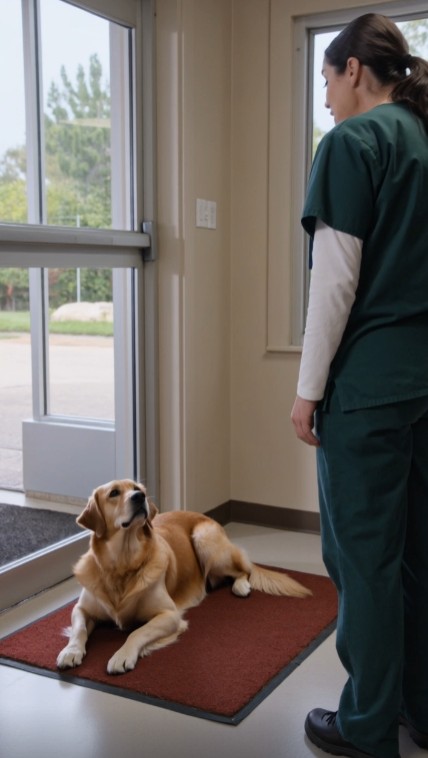
A rescued golden retriever had six comfortable beds at the shelter.
Soft blankets.
A raised cot.
A padded orthopedic bed.
Even a quiet corner with extra cushions.
But every afternoon, Scout ignored all of them.
Instead, he walked to the adoption-room entrance.
Circled once.
Then settled on the same faded red doormat.
Nobody understood why.
Scout was gentle.
Friendly.
Perfectly healthy.
He enjoyed walks.
Loved treats.
And greeted visitors without hesitation.
Yet whenever the shelter grew quiet, he returned to that old red mat.
Sometimes he slept there.
Sometimes he simply rested with his head between his paws, facing the door.
The mat had arrived with him months earlier.
It was listed among the few possessions transferred from his original rescue.
One collar.
One blanket.
One red doormat.
The shelter staff had almost thrown it away.
It was worn.
Faded.
One corner was frayed.
But Scout refused to settle whenever it disappeared during cleaning.
So caretaker Emma washed it carefully and returned it.
After that, nobody tried to remove it again.
Then one afternoon, an elderly man named George visited the shelter.
He wasn’t looking to adopt.
His granddaughter volunteered there, and he had stopped by to pick her up.
As they walked through the adoption area, George suddenly stopped.
He stared at Scout.
Then at the red mat.
“Where did you get that?”
Emma looked confused.
“The mat?”
“Yes.”
“It arrived with Scout.”
George’s expression changed.
He slowly reached into his jacket.
Inside his wallet was an old photograph.
He handed it to Emma.
The picture showed a farmhouse.
White walls.
Green shutters.
And outside the front door was a bright red doormat.
Beside it sat a young golden retriever.
The dog had a tiny white patch on his chest.
Exactly like Scout.
Emma leaned closer.
“That’s him.”
George nodded.
“I think it is.”
Emma looked at the farmhouse.
“You know this place?”
George’s eyes softened.
“I knew the family.”
The property belonged to a woman named Margaret Wilson.
George had lived on the neighboring farm for more than thirty years.
Margaret lived there with her husband, Robert.
After Robert died, she remained at the farmhouse alone.
Then Scout arrived.
Margaret adopted him as a young dog.
George remembered seeing them almost every morning.
Margaret watering flowers.
Scout lying on the red mat beside the door.
If Margaret walked into the garden, Scout followed.
If she sat on the porch, he sat beside her.
If visitors arrived, Scout usually returned to the mat and waited.
“That was his spot,” George said.
Emma looked toward Scout.
He was still lying on it.
“What happened to Margaret?”
George’s smile disappeared.
“I don’t know.”
That surprised Emma.
“You were neighbors.”
“I moved away four years ago.”
Before leaving, George remembered Margaret mentioning that she might sell the farm.
Her health had become more difficult to manage.
They exchanged occasional Christmas cards.
Then the cards stopped.
George assumed she had moved.
Emma immediately pulled up Scout’s original intake file.
The farmhouse address matched the photograph.
Then she saw a name.
Margaret Wilson.
George leaned closer.
“Yes.”
“That’s her.”
Scout had been transferred to the shelter through a rural rescue group after the farmhouse property was sold.
The paperwork said the dog had been found on the porch several days after the house became vacant.
A local worker fed him until animal services arrived.
There was no information about Margaret.
Emma kept searching.
Then she noticed something else.
The file included a photograph from the day Scout was collected.
He was sitting on the red doormat.
The rescue worker had apparently brought the mat along because Scout refused to leave it.
George whispered:
“Poor boy.”
But Emma was staring at another page.
A forwarding contact associated with the property.
A woman named Anna Wilson.
George froze.
“Anna?”
“You know her?”
“Margaret’s daughter.”
Emma looked toward the shelter office.
Something about the name felt familiar.
She searched the volunteer database.
Then stopped.
There she was.
Anna Wilson.
Volunteer orientation completed three weeks earlier.
She had worked a shift the previous afternoon.
Emma looked back at George.
“That woman was here yesterday.”
George stared at her.
“Margaret’s daughter?”
“Yes.”
“And she didn’t recognize Scout?”
Emma opened the volunteer photo.
George leaned in.
It was Anna.
Older.
Different hairstyle.
But unmistakably the same girl he remembered visiting Margaret during summers.
Emma frowned.
“Why would she volunteer here without saying anything?”
There was only one way to find out.
The shelter manager contacted Anna and asked if she could come in.
He did not mention Scout.
Anna arrived the following morning.
The moment she walked into the adoption room, Scout lifted his head.
Then stood.
Anna stopped.
Her face changed completely.
“Scout?”
The dog walked toward her.
Slowly.
No jumping.
No dramatic barking.
He sniffed her hands.
Then leaned gently against her legs.
Anna covered her mouth.
“Oh my God.”
Emma looked at her.
“You know him.”
Anna began crying.
“He was my mother’s dog.”
George stepped into the room.
Anna stared.
“George?”
He smiled.
“Hello, kid.”
Anna hugged him.
Then looked back at Scout.
“I thought he was gone.”
The shelter staff listened as she explained.
Three years earlier, Margaret’s health deteriorated rapidly.
Anna tried to move her mother closer to her.
Margaret resisted.
She loved the farmhouse.
She loved the garden.
And she loved Scout.
Eventually, a fall made living alone unsafe.
Margaret agreed to move temporarily into assisted care.
Anna planned to take Scout.
But there was a problem.
Anna already lived with an elderly dog who became extremely stressed around other animals.
Her building also limited pets.
So Margaret arranged for a family friend to care for Scout temporarily.
At least, that was the plan.
Then everything became chaotic.
Margaret’s hospital visits increased.
The farmhouse sale happened faster than expected.
The friend caring for Scout had a family emergency and brought him back to the property, believing Anna would collect him the same day.
Anna never received the message.
By the time she arrived days later, Scout was gone.
She searched.
Called local rescues.
Posted photographs.
But she was looking in the county where the farmhouse stood.
Scout had already been transferred through two different organizations.
One database listed him as “Buddy.”
Another had a misspelled owner surname.
The connection vanished.
Anna thought someone had adopted him.
Margaret believed the same.
Emma asked quietly:
“Is your mother still alive?”
Anna nodded.
“Yes.”
The room became silent.
“She’s eighty-four.”
“She lives in assisted housing about forty minutes away.”
George looked stunned.
“She’s alive?”
Anna smiled through tears.
“She is.”
Then Emma asked the question everyone was thinking.
“Why didn’t you recognize Scout yesterday?”
Anna looked confused.
“I never saw him.”
Her volunteer shift had been in the laundry and food-preparation area.
Scout was at a veterinary appointment most of the afternoon.
They had missed each other by hours.
The discovery felt enormous.
But the shelter still needed to verify the history properly.
Anna produced old veterinary records.
Photographs.
Adoption documents.
Scout’s markings matched.
His age matched.
The original farmhouse address matched.
The red mat matched.
And most importantly, the microchip number in an old veterinary invoice matched the chip now registered under the shelter’s rescue system.
There was no doubt.
Scout was Margaret’s dog.
Anna sat beside him.
“He waited on that mat every morning.”
Emma smiled.
“He still does.”
Anna shook her head.
“No.”
“You don’t understand.”
She showed them another photograph.
Margaret stood inside the farmhouse doorway.
Scout sat on the red mat.
Anna explained.
Margaret had a routine.
Every afternoon at almost exactly four o’clock, she returned from walking to the mailbox at the end of the lane.
Scout waited on the mat until she came back.
Even when neighbors offered to bring the mail, Margaret insisted on walking.
“It was her little daily ritual.”
Emma looked toward the mat.
Scout usually settled there around the same time.
That was likely why the behavior was so consistent.
The mat had become part of a deeply familiar routine.
Nobody needed to imagine Scout understood dates, loss, or promises the way a person would.
He had simply repeated a behavior associated with years of predictable life.
Door.
Mat.
Afternoon.
Margaret returning.
Anna whispered:
“He’s been waiting in the only way he knows.”
The next question was whether Margaret could see him.
Her health was fragile, so Anna spoke with staff at the assisted-living residence.
They approved a short outdoor visit if Scout’s veterinary team agreed.
A week later, Anna brought Margaret to the sanctuary garden.
The shelter staff kept everything quiet.
No crowd.
No cameras.
No staged surprise.
Margaret sat on a bench.
A blanket across her knees.
Anna stood beside her.
Emma led Scout into the garden.
The dog looked around.
Then saw Margaret.
He stopped.
Margaret leaned forward.
Her hands began trembling.
“Scout?”
His ears lifted.
He walked closer.
Margaret repeated his name.
Scout approached slowly.
He sniffed her shoes.
Then her hands.
Margaret touched the side of his face.
For several seconds, neither moved.
Then Scout sat beside her feet.
Margaret began crying.
“My boy.”
Anna knelt beside them.
“I found him, Mom.”
Margaret shook her head.
“No.”
“He found you.”
Everyone smiled.
After a while, Emma brought out the red mat.
She placed it beside Margaret’s bench.
Scout walked over.
Turned once.
Then lay down.
Margaret laughed through tears.
“That ridiculous old thing.”
Anna smiled.
“You refused to throw it away.”
“It was a good mat.”
“It was falling apart ten years ago.”
“It still works.”
The visit lasted less than an hour.
That was enough.
Then came the difficult decision.
Margaret could no longer care for Scout herself.
Anna wanted to adopt him, but her apartment still had restrictions and her elderly dog’s needs had to be considered.
The shelter refused to rush.
They discussed realistic options.
Then something unexpected happened.
George spoke.
“I have a fenced yard.”
Everyone turned.
He had retired recently and lived with his wife on a small property nearby.
No other pets.
Plenty of space.
And he already knew Scout.
More importantly, he could bring Scout to visit Margaret regularly if the facility continued allowing it.
George completed the full adoption process.
Home check.
Veterinary planning.
References.
Nothing was skipped because of the emotional connection.
Two weeks later, Scout left the shelter.
The red mat went with him.
At George’s house, six new dog beds waited.
Scout inspected them.
Sniffed each one.
Then George placed the faded red mat beside the back door.
Scout immediately lay down.
George laughed.
“Of course.”
Every other Sunday, when Margaret was feeling well enough, Scout visited.
Sometimes she talked to him.
Sometimes she simply stroked his head.
Scout often settled beside her chair.
Anna took photographs.
Not because she wanted proof of a miraculous reunion.
Because her mother’s health meant every ordinary afternoon mattered.
Months later, Anna showed Margaret a picture of Scout sleeping on the red mat at George’s house.
Margaret smiled.
“He always did know where home was.”
Anna thought about that.
Scout’s home had changed several times.
The farmhouse was gone.
Margaret no longer lived independently.
George lived in another town.
Maybe “home” was not the right word.
Maybe the red mat was simply something familiar that survived when everything else changed.
That explanation felt just as meaningful.
The shelter kept a copy of Scout’s original farmhouse photograph.
Young Scout.
Red mat.
Margaret standing in the doorway.
Beside it, Emma placed a newer one.
Older Scout.
Same mat.
Margaret sitting beside him in the sanctuary garden.
Underneath, she wrote:
Sometimes the smallest object carries the longest history.
The staff had spent months wondering why a healthy dog with six comfortable beds always chose a worn-out doormat.
They thought it was preference.
Habit.
Maybe stubbornness.
In the end, it was probably all three.
But the mat was also connected to the most stable years of Scout’s life.
To a farmhouse.
To the door where he waited.
To the woman who always came back from the mailbox.
And when one elderly visitor recognized that faded piece of red fabric, an entire missing history suddenly became visible.
Scout had not arrived at the shelter without a past.
His past had been lying underneath him every afternoon.
They simply did not know how to read it yet.