
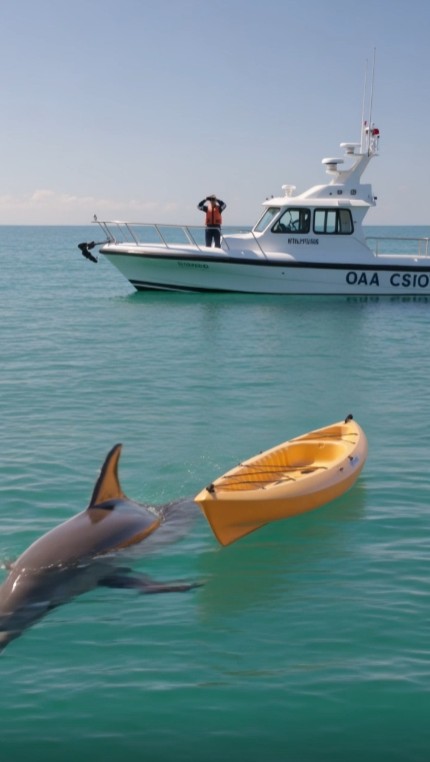
Coast guard officers spotted an empty yellow kayak drifting in the ocean.
At first, it looked like an abandoned recreational boat.
Then they noticed the dolphin.
It was swimming calmly beside the kayak.
The officers slowed their patrol vessel.
The ocean was relatively calm.
Visibility was good.
But there was no paddle.
No person in the water.
No nearby boat.
Officer Anna Reed lifted her binoculars.
“Wait.”
Her partner, Mark, turned.
“What?”
“There’s something inside.”
They approached carefully.
A black waterproof camera was clipped to the kayak by a safety cord.
The coast guard team secured the empty vessel.
Then Anna retrieved the camera.
It was still working.
The first image had been taken earlier that morning.
The same yellow kayak floated near a small rocky island several miles offshore.
The next photograph showed something unexpected.
A second kayak.
Blue.
Pulled onto the island’s narrow sandy beach.
Mark frowned.
“Why were there two kayaks?”
Anna continued scrolling.
More photographs.
Rocky cliffs.
A coastal walking trail.
Sea birds.
An old wooden observation station on the northern side of the island.
Then came the final image.
Anna stopped.
“Mark…”
He leaned closer.
His expression changed immediately.
The photograph had been taken from the beach.
Near the edge of the frame stood the blue kayak.
Farther behind it was the wooden observation station.
And in one of the station’s upper windows…
Someone was holding a red emergency flag.
Mark grabbed the radio.
“Contact the island station.”
The island was part of a protected coastal reserve.
Decades earlier, researchers had used the observation building to monitor seabird colonies and marine mammals.
Most of the year it was unstaffed.
But seasonal teams still visited.
When dispatch contacted the reserve authority, the answer made the situation more serious.
Nobody was supposed to be at the station that day.
Anna looked again at the photograph.
“Then who’s in the window?”
A rescue team was sent to the island.
The yellow kayak was towed alongside the patrol boat.
The dolphin eventually moved away on its own.
Nobody assumed the animal had intentionally led officers anywhere.
Dolphins commonly investigate floating objects and boats.
Its presence had simply made the drifting kayak easier to notice.
When the coast guard reached the island, the blue kayak was still on the beach.
One paddle lay beside it.
The second paddle was missing.
There were footprints leading inland.
The officers followed the marked coastal path.
Then they heard shouting.
“HELLO!”
It came from the observation station.
Inside were two people.
An elderly wildlife photographer named Robert.
And his adult daughter, Claire.
Both were tired.
Cold.
But safe.
Mark stared.
“Which one of you owns the yellow kayak?”
Claire raised her hand.
“I do.”
Anna looked confused.
“Then how did it end up in the ocean?”
Claire sat down.
That was the beginning of the story.
Robert had worked at the island observation station almost thirty years earlier.
He had been part of a seasonal bird-monitoring program.
The station had closed as a permanent facility years later.
But Robert never forgot it.
For his seventy-fifth birthday, Claire arranged permission for them to visit the island for a few hours.
They launched two kayaks from the mainland that morning.
Claire in the yellow one.
Robert in the blue.
The crossing went normally.
They pulled both kayaks onto the beach.
Then walked toward the observation station.
Robert carried the waterproof camera.
He wanted photographs of the place.
Everything had changed.
But enough remained familiar.
The wooden stairs.
The viewing windows.
The narrow path above the cliffs.
Robert became emotional.
“This is where I spent some of the best years of my life.”
Claire photographed him near the station.
Then the weather shifted.
Wind increased sooner than forecast.
The tide rose.
Claire became concerned.
“We should leave.”
They headed back toward the beach.
That was when they discovered something was wrong.
The yellow kayak was gone.
The blue one remained.
Claire stared at the water.
“No.”
The kayak had been secured above the normal tide line.
But one of the lines had apparently slipped loose.
Rising water reached it.
Wind did the rest.
The yellow kayak drifted offshore.
They now had one kayak.
Two people.
And conditions that were becoming less suitable for paddling.
Robert suggested going together in the blue kayak.
Claire refused.
It was a single-person touring kayak.
Overloading it would have been unsafe.
They checked their phones.
Almost no signal.
Claire managed to send one text, but it did not show as delivered.
So they returned to the station.
That decision probably prevented a much more dangerous situation.
The old building still provided shelter from wind.
Inside they found emergency blankets left for authorized researchers.
They also found a weather radio.
It worked intermittently.
But the station’s old emergency transmitter did not.
Then Robert remembered something.
A red marine signal flag used by the former research teams.
He found it inside an old supply cabinet.
Claire laughed when he pulled it out.
“You think someone is going to see that?”
Robert answered:
“If anyone checks the building, yes.”
They hung it from the upper window.
Then waited.
The mystery of the photographs had a simple explanation too.
The final image showing the red flag had been taken before the kayak drifted very far.
Robert had accidentally left the camera clipped to the yellow kayak after photographing the beach.
As the kayak began moving away, the camera’s interval-shooting mode continued taking automatic photographs.
That was why the coast guard found a sequence showing the island from increasing distance.
The final useful image happened to catch the station window.
And the red flag.
Anna looked impressed.
“So the camera was taking pictures by itself?”
Claire nodded.
“Dad had it set to take one every thirty seconds.”
Robert smiled.
“I forget things.”
“That mistake worked out.”
The officers checked both of them medically.
Neither required emergency treatment.
They had been stranded only a few hours.
The coast guard transported them safely back to the mainland.
But one question remained.
The second kayak.
Why was it still sitting on the beach if Robert and Claire had both arrived separately?
Because the blue kayak was Robert’s.
The yellow was Claire’s.
There was no missing third person.
What initially looked like evidence of someone disappearing from the island was simply evidence that two paddlers had arrived and only one kayak remained.
The photographs provided the timeline.
The first showed both kayaks.
Later images showed the yellow kayak already drifting.
And the final image showed the signal flag.
The larger mystery was not where someone had gone.
It was how two people stranded on an island had managed to leave a message on a camera floating away without knowing they were doing it.
They hadn’t planned it.
That was the extraordinary part.
A loose line.
An automatic camera setting.
An old emergency flag.
And a coast guard patrol passing through the right area.
Each one was ordinary.
Together, they were enough.
A few days later, Robert returned to the coast guard station.
Not to the island.
He brought a framed photograph.
It was the final image from the camera.
The distant observation building.
Red flag in the window.
Blue kayak on the beach.
Across the bottom, Robert had written:
Sometimes the picture you take by accident is the one that gets you home.
Anna laughed when she read it.
Then asked:
“What about the dolphin?”
Robert smiled.
“I assume it wanted credit.”
Everyone laughed.
But Anna was careful whenever people retold the story.
The dolphin had not rescued anyone.
There was no evidence it understood the kayak belonged to people in trouble.
It was simply swimming beside a floating object when officers noticed it.
The successful rescue came from good procedure.
The patrol slowed.
The officers investigated an empty vessel.
They secured the camera.
They checked its contents.
And when a photograph suggested someone might be stranded, they contacted the island immediately.
That was enough.
Claire later replaced the line on her kayak with a stronger attachment system.
She also added a marine locator beacon to her safety equipment.
Robert approved.
“Technology.”
Claire raised an eyebrow.
“You’re the one whose camera saved us.”
“That was accidental technology.”
Months later, the observation station was inspected by the reserve authority.
The emergency equipment was updated.
The red flag was replaced with modern signaling equipment.
The old one was preserved in the station archive.
Robert requested one thing.
“Don’t throw it away.”
They didn’t.
The yellow kayak was repaired and returned to Claire.
She still used it.
But she never again left it without checking the line twice.
And somewhere in the coast guard office, Robert’s framed photograph remained on the wall.
An empty island.
A tiny red square in a distant window.
And the beginning of a rescue nobody expected to find inside a drifting camera.