
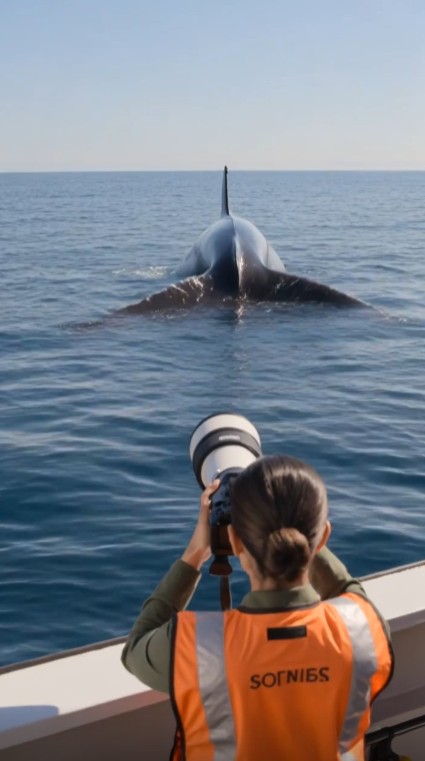
A marine biologist spotted an enormous humpback whale with a white heart-shaped marking on its tail.
At first, she thought it was simply beautiful.
Then she checked the research records.
And everything changed.
Her name was Dr. Anna Reed.
She had spent more than fifteen years studying whale migration patterns.
That morning, she was aboard a research vessel with a small marine team several miles offshore.
The sea was calm.
Visibility was good.
Then someone called from the observation deck.
“Whale at two o’clock!”
Anna lifted her camera.
A massive humpback surfaced in the distance.
It exhaled.
Then disappeared briefly.
Several seconds later, the tail rose above the water.
Anna pressed the shutter.
Once.
Twice.
Three times.
Then she lowered the camera.
Her colleague Michael leaned closer.
“Let me see that.”
Anna opened the image.
Across one side of the whale’s tail was a large white marking.
Curved at the top.
Narrow at the bottom.
Almost perfectly heart-shaped.
Michael stopped talking.
“What?”
Anna asked.
“I’ve seen that marking.”
He opened the marine research database.
Humpback whales are often identified by the unique patterns on the underside of their tails.
Like fingerprints, those patterns can allow researchers to recognize individuals over many years.
Michael searched through archived photographs.
Older field surveys.
Migration records.
Then suddenly stopped.
“There.”
Anna leaned over.
On the screen was a photograph taken twenty-one years earlier.
A much younger humpback whale.
Smaller.
Leaner.
But with the same unusual white heart-shaped marking.
Anna stared at the two images.
“Same whale?”
Michael nodded slowly.
“Looks like it.”
The old record identified the animal only by a research code:
HW-214.
Researchers at the time had nicknamed her Heart.
Anna smiled.
“That seems appropriate.”
But before they could study the file further, another whale surfaced in the distance.
Anna raised her camera again.
This one was smaller.
It rolled near the surface.
Then lifted its tail.
Anna photographed it.
A curved white stripe crossed the right side of the fluke.
Michael looked at the screen.
His expression changed again.
“Hold on.”
He returned to the database.
Anna laughed.
“Don’t tell me you recognize that one too.”
Michael did not answer.
He searched several archived files.
Then found another image.
It showed a juvenile humpback photographed twenty-one years earlier.
The tail marking matched.
Anna looked confused.
“Same year?”
“Yes.”
“Same place?”
Michael stared at the location data.
Then went quiet.
Anna leaned closer.
“What is it?”
Michael turned the screen.
“If these records are right, we need to look at what happened twenty-one years ago.”
The older file described a field season near a protected feeding area.
Researchers had documented Heart repeatedly over several weeks.
But she had not been alone.
She was accompanied by a calf.
The calf carried the curved white tail marking now visible on the second whale.
Anna stared at the records.
“You’re telling me that second whale was her calf?”
“Twenty-one years ago, yes.”
That alone was remarkable.
Researchers rarely get the chance to reconnect individuals across such a long span.
But Michael continued reading.
The story in the archived notes was more complicated.
During that season, Heart and her calf were observed unusually close to a floating line of marine debris.
At first, researchers feared one of the animals might become entangled.
The research vessel kept its distance.
The team contacted a trained marine response group.
Before the response vessel arrived, the calf moved away safely.
Heart remained nearby.
Eventually, the debris was recovered.
There was no confirmed entanglement.
No dramatic rescue.
But the event led researchers to monitor the pair closely for several more days.
Both appeared healthy.
Then migration season changed.
Heart and the calf moved on.
Over the following years, Heart was occasionally photographed in different areas.
The calf was not.
After several seasons without confirmed sightings, the younger whale effectively disappeared from the active database.
Anna looked toward the ocean.
“So we lost track of the calf.”
Michael nodded.
“Not lost in the ocean.”
“Lost from the records.”
That distinction mattered.
The whale had not vanished.
Researchers simply stopped photographing it.
Years of open water.
Different migration routes.
Changing survey areas.
Incomplete data.
Then, twenty-one years later, both whales appeared in the same research zone.
Anna watched through binoculars.
Heart surfaced again.
The second whale surfaced farther away.
They were not swimming side by side.
Not touching.
Not behaving in any way that proved some dramatic reunion.
The research team was careful.
Adult humpback whales are generally independent.
A calf does not remain permanently with its mother for decades.
The fact that both whales appeared in the same area could reflect shared migration routes or feeding habitat.
Still, the historical connection was real.
The younger whale had once been Heart’s calf.
And now both had been independently identified alive more than two decades later.
Anna said:
“That’s incredible enough.”
Michael nodded.
“No need to invent anything.”
The team spent the next several hours documenting both whales from a responsible distance.
Tail photographs.
Location data.
Behavior observations.
No chasing.
No close approach.
No attempt to force interaction.
Later that evening, back at the research station, Anna opened the full twenty-one-year-old file.
There was one more detail.
The calf had been assigned the code HW-215.
But beside it, a field researcher had written a nickname:
Ribbon.
Because of the curved white mark across the tail.
Anna laughed.
“Heart and Ribbon.”
Michael smiled.
“Researchers are not always creative.”
But then Anna found a handwritten note scanned into the archive.
It had been written on the final day the pair were documented together.
Heart remained near calf throughout observation period. Both healthy. Calf increasingly independent. Likely approaching normal separation period.
Anna read it twice.
That changed the emotional meaning of the encounter.
Twenty-one years earlier, researchers had watched a mother whale and her calf nearing the stage when they would naturally separate.
Then human records lost the calf.
Now both individuals had reappeared.
Not as mother and dependent young.
As two adult whales moving through the same ocean.
Anna wondered how many times they had passed through nearby waters without being photographed.
How many migrations had occurred between those two images.
How many storms.
Feeding seasons.
Long-distance journeys.
No database could show that.
The next day, Heart was photographed again.
Ribbon was not.
Two days later, Ribbon appeared several miles south.
Heart had moved north.
That actually reassured Anna.
The whales were behaving like independent adults.
The extraordinary part was not that they were inseparable after twenty-one years.
They were not.
It was that both had survived long enough for researchers to identify them again.
The discovery prompted the team to revisit old whale-photo archives.
Pattern-matching software had improved significantly since the original survey.
Thousands of photographs were digitized.
Researchers began comparing old IDs against newer sightings.
Over the following months, several long-missing whales were rediscovered in the records.
One had been photographed by a tourist boat eight years earlier but never matched to the research database.
Another appeared in a university survey hundreds of miles away.
The ocean had not returned lost animals.
The data had finally caught up with them.
Heart became one of the best examples.
Her white marking was unusually distinctive.
That made the twenty-one-year comparison easier.
Ribbon’s curved marking was less obvious.
Without the second whale surfacing that same afternoon, researchers might not have made the connection.
Anna later presented the findings at a marine conservation meeting.
She was careful with the language.
She did not say:
A mother and child reunited after twenty-one years.
There was no evidence of that.
Instead, she said:
Two humpback whales documented as mother and calf twenty-one years earlier were independently reidentified within the same regional habitat during the same survey period.
Some people thought that wording sounded less emotional.
Anna disagreed.
Truth did not need exaggeration.
Twenty-one years earlier, one whale had been small enough to travel beside its mother.
Now it crossed the ocean as a full-grown animal.
Heart had also survived two more decades.
The markings on their tails connected the photographs across time.
That was extraordinary.
Months later, the research team updated the database.
HW-214 — Heart.
Confirmed alive.
HW-215 — Ribbon.
Confirmed alive.
The old file remained unchanged.
Researchers never erased the years of uncertainty.
Instead, new photographs were added beside the old ones.
Young Heart.
Older Heart.
Calf Ribbon.
Adult Ribbon.
Two lives documented only in fragments.
Anna printed four photographs and pinned them above her desk.
The most recent image showed Heart’s tail rising above the sea.
The white heart clearly visible.
Beside it was the photograph from twenty-one years earlier.
Almost the same shape.
Almost the same angle.
But an entire life had happened between them.
People often asked Anna whether whales remember relatives after decades.
Her answer was always cautious.
Researchers know whales have sophisticated social behavior and memory, but one chance observation cannot prove what two specific animals recognized or felt.
She did not know whether Heart recognized Ribbon that day.
She did not know whether Ribbon recognized Heart.
And she would not pretend otherwise.
What she knew was enough.
These two whales had once traveled together.
One as a mother.
One as a calf.
Then their paths separated.
Human tracking lost one of them.
Years passed.
And on one calm morning twenty-one years later, both tails rose from the same stretch of ocean.
One marked with a white heart.
The other with a curved white ribbon.
For a few minutes, an old research file stopped being history.
It became present tense again.