
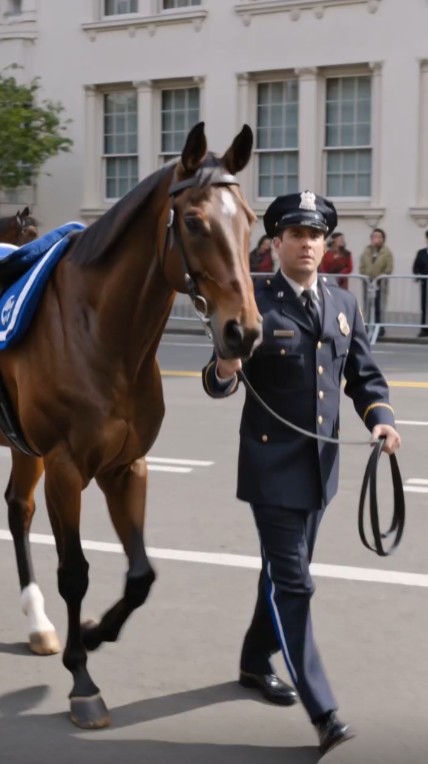
A police horse suddenly stopped during a ceremonial parade.
And turned toward one elderly man in the crowd.
The officer in the saddle looked down.
“Atlas… what’s wrong?”
The horse was not frightened.
He was not injured.
He simply stood quietly.
Looking toward the spectator barrier.
Then an elderly man stepped forward.
Faded green jacket.
Gray hair.
Tears already forming in his eyes.
He made a soft two-note whistle.
Atlas turned both ears toward him.
The mounted officer stared.
“Sir… do you know this horse?”
The old man smiled.
“I used to train him.”
The officer looked surprised.
Atlas had served with the mounted unit for years.
He was known for being calm in crowds.
Steady around traffic.
Reliable during ceremonies.
But few current officers knew much about his early life.
A parade supervisor named Claire approached.
She had heard the conversation.
Then she heard the man’s name.
“William?”
The elderly man nodded.
Her expression changed immediately.
“We’ve been trying to find you.”
William looked confused.
“About Atlas?”
Claire hesitated.
Then answered:
“About what happened before he joined the unit.”
William went silent.
He looked at the horse.
Then at Claire.
“What did you find?”
The story began almost thirteen years earlier.
Atlas had not been bred specifically for police work.
He had been a young gelding at a small training farm outside the city.
Strong.
Intelligent.
But difficult.
Not dangerous.
Just uncertain.
He startled easily around unfamiliar noises.
Refused narrow entrances.
And became tense whenever more than a few people crowded around him.
Several buyers passed on him.
William did not.
At the time, William was sixty-two and had spent most of his life working with horses.
He never described himself as a horse whisperer.
He hated that phrase.
“Training is repetition,” he always said.
“And paying attention.”
William noticed something others missed.
Atlas did not react strongly to noise itself.
He reacted when he could not understand where the noise was coming from.
So William changed the training.
No forcing.
No overwhelming the horse.
They started slowly.
One person clapping from a distance.
Then several.
Plastic flags.
Traffic sounds played quietly.
People walking around him.
Umbrellas opening.
Metal gates moving.
Atlas learned that unfamiliar sounds did not automatically mean danger.
William also taught him a simple two-note whistle.
Not as a trick.
As a cue.
Whenever Atlas became uncertain, William whistled.
Then asked for something familiar.
Stand.
Step.
Turn.
Breathe.
Over time, the whistle became associated with calm, predictable work.
That explained the parade.
At least partly.
Atlas may have recognized the familiar whistle.
He may also have recognized William’s voice, posture, scent, or some combination of familiar cues.
Nobody could know exactly what the horse remembered.
But his response was unmistakably attentive.
Claire asked:
“Did you train him alone?”
William shook his head.
“No.”
There had been another trainer.
A woman named Margaret Hayes.
She was twenty-seven.
Talented.
Patient.
And much better than William at keeping records.
Margaret documented everything.
Every exercise.
Every reaction.
Every improvement.
If Atlas hesitated near a gate, Margaret wrote it down.
If he relaxed around a new sound, she recorded that too.
William joked that she spent more time writing about horses than riding them.
Margaret replied:
“That’s how the next person knows what we learned.”
Those records became important later.
Very important.
When Atlas was six, the training farm ran into financial trouble.
Several horses needed new placements.
William contacted multiple organizations.
One was the city mounted unit.
They were not looking for just any horse.
Mounted police horses needed specific temperaments.
Confidence.
Soundness.
Trainability.
The ability to tolerate crowds without becoming unsafe.
Atlas was assessed.
At first, the unit was skeptical.
His old notes mentioned sensitivity.
William understood.
He told them:
“Don’t take my word for it.”
“Test him.”
They did.
Over several weeks, Atlas went through professional evaluations.
Traffic.
Crowds.
Noise.
Novel objects.
Veterinary examination.
He passed.
Not perfectly.
But well enough that the mounted unit accepted him into further training.
William expected that to be the beginning of something good.
Instead, it became one of the hardest periods of his life.
Margaret became seriously ill.
Her condition progressed quickly.
William spent less time at the farm.
He visited her.
Helped her family.
Handled the remaining horses.
When Atlas officially transferred to the mounted unit, William was not there.
Margaret was in the hospital.
A few weeks later, she died.
William stopped training horses shortly afterward.
Not because of Atlas.
Because too much of the farm reminded him of Margaret.
He sold his equipment.
Moved closer to his daughter.
And gradually lost contact with everyone connected to the old program.
Atlas continued.
He completed mounted-unit training.
Years passed.
He became one of the unit’s most reliable horses.
Claire had joined later.
She knew Atlas only as an experienced police horse.
Then, during a routine archive project, the unit began digitizing old training records.
That was when they found Margaret’s notebooks.
Dozens of pages.
Claire was fascinated.
The notes did more than describe Atlas.
They showed exactly how much careful groundwork had gone into him.
There was one page that stood out.
Margaret had written:
Atlas should never be judged by how quickly he accepts something new. Judge him by what he does after he understands it.
Claire read it several times.
That sentence perfectly described the horse she knew.
Then she found a second note.
If Atlas ever enters public service, please tell William he was right not to give up on him.
Claire looked at the date.
It had been written shortly before Atlas left the farm.
She asked around.
Nobody knew where William was.
The old farm had closed.
Phone numbers were dead.
Mail was returned.
Claire tried again months later.
Nothing.
Then came the parade.
William had not attended because he knew Atlas would be there.
He had no idea.
His granddaughter invited him.
She wanted him out of the house.
William almost refused.
Then agreed.
He stood behind the barrier with hundreds of other spectators.
When the mounted unit approached, he barely paid attention at first.
Then he saw a dark bay horse with a small irregular white marking near the shoulder.
William’s breath caught.
He knew that marking.
But thirteen years had passed.
He thought:
Impossible.
Then Atlas came closer.
William saw the shape of his face.
The way he carried his head.
And suddenly he was sure.
Without thinking, William whistled.
Two notes.
The same cue he had used hundreds of times.
Atlas stopped.
Claire now understood what had happened.
She looked at William.
“We have something for you.”
After the parade, William was invited to the mounted unit’s stable.
No crowd.
No ceremony.
Just a few officers.
Atlas was unsaddled and settled.
William stood outside the stall.
He did not rush in.
Did not grab the horse.
He waited.
Atlas approached.
Sniffed his hand.
Then remained near him.
William smiled.
“That’s enough.”
Claire asked:
“You don’t want to hug him?”
William laughed.
“He’s a horse.”
“I don’t need him to prove anything.”
That answer surprised the younger officers.
William explained.
People loved telling stories about horses remembering someone after many years.
Sometimes they might.
Horses can learn and retain associations.
But humans often turned every reaction into a dramatic reunion.
William did not need that.
“If he remembers something about me, fine.”
“If he doesn’t, also fine.”
“He’s healthy.”
“He has a good life.”
“That’s what matters.”
Then Claire brought out a box.
Inside were copies of Margaret’s training notes.
William stared at them.
He recognized the handwriting immediately.
His hands began trembling.
Claire opened to the marked page.
Atlas should never be judged by how quickly he accepts something new. Judge him by what he does after he understands it.
William laughed quietly.
“She always wrote better than I talked.”
Then Claire showed him the second note.
Please tell William he was right not to give up on him.
William stopped smiling.
For several seconds, he said nothing.
Then he sat down.
Margaret had written that before she became too ill to return to work.
William had never seen it.
He thought Atlas’s successful transfer had been mostly her achievement.
Margaret had apparently thought the opposite.
Claire said:
“We were trying to find you because these records belong to the history of the unit.”
“And because she clearly wanted you to know.”
William wiped his eyes.
“She knew I blamed myself.”
“For what?”
“For not being there when he left.”
Claire shook her head.
“You got him here.”
William looked toward Atlas.
“No.”
“We did.”
That distinction mattered to him.
William had started the work.
Margaret refined it.
The mounted unit continued it.
Veterinarians maintained Atlas’s health.
Officers built years of trust.
No one person created the horse he had become.
Claire agreed.
The archive was updated to reflect exactly that.
Atlas’s early history now included both William and Margaret.
Not as legends.
As trainers.
Their work was documented.
Their methods were preserved.
Some of Margaret’s exercises were even incorporated into training discussions for younger mounted-unit staff.
Especially one principle:
Do not confuse hesitation with inability.
That became Margaret’s quiet legacy.
William began visiting occasionally.
Never too often.
He did not want to interfere with Atlas’s routine.
Sometimes he watched training sessions.
Sometimes he brought old photographs.
One showed Atlas as a young horse standing beside a blue tarp, clearly unsure whether he wanted anything to do with it.
Another showed Margaret beside him, smiling.
Claire placed copies in the archive.
The original photographs stayed with William.
Months later, Atlas participated in another public event.
William attended.
This time, he did not whistle.
He simply watched.
Atlas passed by calmly.
The officer riding him waved.
William waved back.
That was enough.
A young volunteer standing nearby had heard the story.
She asked:
“Aren’t you disappointed he didn’t stop again?”
William smiled.
“No.”
“Why not?”
“Because he has a job.”
The volunteer laughed.
William looked toward Atlas disappearing down the street.
“When I trained him, the goal was never for him to spend the rest of his life looking for me.”
“The goal was for him to be okay without me.”
That sentence stayed with Claire.
Years later, when Atlas reached retirement age, the mounted unit followed its normal welfare and placement procedures.
William was invited to the retirement ceremony.
He was older then.
Walking slowly.
Atlas stood quietly beside his longtime officer.
Claire read a short passage from the archive.
Not about arrests.
Not about parades.
Not about how many years Atlas served.
She read Margaret’s line.
Judge him by what he does after he understands it.
William lowered his head.
Then smiled.
Atlas retired to an approved farm where he could live comfortably with other horses.
William visited once.
He stood near the fence.
Made the same soft two-note whistle.
Atlas lifted his head.
Turned his ears.
Then returned to grazing.
William laughed.
“Good boy.”
He did not need anything more.
The parade story eventually spread.
People simplified it.
They said a police horse recognized his trainer after thirteen years.
Maybe he did.
There were familiar cues and a clear behavioral response.
But nobody could know precisely what Atlas remembered.
The documented truth was already meaningful enough.
Years earlier, a difficult young horse had been given time instead of being written off.
Two trainers worked patiently with him.
One died before she could see how far he went.
The other disappeared from the unit’s history without realizing she had left him a message.
Then, by chance, an elderly man attended a parade.
Made an old two-note whistle.
And gave the mounted unit the final piece it needed to reconnect Atlas’s present with his past.
William thought he was seeing an old horse again.
Instead, he discovered that Margaret’s last words about their work had been waiting for him for years.