
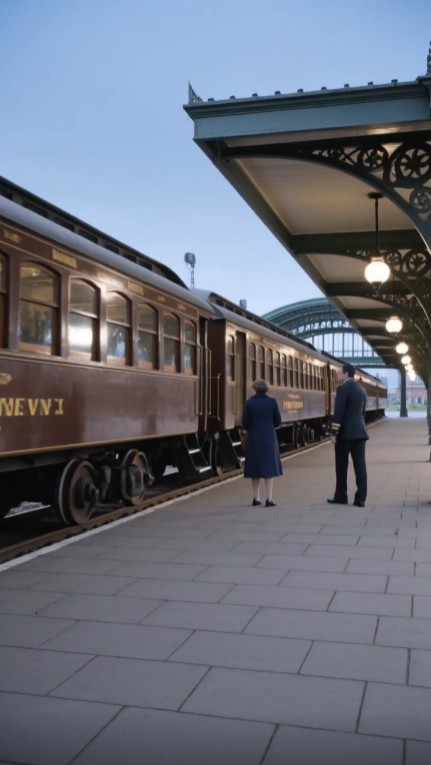
A train conductor noticed an elderly woman carrying an old violin case.
And suddenly shouted:
“WAIT! DON’T CLOSE THE DOORS!”
Passengers turned.
The train was ready to depart.
But the conductor was not looking at the woman’s face.
He was staring at the corner of her violin case.
More specifically, at a tiny silver bird attached to the worn leather.
The elderly woman stopped.
The conductor stepped closer.
“Ma’am… where did you get that?”
She looked confused.
“This?”
She touched the little bird.
“It belonged to my husband.”
The conductor slowly reached into his pocket.
Then pulled out a matching silver bird pin.
The woman’s hands began trembling.
“Where did you find that?”
The conductor did not answer immediately.
Instead, he pointed inside the first carriage.
Near the window was an empty seat.
A single white flower rested on it.
The woman stared.
“Why is that seat empty?”
The conductor lowered his voice.
“Someone asked us to keep it that way.”
“Who?”
He looked at the violin case.
Then back at her.
“Someone who knew your husband.”
Her name was Margaret.
She was seventy-seven years old.
And until that moment, she had believed she was simply taking one last train ride.
The route ran through a chain of small towns, eventually reaching the coastal city where Margaret had lived as a young woman.
She had not traveled it in almost forty years.
Her husband, Thomas, had loved that line.
Before they married, he took it every Friday evening to visit her.
Later, when they had little money, the train became their version of a holiday.
One ticket.
Two sandwiches.
A violin.
They would get off in some small town, walk for an hour, then catch the return train home.
Thomas died three years earlier.
Since then, Margaret had barely opened the violin case.
It had been his.
Not because he was a professional musician.
Thomas had worked most of his life repairing railway signals.
But he played violin beautifully.
Mostly by ear.
At weddings.
Community halls.
On station platforms during charity events.
And sometimes, late at night, just for Margaret.
The silver bird attached to the case had always been there.
Margaret never knew where it came from.
Whenever she asked, Thomas smiled and said:
“Old railway nonsense.”
Now a conductor was holding its twin.
Margaret stepped onto the train.
The doors closed behind her.
The conductor introduced himself.
“My name is Daniel.”
Margaret nodded.
“Tell me what’s happening.”
Daniel glanced toward the empty seat.
“Please sit first.”
“I’m fine.”
“Mrs. Hale…”
She froze.
“I didn’t tell you my name.”
Daniel smiled gently.
“I know.”
That frightened her more than it reassured her.
“Who arranged this?”
Daniel took a breath.
“A man named Arthur Reed.”
Margaret stared.
She knew the name.
But only vaguely.
“Arthur?”
Daniel nodded.
“He worked with your husband.”
Margaret looked toward the window.
Then suddenly remembered.
Arthur.
Young railway apprentice.
Thomas had mentioned him decades earlier.
Not often.
But enough.
“Is he here?”
Daniel’s expression changed.
“No.”
Margaret looked back at the white flower.
“What happened?”
Daniel sat across from her.
Then began explaining.
Forty-six years earlier, Thomas and Arthur had both worked in railway maintenance.
Thomas was older.
More experienced.
Arthur had just turned nineteen.
He was nervous.
Always asking questions.
Always afraid of making mistakes.
Thomas took him under his wing.
Not officially.
He simply noticed the young man was overwhelmed.
When Arthur struggled with technical diagrams, Thomas stayed after shifts and explained them.
When Arthur damaged a piece of equipment and thought he would lose his job, Thomas made him report it properly instead of hiding it.
When Arthur’s father died, Thomas drove him home.
Margaret listened quietly.
“He never told me much about that.”
Daniel nodded.
“Apparently your husband didn’t talk much about helping people.”
“That sounds like him.”
Then Daniel held up the silver bird.
Thomas had made two of them.
From a small piece of scrap metal.
One for himself.
One for Arthur.
The bird was based on an old railway expression.
The early signal workers used to say:
Watch the birds.
Birds often gathered on the telegraph wires that once followed railway lines.
To Thomas, the little bird became a joke about paying attention.
Noticing what others missed.
Arthur kept his pin for the rest of his life.
Margaret looked at Daniel.
“His life?”
Daniel nodded.
Arthur had died six months earlier.
Margaret closed her eyes.
“I’m sorry.”
Daniel continued.
Before Arthur died, he left instructions with his daughter.
Not for money.
Not for property.
For a train journey.
Arthur had spent decades trying to find Thomas.
After railway restructuring, workers moved.
Records changed.
People lost touch.
Arthur knew Thomas had married a woman named Margaret.
He remembered the violin.
He remembered the silver bird.
But little else.
Years later, Arthur discovered Thomas had died.
That hit him harder than he expected.
He had always assumed there would be time to reconnect.
There wasn’t.
So Arthur wrote a letter.
Then asked his daughter to find Margaret if she could.
It took months.
Old employee records.
Retirement newsletters.
A community music archive.
Eventually they found her.
But Arthur’s daughter did not contact Margaret immediately.
Arthur had left very specific instructions.
If Margaret ever traveled the old route with Thomas’s violin, the railway staff were to offer her seat 14A.
The seat where Thomas and Arthur had once sat during a journey neither man forgot.
Margaret looked toward the empty seat.
“That one?”
Daniel nodded.
She slowly stood.
Walked toward it.
The white flower was a lily.
Thomas’s favorite.
Margaret sat down.
Daniel handed her an envelope.
Her name was written across it.
The handwriting was shaky.
Margaret opened it.
Dear Margaret,
You don’t know me well, but your husband changed my life.
She stopped reading.
Her eyes filled.
Then she continued.
Arthur wrote about his first year on the railway.
How scared he had been.
How close he came to quitting.
Then one winter evening, everything changed.
A storm damaged signaling equipment along the line.
Thomas and Arthur were sent out with a maintenance team.
Nothing dramatic happened.
No crash.
No heroic rescue.
But Arthur made an error.
He misunderstood an instruction and prepared to reset a piece of equipment too early.
Thomas noticed.
Stopped him.
Then made Arthur explain the entire procedure again from the beginning.
Arthur expected to be humiliated.
Instead, Thomas said:
“You’re allowed to be new.”
“You’re not allowed to pretend you understand something you don’t.”
Arthur never forgot it.
That sentence shaped his career.
He became a trainer.
Then a supervisor.
Later, he taught hundreds of younger railway workers.
His rule was simple:
If you don’t know, ask.
If someone asks, don’t make them feel stupid.
Margaret wiped her eyes.
Daniel remained silent.
Arthur’s letter continued.
Years later, he asked Thomas why he had been so patient.
Thomas answered:
“Because someone did it for me.”
Arthur never found out who.
Margaret smiled.
She knew.
Thomas’s father.
A carpenter.
The most patient man Margaret had ever met.
Arthur wrote:
Your husband taught me that knowledge only matters if you make it safe for someone else to admit they need it.
I spent my career trying to do that.
Margaret stopped again.
The carriage had become unusually quiet.
Several passengers had realized something personal was happening and lowered their voices.
Then Margaret reached the final paragraph.
Thomas once told me that if I stayed on the railway long enough, I would eventually understand why he carried that ridiculous violin everywhere.
I never did.
So if you are reading this with the case beside you, perhaps you can finally explain it to me.
Margaret laughed through tears.
Daniel smiled.
“Can you?”
She looked down at the case.
“Yes.”
Thomas carried the violin because music had been the one thing he nearly gave up as a young man.
His family had little money.
He worked long shifts.
There was no reason, practically speaking, to keep playing.
Margaret convinced him.
Not because she thought he would become famous.
Because he became different when he played.
Calmer.
Kinder.
More himself.
So Thomas carried the violin on trains.
To weddings.
To family parties.
To long shifts when somebody might ask for music afterward.
Arthur had apparently misunderstood for forty-six years.
Margaret smiled.
“It wasn’t railway nonsense.”
Daniel laughed.
“I suspected that.”
The train began moving through countryside.
Margaret held the silver bird.
Then looked toward the flower.
“What exactly did Arthur ask you to do?”
Daniel answered:
“Keep the seat empty until you arrived.”
“And if I never came?”
Daniel smiled.
“Then apparently Arthur said we should stop being ridiculous after one year.”
Margaret laughed.
“That sounds like someone Thomas would’ve liked.”
The plan had worked because Arthur’s daughter eventually contacted Margaret with a simple invitation.
A commemorative railway journey was being organized for retired workers and their families.
Would she like a ticket?
She never knew the journey had been partly arranged around her.
Margaret brought the violin because the invitation mentioned old railway memories.
She thought Thomas would have liked that.
Now she understood why the date mattered.
It was the anniversary of the day Thomas and Arthur first worked together.
Daniel asked:
“Do you play?”
Margaret shook her head.
“Not properly.”
“Did Thomas teach you anything?”
“One piece.”
Daniel smiled.
“Arthur requested something else.”
Margaret raised an eyebrow.
“This man is demanding a lot for someone I never really knew.”
Daniel laughed.
“He asked that if you were comfortable, someone should play Thomas’s old railway tune.”
Margaret looked down.
Thomas had one melody he always played on train journeys.
A simple folk tune.
Nothing famous.
Just twelve bars he had modified over the years.
Margaret opened the case.
The violin had not been played in almost three years.
Inside, beneath the instrument, was another surprise.
A photograph.
Margaret had never seen it.
Thomas and Arthur.
Both young.
Standing beside a railway maintenance vehicle.
Thomas holding the violin.
Arthur holding a lunchbox.
Pinned to the back was a note from Arthur’s daughter:
Dad kept this photograph for forty-six years.
Margaret pressed the picture against her chest.
Then she lifted the violin.
Her hands were unsteady.
“I haven’t done this in a long time.”
Daniel said:
“You don’t have to.”
Margaret shook her head.
“I want to.”
She tightened the bow.
Adjusted the instrument.
Then played.
Not beautifully.
Not perfectly.
But clearly enough.
The melody was unmistakable to her.
By the fourth bar, something unexpected happened.
A man sitting three rows away began humming.
Margaret stopped.
He looked embarrassed.
“My grandfather worked on the railway.”
“He used to hum that.”
Another passenger recognized part of it too.
The melody had traveled.
Not widely.
Not historically.
Just through families.
Workers.
Station gatherings.
Small events.
Thomas had apparently played it more often than Margaret realized.
She began again.
This time she finished.
When the final note faded, nobody immediately applauded.
The silence felt more appropriate.
Then Daniel placed Arthur’s silver bird beside Thomas’s on the violin case.
Margaret looked at him.
“Shouldn’t this go to his daughter?”
“She has another keepsake.”
“Arthur wanted these two together.”
Margaret touched both pins.
Two tiny birds.
One polished from years in Arthur’s pocket.
One scratched from decades on Thomas’s violin case.
Near the end of the journey, the train reached the coastal station where Thomas used to visit Margaret before they married.
Margaret stepped onto the platform.
Arthur’s daughter, Claire, was waiting.
They recognized each other immediately despite never having met.
Claire walked forward.
“Mrs. Hale?”
Margaret hugged her.
No introduction needed.
They sat on a bench while the train remained at the station during its scheduled layover.
Claire told Margaret more about Arthur.
He had married.
Raised three children.
Become a grandfather.
Retired after forty-one years on the railway.
For decades, whenever he trained a new employee, he repeated Thomas’s sentence:
You’re allowed to be new.
You’re not allowed to pretend you understand something you don’t.
Eventually younger workers began quoting it without knowing where it came from.
Margaret smiled.
“Thomas would’ve liked that.”
Claire handed her one final object.
Arthur’s old notebook.
On the first page was a list titled:
THINGS TOM TAUGHT ME.
Number one:
Ask twice before guessing once.
Number two:
Never embarrass the new person.
Number three:
If someone has a violin, make them play it.
Margaret laughed so loudly that people on the platform turned.
“That one sounds exactly like him.”
Claire smiled.
“Dad said Thomas ruined quiet train rides forever.”
Before they parted, Margaret asked the question that had bothered her.
“Why did your father go to all this trouble?”
Claire thought for a moment.
“Because he regretted waiting.”
“He always thought he’d find Thomas next year.”
“Then another year passed.”
“When he learned Thomas had died, he said something I never forgot.”
Margaret waited.
Claire continued:
“He said gratitude has an expiration date if you never deliver it.”
Margaret looked toward the train.
That was why Arthur arranged the journey.
Not to create a spectacle.
Not to claim Thomas had performed some extraordinary act.
Thomas had simply been kind to a frightened young coworker.
Patient when he could have been cruel.
Careful when someone else was learning.
Arthur carried that lesson through an entire career.
And by the time he finally understood how much it mattered, Thomas was gone.
So Arthur sent the thank-you to the person who had shared Thomas’s life instead.
Margaret returned home that evening with the violin.
Two silver birds.
Arthur’s letter.
And the photograph.
Months later, she donated copies of the letters and photographs to a small railway heritage archive.
The originals stayed with the families.
The railway also began using Arthur’s favorite line in its apprentice training materials.
Not because it was official doctrine.
Because the principle still mattered.
You’re allowed to be new.
You’re not allowed to pretend you understand something you don’t.
Margaret continued taking the train occasionally.
Seat 14A was no longer kept empty.
She did not want it turned into a shrine.
Seats were for passengers.
Thomas would have said the same thing.
But once a year, on the anniversary of that journey, Margaret brought the violin.
Sometimes she played the old tune.
Sometimes she just carried it.
And whenever someone asked about the two silver birds attached to its corner, she told them the truth.
They did not mark a famous friendship.
They belonged to two railway workers who had once shared a shift, a train seat, and a lesson.
One man gave the lesson.
The other carried it for forty-six years.
And when there was no longer time to thank him directly, he left one final seat empty so the message could still find its way home.