
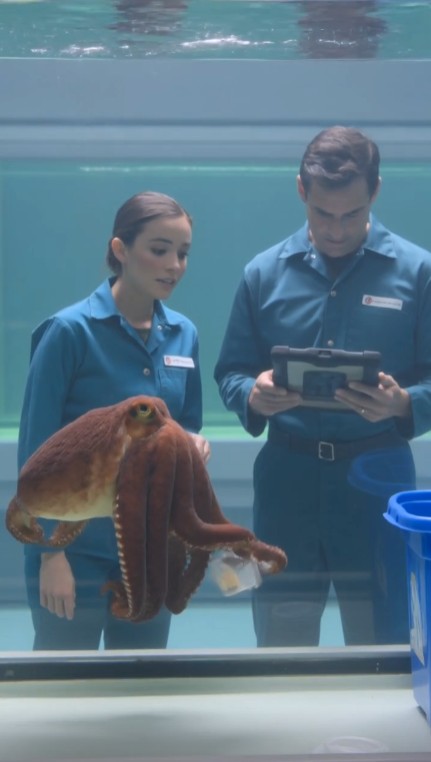
An octopus opened a container the aquarium staff had not prepared for him.
And what was inside surprised the researchers.
His name was Atlas.
He was a giant Pacific octopus living in a professional marine research aquarium.
Healthy.
Curious.
And very good at solving enrichment puzzles.
The staff regularly gave him safe containers with food or textured objects inside.
Nothing dangerous.
Nothing sharp.
Nothing placed in the habitat without approval.
That morning, marine biologist Claire was preparing the normal enrichment session when she noticed Atlas moving toward a transparent container near the side of the tank.
She stopped.
“Wait.”
Her colleague Ben looked over.
“What?”
“That isn’t today’s box.”
The container was rectangular.
Clear acrylic.
With a simple twist mechanism on one side.
Atlas had already reached it.
One arm slid across the lid.
Then another.
He explored the edges.
Ben frowned.
“Where did that come from?”
Claire checked the preparation table.
Their approved enrichment container was still sitting there.
Unopened.
This one definitely did not belong in the habitat.
The staff immediately reviewed whether it posed any risk.
The acrylic was intact.
No sharp edges.
No loose hardware.
Atlas continued manipulating the mechanism.
Before anyone could safely intervene without disturbing him unnecessarily, the lid shifted.
Then opened.
Something small rolled out.
A yellow plastic token.
Atlas touched it briefly.
Then ignored it.
Claire stared.
There was a dark symbol printed on the token.
A circle crossed by three short lines.
She recognized it.
“I’ve seen that before.”
Ben looked closer.
“Where?”
Claire left another staff member monitoring Atlas and hurried toward an old equipment display in the aquarium’s research corridor.
Several retired instruments were kept there.
Early water-quality meters.
Tag readers.
Camera housings.
A bulky experimental feeder.
On the side of one instrument was the same symbol.
Circle.
Three lines.
Claire called Ben over.
“That’s it.”
Ben read the label.
PROJECT LANTERN — 2004–2008.
Neither of them knew much about it.
The project had ended years before they joined the aquarium.
Ben opened the digital archive.
The first files were ordinary.
Enrichment trials.
Behavioral observations.
Prototype equipment.
Then he found a restricted-storage note.
His expression changed.
Claire noticed.
“What?”
Ben kept reading.
“This equipment was supposed to have been separated from active animal-care materials.”
“Why?”
He scrolled farther.
Then stopped.
“This container was never supposed to be here.”
Claire looked through the window toward Atlas.
“What did you find?”
Ben turned the screen.
Project Lantern had been an early attempt to study how octopuses interacted with different types of puzzle mechanisms.
Researchers created several containers.
Some opened by twisting.
Some sliding.
Some pulling.
Each was marked with colored tokens so staff could record which mechanism had been used during each trial.
Yellow meant one specific experimental sequence.
The symbol identified equipment belonging to the study.
That explained the token.
It did not explain how a twenty-year-old research container had ended up in Atlas’s habitat.
Then Claire noticed another note.
Retired following protocol review. Do not reuse for enrichment.
Her expression changed.
“Was something wrong with it?”
Ben opened the review file.
The answer was less dramatic than they feared.
The containers were not inherently dangerous.
But the old project had inconsistent cleaning and labeling procedures by modern standards.
Some prototypes also had removable components that current animal-care rules would not allow.
So when the study ended, the remaining equipment was supposed to be archived permanently.
Not reused.
Not mixed with current enrichment materials.
Claire immediately contacted the aquarium’s animal-care supervisor.
Atlas was calmly exploring another section of the habitat.
The yellow token had been recovered safely.
The container was removed once the team could do so without causing unnecessary disruption.
Then they started tracing how it got there.
The answer began in a storage room.
Several weeks earlier, the aquarium had been reorganizing old research spaces.
Boxes from the former laboratory were moved temporarily while shelving was replaced.
One unlabeled crate contained retired Project Lantern equipment.
At some point, a clear acrylic container was placed on the wrong cart.
Because it looked almost identical to modern enrichment boxes, someone later carried it into the preparation room.
Nobody realized what it was.
The symbol was small.
The yellow token was inside.
And the container itself had no obvious warning label.
Claire looked at the supervisor.
“So this was a storage mistake.”
“Most likely.”
That solved how it reached Atlas.
But not why Project Lantern had been stored so carefully in the first place.
Ben kept reading.
The original study had involved an octopus named Iris.
She had become well known among the old research team because she repeatedly solved one particular puzzle faster than expected.
Not because she understood some secret human code.
Not because she was performing tricks on command.
She was simply highly exploratory and learned quickly through repeated interaction.
Researchers eventually began testing whether she would transfer experience from one container mechanism to another.
The yellow token belonged to her final series of trials.
Claire found an old photograph.
Iris was partly visible behind the same style of container.
Beside the photograph stood a young researcher named Dr. Samuel Hale.
Ben recognized the name.
“He used to direct the marine cognition program.”
Samuel had retired more than a decade earlier.
The archive included one final report he had written when Project Lantern ended.
Claire began reading.
The report explained that the project was closed not because it failed.
It ended because the team became uncomfortable with how people outside the research program were interpreting the results.
Visitors heard that Iris could open complex containers.
Soon stories spread that she could “read symbols.”
That she “understood locks.”
That she was “planning solutions like a human engineer.”
The researchers never claimed those things.
They had only documented repeated problem-solving behavior under controlled conditions.
Samuel wrote:
The animal’s abilities are remarkable enough without assigning human motives or concepts we have not demonstrated.
Claire read that line aloud.
Ben smiled.
“That could’ve been written yesterday.”
The project shifted after that.
Rather than trying to make increasingly spectacular puzzles, the team focused more on welfare-centered enrichment.
Variety.
Choice.
Safe exploration.
Less emphasis on “proving intelligence” for public attention.
The old Project Lantern equipment was retired partly to prevent it being casually reused as entertainment without the original research context.
That was why the storage note existed.
Claire looked toward Atlas.
“So he just happened to open something from an old cognition project.”
“Pretty much.”
Still, there was one more mystery.
The yellow token.
According to the archived inventory, every token from the final Project Lantern series had been accounted for.
Except one.
Yellow token L-17.
Status:
Missing.
Claire stared at the number printed faintly on the recovered token.
L-17.
“No way.”
Ben checked again.
Same code.
The token Atlas had just exposed had been officially missing for almost twenty years.
The team reconstructed the likely explanation.
It had probably never been lost in the building.
It was trapped inside the container.
The prototype’s inner compartment had a narrow recess.
If the token slid behind it during a trial, staff might not have been able to see it.
The container was retired.
Placed into storage.
And the token remained inside.
For almost two decades.
Then a storage mix-up brought the box back into circulation.
Atlas manipulated it.
The old compartment shifted.
And the missing token rolled free.
Ben laughed.
“So Atlas solved a twenty-year inventory problem.”
Claire shook her head.
“Accidentally.”
“Still counts.”
“No, it counts as us needing better labels.”
That became the official lesson.
The aquarium did not present the incident as proof that Atlas had somehow recognized old research equipment.
There was no evidence of that.
To him, it was simply another unfamiliar object.
He explored it because octopuses are naturally curious and because he had previous experience manipulating safe enrichment devices.
The mystery belonged to the humans.
Why was the container there?
Why did the symbol match old equipment?
Why was a missing token inside?
And why had the original project been shut away?
The answers were all in the archive.
But the discovery also revived interest in Project Lantern for a better reason.
Not the sensational claims.
The philosophy that ended it.
Claire contacted Samuel Hale.
He was eighty-one.
When she explained what happened, he laughed for nearly a full minute.
“You’re telling me L-17 was inside the container?”
“Yes.”
“We tore that lab apart looking for it.”
“Atlas found it.”
“No.”
Samuel corrected her immediately.
“Atlas opened a box.”
“You found it.”
Claire smiled.
“You really haven’t changed.”
Samuel agreed to visit the aquarium.
When he arrived, Claire showed him the token.
He held it carefully.
“Twenty years.”
Ben asked:
“Did Iris really solve these puzzles as quickly as the notes say?”
Samuel nodded.
“She was extraordinary.”
Then he added:
“But extraordinary is not the same as magical.”
He explained how easy it was for people to overinterpret intelligent animal behavior.
Octopuses can explore, manipulate objects, learn from repeated experience, and show complex behavior.
But researchers still have to distinguish observation from story.
“We knew what Iris did.”
“We didn’t always know why.”
That was one reason Samuel eventually changed the program.
He wanted enrichment to support animal welfare rather than become a contest to see what impressive thing an octopus could do next.
Claire asked:
“Would you use Project Lantern equipment today?”
Samuel looked at the old container.
“No.”
“Modern designs are safer.”
“And you know more now.”
“That’s how research is supposed to work.”
The aquarium made several changes after the incident.
Archived research equipment was moved into clearly marked storage.
Old containers were cataloged individually.
Active enrichment materials were separated by design and color.
Nothing entered an animal habitat without a current inspection label.
The mistake that brought the Project Lantern box to Atlas would be much harder to repeat.
As for the yellow token, Samuel did not want it.
He asked the aquarium to keep it.
The conservation team placed it in the research-history display beside the old instrument.
The new label explained:
Token L-17, Project Lantern.
Unaccounted for since 2008.
Recovered from a retired experimental container during a storage review years later.
Atlas was mentioned only briefly.
No claims that he had “solved the mystery.”
No suggestion he knew what the token meant.
Claire insisted on that.
Visitors still loved the story.
A giant Pacific octopus opened the wrong box.
Inside was an object missing for years.
That object connected the present-day aquarium to an old research project.
And the project’s records revealed something more valuable than a forgotten experiment.
A reminder.
Interesting animal behavior does not become less remarkable when scientists refuse to exaggerate it.
Atlas did not uncover a secret message.
He did not recognize an ancient symbol.
He did not deliberately lead researchers into an archive.
He explored a container.
That was all.
But because one researcher noticed that the container was wrong, the team uncovered a forgotten piece of their own scientific history.
Months later, Claire was preparing another enrichment session.
This time she checked every label twice.
Ben watched.
“You’re becoming paranoid.”
“I’m becoming employed.”
Atlas approached the approved container.
Examined it.
Then ignored it completely.
Ben laughed.
“He doesn’t like today’s puzzle.”
Claire watched him move away.
“Or he just doesn’t feel like opening it.”
That answer was less exciting.
It was also honest.
And somewhere down the corridor, behind museum glass, a tiny yellow token sat beside an old research instrument.
Missing for almost twenty years.
Found not through detective work.
But because an octopus happened to open the wrong box.