
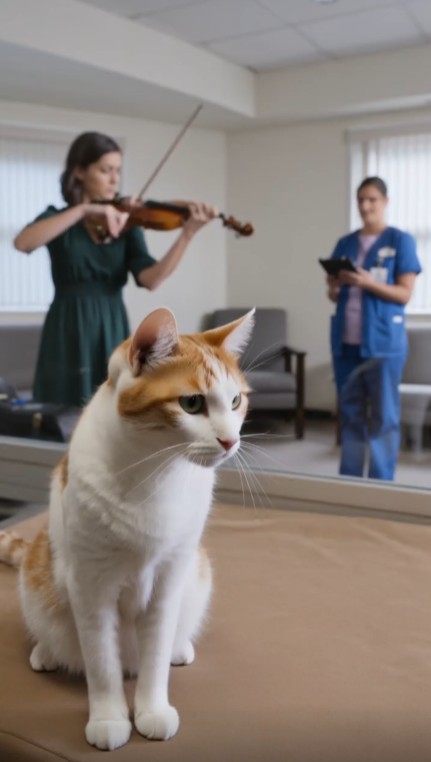
A violinist started playing at an animal shelter.
Then one cat did something the volunteers had never seen before.
His name was Milo.
A white-and-orange rescue cat.
Healthy.
Gentle.
Quiet.
He usually spent adoption events sitting on the highest platform in his enclosure, watching people without approaching the glass.
Volunteers joked that Milo preferred interviewing potential adopters from a distance.
That afternoon, the shelter was hosting a charity event.
A local violinist named Elena had agreed to perform.
She entered the main adoption room.
Opened her case.
Adjusted the instrument beneath her chin.
Then began playing a soft melody.
Milo’s head lifted immediately.
One volunteer noticed.
“Look at him.”
The cat climbed down from his platform.
Slowly.
Then walked toward the transparent enclosure wall.
He sat directly in front of Elena.
The volunteer stared.
“He never does that.”
Elena stopped playing.
Milo remained there.
She looked toward the volunteer.
“Can I try again?”
“Sure.”
Elena played the same four notes.
A simple rising phrase.
Milo’s ears turned toward the sound.
He stayed beside the glass.
Elena repeated it.
Again, Milo remained attentive.
Nobody claimed he recognized a particular song.
Cats can respond to sounds for many reasons.
Pitch.
Volume.
Familiarity.
Novelty.
But his sudden change in behavior was unusual enough that the volunteers noticed.
Then one of them, Sarah, looked down at Elena’s violin case.
A faded blue ribbon was tied around the handle.
“Where did you get that?”
Elena smiled.
“My grandmother.”
Sarah’s expression changed.
“What was her name?”
“Margaret Hale.”
Sarah stared at her.
Then looked toward Milo.
“Wait here.”
She hurried toward the shelter office.
Elena looked confused.
“What happened?”
Sarah returned with Milo’s intake file.
The shelter had received him almost eleven months earlier after his previous owner could no longer be located.
The original intake had been handled through an animal welfare transfer.
Sarah flipped through the records.
Address.
Veterinary history.
Photographs.
Then she stopped.
There was an image from the day Milo was first collected.
He was sitting on a windowsill inside a small apartment.
Beside him was a blue ribbon.
Almost identical to the one tied around Elena’s violin case.
Sarah looked at Elena.
“I think this cat lived somewhere you know.”
Elena stared at her.
“Where?”
Sarah turned the form.
The previous address was on Linden Street.
Elena went pale.
“My grandmother lived on Linden Street.”
Sarah checked the number.
Elena covered her mouth.
“That’s her building.”
The room went quiet.
Elena stepped closer.
“My grandmother had a cat?”
Sarah did not answer immediately.
The records needed to be checked.
Milo had arrived through a complicated chain.
He had first been found inside an apartment after neighbors reported that an elderly resident had been taken to hospital and had not returned.
A relative was supposed to collect the cat.
That never happened.
The building manager contacted animal services.
From there, Milo entered temporary care before being transferred to the shelter.
The elderly resident’s first name was Margaret.
Elena sat down.
“My grandmother died last year.”
Sarah nodded gently.
The dates matched.
But one thing made no sense.
Elena had visited Margaret frequently.
She had never seen Milo.
Never heard about him.
Her grandmother had always said she did not want another pet after her old cat died years earlier.
Elena looked through the intake photographs.
Milo on the windowsill.
Milo beneath a kitchen chair.
Milo beside the same blue ribbon.
Then she noticed something else.
In one photograph, part of a violin stand was visible in the background.
Elena whispered:
“She used to play.”
Sarah looked surprised.
“Your grandmother?”
“Yes.”
Not professionally.
Margaret had taught music at a primary school for decades.
After retirement, she still played violin almost every evening.
Elena had learned from her.
That was why the blue ribbon mattered.
Margaret used to tie one around every violin case she owned.
She said it made black cases easier to spot backstage.
After Margaret died, Elena kept one of the ribbons.
Now she was standing in front of a cat whose intake photographs showed the same ribbon in his home.
Elena asked:
“How long had he lived there?”
Sarah checked.
That was where the records became unclear.
Milo had no original microchip registration linked to Margaret.
No adoption contract under her name.
But veterinary notes found among the apartment paperwork suggested she had been caring for him for at least two years.
The shelter contacted the veterinary clinic listed on an old vaccination receipt.
The next day, they received confirmation.
Milo had first been brought there by Margaret twenty-six months before her death.
The clinic’s notes described him as:
Found cat, likely abandoned. Owner currently providing temporary care.
Six months later, the wording changed.
Milo — household cat.
Elena laughed softly when she heard that.
“That sounds exactly like her.”
Margaret had apparently intended to keep him only temporarily.
Then never let him leave.
Why had she never told Elena?
That question took longer to answer.
Elena’s mother still had several boxes of Margaret’s belongings.
They searched them.
Inside a desk drawer was a small notebook.
Most pages contained shopping lists.
Appointments.
Music reminders.
Then Elena found Milo’s name.
First entry:
Orange-white cat appeared behind building again. Fed him. Bad idea.
A week later:
Cat returned. Worse idea.
Then:
Vet says healthy. No chip.
Then months later:
Milo slept through violin practice today. Finally, a critic with manners.
Elena laughed until she cried.
Page after page showed Milo slowly becoming part of Margaret’s life.
She wrote about him stealing her chair.
Sleeping inside an empty music bag.
Sitting near her during practice.
And repeatedly batting at the blue ribbon on her violin case.
Then Elena found a line that explained why nobody in the family knew.
Do not tell Elena yet. She worries about me managing alone. She’ll think the cat is too much work.
Elena closed her eyes.
Her grandmother had hidden Milo because the family had already been worried about her health.
Margaret knew Elena would probably insist on helping.
Or ask whether keeping a cat was practical.
Margaret wanted one thing in her apartment that was entirely her decision.
Elena understood.
Still, it hurt.
“I would have taken care of him.”
Sarah said:
“She may not have wanted you to feel responsible.”
That turned out to be close to the truth.
The notebook’s later entries changed.
Margaret’s handwriting became shakier.
One note read:
If something happens to me, Elena would love him, but she already has too much. Must arrange properly.
There was no evidence she ever completed that arrangement.
Her final hospitalization happened suddenly.
Milo remained in the apartment.
By the time family members began clearing belongings, animal services had already removed him.
There had been a communication failure.
One relative assumed Milo belonged to a neighbor.
Another did not know Margaret had a cat at all.
The shelter intake listed no verified next of kin for the animal.
So Milo entered the normal adoption system.
Elena stared through the enclosure glass.
“He was there the whole time.”
Sarah nodded.
“For part of her last years, yes.”
Then Elena asked the obvious question.
“Did he recognize the music?”
Sarah answered carefully.
“We can’t know that.”
That mattered.
Milo may have responded because violin sounds were familiar from living with Margaret.
He may have been interested in the particular pitch or tone.
He may have associated the instrument with calm evenings.
Or he may simply have been curious that day.
Nobody could prove he remembered Elena’s grandmother or recognized one specific melody.
But the shelter could document something else.
Milo had lived in a home where violin music was played regularly.
Margaret’s notebook mentioned it repeatedly.
And Elena had unknowingly played the same four-note warm-up Margaret used before practicing.
Elena froze when she realized that.
“How do you know?”
Her mother found an old recording.
Margaret had recorded several lessons for Elena when she was younger.
At the beginning of almost every one, she played the same four ascending notes to check tuning and bow pressure.
The phrase was not a special composition.
Just a habit.
A musical routine.
The same routine Elena inherited.
Years later, she had played it at the shelter without thinking.
Milo approached the glass.
That was all anyone could responsibly claim.
But for Elena, it was enough.
She returned to the shelter two days later.
Then again.
She did not adopt Milo immediately.
Sarah insisted on the same process required for everyone.
Application.
Household assessment.
Veterinary planning.
Adjustment discussion.
The fact that Milo had belonged to Elena’s grandmother did not automatically mean Elena was the right home.
Elena appreciated that.
She already had an older cat named Sophie.
Introducing another adult cat required care.
So the shelter arranged scent exchanges first.
Blankets.
Bedding.
Short controlled introductions later.
Nothing was rushed.
Milo remained calm.
Sophie was skeptical.
Very skeptical.
On their first visual introduction, Sophie stared at Milo for almost a full minute.
Then walked away.
Elena laughed.
“My grandmother would call that approval.”
Several weeks later, the adoption was finalized.
Elena brought Milo home.
She placed Margaret’s old blue ribbon on a shelf.
Not where Milo could chew it.
Then she opened her violin case.
Milo watched from across the room.
Elena played.
He did not run toward her.
He did not perform some dramatic reaction.
He curled up on the sofa.
And went to sleep.
Elena smiled.
That felt more believable.
According to Margaret’s notebook, that was exactly what he used to do.
Months later, Elena performed another shelter fundraiser.
Milo did not attend.
He stayed home where he was comfortable.
But Elena brought a photograph.
Milo asleep beside the closed violin case.
Sophie several feet away pretending not to care.
The blue ribbon visible on a high shelf.
Sarah placed the photograph in the shelter office beside Milo’s original intake picture.
Two moments.
Same cat.
Same musical family.
Different years.
Elena later donated copies of Margaret’s notebook entries to the shelter’s educational archive, with private family details removed.
They used the story to teach something practical.
Pets can become lost in the confusion following an owner’s hospitalization or death.
Families should document who will care for them.
Microchip information should be current.
Emergency contacts should know animals exist.
Margaret loved Milo.
But love alone had not created a plan.
That oversight almost meant Elena never found him.
The blue ribbon and violin did not magically reunite them.
Records did.
Photographs.
Veterinary notes.
A remembered address.
And one volunteer who noticed a familiar object in an intake image.
Years later, people still told the story as:
The cat heard his old owner’s song and found her granddaughter.
Elena always corrected that.
“We don’t know what Milo remembered.”
Then she would smile.
“But we know where he lived.”
That truth was already extraordinary.
An elderly woman quietly took in a stray cat.
Played violin while he slept nearby.
Kept him secret because she did not want her granddaughter worrying.
Then died before she could finish making arrangements for him.
Nearly a year later, her granddaughter walked into an animal shelter carrying a violin case with one of Margaret’s blue ribbons tied around it.
She played four ordinary notes.
Milo walked toward the glass.
And that small moment gave someone enough reason to open an old file.
Inside it was the missing chapter of both their lives.