
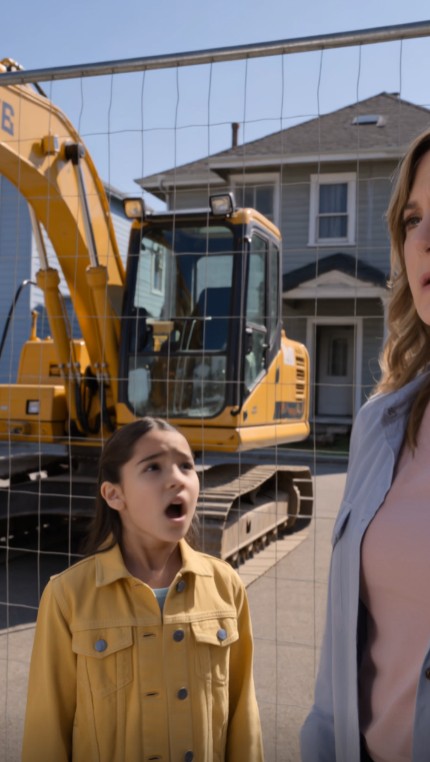
A little girl stopped the demolition of an old house.
And at first, nobody understood why.
The excavator was already in position.
Safety fencing surrounded the property.
Workers had checked the site.
The abandoned house had been empty for years.
Its roof sagged.
Several windows were broken.
The structure had been declared unsafe.
That morning, it was scheduled to come down.
Then a ten-year-old girl named Sophie started shouting from the sidewalk.
“PLEASE! DON’T TEAR IT DOWN!”
The site supervisor turned.
Sophie was standing beside her mother, pointing toward the second floor.
The supervisor walked over.
“What did she see?”
Sophie did not wait for her mother to answer.
“Something is living there.”
He looked toward the house.
At first, he saw nothing.
Just peeling paint.
A cracked window frame.
Loose roof tiles.
And darkness behind the upper windows.
Sophie pointed again.
“Up there.”
Near the roofline.
The supervisor lifted his binoculars.
Then stopped.
A tiny bird disappeared beneath a gap in the roof.
A few seconds later, another appeared.
Then another.
The supervisor lowered the binoculars.
“Okay.”
The demolition stopped.
Not permanently.
Just long enough to find out exactly what was inside.
A wildlife officer named Claire arrived less than an hour later.
She stood outside the safety boundary and watched the building carefully.
Nobody entered.
The structure was unstable.
Claire used binoculars and a long-lens camera instead.
Within minutes, she saw what Sophie had noticed.
Small birds were repeatedly flying toward gaps beneath the roof.
But then Claire noticed something the workers had completely missed.
The activity was not concentrated in one place.
There were several entry points.
One beneath the eastern roofline.
Another near a damaged vent.
A third above the rear window.
Sophie looked up at her.
“Are they going to be okay?”
Claire lowered her binoculars.
“There’s more here than we thought.”
That changed everything.
The demolition company had already completed a standard site inspection.
But the inspection had focused mainly on structural hazards.
Loose materials.
Utility lines.
Unsafe flooring.
The workers had not been conducting a detailed wildlife survey.
Now that active nesting was suspected, the site needed specialist assessment before demolition could continue.
Claire contacted a local ecologist.
The next morning, the team returned before sunrise.
That timing mattered.
Bird activity is often easier to observe early in the day.
The workers remained outside.
The excavator stayed parked.
Sophie came back too.
Her mother had explained that they should not approach the building or disturb anything.
So Sophie stood behind the barrier with binoculars borrowed from Claire.
For nearly an hour, everyone watched.
The first confirmed nest belonged to house sparrows.
Then the ecologist identified another species using a different part of the roof cavity.
Starlings.
But the most surprising discovery came from the rear of the property.
A bird flew rapidly toward a narrow gap under the eaves.
Then vanished.
The ecologist raised his camera.
“Again.”
A few minutes later, another bird followed.
He checked the photographs.
Then smiled.
Swifts.
The old house was supporting multiple nesting groups.
Not all in the same cavity.
Not all belonging to the same species.
Claire explained that old buildings often contain tiny gaps and roof spaces that can become useful nesting sites.
To people, those cracks look like damage.
To some birds, they can look like shelter.
Sophie stared at the house.
“So they live inside?”
“Some of them nest in spaces within the roof.”
“Can we move them?”
Claire shook her head.
“Not while they’re using active nests.”
That was the key issue.
The house still needed to be demolished.
It was unsafe.
Nobody was arguing that it should remain standing forever.
But timing now mattered.
The demolition could not simply proceed as though the birds were not there.
The project team contacted the relevant local authority and ecological advisers.
The plan was paused.
Not canceled.
Modified.
Workers established a wider quiet zone around the most active sections.
No machinery operated near the house during the monitoring period.
Nobody tried to block the holes.
Nobody climbed onto the roof.
And nobody removed nesting material.
The ecologist began mapping each observed entry point.
One.
Two.
Three.
Then five.
By the third day, the count had increased again.
Several nesting cavities were active.
Claire showed the map to the demolition supervisor.
He stared at it.
“We checked this whole place.”
“You checked it for people and structural danger.”
“Not birds.”
He nodded.
“Fair.”
Then the team discovered something else.
The old detached garage behind the house was also being used.
Not by the same species.
A pair of small birds repeatedly entered through a broken panel near the roof.
The demolition plans included the garage too.
That meant the entire property had to be reconsidered as one wildlife-sensitive site.
Sophie’s mother asked:
“What happens now?”
The ecologist explained.
First, they would monitor.
Then they would determine when the active nesting period had ended.
Only after the young birds had left and the nests were no longer active could demolition safely proceed, subject to local wildlife requirements.
Afterward, replacement nesting opportunities could be added to the redevelopment.
Sophie brightened.
“Like birdhouses?”
“Something like that.”
But the replacement structures had to match the species.
Not every bird uses a generic nest box.
The team planned integrated nest bricks and specially designed boxes in the new development.
Some high under the eaves.
Some with narrow entrances.
Some placed where future disturbance would be low.
The construction company agreed.
At first, the site supervisor worried about delays.
Schedules mattered.
Equipment had been booked.
Crews had other jobs.
But after seeing the number of birds using the property, he changed his attitude.
“We’ll move the job.”
That did not mean the delay was easy.
It cost money.
Dates had to be changed.
But the alternative—destroying active nests simply because nobody had noticed them—was not acceptable.
The excavator left.
For several weeks, the old house remained standing.
Sophie passed it almost every afternoon.
She never crossed the fence.
She simply looked up.
Sometimes she saw birds.
Sometimes nothing.
Claire returned regularly to check progress.
One afternoon, Sophie noticed a small bird sitting near the roof opening.
Then another appeared beside it.
Not an adult.
A younger bird.
Claire confirmed that some of the nestlings were beginning to fledge.
“That means they’re leaving?”
“Slowly.”
Sophie smiled.
That became her favorite part.
Not the demolition stopping.
Watching the birds become independent.
One by one, activity around the cavities changed.
Fewer adults carrying food.
More young birds appearing near openings.
Then fewer birds overall.
Eventually, after repeated checks, the ecologist confirmed that the active nests had been vacated.
But the team did not immediately start the machines.
They performed one final inspection.
No active nesting behavior.
No dependent young.
No newly occupied cavities.
Then demolition was rescheduled.
Sophie was there on the morning it began.
This time, she did not shout.
Claire stood beside her.
“You okay?”
Sophie nodded.
“They left.”
“Yes.”
“Where did they go?”
“Different places.”
The birds were wild.
The team did not know exactly where every individual went.
That was normal.
The purpose had never been to keep them attached to one unsafe house forever.
It had been to avoid destroying active nests while the birds still depended on them.
The demolition started carefully.
The house came down in sections.
Dust control was used.
Materials were sorted.
The old roof disappeared.
Then the walls.
By the end of the week, the house Sophie had known was gone.
She felt sad.
But not angry.
Because the story had not ended there.
The property was redeveloped into several small homes.
Before the new roofs were completed, Claire returned with the ecologist.
They inspected the locations chosen for replacement nesting features.
Integrated swift boxes.
Sparrow terraces.
Other suitable cavities.
Not decorative additions placed randomly.
They were positioned based on height, direction, and likely disturbance.
The builders even changed one small section of the roof design to accommodate them better.
Months later, Sophie visited again.
The old abandoned house was gone.
In its place stood a finished building.
Fresh walls.
New windows.
Safe roof.
Nothing like the ruin she remembered.
She looked disappointed for a moment.
Then Claire pointed upward.
“See those openings?”
Sophie squinted.
Near the roofline were several narrow slots.
“Those are for them?”
“Yes.”
Not guarantees.
Nobody could force wild birds to return.
But the opportunities were there.
The following spring, monitoring began.
For weeks, nothing happened.
Sophie asked Claire:
“What if they never come back?”
Claire answered honestly.
“Then other birds may use them.”
“Or maybe none will.”
“That’s wildlife.”
You could protect habitat.
Create opportunities.
Reduce disturbance.
But you could not script what happened next.
Then, one morning, a resident contacted Claire.
Birds were flying toward the upper nest boxes.
Claire checked.
House sparrows had started using one section.
Weeks later, swift activity was recorded near another.
Sophie was thrilled.
“Are they the same birds?”
Claire smiled.
“We can’t know.”
There were no identifying tags linking them to the individuals from the demolished house.
Claiming they were exactly the same birds would have been guessing.
But the replacement habitat was being used.
That was enough.
The construction company changed its procedures after that project.
Older buildings scheduled for demolition received more explicit wildlife checks when appropriate.
Supervisors were trained to report repeated bird activity around roofs, vents, and cavities.
Workers were reminded that an “empty” building might not actually be empty.
The site supervisor even used Sophie’s story during staff briefings.
Not as:
A little girl knew more than the professionals.
That was not fair.
The workers had been doing a different kind of inspection.
Instead, he said:
“People notice different things.”
That was the lesson.
Sophie noticed birds because she happened to be looking upward.
The workers were looking at machinery, structure, safety barriers, and schedules.
Once she spoke, they listened.
That mattered.
Years later, Sophie barely remembered the excavator.
She remembered the first tiny bird disappearing beneath the roof.
She remembered everyone telling her to stay behind the fence.
And she remembered asking Claire:
“Are they going to be okay?”
Claire’s answer had been careful.
“We’ll do what we can.”
That was exactly what happened.
No miracle.
No dramatic rescue from falling walls.
No abandoned house preserved forever.
Just a demolition paused at the right moment.
A proper wildlife assessment.
Several active nests given time.
And a new building designed so birds would still have places to use after the old one disappeared.
The little girl had not saved an old house.
She had done something more practical.
She made people look twice before tearing it down.