
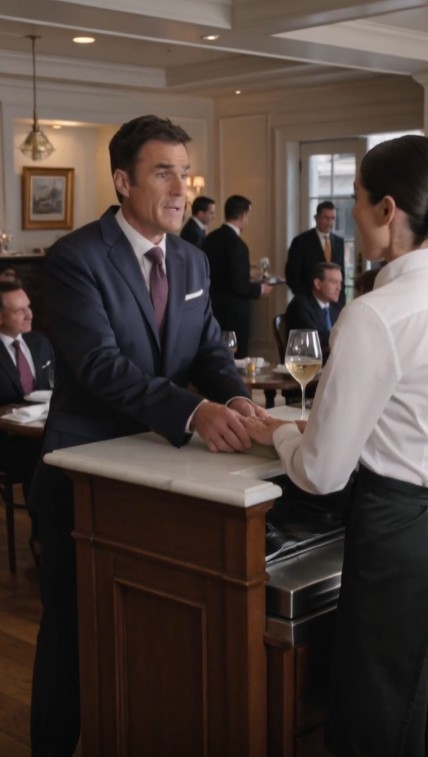
A millionaire offered a waitress a thick bundle of cash.
She pushed it straight back.
“I’m paying for the best table.”
The waitress shook her head.
“I’m sorry, sir. It isn’t available.”
The businessman stared at her.
His name was Daniel Mercer.
He was fifty-two years old, owned several companies, and was accustomed to problems becoming smaller when enough money was placed in front of them.
He had arrived without a reservation.
The restaurant was nearly full.
But Daniel had noticed one table immediately.
Small.
Round.
Beside the front window.
The best view in the room.
An elderly woman sat there alone wearing a lavender cardigan.
Daniel pointed toward her.
“Then why does she get that table?”
The waitress answered without hesitation.
“Because it’s hers.”
Daniel laughed.
“Hers?”
“Yes.”
“I’ll pay double whatever she paid.”
The waitress remained calm.
“It doesn’t work like that.”
Daniel lowered his voice.
“Do you know who I am?”
“Yes, Mr. Mercer.”
That surprised him.
The restaurant manager hurried over.
“Is there a problem?”
Daniel turned toward him.
“I’m trying to understand why an empty chair at your best table is apparently worth more than my business.”
The manager glanced toward the elderly woman.
Then said:
“That table is not available for reservation.”
“Ever?”
“Not when she’s here.”
Daniel was about to answer when something behind the reception desk caught his attention.
An old framed photograph.
Black and white.
Probably forty years old.
It showed the restaurant shortly after it opened.
A younger man stood beside the entrance.
Daniel recognized him immediately.
Thomas Bennett.
The restaurant’s original founder.
But beside Thomas stood a young woman.
Dark hair.
Same eyes.
Same unmistakable expression as the elderly woman sitting by the window.
Daniel moved closer to the photograph.
His face changed.
“I know her.”
The manager said nothing.
Daniel turned slowly.
The elderly woman was now looking at him.
Their eyes met.
For several seconds, neither spoke.
Then Daniel whispered:
“Margaret?”
The woman set down her glass.
“Hello, Daniel.”
He went pale.
“Why are you here?”
Margaret looked toward the empty chair across from her.
“I was hoping you’d come back.”
The entire argument about the table suddenly disappeared.
Daniel walked over.
The waitress quietly moved away.
He remained standing.
Margaret gestured toward the chair.
“You may sit.”
Daniel almost laughed.
“Apparently that’s a rare privilege.”
“It is.”
He sat.
For a moment, neither knew what to say.
They had not seen each other in thirty-one years.
Daniel had been twenty-one the last time he saw Margaret Bennett.
Back then, she was not an elderly woman sitting alone in a lavender cardigan.
She was the person who ran almost everything inside that restaurant.
Thomas’s name was on the sign.
But Margaret kept the place alive.
She handled reservations.
Balanced accounts.
Ordered produce.
Covered the dining room when staff called out.
And, when necessary, went into the kitchen and cooked.
Daniel knew because he had worked there.
Not as a businessman.
As a dishwasher.
He had almost forgotten how desperate he was when he first walked through those doors.
Daniel grew up nearby.
His father left when he was young.
His mother worked long hours.
At seventeen, Daniel wanted money badly enough to lie about his experience.
Thomas asked:
“You ever worked in a restaurant?”
Daniel answered:
“Of course.”
Ten minutes into his first shift, it became obvious he had never operated an industrial dishwasher in his life.
Margaret caught him staring at it.
“You lied.”
Daniel nodded.
“You going to fire me?”
Margaret folded her arms.
“Probably.”
Then she spent ten minutes showing him what to do.
He stayed.
At first, Daniel hated the work.
Hot water.
Heavy trays.
Late nights.
People shouting during dinner service.
But the restaurant became important to him.
Thomas taught him how to speak to customers.
Margaret taught him how to work when nobody was praising him.
She had one rule Daniel remembered clearly:
“If you see something that needs doing, don’t wait for somebody important to notice.”
At eighteen, Daniel started waiting tables.
At nineteen, he helped with inventory.
By twenty, he was studying business at a local college during the day and working at the restaurant at night.
And whenever he had a break, he sat at the little table by the window.
The same one Margaret occupied now.
Daniel looked around.
“It hasn’t changed.”
Margaret smiled.
“The chairs have.”
“The table?”
“No.”
“Why?”
Margaret looked out the window.
“Because Thomas was sentimental.”
Daniel became quiet.
Thomas Bennett had died many years earlier.
Daniel knew that.
He had read the obituary.
He had considered attending the funeral.
Then convinced himself it would be awkward after so much time.
He regretted that now.
Margaret asked:
“Do you remember what happened at this table?”
Daniel frowned.
“A lot happened.”
“Your first business plan.”
That brought everything back.
Daniel had been twenty.
He wanted to start a delivery company.
Not a giant corporation.
Not anything impressive.
Just a small local courier service.
He had calculated that he needed $3,800.
He had $612.
No bank wanted to lend money to a twenty-year-old student with little credit history.
Daniel was angry.
Embarrassed.
Ready to abandon the idea.
One night, after the restaurant closed, Thomas found him at the window table surrounded by papers.
“What is all this?”
Daniel explained.
Thomas listened.
Then asked:
“How much are you short?”
Daniel told him.
Thomas nodded.
Then walked away.
Daniel assumed the conversation was over.
The next day, Margaret handed him an envelope.
Inside was a check for $3,200.
Daniel stared at it.
“No.”
Margaret said:
“It’s a loan.”
“I can’t take this.”
“Then don’t.”
She took the check back.
Daniel stopped her.
“What are the terms?”
Margaret smiled.
Now he sounded like a businessman.
They drew up a simple loan agreement.
Nothing secret.
Nothing magical.
Daniel would repay it monthly with modest interest.
Thomas insisted everything be written down.
“If you want a business,” he said, “start by treating it like one.”
That money launched Daniel’s first small delivery company.
It almost failed within a year.
Daniel made mistakes.
Charged too little.
Bought an unreliable van.
Trusted one customer who never paid.
But he survived.
Then grew.
One van became three.
Three became twelve.
Years later, Daniel sold the company.
He invested.
Started another business.
Then another.
By his forties, newspapers were calling him a self-made millionaire.
Margaret never liked that phrase.
Sitting across from him now, she said:
“You weren’t self-made.”
Daniel looked at her.
“No.”
He had not been.
He had repaid Thomas and Margaret’s loan completely.
With interest.
He even tried to give them extra money.
Thomas refused it.
“Agreement says what you owe.”
Daniel argued.
Thomas answered:
“A deal matters most when you have enough power to change it.”
Daniel remembered that too.
So why had he disappeared?
Margaret knew the answer.
At twenty-one, Daniel had an argument with Thomas.
A terrible one.
Daniel’s business was finally doing well.
He came into the restaurant wearing an expensive new suit.
Thomas laughed at him.
Daniel was offended.
Then Thomas asked why he had bought a luxury car while still owing money on the business.
Daniel snapped.
He told Thomas he was just a restaurant owner who did not understand growth.
Thomas became quiet.
Then said:
“If success makes you ashamed of the people who helped you, you aren’t successful yet.”
Daniel stormed out.
He returned once to finish repaying the loan.
He did it through a bank transfer.
No conversation.
No apology.
Then life kept moving.
Daniel always believed there would be time later.
He would return when he had accomplished more.
When he could prove Thomas had been wrong about him.
Then ten years passed.
Then twenty.
Then Thomas died.
Daniel looked toward the photograph.
“I should have come back.”
Margaret answered:
“Yes.”
No comforting lie.
No immediate forgiveness.
Just yes.
Daniel looked down.
“Did he hate me?”
Margaret almost smiled.
“Thomas couldn’t maintain a proper grudge.”
“He tried.”
“He was terrible at it.”
Daniel laughed once.
Then Margaret’s expression softened.
“He was proud of you.”
Daniel looked up.
“What?”
“He followed every article.”
“Every business announcement.”
“When your first company expanded, he cut the newspaper story out.”
“When you opened your foundation, he saved that too.”
Daniel stared at her.
“He never contacted me.”
“You never contacted him.”
That hurt.
Because it was true.
Margaret reached into the bag beside her chair.
She removed a thin wooden box.
Inside were dozens of newspaper clippings.
Daniel recognized himself across decades.
Young.
Then older.
Company launches.
Interviews.
Awards.
One article had a handwritten note along the edge.
Kid finally learned to wear a suit.
Daniel laughed through tears.
“That’s him.”
Margaret nodded.
Then she removed a sealed envelope.
Thomas’s handwriting appeared on the front.
DANIEL.
Daniel stopped breathing for a moment.
“When did he write this?”
“Near the end.”
“Why didn’t you send it?”
“I tried.”
The address they had was old.
It was returned.
Margaret could have searched more aggressively.
She admitted that.
But Thomas had told her something specific.
“If he comes back, give it to him at the table.”
Daniel looked around.
“This table?”
“Yes.”
That was why nobody else could have it when Margaret was there.
But there was more to the story.
After Thomas died, Margaret sold the restaurant to two longtime employees.
She did not give it away.
They purchased it gradually through a formal agreement.
One condition remained in the sale.
The window table would always be available to Margaret when she visited.
Not because she legally owned the table in some unusual sense.
Because the new owners promised.
And over time, it became tradition.
Every Thursday afternoon, Margaret sat there.
Sometimes alone.
Sometimes with old employees.
Sometimes with Thomas’s photograph beside her.
The restaurant never booked it during that time.
Daniel looked at her.
“You came here every Thursday waiting for me?”
Margaret shook her head.
“No.”
“I came because I like lunch.”
He laughed.
Then she added:
“But I kept the letter in my bag.”
“For how long?”
“Nine years.”
Daniel stared.
Nine years.
He carefully opened the envelope.
Thomas’s letter was short.
Daniel,
If you are reading this, Margaret was right and you eventually found your way back.
Daniel smiled.
Thomas continued.
I was angry with you for about three days.
You were twenty-one.
Twenty-one-year-old men are professionally stupid.
Daniel laughed so loudly several diners turned toward him.
Margaret smiled.
The letter became more serious.
Thomas wrote that he regretted their argument too.
He had been too harsh.
Daniel was not wrong to want a bigger life.
Thomas had misunderstood ambition sometimes because he personally valued stability.
What hurt him was not Daniel’s success.
It was losing contact.
Then came the sentence Daniel had spent thirty years needing to hear.
You never owed me a life that looked like mine.
You only owed yourself the decency to remember where you began.
Daniel stopped reading.
He wiped his eyes.
Margaret waited.
The final paragraph concerned the table.
Thomas explained that it had been the first table he and Margaret bought when opening the restaurant.
They could afford only six matching tables.
The seventh came from a secondhand furniture shop.
This one.
The window table.
Thomas repaired one leg himself.
Years later, it became Daniel’s favorite place to do homework and business planning.
Thomas joked that the cheapest table in the restaurant had generated the most paperwork.
Then he wrote:
If you ever come back, sit there. Not because it belongs to you. Because everybody needs one place that reminds them who they were before people started treating them as important.
Daniel folded the letter.
Now he understood.
He had entered the restaurant that afternoon believing money should buy him the best seat.
He had waved cash at a waitress because he assumed every inconvenience had a price.
And the table he wanted was the same table where a seventeen-year-old dishwasher had once eaten staff meals because he could not afford dinner elsewhere.
Daniel covered his face for a moment.
Margaret said:
“You became exactly as annoying as Thomas predicted.”
He laughed.
“Did he predict millionaire?”
“No.”
“Just annoying.”
The waitress approached cautiously.
Daniel stood.
“I owe you an apology.”
She smiled.
“Yes, sir.”
Margaret laughed.
Daniel looked surprised.
“You’re all very direct here.”
“It saves time.”
He apologized properly.
No excuses.
Then he asked if the staff could accept the money he had offered.
The waitress shook her head.
Daniel smiled.
“Fair.”
He paid for Margaret’s lunch instead.
She objected.
He ignored her.
That was as far as she allowed his generosity to go.
Daniel later asked the restaurant owners whether they needed investment.
They were cautious.
The restaurant was profitable.
They did not want a millionaire arriving after decades and taking control of a place with its own history.
Daniel respected that.
Instead, they eventually agreed on something smaller.
The restaurant established a paid training program for young people entering hospitality who lacked experience.
Daniel funded the first several years through a charitable contribution.
But he insisted the program not carry his name.
Margaret approved.
“What should we call it?”
Daniel looked at the window.
“The Seventh Table.”
That became its name.
Participants learned kitchen work.
Customer service.
Inventory.
Basic accounting.
Food safety.
And practical business skills.
They were paid for their work.
No one was expected to be grateful for exploitation disguised as opportunity.
Daniel insisted on that too.
He knew what it meant to need a first chance.
Years later, the program helped several young people move into restaurant management, culinary work, and other careers.
One eventually started a catering company.
Daniel gave her advice.
She ignored half of it.
Margaret said that proved she was smart.
Daniel also returned to the restaurant.
Not every week.
But often.
Sometimes he sat with Margaret at the window table.
Sometimes she brought friends and told him to find another seat.
He obeyed.
The waitress who had refused his money never stopped teasing him.
“Best table?”
she would ask.
Daniel would reply:
“Whatever you have.”
That became a private joke.
When Margaret eventually became too old to visit regularly, the restaurant changed the tradition.
The table was no longer kept empty.
Margaret did not want that.
“Tables are for people,” she said.
Instead, a tiny brass plaque was attached underneath, where most customers would never see it.
It read:
TABLE 7
Bought secondhand.
Repaired by Thomas Bennett.
Home of bad coffee, good arguments, and one very unlikely business plan.
Daniel added one final line with Margaret’s permission:
Not for sale.
The old photograph beside reception remained too.
Thomas.
Young Margaret.
The restaurant in its earliest days.
And eventually another photograph was added beside it.
Margaret at the window table in her lavender cardigan.
Daniel sitting across from her.
No expensive suit visible.
No bundle of cash.
Just two people laughing.
Visitors sometimes heard the story and assumed Margaret secretly owned the restaurant.
She didn’t.
Others claimed Daniel discovered she was his mother or some hidden relative.
She wasn’t.
The truth was more ordinary.
And more important.
Decades earlier, two restaurant owners had given a difficult young employee work.
Then advice.
Then a properly documented loan when almost nobody else believed his idea would succeed.
Daniel repaid the money.
But he mistook repayment for settling the debt completely.
It took him thirty-one years to understand that gratitude was different.
On the afternoon he finally returned, he tried to buy the restaurant’s best table with cash.
A waitress refused.
He became angry.
Then noticed an old photograph.
And suddenly realized that the elderly woman occupying the seat was not someone standing between him and what he wanted.
She was one of the people who made it possible for him to become the man who thought he could buy it.
Margaret had kept one chair open across from her.
Not forever.
Not every day.
Just often enough.
Because Thomas had believed that someday Daniel might remember where his first business plan had been written.
And when he finally did, the table was still there.