
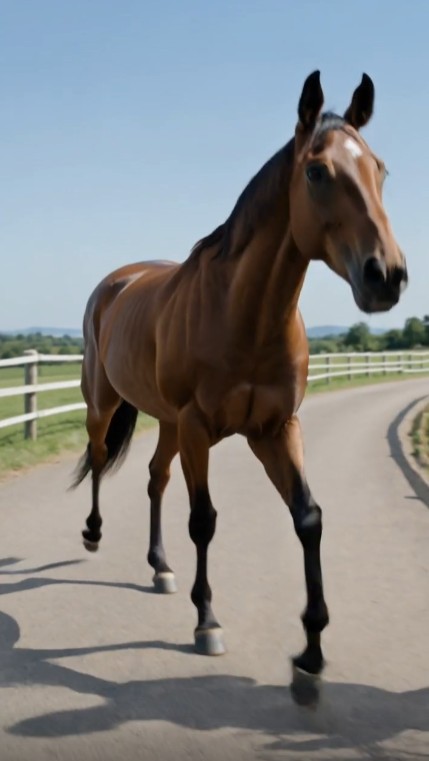
A horse suddenly refused to cross a wooden bridge he had used for years.
His owner could not understand why.
The horse’s name was Ranger.
Strong.
Healthy.
Usually calm.
And familiar with every corner of the farm.
But that morning, he stopped.
Right before the bridge.
His owner, Michael, gave him a gentle cue forward.
Ranger did not move.
Not one step.
“Come on, boy.”
“What’s wrong?”
Ranger stared toward the wooden boards.
His ears pointed forward.
His body remained tense.
Michael tried once more.
Nothing.
He knew better than to force him.
So he backed Ranger away from the entrance.
That was when a farmworker named Luis noticed something.
“Wait.”
Michael turned.
“What?”
Luis pointed.
“Why is that plank sticking up?”
At first, Michael could barely see it.
One board near the middle of the bridge sat slightly higher than the others.
Maybe half an inch.
Maybe less.
There was also a narrow gap beside it.
Nothing dramatic.
No broken railing.
No collapsed section.
No obvious hole.
But now that they were looking carefully, something felt wrong.
Michael dismounted.
He did not step onto the bridge.
Instead, he moved to the side and looked underneath from the bank.
Luis did the same.
That was when they saw it.
One of the wooden supports below the decking looked damaged.
Not completely broken.
But split.
Michael stared.
“How long has that been like that?”
Luis shook his head.
“I don’t know.”
The bridge crossed a shallow drainage channel between two sections of pasture.
Tractors used it occasionally.
Farmworkers crossed it on foot.
Ranger had walked over it dozens of times.
Nothing had ever seemed wrong.
Michael immediately closed the crossing.
No horses.
No people.
No machinery.
Then he called a local maintenance inspector.
By early afternoon, an engineer named Claire arrived.
She did not walk onto the bridge either.
First, she photographed it.
Then examined the structure from below and from both ends.
After several minutes, she stood up.
“Keep this closed.”
Michael frowned.
“Is it really that serious?”
Claire looked back at the bridge.
“Worse than it looks.”
The raised plank was only the visible symptom.
The real problem was underneath.
One support beam had developed a long split along the grain.
Another had begun rotting near the point where it met the bank.
Several metal fasteners were heavily corroded.
And one cross-brace had partially pulled away.
None of those failures alone had caused the bridge to collapse.
Together, they had reduced its strength significantly.
Claire explained that wooden structures often deteriorate gradually.
Moisture works into joints.
Fasteners corrode.
Wood expands and contracts.
Small cracks widen.
From above, everything can appear almost normal.
The bridge looked usable because most of the deck boards were still intact.
But the load-bearing structure beneath them was another story.
Michael looked toward Ranger.
“So he knew?”
Claire smiled.
“I wouldn’t put it that way.”
She was careful.
Nobody could know exactly why Ranger had stopped.
He may have seen the raised plank.
He may have heard the boards shift.
He may have felt vibration through the ground or decking during the first step.
Horses are sensitive to footing and changes in surfaces.
Or he may simply have become uncertain for some other reason.
What mattered was not claiming that Ranger somehow performed a structural inspection.
What mattered was that he refused.
And Michael listened.
Claire continued the inspection.
Then found the part that worried her most.
The bridge had suffered water damage after recent heavy rain.
The drainage channel had risen higher than normal.
Mud and debris collected around one side.
That trapped moisture against an already aging support.
A section that had looked solid from above had softened internally.
Claire pushed a probe into the timber from below.
It went farther than Michael expected.
He stared.
“That’s supposed to hold weight?”
“Not anymore.”
She showed him photographs.
Darkened wood.
Cracking.
Corrosion.
A gap near a joint.
Michael thought about the tractor that had crossed only a week earlier.
Claire explained that structural failure does not always give a dramatic warning.
Sometimes a bridge remains standing while becoming progressively less safe.
Then one load is enough.
A tractor.
Several animals.
A vehicle.
Or simply continued deterioration.
Michael looked sick.
“We use this all the time.”
“That’s why we’re closing it now.”
The next morning, temporary barriers were installed.
The farm used another route between the pastures.
It added several minutes to daily work.
Nobody complained.
A more detailed inspection followed.
Several deck boards were removed.
That revealed even more hidden damage.
Two joists had rot around old fastener holes.
One connection had shifted.
A section of framing had been repaired years earlier, but the repair itself had weathered badly.
The bridge had not been one dramatic accident waiting to happen because of a single broken board.
It was an aging structure with several small problems that had accumulated.
That distinction mattered.
Michael found the original maintenance records.
The bridge had been built more than twenty years earlier.
It had received routine surface repairs.
Loose boards replaced.
Railings fixed.
New stain applied.
But no full structural assessment had been carried out recently.
The top looked maintained.
The underside had been forgotten.
Luis shook his head.
“We kept fixing what we could see.”
Claire nodded.
“That happens a lot.”
The bridge needed more than a new plank.
Replacing the raised board would have hidden the warning while leaving the real problem untouched.
The repair estimate confirmed it.
Several structural members needed replacement.
The bank connection had to be rebuilt.
Drainage around one side needed improvement.
The farm decided that rebuilding the small bridge made more sense than patching it again.
For several weeks, the old crossing remained closed.
Ranger used the longer path.
He did not seem bothered.
Michael, however, could not stop thinking about that morning.
What if he had pushed harder?
What if he had assumed the horse was simply being stubborn?
Riders and handlers often encounter hesitation.
Most hesitation does not mean a bridge is about to fail.
Sometimes an animal is distracted.
Sometimes footing looks unfamiliar.
Sometimes there is noise.
Sometimes the horse simply does not want to proceed.
But Michael realized that resistance was information.
Not proof.
Information.
Enough to stop and look.
That became the lesson he repeated whenever people told the story.
“Ranger didn’t diagnose the bridge.”
“He made me check it.”
Construction began on a new crossing.
The old bridge was dismantled carefully.
Once the deck came off, the extent of the deterioration became impossible to miss.
One beam that had appeared reasonably solid from the side had extensive internal decay near one end.
The surface was harder.
The center was weak.
Luis stared at the removed timber.
“You could hide that with paint.”
Claire shook her head.
“You could hide how it looks.”
“Not what it is.”
That sentence stayed with Michael.
The rebuilt bridge used treated structural timber designed for the conditions.
Connections were improved.
Drainage was redirected.
Inspection access underneath was made easier.
And the farm created a simple maintenance schedule.
Surface inspection several times a year.
More detailed checks after major storms.
Regular inspection of supports and connections.
Weight limits clearly posted.
Any unusual movement, cracking, or raised decking reported immediately.
The system was not complicated.
That was the point.
Small rural structures often become part of everyday life.
People stop seeing them.
The bridge had become background.
Workers crossed it without thinking.
Michael rode Ranger over it without thinking.
Until Ranger stopped.
When the new bridge was complete, Michael brought him back.
Luis stood nearby.
“Think he’ll cross?”
Michael laughed.
“We’re about to find out.”
Ranger approached.
Slowed.
Looked toward the boards.
Michael gave him time.
The horse sniffed.
Then stepped forward.
One hoof.
Then another.
He walked across without hesitation.
Luis grinned.
“Inspection passed.”
Michael laughed.
“Don’t tell Claire that.”
But the story spread.
Neighbors heard about the horse that “saved everyone from a collapsing bridge.”
Michael always corrected them.
The bridge had not collapsed.
Nobody knew whether it would have failed that morning.
And nobody knew precisely what Ranger detected.
That was important.
The truth was already remarkable without exaggeration.
An experienced horse that had crossed the same bridge many times suddenly refused.
His owner did not force him.
A worker noticed a small visual irregularity.
They checked.
Then professionals found structural deterioration hidden beneath a surface that still looked mostly normal.
A few months later, the farm hosted a small riding event.
Visitors crossed the new bridge.
One rider asked Michael:
“Is this the Ranger bridge?”
Michael smiled.
“I guess it is now.”
Ranger stood nearby eating grass.
Completely uninterested in his reputation.
Claire happened to visit that day to inspect another structure.
Michael pointed toward Ranger.
“People think he’s an engineer.”
Claire laughed.
“He charges less than I do.”
Then she became serious.
“What he did was useful.”
Michael nodded.
Claire added:
“Just remember why.”
Not because animals possess supernatural knowledge.
Because unusual behavior can be a reason to investigate.
A horse’s hesitation.
A strange sound.
A shifting board.
A crack that was not there before.
Most warnings start small.
The mistake is assuming small means unimportant.
The original raised plank was eventually kept in the farm workshop.
Someone wrote on it:
THE BOARD RANGER WOULDN’T CROSS.
Michael considered throwing it away.
Then decided against it.
Not because the wood was special.
Because it reminded everyone of the morning the bridge looked almost normal.
The railing stood.
The deck appeared intact.
There was no dramatic hole.
Nothing obvious enough to frighten a person walking toward it.
Only one board sitting slightly too high.
And one horse that refused to place a hoof on it.
That refusal led Michael to look underneath.
And beneath the bridge was the part nobody had been watching.
The damaged supports.
The weakened connections.
The rot hidden inside apparently solid timber.
No miracle.
No magical warning.
Just one animal reacting to something people had overlooked.
And one owner wise enough not to force him forward.