
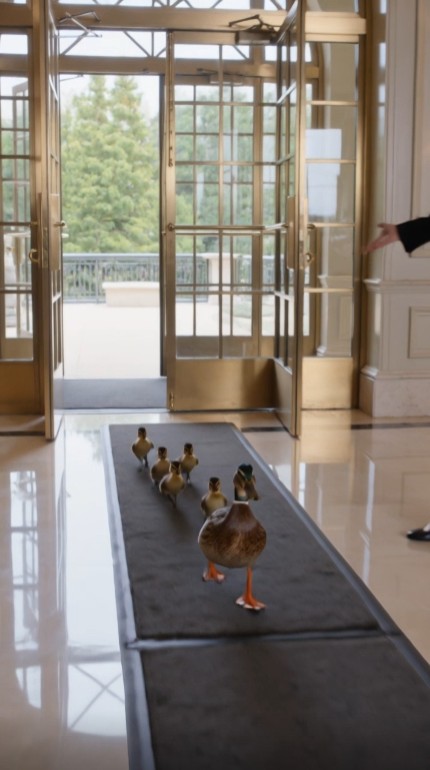
A mother duck walked straight into a five-star hotel.
And behind her came eight tiny ducklings.
The receptionist froze.
Guests stopped walking.
Even the hotel manager could not believe what she was seeing.
“Why are there ducks in our lobby?”
The mother duck did not seem confused.
She waddled calmly across the polished floor.
Eight ducklings followed in a perfect little line.
Past the reception desk.
Past the expensive furniture.
Past a row of luggage carts.
And straight toward the glass wall overlooking the hotel’s courtyard.
The concierge, Daniel, watched them closely.
“I think she’s trying to get outside.”
The automatic garden doors were shut.
So Daniel opened one manually.
The mother duck walked through.
One duckling followed.
Then another.
One.
Two.
Three.
All eight.
The hotel staff gathered near the glass.
The little family crossed the courtyard toward a decorative pond surrounded by reeds and low shrubs.
Then the hotel’s elderly gardener appeared.
His name was Arthur.
He had worked on the property for nearly twenty-five years.
The moment he saw the ducks, he stopped.
“Wait.”
The manager turned.
“What?”
Arthur smiled.
“I think I know this duck.”
The manager stared at him.
“How?”
Arthur pointed toward the far corner of the garden.
Near a row of flowering shrubs was a large wooden planter.
For months, hotel employees had walked past it every day.
Guests sat nearby.
Gardeners watered around it.
Nobody had noticed anything unusual.
Arthur led the manager toward the area but stopped well back from the planter.
“Look beneath the rosemary.”
The manager crouched slightly.
At first, she saw only leaves.
Then she noticed a shallow depression hidden beneath the plants.
Bits of dry grass.
Small feathers.
Pieces of down.
An empty nest.
The manager looked toward the pond.
“You’re telling me she nested here?”
Arthur nodded.
“Looks like it.”
That explained far more than the staff expected.
Two weeks earlier, Arthur had noticed a female duck spending unusual amounts of time near the planter.
He assumed she was resting.
Then she disappeared whenever anyone came close.
Arthur suspected she might be nesting.
But he could not see eggs.
He did not disturb the area.
Instead, he quietly told the gardening team:
“Leave that planter alone for a while.”
They stopped trimming around it.
No leaf blower.
No heavy watering near the base.
No unnecessary work.
Arthur never told the entire hotel staff because he was not certain.
He did not want people gathering around the site.
Now it was obvious.
The eggs had hatched.
The mother duck had eight ducklings.
And somehow, on her way toward the courtyard pond, she had taken a route through the hotel.
The manager looked confused.
“But why go through the lobby?”
Arthur shrugged.
“Probably because it was the easiest open route.”
The hotel was built around the courtyard.
Several landscaped paths connected different sections of the property.
During recent maintenance, one exterior passage had been temporarily closed with fencing.
Another garden gate had been shut.
The lobby may simply have become the most accessible path toward the pond.
Nobody could know whether the duck had used the route before.
There was no reason to assume she understood the building in a human way.
She found an open passage.
Walked through.
Her ducklings followed.
Still, the sight was unforgettable.
Guests began taking photographs through the windows.
The manager immediately asked staff to keep everyone away from the duck family.
No chasing.
No feeding.
No children approaching the pond.
The hotel contacted a local wildlife adviser.
The advice was simple.
If the ducklings were healthy and the mother was caring for them, leave them alone.
The courtyard already had water.
Vegetation.
Shelter.
The family did not need to be captured or moved simply because people found them adorable.
The biggest problem was human activity.
So the hotel made a few temporary changes.
One path near the pond was closed.
Outdoor tables closest to the reeds were moved farther away.
Signs asked guests not to feed or approach wildlife.
The grounds team delayed maintenance in that section.
Arthur watched from a distance.
The mother duck led the ducklings into the water.
For several minutes, all eight stayed close to her.
One wandered toward the edge.
Then quickly returned.
The hotel receptionist laughed.
“They look like tiny boats.”
The manager smiled.
Then became serious.
“Are we sure there were only eight?”
Arthur counted again.
Eight.
They checked the empty nest from a respectful distance later, after the family had moved well away.
No unhatched eggs were visible.
Nothing suggested another duckling had been left behind.
That was a relief.
But then Arthur showed the staff something else.
The planter was not the only sheltered spot around the courtyard.
Near another section of hedging, he had seen birds entering repeatedly.
Not ducks.
Small songbirds.
There was also a low ledge above a service corridor where another nest appeared to be active.
The hotel had much more wildlife using the courtyard than anyone realized.
The manager frowned.
“We have hundreds of guests out here.”
Arthur nodded.
“And wildlife doesn’t read hotel signs.”
That sentence became a joke among the staff.
But it also changed how the garden was managed.
The hotel hired an ecologist to conduct a simple seasonal review of the courtyard and outer grounds.
The goal was not to turn the hotel into a nature reserve.
It was to avoid disturbing active nests unnecessarily.
The review found several nesting sites.
Most were ordinary.
Small birds in shrubs.
Another nest high beneath an exterior structure.
And signs that ducks had used the pond area before.
The manager asked:
“Has this happened in previous years?”
Arthur thought for a moment.
“Maybe.”
“You never saw ducklings?”
“Not in the lobby.”
Everyone laughed.
That became the story guests told.
The luxury hotel with ducks checking in.
Staff made sure the joke did not turn into harassment.
No one was allowed to lure the ducks inside for photographs.
No food was placed near the lobby.
No one tried to recreate the moment.
The first walk-through had been spontaneous.
That was why it was special.
Over the next few days, the duck family became part of the courtyard routine.
Guests saw them early in the morning.
Sometimes near the water.
Sometimes resting beneath vegetation.
The staff learned to check before moving outdoor furniture.
Gardeners approached slowly.
The maintenance team inspected the pond area before using equipment.
Arthur kept reminding everyone:
“They don’t need us unless something’s wrong.”
That was important.
The mother duck was doing exactly what she was supposed to do.
The ducklings followed.
Fed.
Rested.
Stayed near cover.
Then, one morning, the family was gone.
The receptionist noticed first.
“No ducks.”
Arthur checked the pond.
Nothing.
He looked along the garden paths.
Still nothing.
The manager worried.
“Should we search?”
Arthur shook his head.
“No.”
The wildlife adviser agreed.
The family had likely moved to another suitable area.
Wild ducks do not stay because hotel guests enjoy seeing them.
If they had left safely, that was a good outcome.
The empty courtyard felt strangely quiet.
But the hotel kept the changes it had made.
Wildlife checks became part of seasonal garden maintenance.
Shrubs were inspected before major trimming.
Known active nesting areas were given space.
Employees were taught not to assume a seemingly empty planter was actually empty.
Arthur’s planter became famous among the staff.
Not with guests.
There was no sign marking it.
Arthur did not want people searching around it every year.
But each spring, the gardening team paid extra attention.
Two years later, another duck nested near the pond.
Nobody knew whether it was the same female.
There was no identification tag.
No reliable way to prove it.
Arthur refused to guess.
“Could be.”
“That’s all.”
The second nest was in a different location.
This time, staff spotted it early.
They adjusted maintenance before the eggs hatched.
The duck family never entered the lobby.
The receptionist said she was disappointed.
Arthur replied:
“That means the plan worked.”
Years later, the original story was still remembered by employees.
New staff heard about it during orientation.
Not as a lesson about a magical duck that knew its way through a hotel.
As a practical example.
Wild animals sometimes use spaces humans think belong only to humans.
Gardens.
Planters.
Courtyards.
Parking areas.
Building ledges.
And when people notice, the right response is often surprisingly simple.
Give them room.
Reduce unnecessary disturbance.
And let them move on when they are ready.
The most famous photograph from that morning showed the mother duck crossing the polished lobby.
Eight tiny ducklings behind her.
A five-star reception desk in the background.
Arthur kept a copy in the gardening office.
Underneath, someone had written:
Guests: 8.
Reservation: none.
Arthur pretended not to like the joke.
But he never removed the photograph.
Because he remembered the moment differently.
The staff thought a duck had wandered into the wrong place.
In reality, she was simply moving between two parts of an environment that made sense to her.
A hidden nest.
A sheltered courtyard.
A pond.
And one temporary route through a very expensive hotel lobby.
The staff had been walking past her nest every day without seeing it.
Then one morning, she came through the front of their world with eight tiny ducklings behind her.
Only then did everyone realize how much life had been quietly sharing the garden all along.