
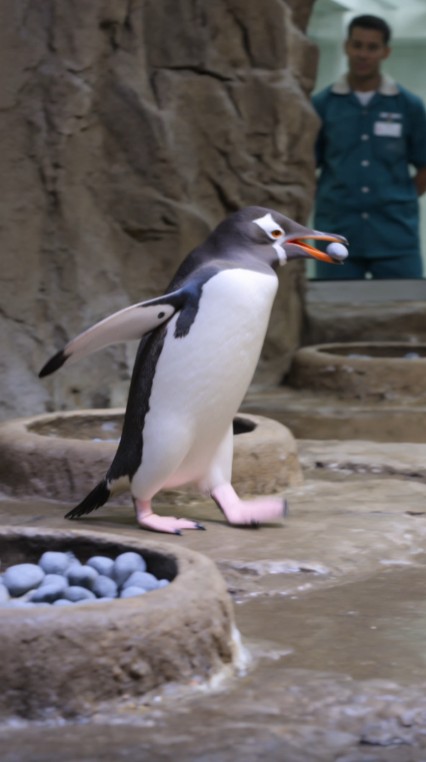
A penguin kept collecting purple pebbles.
But he was not taking them to his own nesting spot.
He was giving them to another penguin.
The aquarium keepers could not stop watching.
His name was Percy.
A healthy gentoo penguin with one very noticeable habit.
Whenever he found a pebble with a purple-gray color, he picked it up.
Carried it across the nesting area.
And placed it beside Luna.
Another gentoo penguin.
At first, the keepers thought it was coincidence.
Penguins moved stones constantly.
Pebbles were part of everyday nesting behavior.
Birds picked them up.
Dropped them.
Moved them.
Sometimes even tried to take them from neighboring nesting areas.
So one purple pebble meant nothing.
Then Percy brought another.
And another.
And another.
One keeper laughed.
“Does he want every purple pebble in the colony?”
Nobody knew.
The keepers were careful not to claim Percy understood color the same way humans did.
Maybe he preferred a certain contrast.
Maybe those stones were simply easy for him to spot.
Maybe the shape or size mattered more than the color.
But whatever Percy was selecting, the pattern was becoming hard to ignore.
Then Luna did something interesting.
She picked up one of the pebbles Percy had brought.
Carried it a short distance.
And placed it carefully into the shallow ring forming around her nesting area.
Percy stood nearby.
Watched for a moment.
Then turned around.
And went searching again.
The keepers began counting.
Five stones.
Then eight.
Then twelve.
Some were clearly more purple than others.
A few were closer to gray.
But all had a similar smooth shape.
Luna kept arranging them.
Not into a perfect circle.
Penguin nests rarely looked that neat.
Instead, she shifted stones around the edge.
Pulled some inward.
Pushed others outward.
Percy repeatedly brought more.
One keeper leaned closer to the viewing window.
“Wait.”
“What?”
“Look at the nest.”
The others gathered.
The nesting area had changed.
What had started as a loose patch of stones was becoming a more defined raised ring.
The purple-gray pebbles were mixed with ordinary stones already in the area.
Luna was not displaying them like decorations.
She was using them.
Exactly as nesting material.
That was the moment the keepers realized they were not watching Percy build some mysterious collection.
They were watching a pair cooperate.
Gentoo penguins are known for building nests from stones, and pebble exchange can occur during courtship and pair-bonding behavior.
Still, every pair behaved a little differently.
Percy seemed unusually persistent.
Luna seemed unusually selective about placement.
The combination made them fascinating to watch.
Over the next several days, Percy continued his routine.
Walk.
Search.
Inspect.
Pick up a stone.
Carry it back.
Sometimes Luna accepted it immediately.
Sometimes she ignored it.
Sometimes she moved it.
And occasionally, Percy would bring a pebble only for Luna to pick it up and place it somewhere completely different.
The keepers joked that Percy supplied materials while Luna handled design.
One morning, Percy returned carrying a particularly large stone.
It was much bigger than the others.
He struggled with it.
Dropped it once.
Picked it up again.
Carried it toward Luna.
The keepers watched closely.
Percy placed it beside the nest.
Luna examined it.
Then pushed it away.
Percy stared at the rejected stone.
One keeper laughed.
“Too big.”
Percy did not give up.
A few minutes later, he returned with a smaller one.
Luna used that.
The staff laughed even harder.
But underneath the humor was something genuinely interesting.
The pair appeared to be coordinating through repeated, simple behaviors.
Not planning in a human sense.
Not designing a nest from a blueprint.
Just responding to one another.
Percy brought stones.
Luna arranged them.
Both adjusted as the nest developed.
The keepers documented what they saw.
Photos.
Dates.
Approximate numbers.
Which bird collected.
Which bird placed.
The observations became useful for the aquarium’s behavioral records.
That mattered because good animal care depends on knowing what normal behavior looks like for each individual.
If Percy suddenly stopped collecting.
If Luna abandoned the nest.
If either bird began behaving unusually.
The keepers would have a baseline.
Visitors soon noticed the pair too.
Children pressed close to the glass.
Adults pointed toward the purple-gray stones.
Some people immediately called them “love stones.”
The keepers smiled, but they used more careful language.
Pebble exchange among penguins can be associated with courtship and nesting behavior.
That does not mean every stone functions like a human engagement ring.
The reality is more interesting than the myth.
For penguins that build stone nests, suitable pebbles are practical resources.
They help raise the nest above wet ground.
They define the nesting area.
They can become part of pair interaction.
And because useful stones are limited, they can be surprisingly valuable inside a colony.
Percy’s repeated deliveries were therefore both charming and practical.
Then came the morning everyone had been waiting for.
Luna settled into the nest.
She stayed there longer than usual.
Percy remained nearby.
The keepers monitored without disturbing them.
Later, when Luna shifted position, one keeper noticed something beneath her.
An egg.
The team became quiet.
All those stones suddenly had a new purpose.
The raised nest helped keep the egg off the colder, wetter floor.
The little ring Percy and Luna had built was no longer just a construction project.
It was now being used exactly as gentoo nests are meant to be used.
Percy continued bringing stones even after the egg appeared.
Not constantly.
But enough for the keepers to notice.
Luna continued making adjustments.
One day, she moved three stones in less than ten minutes.
Another time, she pulled a pebble from the far side and repositioned it closer to the center.
The nest never looked finished.
Maybe, from a penguin’s perspective, nests rarely are.
The keepers reduced unnecessary activity around the breeding area.
Visitors were asked not to tap the glass.
Lighting and routine remained consistent.
The birds were allowed to behave naturally.
Then a second egg appeared.
Now Percy spent even more time near Luna.
The pair began alternating nest attendance.
When Luna moved away, Percy settled over the eggs.
When Percy left, Luna returned.
The keepers recorded the exchanges carefully.
One visitor asked:
“Do they know they’re going to be parents?”
The keeper smiled.
“We can’t know what they understand the way humans do.”
What they could observe was clear.
The pair maintained the nest.
Protected the eggs.
And coordinated their attendance.
That was enough.
Weeks passed.
The purple stones became harder to distinguish.
Some were partly buried.
Others had shifted.
The nest changed constantly under the birds’ feet.
Then one morning, a keeper noticed a crack.
One egg had begun to hatch.
Nothing dramatic happened quickly.
Hatching takes time.
The team monitored.
Waited.
Then, eventually, a tiny chick emerged.
Wet.
Fragile.
Almost hidden beneath Luna.
The keepers were thrilled.
But they kept their distance.
The chick needed warmth and parental care, not attention from humans.
A second chick followed later.
Now Percy’s old pebble deliveries seemed even more meaningful—not because he had known exactly what would happen, but because simple nesting behavior had contributed to a safe place for the eggs.
The pair continued caring for the chicks.
The keepers watched feeding.
Brooding.
Position changes.
Normal developmental behavior.
The chicks grew quickly.
Soon they became fluffy enough for visitors to spot them.
People returned specifically to see Percy and Luna.
The story spread around the aquarium.
THE PENGUIN WHO BRINGS PURPLE STONES.
But the staff resisted turning it into something it was not.
Percy had not built a romantic sculpture.
Luna had not arranged the stones to spell a message.
No pebble carried secret meaning anyone could prove.
What made the story beautiful was that nothing extraordinary had to be invented.
A male gentoo penguin repeatedly collected stones.
A female used them to build and maintain a nest.
The pair coordinated naturally.
Then cared for their eggs together.
That was already enough.
Months later, after the chicks became independent and the nesting area changed again, many of the purple-gray stones were scattered.
Some remained near the old nest.
Others moved around the colony.
Percy still occasionally picked one up.
One keeper joked:
“He’s back to collecting.”
But this time, Percy carried the pebble only a few steps.
Dropped it.
Then wandered away.
Luna was nearby.
She ignored it.
The breeding season had moved on.
So had they.
The keepers kept one photograph from the season.
Not of the chicks.
Not of an egg.
The photograph showed Percy walking toward Luna carrying a small purple-gray pebble in his beak.
Luna stood beside the half-built nest.
Nothing dramatic.
Just one small piece of ordinary penguin behavior.
Under the photograph, the staff wrote:
BUILDING TOGETHER.
That was what visitors had really witnessed.
Not a human-style love story.
Something quieter.
A pair of penguins responding to each other through instinct, routine, and shared nesting behavior.
Percy brought the stones.
Luna arranged them.
The nest grew.
Then one day, two tiny chicks were tucked safely inside it.
And the strange little pile of purple pebbles finally made perfect sense.