
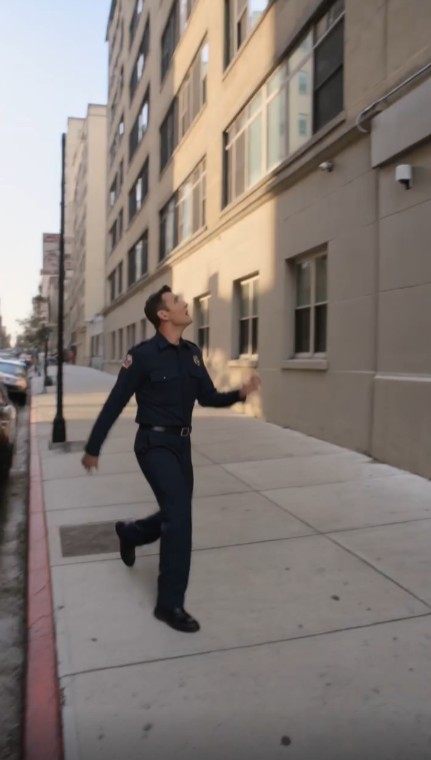
A firefighter noticed three strange flashes coming from an apartment building.
At first, he thought it was sunlight.
Then it happened again.
Three flashes.
A short pause.
Three more.
Alex stopped walking and looked up.
“Sarah… did you see that?”
His colleague turned.
The light flashed again.
Same window.
Same pattern.
Three quick bursts.
Pause.
Three more.
The two firefighters had been returning from a routine inspection nearby.
There was no emergency call at the building.
No smoke.
No alarm.
Nothing unusual on the street.
Except that light.
Alex raised his hand to block the sun.
The flashing came from an upper-floor apartment.
“That’s deliberate.”
Sarah nodded.
“It looks like someone’s signaling.”
They contacted the building manager.
His name was Martin.
He arrived several minutes later, slightly out of breath and carrying a ring of keys.
Alex pointed upward.
“That window.”
Martin looked.
Then frowned.
“That floor is supposed to be empty.”
“What do you mean?”
“Renovation.”
“The apartments on that side were cleared last week.”
Sarah looked at him.
“Workers inside?”
“Not today.”
“Cleaning crew?”
“No.”
“Owner?”
Martin shook his head.
“Nobody should be up there.”
The light flashed again.
Martin’s expression changed.
Alex said:
“Then somebody is.”
They entered the lobby.
Martin checked the building access log.
No contractor had signed in.
No maintenance appointment.
No move-in.
Nothing.
Sarah looked through the glass entrance toward the upper floors.
Then stopped.
“Alex.”
He turned.
“Look at the other window.”
A flash.
Not from the original apartment.
From a window several floors lower and farther across the building.
Then another.
Then another.
Three.
Pause.
Three.
Martin went pale.
“That doesn’t make sense.”
Now there were two windows.
Both appearing to signal.
Alex radioed their location and requested additional support.
They were not going to rush blindly into supposedly vacant apartments.
First, they needed to know exactly what they were dealing with.
Martin pulled up the floor plan.
The first signal came from Apartment 804.
The second appeared to be Apartment 517.
Alex pointed.
“Connected somehow?”
“No.”
“They’re on opposite sides.”
Sarah asked:
“Could mirrors be causing reflections between windows?”
Martin looked uncertain.
“Maybe?”
But the timing seemed too regular.
Three flashes.
Pause.
Three.
Again.
Alex tried something simple.
He stepped outside and aimed his flashlight toward the first window.
Three quick flashes.
He waited.
For several seconds, nothing happened.
Then:
Three flashes came back.
Sarah looked at him.
“That answered you.”
Someone was definitely there.
They went upstairs.
Martin unlocked the eighth-floor corridor.
Dust sheets covered part of the hallway.
Several doors were marked for renovation.
Apartment 804 stood at the far end.
Alex knocked.
“Fire department.”
No answer.
He knocked again.
“Can anyone inside hear me?”
Silence.
Then something struck the inside of the door.
Three times.
Knock.
Knock.
Knock.
Sarah immediately moved closer.
“Someone’s in there.”
Martin unlocked the door.
They entered carefully.
The apartment appeared empty.
No furniture.
No boxes.
No contractors.
Then Alex heard a faint metallic sound.
Near the balcony.
They moved toward it.
That was when they found the source of the flashes.
A small hand mirror lay on the floor near the window.
Beside it sat an elderly man.
His name was Walter.
He was conscious.
Confused.
And extremely relieved to see them.
“I knew somebody would notice eventually.”
Sarah crouched beside him.
“Are you hurt?”
“My ankle.”
“What happened?”
Walter explained.
He did not live in Apartment 804.
He lived on the sixth floor.
That morning, he had taken the stairs because the elevator was being serviced.
On his way up from collecting mail, he noticed the eighth-floor renovation door partly open.
Walter had been friends with the former tenant.
He knew the apartment had recently been emptied.
He stepped inside because he thought workers might have left the balcony door open.
It was a mistake.
A strong draft slammed the apartment door behind him.
The temporary interior handle had been removed during renovation.
His phone was downstairs in his apartment.
When he tried to force open the door, he slipped on protective plastic covering the floor and injured his ankle.
He could not get back up easily.
Walter shouted.
Nobody heard him.
Then he noticed the mirror.
It had been left behind in a box of discarded bathroom fixtures.
He dragged himself toward the window.
And began reflecting sunlight toward the street.
Three flashes.
Pause.
Three more.
Not an official distress code.
Just a simple pattern he hoped somebody would recognize as intentional.
Alex smiled.
“We did.”
Sarah looked toward the window.
“Then what’s happening on the fifth floor?”
Walter stared at her.
“What?”
“There’s another signal.”
“I don’t know anything about that.”
That made everyone uneasy again.
Paramedics arrived and began helping Walter.
Alex and Sarah headed toward the fifth floor with Martin.
Apartment 517 was not under renovation.
But according to Martin’s records, the tenant was away visiting family.
He knocked.
No answer.
Then three knocks came from inside.
Sarah and Alex exchanged a look.
Martin unlocked the door.
“Fire department!”
They entered.
Nothing immediately looked wrong.
Then something small moved near the living room window.
Sarah stopped.
“Oh.”
A child was standing behind a partially closed interior door.
A little boy.
Maybe seven years old.
He held a small flashlight.
Alex immediately lowered himself to the child’s height.
“Hey.”
“My name’s Alex.”
“Are you okay?”
The boy nodded.
“Is anyone else here?”
He pointed toward the bedroom.
There they found his grandmother, Rosa.
She was sitting on the floor beside the bed.
Conscious.
Unable to stand.
She had fallen while reaching for something on a shelf.
Her mobile phone had landed on the other side of the room.
The boy, Mateo, had been staying with her unexpectedly because his mother’s travel plans changed.
That was why the building records showed the apartment occupant as away.
Martin had not known Rosa had returned early with her grandson.
Sarah asked Mateo:
“Were you flashing the light out the window?”
The boy nodded.
“Why three times?”
Mateo pointed toward the building across the courtyard.
“I saw somebody else doing it.”
Everyone went quiet.
The two mysteries were connected after all.
But not in the way anyone expected.
Mateo had been looking out the window after his grandmother fell.
He did not know how to unlock her phone.
He had been told not to leave the apartment alone.
Then he noticed Walter’s flashes from the eighth floor.
Three flashes.
Pause.
Three more.
Mateo found a flashlight in a drawer.
He copied the pattern.
He was not signaling Walter because they knew each other.
He was imitating the one deliberate signal he had seen.
Then Alex and Sarah noticed both.
The firefighters stared at each other.
Two people trapped in separate apartments.
Neither knew the other needed help.
One used sunlight and a mirror.
The other used a flashlight.
And by coincidence, their signals became identical.
Rosa was examined by paramedics.
Her injuries were not life-threatening, but she needed medical attention.
Walter was taken in for his ankle.
Mateo remained calm once he understood his grandmother was being helped.
Before leaving, Alex asked him:
“Why didn’t you go into the hallway?”
Mateo answered:
“Grandma told me never to open the door when I’m alone.”
Sarah smiled gently.
“That’s usually a good rule.”
“But when there’s an emergency, you can call for help.”
Mateo looked embarrassed.
“I didn’t know the number.”
Rosa heard him.
“That’s my fault.”
It became one of the most important details of the day.
Everyone assumed children knew what to do during emergencies.
But Mateo had never been taught how to use the emergency-call function on a locked phone.
Rosa’s phone required a code for most features.
The emergency option was available from the lock screen.
Mateo simply did not know it existed.
Later, his mother showed him.
Martin took the situation personally too.
He reviewed the eighth-floor renovation area.
The apartment door should never have been left able to close without an accessible interior handle.
The contractor had removed hardware temporarily but failed to secure the door correctly.
Martin suspended work until the issue was reviewed.
Every renovation unit was inspected.
Temporary locks were changed.
Doors were fitted so nobody could accidentally become trapped inside.
The building also introduced a clearer contractor sign-in process.
Then there was Apartment 517.
Rosa had returned earlier than expected.
The building office had not been informed.
That was not necessarily a violation.
Residents did not need permission to come home.
But it explained why Martin confidently believed nobody was there.
Records could tell him what was expected.
Not necessarily what was happening.
Alex later said that was one of the biggest lessons.
“Never let a spreadsheet convince you that a room is empty when something in front of you says otherwise.”
The firefighters had seen the flashes.
That evidence mattered more than assumptions.
Walter returned home several days later wearing a walking boot.
Rosa returned not long after.
The two had never met before.
Martin introduced them in the lobby.
Walter laughed when he learned what happened.
“So you copied me?”
Mateo nodded.
“I thought you were doing a secret code.”
Walter smiled.
“So did I.”
Rosa looked at Walter.
“You were trapped too?”
“Apparently we had a very bad morning.”
They became friends after that.
Not instantly inseparable.
Nothing so dramatic.
But Walter occasionally visited Rosa for coffee.
Mateo always asked whether he had brought the mirror.
Walter eventually gave him a safer plastic one.
On the back, he wrote:
FOR SIGNALING ONLY.
Rosa added underneath:
AFTER CALLING FOR HELP.
The firefighters returned to the building several weeks later for a community safety session.
They covered emergency calling.
Smoke alarms.
Fire exits.
When children should leave an apartment.
When they should stay away from hazards.
How to describe their address.
And how to use the emergency function on common phones.
Mateo sat in the front row.
Walter attended too.
Someone asked Alex whether three flashes were an official rescue signal.
He answered carefully.
“No.”
There are recognized emergency signals in some contexts, but the pattern Walter used was improvised.
It worked because it was repetitive and obviously deliberate.
The important thing was not memorizing Walter’s exact pattern.
It was understanding that unusual repeated signals can deserve attention.
A flashlight.
A reflection.
Knocking.
Something being waved from a window.
Anything that appears intentionally repeated.
Sarah added:
“And if you can call emergency services directly, do that first.”
No one wanted people relying on chance.
Walter had been lucky.
Mateo had been lucky too.
The story spread through the neighborhood.
As stories often do, it became exaggerated.
Some people claimed Walter and Mateo had coordinated from different floors.
They had not.
Others said they were using Morse code.
They were not.
Someone even said firefighters decoded a secret message.
There was no message.
Only three flashes repeated.
What really happened was stranger in a quieter way.
An elderly man became trapped inside an empty renovation apartment.
He used sunlight and a mirror hoping someone on the street would notice.
Several floors below, a child needed help for his grandmother.
He saw the repeated flashes.
Assumed they were a signal.
And copied them using a flashlight.
Two separate emergencies.
Two separate windows.
One accidental pattern.
And two firefighters who happened to look up.
Months later, Walter replaced the small mirror he had used.
The original cracked when he fell.
He gave the damaged one to Alex as a joke.
“For your department’s advanced communications system.”
Alex kept it in a desk drawer.
Beside it, he placed a note:
WHEN SOMETHING REPEATS, PAY ATTENTION.
That was the real lesson.
The building manager had said the floor was empty.
The records said no one should be there.
The second apartment was supposed to be vacant too.
Every reasonable assumption told Alex and Sarah there was nothing to investigate.
Then the light flashed again.
Three times.
Pause.
Three times.
And because they stopped long enough to notice, two separate calls for help were finally answered.