
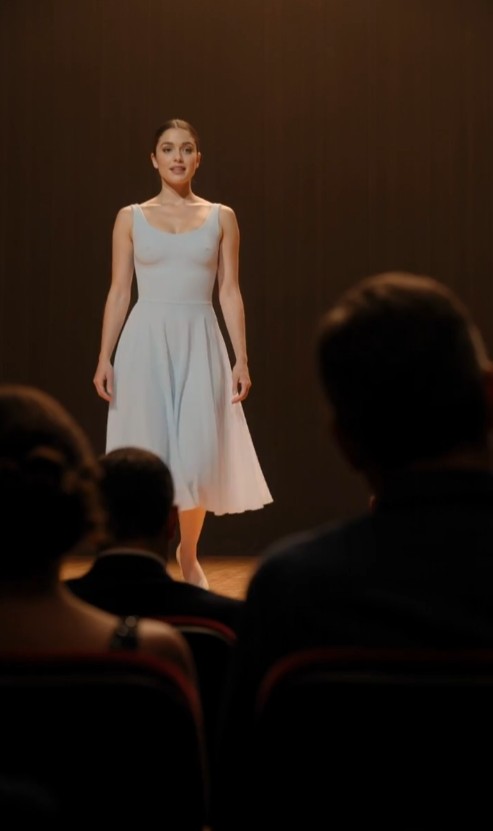
A dancer suddenly stopped her performance and pointed toward a man in the audience.
“Dad… come here.”
The entire theater fell silent.
Her father was sitting in the front row.
Wearing ordinary work clothes.
Holding a small bouquet of flowers.
He looked around, confused.
“Me?”
His daughter smiled.
“Yes, Dad. You.”
His name was Michael.
He had never performed on a stage in his life.
He had never taken a dance class.
And he definitely had not planned to become part of the most important performance of his daughter’s career.
But slowly, awkwardly, he stood.
The audience watched as he made his way toward the stage.
His daughter, Emily, waited for him.
When he reached her, he looked down at his clothes.
Work boots.
Dark trousers.
A shirt with faint marks near one sleeve from a long day.
“Sweetheart, I’m not dressed for this.”
Emily took his hand.
“You always showed up for me.”
Then the music started again.
Softly.
Michael looked terrified.
Emily smiled.
“Just follow me.”
There was no complicated choreography.
No dramatic lift.
No perfect turn.
Just a few simple steps.
Emily guided him.
One step.
Then another.
Michael’s hands trembled slightly.
His eyes filled with tears.
Then Emily leaned closer and whispered:
“This dance is yours, Dad.”
That was when the audience began to understand.
For years, people saw Emily onstage.
They saw the costumes.
The lights.
The competitions.
The graceful movements.
What they did not see was everything that happened before she reached the stage.
When Emily was six, she saw a dance class through the window of a community center.
She stopped walking.
Michael kept going.
Then realized his daughter was no longer beside him.
He turned around.
Emily was standing against the glass.
Watching.
“Dad.”
“Yes?”
“I want to do that.”
Michael looked through the window.
Ballet shoes.
Mirrors.
Parents sitting along the wall.
He knew almost nothing about dance.
He also knew lessons cost money.
At the time, Michael worked maintenance at a distribution warehouse.
He was raising Emily mostly on his own.
Her mother lived in another city and remained part of Emily’s life, but day-to-day responsibility fell largely on him.
Rent was high.
The car was unreliable.
There was no large savings account waiting for dance classes.
Michael asked for a brochure anyway.
That night, after Emily went to bed, he sat at the kitchen table with a calculator.
Lesson fee.
Shoes.
Leotard.
Registration.
Transport.
He stared at the total.
Then circled one number.
Saturday overtime.
The next week, Emily began class.
She had no idea her father had changed his work schedule to make it happen.
At first, she was not unusually talented.
She forgot sequences.
Mixed up directions.
Talked during instructions.
One teacher described her as enthusiastic but distracted.
Michael loved that sentence.
Whenever Emily told people she had been “born to dance,” he corrected her.
“You were born to talk.”
She hated that joke.
But she kept dancing.
Michael kept driving.
For years, his life became organized around rehearsal times.
Monday at five.
Thursday at six-thirty.
Saturday morning.
Then competitions.
Then extra rehearsals.
Then performances.
He knew every parking lot outside every studio.
He knew which vending machines accepted cards.
He knew exactly how long he could nap in the car before Emily came outside.
Other parents sometimes sat in the lobby.
Michael usually waited outside because he came directly from work.
His clothes were dusty.
His boots were heavy.
He felt out of place among parents discussing costumes and choreography.
So he sat in the car.
Sometimes for three hours.
Emily never thought much about it.
Children rarely understand the logistics behind the things they love.
They simply know someone gets them there.
As Emily became more serious, the expenses increased.
Private coaching.
Competition fees.
Travel.
Costumes.
Michael never lied and told her money did not matter.
It did.
Sometimes he said no.
Sometimes they chose one competition instead of two.
Sometimes Emily wore a costume another dancer had outgrown.
Sometimes Michael repaired things himself.
One year, a costume zipper broke the night before a competition.
Michael sat at the kitchen table with a sewing tutorial playing on his phone.
Emily watched him struggle.
“Dad, you’re doing it wrong.”
“I’m aware.”
“You’re going to ruin it.”
“I’m also aware.”
He fixed it badly.
Then took it to a professional the next morning.
Emily won second place.
Michael kept the broken zipper in a drawer for years.
Not because it mattered.
Because that entire night somehow represented parenthood to him.
You do not always know what you are doing.
You just keep trying until your child gets back onstage.
When Emily was twelve, she almost quit.
A new teacher was demanding.
Other dancers seemed better.
Emily came home after rehearsal, threw her shoes into the hallway and said:
“I’m done.”
Michael nodded.
“Okay.”
She stared at him.
“That’s it?”
“What do you want me to say?”
“You’re supposed to tell me not to quit.”
Michael sat down.
“Do you hate dancing?”
Emily hesitated.
“No.”
“Do you hate feeling bad at it?”
“Yes.”
“That’s different.”
She looked at him.
Michael continued.
“You can quit if you don’t love it anymore.”
“But don’t quit today because today hurt.”
Emily returned to class the next week.
She never forgot that.
Years later, she would tell younger dancers the same thing.
Do not make permanent decisions on temporary bad days.
By sixteen, Emily had become exceptional.
Teachers noticed.
Then schools noticed.
She won a place in a respected summer program.
The tuition was far beyond what Michael could comfortably afford.
Emily told him:
“I don’t have to go.”
Michael asked:
“Do you want to?”
“Yes.”
“Then let me worry about the rest.”
He took extra shifts.
Sold an old motorcycle he had barely ridden in years.
Cut expenses.
Accepted help from one aunt who insisted.
Emily attended.
That summer changed everything.
She trained harder than ever.
Met professional dancers.
Saw what a real career required.
And understood for the first time that talent was only the beginning.
She also began understanding her father.
One night, another student complained that her parents were late picking her up.
Emily looked at the clock.
Then realized Michael had never once failed to come.
Late sometimes.
Exhausted often.
But always there.
She started noticing the details.
The work shirt at recitals.
The coffee cups in the car.
The way he rubbed his lower back after long shifts.
The envelope marked DANCE tucked beside household bills.
The shoes he kept wearing long after they should have been replaced.
That was when gratitude changed from something polite into something real.
At eighteen, Emily received an offer to study dance professionally.
Michael cried before she did.
He tried to hide it by pretending he had something in his eye.
Emily said:
“Dad.”
“Dust.”
“We’re inside.”
“Indoor dust.”
She hugged him.
Then moved away for training.
For the first time, Michael was not driving her everywhere.
At first, Emily loved the independence.
Then she missed the car rides.
The bad radio.
The fast-food dinners.
Michael asking after every rehearsal:
“How was it?”
Even though he understood none of the terminology in her answer.
Her career developed slowly.
Small performances.
Understudy roles.
Touring productions.
Teaching work.
Auditions that led nowhere.
Michael attended whatever he could.
Sometimes he drove hours.
Sometimes he took unpaid time off.
Sometimes he watched online when travel was impossible.
He always sent the same message afterward.
Proud of you.
Not:
You were the best.
Not:
You should have gotten the bigger role.
Just:
Proud of you.
Then Emily was offered the lead in a new production.
It was the largest role of her career.
The final performance would be filmed.
Industry people were expected.
Her name was on the poster.
Michael bought his own ticket before Emily could arrange one.
Front row.
Emily laughed when she found out.
“You know I could have gotten you in free.”
“I support the arts.”
“You complain about ticket prices.”
“I support the arts selectively.”
On the afternoon of the performance, Michael worked a half shift.
He planned to go home.
Shower.
Change into the suit Emily had bought him for his birthday.
Then a mechanical problem at work delayed everyone.
Michael stayed.
By the time he got out, there was barely enough time to reach the theater.
He called Emily.
“I might be late.”
She panicked.
“How late?”
“I don’t know.”
“Dad.”
“I’m trying.”
Michael drove directly from work.
He arrived minutes before the performance began.
No suit.
No polished shoes.
Just his work clothes.
He almost stayed in the back.
An usher checked his ticket.
Front row.
Michael hesitated.
Then sat.
He held a small bouquet he had bought from a convenience store because the florist was already closed.
Emily saw him from backstage.
Work clothes.
Flowers.
Same father.
Same person who had spent years arriving exactly like that.
Something changed in her.
The final piece had been carefully choreographed.
Every movement planned.
Every cue timed.
There was no section for Michael.
But near the end, Emily looked toward the front row.
And suddenly the polished performance felt incomplete.
She stopped.
The music continued for a few seconds.
Then the conductor faded it.
Emily pointed.
“Dad… come here.”
Back onstage, Michael whispered:
“You’re going to get in trouble for this.”
Emily laughed.
“Probably.”
“You planned this?”
“No.”
“That is worse.”
The audience laughed.
Then she took his hand.
The music started again.
Emily guided him through a slow sequence adapted from the final section.
Nothing technically impressive.
Michael stepped the wrong direction once.
Emily corrected him.
He almost stepped on her dress.
They both laughed.
Then she told him:
“This dance is yours, Dad.”
The audience stood.
Not because Michael danced beautifully.
He did not.
Not because they knew every detail of their history.
They didn’t.
They stood because the meaning was obvious.
One performer stood in the spotlight.
But another person had spent years making sure she could reach it.
Michael hugged Emily.
“I’m so proud of you.”
She whispered:
“I learned from you.”
After the performance, people told Michael he had stolen the show.
He hated that phrase.
“It wasn’t my show.”
Emily corrected him.
“That part was.”
The artistic director was not angry.
Mostly.
She told Emily afterward:
“Next time, warn me.”
Emily promised.
She did not mean it.
The spontaneous dance became the moment people remembered most.
But Emily was careful when talking about it later.
She did not want her father’s sacrifices turned into some story where suffering was automatically beautiful.
Michael had worked hard because he had limited options.
If affordable arts programs, transportation support, and scholarships had been easier to access, perhaps he would not have needed so much overtime.
Emily knew that too.
So she did something practical.
As her career improved, she helped establish a small scholarship fund through her old community studio.
It covered lesson fees.
Shoes.
Costumes.
Transportation.
The kinds of expenses that had nearly stopped her before she began.
Michael insisted the fund not carry his name.
Emily agreed.
She called it:
THE FRONT ROW FUND.
Michael asked:
“Why?”
Emily answered:
“Because every kid deserves someone there.”
The fund grew.
Other families contributed.
Former dancers helped.
The studio expanded it.
Michael occasionally attended scholarship showcases.
He still wore ordinary clothes.
Still sat near the front.
Still clapped too loudly.
Years later, Emily became a teacher as well as a performer.
Whenever she saw a parent waiting outside rehearsal in a work uniform, she noticed.
A father asleep in his car.
A mother answering work emails from the hallway.
A grandparent arriving with dinner in a plastic container.
Emily understood what those people represented.
Not perfection.
Presence.
One evening, a young dancer complained:
“My dad never watches rehearsal.”
Emily looked through the studio window.
Outside, the girl’s father was sitting in his van.
Still wearing a delivery uniform.
Emily smiled.
“Maybe he’s watching in a different way.”
The girl did not understand yet.
Emily knew she might someday.
Michael kept the bouquet wrapper from the famous performance.
Emily discovered it years later in the same drawer as the old broken costume zipper.
“You kept this?”
Michael shrugged.
“You keep costumes.”
“That’s different.”
“No.”
It wasn’t.
Families build private museums without realizing it.
Ticket stubs.
Broken zippers.
Photographs.
Cheap flowers.
Small proof that ordinary days once mattered enormously.
The photograph Emily treasured most from that performance did not show her alone beneath the stage lights.
It showed Michael beside her.
Work clothes.
Awkward posture.
One hand holding hers.
The other uncertain about where to go.
Emily was laughing.
So was he.
Whenever people asked why she interrupted the biggest performance of her career, Emily gave a simple answer.
Because her father had spent years standing outside the spotlight.
Driving.
Waiting.
Working.
Paying.
Encouraging.
Showing up.
And for once, she wanted everyone to see him too.
Sometimes the person who deserves the biggest applause is not the one standing in the spotlight.
Sometimes it is the person who spent years making sure someone else could get there.