
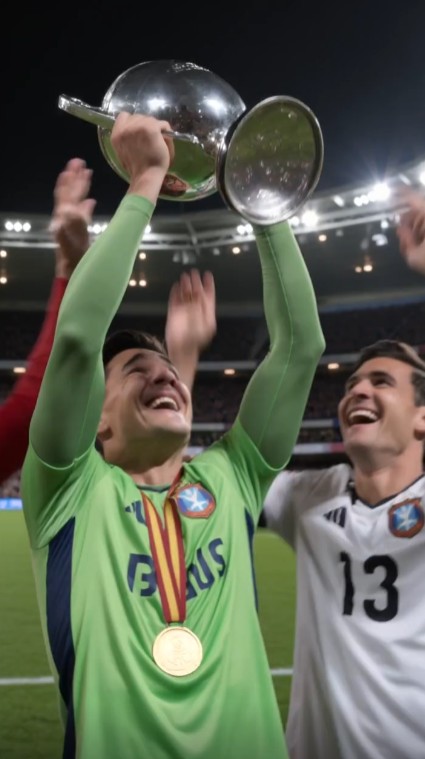
A goalkeeper won the biggest trophy of his career.
Then walked away from his celebrating teammates.
The stadium was roaring.
Cameras were flashing.
His teammates were jumping, shouting, spraying water into the air.
But Daniel was no longer celebrating.
He held the enormous silver trophy in both hands.
Looked toward the crowd.
And started walking.
“Daniel!”
“Where are you going?”
Nobody understood.
He crossed the edge of the pitch.
Walked toward the front row.
Then stopped in front of an ordinary-looking man wearing a blue jacket.
The man looked stunned.
Daniel lifted the trophy slightly.
“This belongs to you.”
The man immediately shook his head.
“No, son.”
“You earned it.”
But Daniel’s eyes filled with tears.
“Not without what you did.”
One of Daniel’s teammates followed him.
“Who is this man?”
Daniel carefully set the trophy down.
Then reached toward the stranger.
The man looked overwhelmed.
Thousands of people were watching.
The stadium cameras had turned toward them.
Daniel finally answered:
“The man who saved my career before it even started.”
Almost nobody in the stadium knew the story.
Because the man in the blue jacket was not a famous coach.
Not an agent.
Not a former player.
His name was Robert Ellis.
And twenty years earlier, he had been the caretaker at a small community football ground.
Daniel first met him when he was eleven.
Back then, nobody thought Daniel would become a professional goalkeeper.
Including Daniel.
He was tall for his age.
Quiet.
Awkward.
And terrified of making mistakes.
He played because his friends played.
Nothing more.
The team’s usual goalkeeper became sick before a weekend match.
The coach looked around.
“You.”
Daniel pointed at himself.
“Me?”
“You’re the tallest.”
That was the entire selection process.
Daniel hated every second.
He conceded four goals.
One slipped underneath his hands.
Another bounced off his shoulder.
After the match, two boys laughed.
Daniel pretended not to care.
Then walked behind the changing rooms and cried.
That was where Robert found him.
The caretaker was carrying a bucket and a bundle of corner flags.
He stopped.
“Bad day?”
Daniel wiped his face.
“I’m never playing in goal again.”
Robert nodded.
“Fair enough.”
Daniel looked surprised.
He expected one of those speeches adults gave children.
Don’t quit.
Believe in yourself.
Try harder.
Robert said none of that.
Instead, he asked:
“Did you enjoy any part of it?”
Daniel thought.
One save.
Late in the second half.
A striker broke through.
Daniel rushed forward.
Blocked the shot.
For maybe two seconds, the entire sideline cheered.
He admitted:
“One part.”
Robert smiled.
“That’s inconvenient.”
Daniel frowned.
“Why?”
“Because now you have to decide whether one good moment is worth surviving the bad ones.”
That sentence stayed with him.
The next Saturday, Daniel returned.
Not because he had suddenly become brave.
Because Robert offered to meet him early.
The old caretaker had been a goalkeeper too.
Not professionally.
He played semi-competitive football in his twenties.
Then injured his knee.
Life moved on.
Jobs.
Marriage.
Children.
Eventually, maintenance work at the community ground.
But he still knew the position.
So before Saturday training, Robert showed Daniel the basics.
Where to stand.
How to set his feet.
How to fall without panicking.
How to catch the ball against his body.
How to communicate with defenders.
The training was not sophisticated.
Two old footballs.
A muddy goal.
No specialist gloves.
Robert used cones made from plastic bottles filled with sand.
Daniel improved.
Slowly.
At first, he still flinched when shots came toward his face.
Robert never mocked him.
“Fear is useful.”
Daniel looked confused.
Robert explained.
“It tells you something might hurt.”
“The trick is not letting it make every decision.”
Week after week, they trained.
Robert arrived before his shift officially started.
Sometimes Daniel arrived before him.
By thirteen, Daniel was his team’s first-choice goalkeeper.
By fourteen, scouts had started appearing.
That should have been the easy part.
It wasn’t.
Daniel’s family had very little money.
His mother raised him and his younger sister alone.
Trial sessions were often far away.
Train tickets cost money.
Goalkeeper gloves wore out quickly.
One academy invited Daniel for a three-day assessment.
His mother looked at the travel cost.
Then at the unpaid electricity bill on the kitchen table.
Daniel knew the answer before she spoke.
“We can’t.”
He nodded.
“It’s okay.”
It wasn’t.
He went to the football ground that evening.
Robert immediately knew something was wrong.
“What happened?”
Daniel showed him the academy letter.
Robert read it.
“When?”
“Next week.”
“You going?”
Daniel shook his head.
“Can’t afford it.”
Robert folded the letter.
Then asked:
“How much?”
Daniel told him.
Robert did not answer.
The next morning, he gave Daniel an envelope.
Inside was enough for the train.
A cheap hotel.
And meals.
Daniel stared at him.
“No.”
Robert pushed it back.
“Take it.”
“My mom won’t let me.”
“Then tell her it’s a loan.”
Daniel looked at him.
“Is it?”
Robert smiled.
“If that makes her happy.”
Daniel’s mother did not like it.
She called Robert.
They argued.
Eventually, Robert made the arrangement formal enough that she would accept it.
Daniel would repay him one day if football worked out.
No interest.
No deadline.
The academy trial did not result in an offer.
Daniel came home devastated.
He thought he had wasted Robert’s money.
Robert disagreed.
“You learned what the level is.”
“That cost you a lot.”
“Yes.”
“I failed.”
“No.”
“You went.”
Daniel did not understand then.
He did later.
The next invitation came from another club.
Then another.
One finally offered him a place.
That created a new problem.
Daniel needed better equipment.
Robert found secondhand gloves.
Then persuaded a local sports shop to give Daniel a discount.
He arranged extra training on mornings when the pitch was free.
Nothing dramatic.
Nothing glamorous.
Just hundreds of small interventions.
When Daniel was fifteen, he suffered a wrist injury.
Doctors told him to rest.
Daniel became convinced his opportunity was disappearing.
Robert visited him at home.
Daniel said:
“They’ll replace me.”
Robert replied:
“Maybe.”
Daniel stared.
Again, no empty reassurance.
Robert continued.
“Then you recover.”
“And make them notice you again.”
That became another sentence Daniel carried for years.
He recovered.
Returned.
Earned his place back.
At seventeen, he signed his first professional contract.
His mother cried.
Daniel called Robert before telling almost anyone else.
“You remember that loan?”
Robert laughed.
“No.”
“I do.”
Daniel repaid every cent.
Robert tried to refuse.
Daniel insisted.
Then he added extra money.
Robert refused that.
“The agreement was the agreement.”
Daniel eventually accepted.
His career moved quickly after that.
Reserve team.
Cup appearances.
A loan to a smaller club.
Then first-team football.
Daniel became known for staying calm in penalty situations.
Journalists called it natural composure.
Robert laughed whenever he heard that.
“Natural?”
“He used to close his eyes when people kicked the ball at him.”
Years passed.
Daniel moved away.
Training schedules became demanding.
He married.
Had children.
Robert retired from the community ground.
They stayed in contact, but irregularly.
Birthday messages.
Occasional calls.
Tickets when Daniel could arrange them.
Robert rarely accepted expensive hospitality.
He preferred ordinary seats.
“Football looks better from the crowd.”
Then came the biggest season of Daniel’s career.
His club reached a major final.
The match went to extra time.
Then penalties.
Daniel saved the final kick.
The stadium exploded.
He fell to his knees.
His teammates buried him beneath a pile of bodies.
Within minutes, Daniel became the face of the victory.
The goalkeeper who won the final.
That was how newspapers described it.
Daniel knew better.
A goalkeeper never wins alone.
Defenders.
Coaches.
Analysts.
Teammates who scored.
Thousands of hours of training.
Luck.
Timing.
And, somewhere near the beginning of all of it, a caretaker with two old footballs and some plastic bottles.
Before the final, Daniel had sent Robert one ticket.
Front row.
Near the halfway line.
Robert almost did not come.
He hated flying.
His knees hurt.
He told Daniel:
“I’ll watch from home.”
Daniel replied:
“No.”
For once, Robert lost the argument.
Now the final whistle had blown.
Daniel’s team had lifted the trophy.
Confetti filled the air.
And Daniel saw the blue jacket in the front row.
Robert.
Exactly where Daniel hoped he would be.
That was when he walked away from the celebration.
He carried the trophy toward him.
“This belongs to you.”
Robert shook his head.
“No.”
Daniel smiled through tears.
“Then at least touch it.”
Robert reluctantly placed one hand on the silver cup.
The stadium cameras zoomed in.
Daniel’s teammate asked again:
“Who is he?”
Daniel answered:
“The first person who saw a goalkeeper when I only saw someone who was scared.”
Robert looked away.
He hated attention.
Daniel continued.
“He paid for the trial I couldn’t afford.”
“He trained me before work.”
“He gave me gloves.”
“He taught me that losing one opportunity doesn’t mean you lost everything.”
Robert interrupted.
“You did the work.”
Daniel nodded.
“I know.”
“But somebody had to keep me there long enough to do it.”
That was the line the television commentators repeated later.
Not because it was dramatic.
Because it was true.
Daniel did not give Robert the trophy permanently.
It belonged to the club.
Nobody could simply walk away with it.
Instead, he invited Robert onto the edge of the pitch after the official ceremony.
The team photographer took a picture.
Daniel.
Robert.
The trophy between them.
Years later, that photograph would mean more to Daniel than the one of him lifting the cup.
During interviews after the match, reporters asked about the mysterious man.
Daniel told the story carefully.
Robert was not the person who “made” him successful.
No one person could claim that.
Daniel had professional coaches.
Teammates.
Family.
Medical staff.
Academy trainers.
Many people contributed.
But Robert had been there before success looked possible.
That was different.
The story spread.
Reporters found the old community ground.
The muddy pitch had been renovated.
The changing rooms were newer.
But one original storage shed remained.
Inside were old photographs.
Youth teams.
Local tournaments.
Then someone found a picture of thirteen-year-old Daniel standing beside Robert.
Daniel wore gloves two sizes too large.
Robert held a bag of footballs.
Neither looked remotely famous.
The club invited Robert to a later home match.
He agreed on one condition.
“No speech.”
They gave him a speech.
He refused to make it.
Instead, he walked onto the pitch, waved once, and returned to his seat.
Daniel laughed harder than anyone.
The community ground received donations after people heard the story.
Robert insisted the money be used for practical things.
Goalkeeper gloves.
Travel costs.
Registration fees.
Equipment for children whose families could not afford everything.
A small assistance fund was created.
Daniel wanted to name it after Robert.
Robert refused.
“Absolutely not.”
“So what do we call it?”
Robert thought.
“The Next Trial Fund.”
Daniel smiled.
That was perfect.
The fund did not promise to create professional athletes.
Most children who used it would never become professionals.
That was never the point.
It existed so a child would not miss a legitimate opportunity simply because a train ticket or pair of boots cost too much.
Robert liked that.
Years later, Daniel returned to the old pitch with his own son.
The boy stood in goal.
Daniel took a few gentle shots.
Robert sat on a bench nearby, older now.
Daniel’s son missed one.
Then another.
Then complained:
“I’m terrible.”
Robert called out:
“Good.”
The boy looked confused.
Daniel started laughing.
His son asked:
“Why is that good?”
Robert smiled.
“Now we know where to start.”
Daniel remembered being eleven.
Crying behind the changing rooms.
Certain he would never stand in goal again.
Life had somehow carried him from that moment to a stadium filled with tens of thousands of people.
From plastic-bottle cones to professional training grounds.
From borrowed gloves to a major trophy.
But the important part of the story was not that Robert predicted all of it.
He didn’t.
He never told Daniel:
“You’re going to be famous.”
He never promised a professional career.
He simply believed that one bad match should not make the decision for him.
Then, when money threatened to end Daniel’s chance, he helped him reach the next trial.
That was all.
And sometimes “the next chance” is enough to change an entire life.
The night Daniel won the biggest trophy of his career, the world saw a goalkeeper walk away from his celebrating teammates.
He carried the silver cup to an elderly man in a blue jacket.
People thought he was giving away his prize.
He wasn’t.
He was acknowledging where the journey had begun.
Robert looked at the trophy.
Then at Daniel.
And said the same thing he had told him years earlier:
“You did the work.”
Daniel smiled.
This time, he knew exactly how to answer.
“Yes.”
“But you made sure I got the chance.”